



How to Open a Company in a UAE Free Zone (2026 Guide)
The UAE has 45+ free zones across all seven emirates. Picking the right one — and getting through licence, visa, banking, and tax registration in a sensible sequence — is what separates a 4-week setup from a 4-month headache. This guide is the umbrella overview: how to choose the emirate, then the zone, then the licence, and how to complete each step. If you’re still evaluating the right UAE business structure, compare free zone and mainland company formation before selecting a jurisdiction. Step 1 — Choose the Emirate Emirate Best for Starting Licence (AED) Dubai Tech, financial services, trading, media, regional HQs 12,500+ Sharjah Cost-conscious SMEs, freelancers, media, light industry 5,750+ Ras Al Khaimah Cost-effective trading and manufacturing 5,750+ Abu Dhabi Finance (ADGM), media (twofour54), industry (KIZAD) 20,000+ Fujairah Maritime, oil & gas, cost-conscious service companies 9,000+ Ajman Budget service companies, ecommerce 6,000+ Umm Al Quwain (UAQ) Small-scale trading, warehousing 10,000+ Step 2 — Choose the Free Zone Within the Emirate Dubai DMCC (trading), DIFC (financial), Internet City (tech), JAFZA (logistics, designated zone), IFZA / Meydan (cost-conscious SMEs), Dubai CommerCity (e-commerce, designated). Sharjah Shams (media, IT, freelance), SAIF Zone (aviation, designated), HFZA (industrial, designated), Sharjah Publishing City. Ras Al Khaimah RAKEZ for operational businesses; RAK ICC for offshore holdings (no visa eligibility). Abu Dhabi ADGM (finance, English common law), twofour54 (media), KIZAD (industrial, designated). Fujairah FFZA (government, broad activities), Fujairah Creative City (media, consultancy). Ajman Ajman Free Zone (designated zone) and Ajman Media City Free Zone. Umm Al Quwain UAQ Free Trade Zone (two locations — Ahmed Bin Rashid Port and Sheikh Mohammed Bin Zayed Road). Step 3 — Choose the Entity Type and Licence Category Licence categories: service / consultancy, commercial / trading, industrial, e-commerce, freelance, holding, media. Map your 12-month invoicing plan to the activity list before choosing — adding activities later costs AED 1,000–2,500 each. Choosing the right UAE free zone depends on your business activity, banking requirements, and long-term expansion strategy. Step 4 — Standard Document Pack Step 5 — Submit Application, Pay Fees, Receive Licence Most UAE free zones support remote application via portal. Initial approval typically takes 1–3 business days; trade licence is usually issued digitally within 24–48 hours of payment. RAKEZ’s Instant Licence option delivers a licence in as little as 1 business day. Step 6 — Establishment Card, Immigration Card, Visas Establishment card (MOHRE) and immigration card (ICP) — each ~AED 1,500/year — are prerequisites for visa sponsorship. Visa process: entry permit → medical examination → Emirates ID biometrics → visa stamping. 2–4 weeks per visa. Health insurance must be in place before stamping. Step 7 — Open Corporate Bank Account Documents required: trade licence, MOA / AOA, passport and visa copies of all shareholders, proof of activity (sample invoices, contracts, website), proof of address, initial deposit. Approval typically takes 2–6 weeks. Tier-1 banks (Emirates NBD, ADCB, Mashreq, HSBC) prefer DMCC, DIFC, JAFZA, ADGM, and DAFZA entities; cheaper free zones often route to digital banks (Wio, Mashreq Neo) first. Step 8 — Register for VAT and Corporate Tax VAT: mandatory registration if taxable supplies exceed AED 375,000; voluntary above AED 187,500. Federal Decree-Law No. 8 of 2017. Corporate tax: mandatory registration on EmaraTax for every free-zone entity, regardless of revenue, within the deadline matched to your trade-licence issuance date (FTA Decision No. 3 of 2024). Late registration: flat AED 10,000 penalty. Federal Decree-Law No. 47 of 2022. Free-zone entities can qualify for 0% corporate tax on qualifying income under the QFZP regime (Cabinet Decision No. 100 of 2023; Ministerial Decision No. 265 of 2023). Non-qualifying income is taxed at 9% above AED 375,000. Indicative Total First-Year Cost — By Profile What We See Most Often (BCL Globiz Experience) Clients self-select free zone for cost reasons before checking customer mix. The actual trigger should be: where will more than 60% of revenue come from? If it’s overseas customers or other free-zone entities → free zone, with the chance of 0% corporate tax. If it’s UAE mainland B2B / B2C with input-VAT-recovery needs → mainland is often cheaper net-net. Corporate-tax registration on EmaraTax is the most-overlooked step. The deadline tracks your trade-licence issuance date, not your incorporation date. The AED 10,000 late-registration penalty applies to every entity, regardless of revenue or qualifying status. Who Should NOT Choose a UAE Free Zone? A UAE free zone may not be the best option for businesses mainly targeting UAE mainland customers, government contracts, retail operations, or businesses requiring strong local banking relationships from the beginning. Mainland company formation is often more suitable for businesses with heavy UAE local operations, significant VAT recovery requirements, or physical storefronts. While free zones offer lower setup costs and 100% foreign ownership, choosing the wrong jurisdiction can create operational and banking challenges later. Frequently Asked Questions How many free zones are there in the UAE? The UAE has 45+ active free zones across all seven emirates as of 2026. Dubai has the most (30+), followed by Sharjah (6), Abu Dhabi (8+), and others across RAK, Fujairah, Ajman, and Umm Al Quwain. Which is the cheapest UAE free zone? Shams in Sharjah is the most affordable, with freelancer permits from approximately AED 5,750/year. Ajman Free Zone, RAKEZ, and Fujairah Creative City also offer competitive starting packages. Can a foreigner open a company in a UAE free zone? Yes. All UAE free zones allow 100% foreign ownership — no local sponsor or partner is required. Do free-zone companies pay UAE corporate tax? Yes. Free-zone companies are subject to UAE corporate tax under Federal Decree-Law No. 47 of 2022. They may benefit from a 0% rate on qualifying income if they meet QFZP conditions (Cabinet Decision No. 100 of 2023; Ministerial Decision No. 265 of 2023). Non-qualifying income is taxed at 9% above AED 375,000. How long does it take to open a free-zone company in the UAE? Licence issuance: 1–5 business days. Visa processing: 2–4 weeks per visa. Bank account opening: 2–6 weeks. Total realistic timeline: 4–8 weeks.
Best Free Zone in Dubai: Top UAE Free Zones Compared 2026
“Which is the best free zone in Dubai?” doesn’t have a single answer. The right zone depends on your activity, customer mix, banking needs, and budget. Dubai has many free zones; this guide picks the strongest option for each business profile, with the trade-offs spelled out. Choosing the wrong Dubai free zone can affect banking approvals, UAE corporate tax treatment, visa costs, operational flexibility, and even customer perception. The best free zone is not always the cheapest one, the right choice depends on your business activity, customer location, banking requirements, and long-term expansion plans. Before selecting a Dubai free zone, it’s worth understanding how free zone companies compare with mainland structures in terms of tax, banking, and operational flexibility (see BCL’s free zone vs mainland guide). How We Picked Best for Tech/SaaS Startups:Dubai Internet City (DTEC) Dubai Internet City has been the regional tech hub since 1999. Anchor tenants include the regional offices of major global tech companies. Strong ecosystem for SaaS, IT consultancies, and software product companies. Indicative starting licence ~AED 25,000. Banking acceptance: high with tier-1 UAE banks. Pick DTEC (Dubai Technology Entrepreneur Campus) inside Dubai Silicon Oasis instead if you’re a very early-stage tech startup wanting a co-working environment. Best for Trading and Commodities: DMCC DMCC is Dubai’s largest free zone by company count. Originally founded for commodities (gold, diamonds, tea, coffee), it now covers general trading, professional services, and tech. Strong banking acceptance, every tier-1 UAE bank works with DMCC entities. Indicative starting licence ~AED 20,000. Issued in 5–10 business days from clean documentation. Best for Logistics, Import/Export and Heavy Trading: JAFZA JAFZA is Dubai’s original free zone (1985) and a designated zone for VAT. Direct access to Jebel Ali Port, one of the world’s busiest container ports. Best for international trading, logistics, manufacturing, and re-export operations. Indicative starting licence ~AED 25,000+. Higher overall cost than DMCC, but the designated-zone status and port access matter for goods-heavy businesses. Best for Airport-Adjacent Trade, Aviation and Pharma Logistics: DAFZA Dubai Airport Free Zone (DAFZA) sits inside Dubai International Airport (Al Qusais) and is purpose-built for aviation, freight forwarding, pharmaceuticals, electronics, and time-critical import/export. It is a designated zone for VAT, so goods movements to other designated zones carry the same favourable treatment as JAFZA and Dubai Commer City. Indicative starting licence ~AED 13,000–15,000, plus a registration fee from ~AED 7,000. Visa quota is tied to office size (a 50 sqm office typically supports up to six visas). Banking acceptance is high with tier-1 UAE banks, particularly for logistics and pharma entities with a genuine trading history. Note: DAFZA holds designated-zone status for VAT, but it is not automatically on the Ministry of Finance’s Qualifying Free Zone list for the 0% corporate tax QFZP regime. These are two separate classifications; verify current QFZP status with BCL before assuming both benefits apply. Best for Large-Scale Logistics, Aviation and E-commerce Fulfilment: Dubai South Dubai South (formerly Dubai World Central) is a 145 sq. km master-planned zone built around Al Maktoum International Airport, positioned as the long-term hub for Dubai’s logistics, aviation, and e-commerce growth as the airport expands toward a 260 million passenger annual capacity. It offers Business Park, Logistics District, and Aviation District options under one authority. Indicative starting licence ~AED 8,500–12,500, scaling to AED 35,000+ for larger logistics or warehouse setups. Best suited to businesses that want proximity to Jebel Ali Port and Al Maktoum Airport without JAFZA or DAFZA pricing. Visa allocation is tied to facility choice (flexi-desk, private office, or warehouse unit). Best for Financial Services / Fintech: DIFC DIFC operates under English common law with its own regulator (the DFSA). It’s the only credible option in Dubai for licensed financial activities, asset management, banking, fintech, insurance, family offices. The ecosystem is well-developed and banking acceptance is universally strong. Indicative starting licence AED 50,000+. The most expensive Dubai free zone, but financial-services entities have no realistic alternative. Best for Very Early-Stage Tech Founders Wanting a Campus Ecosystem: Dubai Silicon Oasis (DSO) Dubai Silicon Oasis (DSOA) is a dedicated technology park offering direct free zone registration for software, SaaS, hardware, and R&D companies that want the on-campus ecosystem, incubation access, and university collaboration, not just a registered address. IFZA is technically housed within DSO but operates as a separate, lower-cost, broader-activity authority. Indicative starting licence ~AED 12,000–20,000, sitting between IFZA’s zero-visa entry price and DMCC’s premium tier. Best for companies that specifically need DSOA’s direct authority relationship (hardware testing, light industrial units, or incubator participation) rather than a general commercial licence. Best for Cost-Conscious SMEs / Foreign Entrepreneurs: IFZA or Meydan Both offer multi-activity packages, fully digital setup, and starting licence fees from approximately AED 12,500–12,900. IFZA is located in Dubai Silicon Oasis under the DSO Authority. Meydan is centrally located on Sheikh Mohammed Bin Zayed Road. Banking trade-off: tier-1 banks accept IFZA and Meydan companies but typically more conservatively than DMCC. Many setups use digital banks (Woo , Mashreq Neo) as a first account. Best for E-commerce: Dubai Commer City The first free zone dedicated entirely to e-commerce. Designated zone for VAT, favourable treatment on goods movements between designated zones. Best for cross-border ecommerce sellers, online retailers, and digital trade businesses. Indicative starting licence ~AED 15,000. Best for Media / Content / Production: Dubai Media City Long-standing hub for media, advertising, content, and PR firms. Strong ecosystem of production companies and creative agencies. Indicative starting licence ~AED 20,000+. Best for Healthcare, Clinics and Medical Tourism: Dubai Healthcare City (DHCC) Dubai Healthcare City is Dubai’s dedicated healthcare free zone, regulated by its own authority (DHCA/DHCR) rather than the DHA that governs mainland clinics. It houses major hospitals and 170+ clinical and non-clinical facilities, and suits specialist centres, medical tourism operators, and international healthcare brands. Indicative starting licence from ~AED 15,000 for the commercial licence component alone (non-clinical desk-space setups), with clinical facility licensing, DHA/DHCR approvals, and central-Dubai office rents (commonly AED 40,000+/year) pushing realistic Year 1 budgets to ~AED 60,000+. Important limitation: DHCC clinics are primarily structured
Cheapest Free Zone Licence Accessible From Dubai (2026): Full Cost Guide
Scope note: this guide covers the most affordable free-zone licences relevant for Dubai-based entrepreneurs. That includes both strict Dubai free zones and the nearby Sharjah, Ajman, and RAK zones that many Dubai-based founders pick for cost reasons. Each option is within a 30–75 minute drive of central Dubai. The cheapest free-zone licence can cost anywhere from under AED 5,750 to over AED 50,000 once you add visas, office, establishment card, and basic compliance. This guide breaks down the indicative 2026 figures and the hidden charges most cost lists miss. Many founders budget only for the trade licence — then discover the actual first-year setup cost is 2–3x higher after visas, office, banking, and compliance. Cheapest Starting Licences (2026) Zone Emirate Starting Licence (AED) Visa Allocation Notes Shams Freelancer Permit Sharjah ~5,750 1 (add-on) Most affordable in the UAE Ajman Free Zone Ajman ~5,500–6,000 0–3 (add-on) Designated zone for VAT Sharjah Publishing City Sharjah ~6,500 1 (add-on) Publishing & media focused RAKEZ Freelancer RAK ~5,750 1 Plus instant licence option Fujairah Creative City Fujairah ~6,500–12,000 0–3 Media & consultancy IFZA (DSO) Dubai ~12,900+ 0–6 Strictly Dubai free zone Meydan Dubai ~12,500+ 0–3 Strictly Dubai free zone Hidden Cost Components That Inflate the True First-Year Bill True First-Year Cost — Three Worked Scenarios Scenario A — Solo Consultant on Shams Freelancer Permit Indicative total: AED 13,250 without office, or AED 16,000–18,000 with a virtual office. Scenario B — Single-Shareholder Service Company in Meydan Indicative total: ~AED 25,000. Scenario C — IFZA Service Company with 2 Visas Indicative total: ~AED 31,500. Cheapest Strictly-Dubai Free Zones If you specifically want a Dubai-issued licence (not Sharjah / Ajman / RAK), the cheapest options as of 2026 are: All three issue trade licences in 3–5 business days, support fully digital setup, and offer multi-activity packages. Tax Position All these free zones are subject to UAE corporate tax under Federal Decree-Law No. 47 of 2022. Entities can qualify for 0% on qualifying income under the QFZP regime (Cabinet Decision No. 100 of 2023; Ministerial Decision No. 265 of 2023). Non-qualifying income is taxed at 9% above AED 375,000. Corporate-tax registration on EmaraTax is mandatory regardless of revenue. VAT registration is mandatory above AED 375,000 in taxable supplies; voluntary above AED 187,500. What We See Most Often (BCL Globiz Experience)? The biggest hidden cost on cheap-licence setups is banking time. Tier-1 UAE banks routinely add 4–8 weeks to onboard a freelancer-permit or budget-zone entity compared to a DMCC or DIFC entity. Cost-conscious founders often start with a digital bank (Wio, Mashreq Neo) as a first account, then migrate to a tier-1 bank after 6 months of operating history. Activity-add traps: clients regularly choose the cheapest package, then find their activity list is too narrow for their actual invoicing. Adding activities costs AED 1,000–2,500 each, and if the new activity sits in a different group the licence may need full reissuance. Map the 12-month invoicing plan to the activity list before signing. Who Should Avoid Cheap Free Zones? Low-cost UAE free zones are not ideal for every business. Businesses requiring strong banking credibility, enterprise clients, government contracts, or immediate UAE mainland expansion may face operational and banking challenges with budget free zones. In such cases, premium jurisdictions like DMCC, DIFC, or mainland company formation may offer better long-term commercial value despite higher setup costs. Before choosing between a low-cost free zone or mainland structure, compare the operational and tax differences in our detailed Free Zone vs Mainland UAE guide. Frequently Asked Questions What is the cheapest free-zone licence accessible from Dubai? The cheapest licences accessible to Dubai-based entrepreneurs are Shams Freelancer Permit (Sharjah, ~AED 5,750), Ajman Free Zone (~AED 5,500–6,000), and RAKEZ Freelancer (~AED 5,750). For strictly-Dubai zones, Meydan (~AED 12,500) and IFZA (~AED 12,900) are the most affordable. Does the cheapest licence include a visa? No, typically not. Most starting packages exclude visas. Each visa costs approximately AED 4,000–5,000 and requires the establishment card (~AED 1,500) and immigration card (~AED 1,500) to be in place. Is the cheapest free zone always the best choice? No. The cheapest zone often has weaker banking acceptance and adds 4–8 weeks to account opening with tier-1 banks. Factor banking timeline and credibility into the total cost, not just the licence headline. Can I avoid the flexi-desk fee? Some freelancer permits do not require a flexi-desk. Most company licences (FZE, FZ-LLC) require at least a virtual office or flexi-desk for visa sponsorship. Confirm before signing. Do cheap free-zone companies pay UAE corporate tax? Yes. All UAE free-zone companies — regardless of price — are subject to UAE corporate tax under Federal Decree-Law No. 47 of 2022. They can qualify for 0% on qualifying income under the QFZP regime; non-qualifying income is taxed at 9% above AED 375,000. Reach out to our experts at info@bcl.ae.
RAK Free Zone Companies 2026: Everything You Need to Know Before You Register
Ras Al Khaimah (RAK) has become one of the smartest options for entrepreneurs who want a UAE business without Dubai-level costs. RAKEZ alone is now home to over 40,000 companies from more than 100 countries, with 19,000 new registrations in 2025 alone. This guide profiles the major RAK free-zone authorities, the most common types of companies you’ll find there, the indicative costs of setting one up in 2026, and the corporate-tax obligations that apply from day one. If you’re planning to launch a UAE business, understanding the complete RAK Free Zone company setup process helps you choose the right licence structure, visa package, and banking strategy. RAK Free-Zone Authorities: Quick Distinction RAKEZ (Ras Al Khaimah Economic Zone) Created in 2017 from the merger of RAK Free Trade Zone (RAK FTZ) and RAK Investment Authority (RAKIA). Operational free zone offering trading, services, industrial, e-commerce, and freelance licences with visa eligibility. Most RAK free-zone companies are RAKEZ entities. RAK ICC (RAK International Corporate Centre) Offshore / international business company (IBC) registry. RAK ICC companies cannot obtain UAE residence visas and cannot conduct business in the UAE. They’re typically used as holding entities for international assets, IP, or as parent companies in cross-border structures. Which Do You Need? If you need a UAE residence visa or want to do business in or from the UAE, you need RAKEZ. If you only want a tax-efficient international holding vehicle with no UAE presence, RAK ICC may fit. RAKEZ Entity Types: FZE, FZ-LLC, FZC and Branch Office Before you pick a licence, you pick a legal form. The right one depends on how many shareholders you have and whether you’re launching fresh or extending a company that already exists. Free Zone Establishment (FZE) Single shareholder, limited liability. The default choice for solo founders and one-person consultancies. The shareholder can be an individual or a corporate entity. Free Zone Company (FZC) / FZ-LLC Two or more shareholders, limited liability. RAKEZ issues this multi-shareholder form as an FZC (or FZ-LLC, the free-zone limited liability company). Shareholders can be individuals, corporates, or a mix. This is the standard structure for partnerships, joint ventures, and companies bringing in investors. Branch Office A branch office is not a separate legal entity; it’s an extension of an existing UAE or foreign parent company, carrying out the same (or a subset of the same) activities. There’s no share capital and no new incorporation, but you’ll need the parent’s company incorporation certificate, a board resolution approving the branch, and, for a foreign parent, a certificate of good standing. A branch is often the cleanest route when an established company simply wants a licensed RAK presence. Most Common RAKEZ Company Profiles Solo Consultant / Freelancer Freelancer Permit. From approximately AED 5,750/year. Single activity, single visa. Good for individual consultants, designers, developers, content creators. Single-Shareholder Service Company (FZE) Service or consultancy licence from approximately AED 11,400+. Suited for IT firms, marketing agencies, advisory practices. Trading / E-commerce Company Commercial or e-commerce licence from approximately AED 7,500 to 15,000. Import/export code available. Suited for ecommerce sellers, importers, and general traders. Industrial / Manufacturing Company Industrial licence from approximately AED 10,000+ for the licence alone, plus warehouse and facility costs. Suited for SME manufacturers and assembly operations. Holding Company RAK ICC IBCs are commonly used to hold shares in operating companies or intellectual property. No UAE physical presence, no visa eligibility. Company Name Rules and Trade Name Reservation Your company name is locked in early, so it’s worth getting right the first time. RAKEZ runs a trade name reservation step where your proposed name is checked and held before incorporation proceeds. A few rules to keep in mind: Reservation is handled through the RAKEZ portal and the held name typically feeds straight into your licence application. Step-by-Step RAKEZ Incorporation Workflow From first decision to licence in hand, a standard RAKEZ setup runs like this: Standard processing runs 3 to 5 business days; the Instant Licence route can deliver a licence in as little as 1 business day. Document Checklist for Individual and Corporate Shareholders What you’ll need depends on whether the shareholder is a person or another company. Individual Shareholders Corporate Shareholders Foreign corporate documents usually need to be attested/legalised before they’ll be accepted. Choosing Your Facility: Flexi-Desk, Smart Desk, Office and Warehouse Every RAKEZ licence comes attached to a facility, and your facility choice caps how many visas you can apply for. Facility Best For Typical Visa Allocation Flexi-desk Freelancers, solo founders, service start-ups 1-2 visas Smart desk Small teams needing a fixed shared workspace 2-4 visas Private office Growing teams wanting a dedicated space Scales with office size Warehouse Trading, light manufacturing, storage Scales with area + staff rules Pick the smallest facility that comfortably covers your visa headcount for the year. Upgrading later is straightforward, but under-provisioning stalls your visa applications. The RAKEZ Visa Process: Entry Permit, Medical, Biometrics and Stamping Once your licence and establishment card are issued, the residence-visa process for each applicant follows a set sequence: Two cards sit behind all of this: the establishment card, which registers your company with immigration, and the immigration card, which authorises the company to sponsor employees. Both must be in place before visas can be issued. Indicative First-Year Costs (RAKEZ, 2026) Profile Licence Type Annual Licence (AED) First-Year Total Solo professional Freelancer Permit ~5,750 ~18,000-20,500 Service company Service / Consultancy ~11,400+ ~32,000-35,000 E-commerce seller E-commerce ~5,750-9,000 ~20,000-28,000 Trading company (4 visas) Trading / General Trading ~15,000 ~70,000-100,000 First-year totals include flexi-desk, establishment + immigration cards, visas, and basic health insurance. Confirm against the current RAKEZ quote. Official Fee Verification and Pricing Disclaimer The figures above are indicative and change with RAKEZ promotions, facility choice, visa count, and activity. Before you commit, verify current pricing against an official RAKEZ quote or the RAKEZ portal. Packages and add-on fees are updated periodically, and the number that matters is the one on your own quotation, not a published estimate. Why RAKEZ for Your UAE Company? Tax Position
RAK Free Zone Company Setup: 2026 Step-by-Step Guide
RAKEZ has become one of the most popular UAE free zones for cost-conscious entrepreneurs. The authority is now home to over 40,000 companies from more than 100 countries, with 19,000 new registrations in 2025 alone. This guide focuses on the mechanics of setting up a RAKEZ company in 2026 — choosing the licence, the document pack, the timeline, banking, and the post-setup corporate-tax compliance. For a directory of RAK free-zone company types, see our separate RAK Free Zone Companies guide. Businesses looking for affordable UAE company formation solutions increasingly choose RAKEZ company setup services for low-cost licensing, flexible visa options, and streamlined remote incorporation. RAKEZ Licence Types (Quick Pick) Entity Options Tax Position RAKEZ entities are subject to UAE corporate tax under Federal Decree-Law No. 47 of 2022. They can qualify for 0% corporate tax on qualifying income under the QFZP regime (Cabinet Decision No. 100 of 2023; Ministerial Decision No. 265 of 2023). Non-qualifying income is taxed at 9% above AED 375,000. Small Business Relief is available for entities with revenue ≤ AED 3 million for tax periods starting before 1 January 2027. Step-by-Step Setup Step 1 — Choose Activity and Licence Type Use RAKEZ’s official activity list. Choose carefully — adding activities later costs AED 1,000–2,500 each, and if the new activity sits in a different RAKEZ activity group, the licence may need to be reissued at full price. Timeline: 1–3 days research. Step 2 — Reserve Company Name Name must not be offensive, must not infringe trademarks, and must end in the proper suffix (FZE, FZ-LLC depending on entity type). Have 2–3 backup names ready. Timeline: 1–2 business days. Step 3 — Submit Application and Documents Standard documents: passport copy (valid 6+ months), passport-size photograph, brief business plan or activity description (for some activities), and proof of residential address. Non-residents can submit remotely via email or the RAKEZ portal. Corporate shareholders also submit certificate of incorporation, MOA, board resolution, and good-standing certificate. Timeline: 1–2 business days for initial review. Step 4 — Choose Office / Facility Package Options: flexi-desk (from ~AED 5,000/year), smart desk, physical office, warehouse. Most service companies start with a flexi-desk and upgrade later. Step 5 — Pay Fees and Receive Licence Payment by bank transfer, credit card, or (for some packages) instalments. RAKEZ’s Instant Licence option delivers the licence in as little as 1 business day. Standard processing 3–5 business days. Step 6 — Establishment Card and Immigration Card Both required for visa sponsorship. Approximately AED 1,500 each annually. Step 7 — Apply for Visas Process: entry permit → enter UAE → medical examination → Emirates ID biometrics → visa stamping. 2–4 weeks per visa. Step 8 — Open Corporate Bank Account UAE banks conduct strict KYC. Documents typically required: trade licence, MOA, passport and visa copies, proof of business activity, personal bank statements, reference letters. 2–6 weeks. Tier-1 banks (Emirates NBD, ADCB, RAK Bank) prefer in-person meetings; digital banks (Wio, Mashreq Neo) often clear faster as a first account. Step 9 — Register for VAT and Corporate Tax VAT registration mandatory above AED 375,000 in taxable supplies; voluntary above AED 187,500. Corporate-tax registration on EmaraTax is mandatory for every RAKEZ entity within the deadline matched to your trade-licence issuance date (FTA Decision No. 3 of 2024). AED 10,000 penalty for late registration regardless of revenue. Indicative First-Year Cost Scenarios (2026) Solo Consultant, Freelancer Permit, 1 Visa, Flexi-Desk Indicative total: ~AED 18,500–20,500. Service Company FZ-LLC, 1 Shareholder, 2 Visas, Smart Desk Indicative total: ~AED 32,000–35,000. General Trading, 4 Visas, Small Warehouse Indicative total: ~AED 70,000–100,000. What We See Most Often (BCL Globiz Experience) Banking is the slowest step. The single biggest determinant of approval rate is whether the shareholder is physically in the UAE for the bank meeting. Remote-only setups can secure an account but typically take 8–10 weeks longer and have higher rejection rates with bank compliance teams. Activity-list trap: adding a business activity after issuance costs AED 1,000–2,500 each, but if it sits in a different RAKEZ activity group, the licence may need to be reissued at full price. Define the activity list before incorporation, not after. Frequently Asked Questions How long does a RAK free-zone company setup take? RAKEZ’s Instant Licence option delivers a licence in as little as 1 business day. Standard processing 3–5 business days. Total realistic timeline including visas and bank-account opening: 4–8 weeks. How much does a RAK free-zone company setup cost? Indicative first-year totals: AED 18,500–20,500 for a freelancer permit with 1 visa; AED 32,000–35,000 for a service company with 2 visas; AED 70,000–100,000 for a general trading company with 4 visas and a small warehouse. Can I set up a RAK free-zone company remotely? Yes. The licence application and approval can be completed remotely. However, you will need to visit the UAE in person for visa stamping (medical and Emirates ID biometrics), and most banks require an in-person meeting for account opening. Are RAK free-zone companies subject to UAE corporate tax? Yes, RAKEZ entities are subject to UAE corporate tax under Federal Decree-Law No. 47 of 2022. They may qualify for a 0% rate on qualifying income under the QFZP regime (Cabinet Decision No. 100 of 2023; Ministerial Decision No. 265 of 2023). Non-qualifying income is taxed at 9% above AED 375,000. Can a RAK free-zone company sell to UAE mainland customers? Yes for invoicing — RAKEZ companies can invoice clients anywhere in the UAE. Selling physical goods directly to UAE mainland consumers typically requires a mainland trade licence or a dual-licence arrangement. Reach out to our experts at info@bcl.ae.
TRN Verification in UAE: EmaraTax Guide 2026
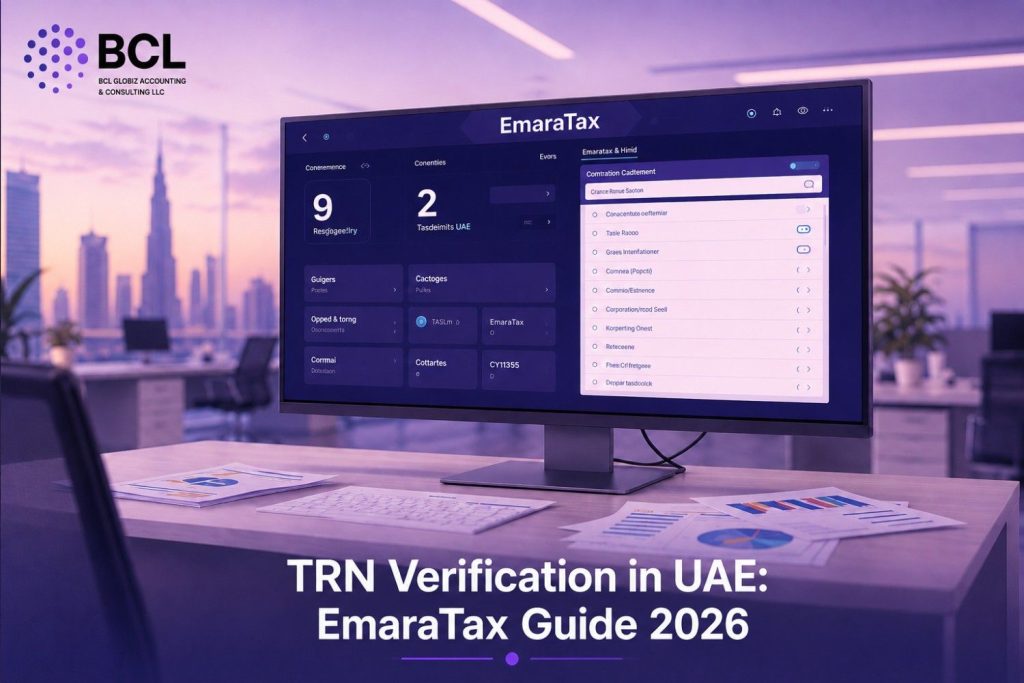
Transacting with an unregistered or deregistered entity can trigger FTA penalties and disallow your entire VAT recovery on that invoice. For a single large purchase, that could mean tens of thousands of dirhams lost. This guide has been refreshed for 2026 to reflect EmaraTax, the Federal Tax Authority’s current verification channels, and the VAT law amendments that took effect on 1 January 2026 under Federal Decree-Law No. 16 of 2025. Key Takeaways What Is a TRN (Tax Registration Number) in the UAE? A Tax Registration Number (TRN) is a unique 15-digit identifier issued by the Federal Tax Authority (FTA) to every business or individual that registers for VAT, corporate tax, or excise tax in the UAE. It is the primary reference number for all UAE tax matters, and it appears on the VAT registration certificate (also called the Tax Registration Certificate) the FTA issues on approval. A common mistake among new business owners: confusing the TRN with a trade licence number or commercial registration number. These are entirely different identifiers. Your trade licence is issued by the Department of Economic Development or a free zone authority. Your TRN comes from the FTA. The TRN format is consistent. It is always 15 digits, starts with “100”, and contains no letters or special characters. Since the introduction of UAE corporate tax in June 2023, the TRN landscape has expanded. Businesses now receive TRNs for corporate tax registration as well. A single entity typically holds one TRN that covers both VAT registration and corporate tax, though the registration status may differ per tax type. Attribute Detail Issued by Federal Tax Authority (FTA), via EmaraTax Length 15 digits Starts with 100 Applies to VAT, Corporate Tax, Excise Tax Shown on VAT registration certificate / Tax Registration Certificate, tax invoices NOT the same as Trade Licence Number, Commercial Registration Tip: if someone gives you a TRN that is shorter than 15 digits or contains letters, it is not a valid UAE TRN. Why TRN Verification Matters for UAE Businesses TRN verification isn’t optional housekeeping. It directly protects your money, your compliance record, and your business relationships. Four core reasons: 1. VAT compliance: Businesses can only claim input VAT on invoices from legitimately VAT-registered suppliers. If a supplier’s TRN is invalid or deregistered, the FTA will disallow your input VAT claim during an audit. For companies processing significant purchase volumes, the disallowed amounts add up fast. 2. Fraud prevention: Fake TRNs on invoices are a documented issue in the UAE market. Verifying every supplier TRN before processing payment is basic due diligence. It protects your business from fraudulent transactions and ensures you’re dealing with a real, registered entity. 3. Avoiding FTA penalties: The FTA imposes administrative penalties under Cabinet Decision No. 49 of 2021 (amending Cabinet Decision No. 40 of 2017) for non-compliance. Penalties for tax invoice errors can reach AED 5,000 per invoice for the first offence and AED 10,000 for repeats. Other VAT-related violations carry their own specific amounts under the published schedule, most ranging from a few hundred dirhams up to AED 50,000 per article breached, depending on the violation type and frequency. 4. Supplier due diligence under the 2026 anti-evasion rules: Federal Decree-Law No. 16 of 2025, effective 1 January 2026, added Article 54 bis to the VAT Law. It allows the FTA to deny input tax recovery where a supply is part of an evasion chain and the taxpayer knew, or should have known, about it. Documented TRN verification is now part of the evidence that shows you exercised reasonable care. Staying updated with the latest FTA regulations is essential to avoid administrative fines and VAT-related penalties. Read our related guide on FTA updates and how to avoid tax penalties in the UAE. Businesses using reliable accounting systems can automate supplier validation and reduce VAT-compliance risks. Explore our guide on FTA-approved accounting software solutions in Dubai to improve your VAT and bookkeeping workflows. A real anonymised mini-case Last quarter we ran a TRN sweep on a Jebel Ali trading client’s vendor list (about 80 suppliers) and found two TRNs that had been deregistered mid-year. The client had reclaimed AED 18,200 of input VAT on invoices issued after deregistration. Catching this in the next return saved the same amount in disallowed credit and avoided AED 5,000 in invoice-error penalties. This is why we build TRN verification into every client’s monthly compliance workflow, catching issues before they become penalties. How to Verify TRN on EmaraTax (Step-by-Step) EmaraTax is the FTA’s unified digital tax platform, launched in 2023 as the successor to the original e-Services portal. It hosts VAT and corporate tax registration, return filing, payments, certificates, and the public TRN verification tool. The shortcut: go to https://eservices.tax.gov.ae, find the TRN Verification tile, enter the 15-digit TRN, complete the CAPTCHA, and click validate. No EmaraTax account or login is required for a basic TRN check. Verifying TRN through the mobile app The FTA also offers TRN verification through its official “UAE Tax” mobile app, available on the Apple App Store and Google Play Store. Open the app, navigate to TRN Verification, and search using the same 15-digit number. No login is needed, and the result mirrors what you would see on EmaraTax. Mobile app verification is useful for on-the-spot checks, for example during a supplier site visit or when reviewing an invoice away from your desk. How to verify a TRN by company name Sometimes you have a supplier’s company name but not their TRN. EmaraTax’s verification tool supports this too. On the same verification page, switch the search type from “TRN” to “Name” using the dropdown or toggle, and enter the company name exactly as it appears on the trade licence, not a shortened or trading name. The name must match the FTA registration closely. Partial matches may not return results. If your first search fails, try variations: “ABC Trading LLC” vs. “ABC Trading L.L.C.” vs. the full legal name. How to Find Your Own TRN on the VAT Registration Certificate If
Dubai Free Zones Comparison (2026): Cost, Activity Focus & Pick by Business Type

Dubai has over 30 free zones, each with a different fee structure, activity focus, and reputation with banks. Picking the wrong one can mean compliance headaches, unnecessary fees, or rejected bank applications later. This directory profiles 21 of the most-used Dubai free zones for 2026 — what they’re good for, who they’re not for, and indicative starting costs. How to Use This Directory Each profile below covers: year established, activity focus, indicative starting licence cost (excluding visas, establishment cards, and office), visa allocation, designated-zone status (Y/N), and best-for. Numbers are indicative for 2026; confirm against the zone’s own quote before signing. Dubai Free Zones at a Glance Zone Starting Licence (AED) Activity Focus Designated Zone? DMCC ~20,000 Commodities, trading, services No JAFZA ~25,000+ Trading, logistics, manufacturing Yes DAFZA ~25,000+ Aviation, logistics, trading Yes DIFC ~50,000+ Financial services, fintech No Dubai Internet City ~25,000+ Tech, software, IT services No Dubai Media City ~20,000+ Media, advertising, content No Dubai Healthcare City ~25,000+ Healthcare, pharma, wellness No Dubai Design District (d3) ~25,000+ Design, fashion, creative No IFZA (Dubai Silicon Oasis) ~12,900+ Multi-activity, SMEs No Meydan Free Zone ~12,500+ Trading, services, SMEs No Dubai South ~12,000+ Logistics, aviation, e-commerce Yes (parts) Dubai CommerCity ~15,000+ E-commerce, digital trade Yes Dubai Production City (IMPZ) ~15,000+ Printing, publishing No Dubai Studio City ~20,000+ Film, broadcast, production No Dubai Knowledge Park ~20,000+ Education, HR, training No Dubai Outsource City ~15,000+ BPO, contact centres No Dubai Industrial City ~25,000+ Light & medium industry No DTEC (DSOA) ~15,000+ Tech startups No Dubai International Academic City ~25,000+ Higher education No Dubai Auto Zone (DUCAMZ) ~15,000+ Used / re-export vehicles Yes International Humanitarian City ~15,000+ Humanitarian aid Yes Key Benefits Common to All Dubai Free Zones 100% Foreign Ownership Free zones have always allowed 100% foreign ownership. The UAE amended the Commercial Companies Law in 2020 to allow full foreign ownership on the mainland for most activities (effective 1 June 2021), but free zones remain the simpler, faster path. 0% Personal Income Tax The UAE has no personal income tax on employment income, dividends, or capital gains. Corporate Tax (QFZP) Free-zone companies can enjoy a 0% corporate-tax rate on qualifying income — but only if they meet Qualifying Free Zone Person (QFZP) conditions under Cabinet Decision No. 100 of 2023 and Ministerial Decision No. 265 of 2023. Non-qualifying income is taxed at 9% above AED 375,000. Full Profit Repatriation No restrictions on repatriating 100% of profits and capital. No foreign-exchange controls. Profiled: 21 Dubai Free Zones 1. DMCC (Dubai Multi Commodities Centre) Established 2002. Dubai’s largest free zone by company count, home to tens of thousands of companies. Originally focused on commodities (gold, diamonds, tea, coffee) but now covers general trading, professional services, and tech. Strong banking acceptance across all major UAE banks. Best for trading, commodities, services, mid-size SMEs. 2. JAFZA (Jebel Ali Free Zone) Established 1985 — Dubai’s first free zone. Designated zone for VAT. Direct access to Jebel Ali Port, one of the world’s busiest container terminals. Best for international trading, logistics, manufacturing, and re-export. 3. DAFZA (Dubai Airport Free Zone) Adjacent to Dubai International Airport (DXB). Designated zone for VAT. Strong for aviation services, logistics, trading, and high-value goods. More expensive than average; best for businesses that benefit from airport proximity. 4. DIFC (Dubai International Financial Centre) Independent financial regulator (DFSA) oversight; English common-law jurisdiction within the UAE. Best for asset managers, banks, fintech, family offices, and any regulated financial services. Materially more expensive than other Dubai free zones — but the only credible option for licensed financial activities. 5. Dubai Internet City Part of TECOM Group. Home to multinational tech anchors (Microsoft, Oracle, Google’s regional offices historically). Best for SaaS, IT consultancies, and tech startups that benefit from the tech-ecosystem brand. 6. Dubai Media City Also TECOM. Long-standing hub for media, advertising, and content businesses. Best for production houses, advertising agencies, PR firms, and content creators. 7. Dubai Healthcare City Healthcare-focused regulator (DHCR) within the zone. Best for clinics, medical-device companies, healthcare-services firms, and pharma. 8. Dubai Design District (d3) Design and creative-industries cluster. Best for fashion, product design, architecture, and creative agencies. 9. IFZA (in Dubai Silicon Oasis) Originally founded in Fujairah in 2018, IFZA relocated to Dubai Silicon Oasis in August 2020 and is now a Dubai free zone operating under the Dubai Silicon Oasis Authority. Competitive starting prices and a wide activity list. Best for SMEs, freelancers, and budget-conscious foreign entrepreneurs. 10. Meydan Free Zone Affordable mid-tier zone with a strong activity list. Streamlined digital setup. Best for trading SMEs and service businesses on a tighter budget. 11. Dubai South Free Zone Adjacent to Al Maktoum International Airport and the future Expo / Dubai South development. Parts of the zone are designated for VAT. Best for logistics, aviation, and e-commerce operations needing southern-Dubai location. 12. Dubai CommerCity First free zone dedicated to e-commerce. Designated zone for VAT. Best for cross-border e-commerce sellers and digital trade businesses. 13. Dubai Production City (IMPZ) Best for printing, publishing, and content production businesses needing warehouse-attached operations. 14. Dubai Studio City Film and TV production infrastructure (sound stages, post-production facilities). Best for production companies and broadcast media. 15. Dubai Knowledge Park Education, training, and HR-services hub. Best for training providers, HR consultancies, and education-services businesses. 16. Dubai Outsource City Built for BPO, contact centres, and back-office operations. Best for outsourcing firms and shared-services centres. 17. Dubai Industrial City Industrial-focused free zone for light and medium manufacturing. Best for SME manufacturers and assembly operations. 18. DTEC (Dubai Technology Entrepreneur Campus) Co-working-style ecosystem within Dubai Silicon Oasis aimed at tech startups. Best for very-early-stage tech companies. 19. Dubai International Academic City Higher-education cluster. Best for universities, training institutions, and education-services providers. 20. Dubai Auto Zone (DUCAMZ) Designated zone for VAT. Best for used-vehicle trading, re-export, and automotive parts. 21. International Humanitarian City Designated zone for VAT. Best for humanitarian-aid organisations and logistics. Picking by Business Type Still deciding between a Dubai free zone and mainland company setup? Read our detailed
Fujairah Free Zone Business Setup: Costs, Steps & Complete Guide (2026)
Fujairah is the only UAE emirate on the Gulf of Oman, with direct access to the Indian Ocean and bypassing the Strait of Hormuz. That geography matters: Fujairah Port is one of the world’s top three bunkering hubs, and the emirate’s free zones cater to maritime, oil and gas, trading, and increasingly to services and digital businesses. This guide covers what you need to decide: which Fujairah based free zone fits your business, indicative 2026 costs, the step by step setup process, the document checklist by entity type, and the corporate tax obligations that apply from day one. If you’re still comparing mainland and free-zone structures in the UAE, read our detailed guide on Free Zone vs Mainland Company Setup in the UAE before deciding on the right jurisdiction. Important Note on IFZA A common point of confusion: IFZA (International Free Zone Authority) was originally established in Fujairah in 2018, but it relocated to Dubai (Dubai Silicon Oasis) in August 2020 and now operates under the Dubai Silicon Oasis Authority. IFZA is a Dubai free zone, not a Fujairah one. The rest of this guide covers the genuinely Fujairah based options. Fujairah-Based Free Zones Fujairah Free Zone Authority (FFZA) Established in 1987 by Emiri Decree, the original government free zone operating under the Fujairah government. Direct access to Fujairah Port and Fujairah International Airport. Covers a broad activity list spanning trading, services, light manufacturing, and consultancy. Fujairah Creative City Free Zone Specialised free zone for media, content, marketing, consultancy, and creative services. Competitive packages for freelancers and solopreneurs. Streamlined remote setup. Fujairah Oil Industry Zone (FOIZ) Designated zone for oil storage, refining, and energy sector operations. Critical to the UAE’s energy infrastructure. Not relevant for most SMEs, included here for completeness. Key Benefits of a Fujairah Free Zone Setup 100% foreign ownership Foreign nationals can own 100% of their Fujairah free zone company. No local sponsor, partner, or service agent required. Applies to all entity types: FZE, FZC, branch, and freelance. Tax position Personal income tax: 0%. The UAE has no personal income tax. Corporate tax: 9% federal rate above AED 375,000, in effect since 1 June 2023. Fujairah free zone companies may qualify as Qualifying Free Zone Persons (QFZPs) and benefit from a 0% rate on qualifying income, subject to substance, qualifying income, transfer pricing, and audit conditions under Cabinet Decision No. 100 of 2023 and Ministerial Decision No. 265 of 2023. Small Business Relief is available separately for eligible entities with revenue at or below AED 3 million, for tax periods ending on or before 31 December 2026 (see the corporate tax section below for an important condition on how this interacts with QFZP status). Cost advantage Fujairah free zone packages generally undercut Dubai equivalents, with indicative starting licence costs from approximately AED 9,000 to 15,000 for service and consultancy entities. Total first year cost, including licence, flexi-desk, one visa, and cards, typically lands at AED 20,000 to 30,000. Strategic location Only UAE emirate on the Gulf of Oman with direct access to the Indian Ocean. Top three global bunkering hubs. Dubai is a 1.5 hour drive. Sharjah is approximately 1 hour. Cost Breakdown (FFZA, 2026) Item Indicative AED Notes Service / consultancy licence 9,000 to 15,000 Activity dependent Trading licence 12,000 to 20,000 May require warehouse for some activities Industrial licence 20,000+ Plus facility costs Flexi-desk / virtual office Approx. 5,000 Annual Establishment + immigration cards Approx. 3,000 Annual Visa (per person) Approx. 4,000 to 5,000 Including medical and Emirates ID Indicative for 2026. Confirm against the current FFZA or Fujairah Creative City quote before signing. License Types Available Trading license Import, export, distribution, and wholesale trading of physical goods. Custom import and export codes are available. Service / consultancy license Professional services, IT, marketing, management consultancy, education, and training. Industrial license Light manufacturing, processing, and assembly. Requires a dedicated facility. Freelance / individual professional Solo professionals operate under a single activity. Typically, one visa. License Comparison: Trading, Service, Industrial, Warehousing and E-Commerce Each license type is tied to a specific facility requirement and activity scope. Choosing the wrong one at application stage is the most common, and most expensive, correction to make later, since amending activities or license type after issuance carries its own fee. Licence type Permitted activity Facility requirement Typical use case Trading Import, export, distribution, and wholesale of physical goods; a defined number of activities per licence Flexi-desk for invoicing-only trade; warehouse where physical stock is held Import/export businesses, distributors Service / consultancy Professional services, IT, marketing, management consultancy, education and training Flexi-desk or office Consultants, agencies, professional firms Industrial Light manufacturing, processing, assembly of goods Dedicated industrial facility or land plot, sized to the process Manufacturers, processors, assemblers Warehousing Storage, handling, and redistribution of goods on behalf of the license holder or third parties Warehouse unit sized to storage volume; cold storage available for specific goods categories Logistics operators, distributors holding stock E-commerce Online sale of goods or services through a digital storefront, with UAE or cross-border delivery Flexi-desk is typically sufficient; a warehouse is added only if physical inventory is held locally Online retailers, digital marketplaces, UAE-routed drop shipping models Confirm exact activity codes and permitted activity combinations with FFZA or Fujairah Creative City before application, since these are updated periodically. Facility Requirements by License Type Flexi-desk A shared desk arrangement within the free zone authority’s own building. Sufficient for service, consultancy, and most e-commerce licenses where the business does not need to receive visitors or hold physical stock. Usually the cheapest and fastest facility option to activate. Office A dedicated, lockable office unit, required where the license mandates a private workspace, where the visa quota exceeds what a flexi-desk supports, or where the business receives clients on site. Office sizes scale with the number of visas applied for. Warehouse Required for trading activities that hold physical stock, for the warehousing license, and for most industrial licenses involving storage of raw materials or finished goods. Warehouse allocation is typically sized
Fujairah Company Setup: Complete 2026 Guide (Mainland & Free Zone)
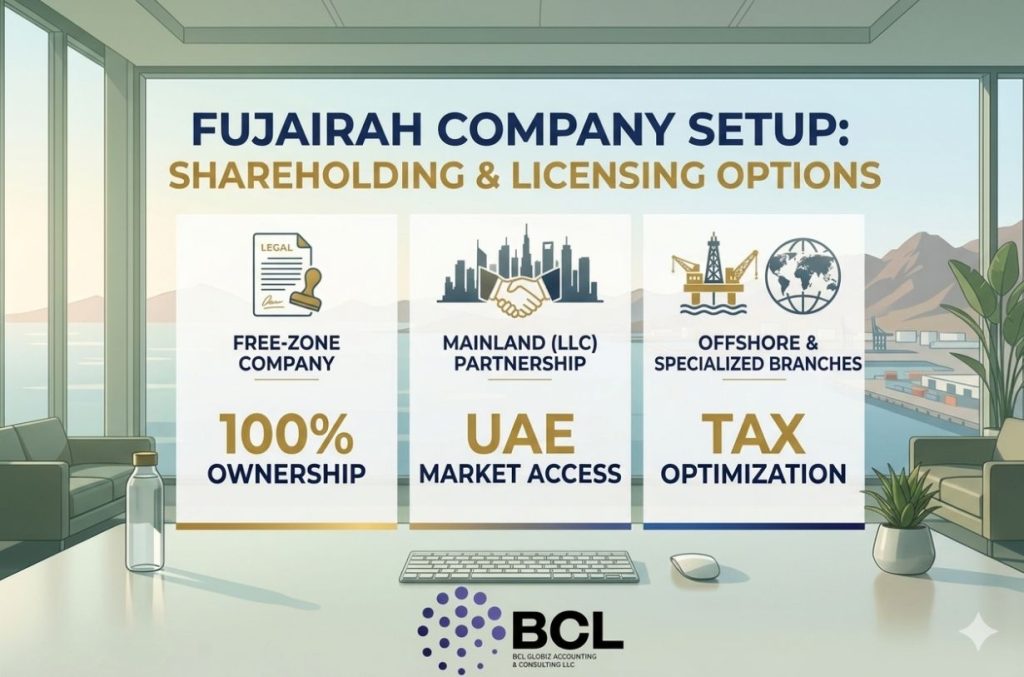
Fujairah is the UAE’s east-coast emirate, the only one with direct access to the Indian Ocean via the Gulf of Oman. For SMEs and startups managing cost carefully, Fujairah is a credible alternative to Dubai with materially lower setup fees, full foreign ownership, and the same UAE legal and tax framework. This guide covers both Fujairah company-setup options — mainland (Fujairah DED) and free zone (FFZA, Fujairah Creative City, FOIZ) — with indicative 2026 costs and a step-by-step process. Note on IFZA IFZA (International Free Zone Authority) was originally founded in Fujairah in 2018 but relocated to Dubai (Dubai Silicon Oasis) in August 2020. IFZA is now a Dubai free zone, not a Fujairah one. The rest of this guide covers the genuinely Fujairah-based options. Mainland vs Free Zone in Fujairah Factor Fujairah Mainland (DED) Fujairah Free Zone Foreign ownership 100% for most activities (since 1 June 2021) 100% always Direct mainland trading Unrestricted Restricted; needs dual licence Starting licence (AED) ~15,000+ ~9,000–15,000 Corporate tax 9% above AED 375,000 0% on qualifying income (QFZP); 9% otherwise Best for Direct B2C, mainland retail, government contracts Service exporters, consultancy, trading Fujairah Free-Zone Options Fujairah Free Zone Authority (FFZA) Established 1987. Government-run. Direct access to Fujairah Port and Fujairah International Airport. Broad activity list spanning trading, services, light manufacturing, and consultancy. Fujairah Creative City Free Zone Specialised for media, content, marketing, consultancy, and creative industries. Competitive freelance packages, streamlined remote setup. Fujairah Oil Industry Zone (FOIZ) Designated zone specialised in oil storage, refining, and energy operations. Not relevant for most SMEs. If you’re still evaluating the best structure for your business, read our detailed comparison of free zone vs mainland UAE business setup before choosing between Fujairah mainland and free-zone incorporation. Indicative Setup Costs (2026) Setup Type Starting Licence (AED) Typical First-Year Total FFZA — service licence ~9,000–15,000 ~22,000–32,000 FFZA — trading licence ~12,000–20,000 ~28,000–40,000 Fujairah Creative City ~6,500–12,000 ~20,000–28,000 Fujairah Mainland ~15,000+ ~30,000–45,000 First-year totals include flexi-desk, establishment + immigration cards, one visa, and basic health insurance. Confirm against the current authority quote. Why Choose Fujairah Tax Position Fujairah free-zone companies are subject to UAE corporate tax under Federal Decree-Law No. 47 of 2022. They can qualify for a 0% rate on qualifying income under the QFZP regime (Cabinet Decision No. 100 of 2023; Ministerial Decision No. 265 of 2023), subject to substance, qualifying-income, transfer-pricing, and audit conditions. Non-qualifying income is taxed at 9% above AED 375,000. Mainland Fujairah entities pay the standard 9% corporate tax above AED 375,000. Small Business Relief (revenue ≤ AED 3 million) is available for tax periods starting before 1 January 2027. Step-by-Step Process Step 1 — Choose Mainland vs Free Zone, and Authority Free zone for service exporters, consultants, and trading SMEs. Mainland for direct retail or government contracting. Within free zone: FFZA for broader operations; Fujairah Creative City for media and consultancy. Step 2 — Define Activity, Entity, and Name Pick the activity list to match your 12-month invoicing plan. Entity options: FZE / FZC for free zone; LLC / sole establishment for mainland. Reserve a compliant name. Step 3 — Submit Documents Passport copies, photographs, brief business plan or activity description, proof of address. Corporate shareholders also submit MOA, board resolution, and good-standing certificate. Step 4 — Pay Fees and Receive Licence Free-zone licences typically issue in 3–5 business days; mainland licences in 5–10 business days from clean documentation. Step 5 — Establishment Card, Immigration Card, Visas Standard UAE visa process. 2–4 weeks per visa. Step 6 — Bank Account 2–6 weeks. Digital banks (Wio, Mashreq Neo) often clear faster than tier-1 banks for first-time free-zone entities. Step 7 — Register for VAT and Corporate Tax VAT registration mandatory above AED 375,000 taxable supplies. Corporate-tax registration on EmaraTax is mandatory regardless of revenue, within the deadline matched to your trade-licence issuance date (FTA Decision No. 3 of 2024). AED 10,000 penalty for late registration. What We See Most Often (BCL Globiz Experience) Clients pick Fujairah for cost, and the cost advantage is real (20–40% below Dubai). The trade-off most underestimate: banking. UAE tier-1 banks treat Fujairah entities more conservatively than Dubai entities — budget 6–8 weeks for a tier-1 bank account, or start with a digital bank. Most-missed compliance step: corporate-tax registration on EmaraTax. The deadline tracks your trade-licence issuance date, not your incorporation date. The AED 10,000 late-registration penalty applies regardless of revenue. Frequently Asked Questions Is IFZA a Fujairah free zone? Not anymore. IFZA was established in Fujairah in 2018 but relocated to Dubai (Dubai Silicon Oasis) in August 2020. IFZA is now a Dubai free zone. How much does a Fujairah company setup cost? Indicative starting licence costs: Fujairah Creative City from AED 6,500–12,000; FFZA service licence AED 9,000–15,000; FFZA trading licence AED 12,000–20,000; Fujairah mainland from AED 15,000+. Total first-year costs typically AED 20,000–45,000 depending on package and visa count. Can a Fujairah free-zone company operate in Dubai? Yes for invoicing — Fujairah free-zone companies can invoice clients anywhere in the UAE including Dubai. Selling physical goods directly to UAE mainland consumers typically requires a mainland trade licence or dual-licence arrangement. Does a Fujairah company pay UAE corporate tax? Yes. Fujairah-based companies are subject to UAE corporate tax under Federal Decree-Law No. 47 of 2022. Free-zone companies may qualify for 0% on qualifying income under the QFZP regime; non-qualifying income is taxed at 9% above AED 375,000. Mainland entities pay 9% above AED 375,000. How long does Fujairah company setup take? Licence issuance 3–10 business days. Visa processing 2–4 weeks per visa. Bank account opening 2–6 weeks. Total realistic timeline 4–8 weeks. Reach out to us at info@bcl.ae.
Sharjah Free Zone Companies: 2026 Directory and Setup Guide
Sharjah is one of the most cost competitive entry points in the UAE for foreign entrepreneurs. Licence packages start from roughly AED 5,750 at Shams, and the emirate offers a spread of free zones built around very different industries: heavy industry and port logistics at Hamriyah, aviation and re-export at SAIF Zone, media and consultancy at Shams, publishing at Sharjah Publishing City, and research and innovation at SRTIP. This guide is part directory and part setup manual. The first half profiles each major Sharjah free zone. The second half walks through the licence types, documents, banking, visas, costs, and tax rules that apply across all of them, with practical notes from the incorporation work our team at BCL Globiz handles for clients every week. Sharjah Free Zones at a Glance Zone Established Activity Focus Starting Licence (AED) SAIF Zone 1995 Aviation, logistics, light manufacturing, trading ~12,000 and up Hamriyah Free Zone (HFZA) 1995 Heavy industry, oil and gas, steel, manufacturing ~10,000 and up Shams (Sharjah Media City) 2017 Media, IT, consultancy, ecommerce, freelance ~5,750 (freelancer) Sharjah Publishing City (SPC) 2017 Publishing, printing, media, content ~6,500 and up SRTIP 2018 Research, innovation, biotech, sustainability ~5,500 (zero visa) and up Beyond these five, Sharjah also hosts several more specialised free zones, including Sharjah Healthcare City (SHCC), Sharjah Communication Technologies Free Zone (COMTECH), the USA Regional Trade Center (USARTC), and the Sharjah Human Resources Development Free Zone (SHRD). So the common claim that Sharjah has exactly six free zones understates the picture. The five above are simply the zones most founders shortlist. A Directory of Sharjah’s Free Zones Sharjah Airport International Free Zone (SAIF Zone) Established in 1995 and located next to Sharjah International Airport, SAIF Zone offers strong logistics infrastructure, on site customs, and bonded warehousing. It is a designated zone for VAT purposes. Best suited to aviation services, logistics, light manufacturing, trading, and re-export businesses that value fast cargo movement. Hamriyah Free Zone (HFZA) Also established in 1995, HFZA has direct access to Hamriyah Port and spans a very large industrial footprint. It is the emirate’s industrial anchor and a designated zone for VAT. Best suited to heavy industry, oil and gas services, steel and metals, food processing, and large scale manufacturing. Shams (Sharjah Media City Free Zone) Launched in 2017, Shams is the most affordable Sharjah free zone and runs a fully digital setup process. Freelancer permits start from around AED 5,750, and the zone covers media, IT, consultancy, ecommerce, education, and general trading. Best suited to solopreneurs, freelancers, and cost conscious SMEs. Sharjah Publishing City Free Zone (SPC Free Zone) SPC Free Zone opened in 2017 as the world’s first free zone dedicated to publishing and printing. It sits alongside Sharjah’s book and publishing infrastructure and offers a housed federal identity and citizenship branch to speed up investor visa processing. Best suited to publishers, printers, content businesses, and media SMEs, though it also permits a broad set of trading and service activities. Sharjah Research, Technology and Innovation Park (SRTIP) SRTIP, established in 2018 and located next to University City, focuses on research and development, innovation, biotech, advanced manufacturing, and sustainability. It hosts university spin-offs and corporate R and D centres, and offers a zero visa package alongside visa linked bundles. Best suited to research led and innovation driven companies. Other Specialised Sharjah Free Zones Sharjah Healthcare City (SHCC) is dedicated to hospitals, clinics, laboratories, and medical R and D. COMTECH targets telecommunications, IT, and digital communications firms. The USA Regional Trade Center (USARTC) supports US based businesses expanding into the GCC. Sharjah Human Resources Development Free Zone (SHRD) focuses on training and HR development activities. If your activity is regulated or highly sector specific, one of these zones may fit better than the five headline zones. Which Sharjah Free Zone Is Best for Your Activity? The single most important setup decision is matching your activity to the right zone, because the licence, the visa quota, and your future banking experience all follow from it. A simple mapping: Most Sharjah zones allow several activities under one licence, so a trading company that also consults can often stay in a single zone. Where an activity needs external regulatory approval, the choice narrows quickly, and this is a good point to take advice before paying any fees. Licence Types and Which One to Choose Sharjah free zones issue a small number of core licence types. Choosing the correct one determines what you can invoice for and whether you need physical space. Commercial Licence A commercial licence covers buying, selling, importing, exporting, and distributing physical goods. It is the standard choice for traders and ecommerce sellers. Trading multiple product lines is usually possible under one commercial licence, subject to the zone’s activity list. Service Licence A service licence, sometimes called a professional licence, covers consultancy and professional activities such as IT services, marketing, management consulting, HR, and financial advisory. It is the most commonly issued licence in service focused zones like SRTIP and Shams and generally does not require a warehouse. Industrial Licence An industrial licence covers manufacturing, processing, and assembly. It requires physical warehouse or factory space inside the free zone and is available mainly in SAIF Zone and HFZA, which are built for industrial operations. Freelancer Permit A freelancer permit is a single person permit that lets an individual work under their own name within defined activity categories. It is available at Shams and SPC, is the cheapest way in, and still carries eligibility for a UAE residence visa. Office, Flexi-Desk, and Warehouse Options and Their Impact on Visas Your office solution is not just a cost line. In a free zone it directly sets your visa quota, which is the number of residence visas your licence can sponsor. Some zones publish visa allocations of up to 20 per licence for larger facilities. If your headcount plan matters, confirm the exact visa quota in writing before you pick a package, because upgrading later means changing your office or lease requirement
SHAMS Free Zone Company Setup in UAE: Cost, Process, Licenses, Visas and Compliance Guide 2026
SHAMS, or Sharjah Media City, is one of the UAE’s more accessible free zones for consultants, IT service providers, ecommerce founders, media businesses, trading companies and international entrepreneurs who want a UAE company with flexible activity options. Setting up a company in SHAMS involves choosing the right license package, understanding total first-year cost beyond the headline license fee, completing the visa process if UAE residency is needed, and putting accounting, VAT and corporate tax compliance in place from day one. This guide covers every stage of the process so founders can make a clear, informed decision before they apply. Note: SHAMS fees, visa quotas and processing timelines change periodically. All figures in this guide are indicative and should be confirmed directly with SHAMS or a licensed advisor before payment or planning. Key Takeaways What Is SHAMS Free Zone? SHAMS Free Zone is a Sharjah-based free zone authority that operates as a business licensing and company registration body. Despite the “Media City” name, SHAMS supports a broad range of commercial activity categories well beyond traditional media, and it is widely used by founders who want a cost-accessible UAE company with fast incorporation and remote setup capability. SHAMS meaning: Sharjah Media City SHAMS stands for Sharjah Media City. It is a free zone in the Emirate of Sharjah, launched in 2017 by Emiri decree, with an original mandate focused on creative and media industries. Rather than a fixed set of license categories, SHAMS structures licensing around business activity Groups and Classes: each license can hold one Activity Group plus up to four Activity Classes, or up to five Activity Classes on their own, spanning different sectors. Terms like “service,” “trading,” “industrial” and “holding” are used loosely across the market (including by many setup consultants and even in some SHAMS activity listings) to describe broad categories of activity, but SHAMS is not a dedicated industrial free zone in the way SAIF Zone or Hamriyah Free Zone are, and “holding” functions as a selectable activity rather than a standalone license type. The legal entity forms available are Free Zone Establishment (FZE) for a single shareholder and Free Zone Company (FZC) for multiple shareholders; the exact shareholder cap should be confirmed with SHAMS, as it is subject to approval and current rules rather than a fixed published number. Who SHAMS company setup is best suited for SHAMS is commonly chosen by management consultants and advisory providers, IT and software service companies, digital marketing and advertising businesses, ecommerce entrepreneurs, content creators and production houses, small trading and import/export operators, overseas founders who want a UAE company without relocating, and solo founders or lean teams who want a low-overhead corporate structure. BCL recommends reviewing any SHAMS setup from a banking, accounting, VAT and corporate tax perspective before committing to a package, especially for founders who want a working company rather than just a license document. When SHAMS may not be the right free zone SHAMS may not be ideal for every situation. Businesses that require large physical premises or heavy warehousing will generally find dedicated industrial zones better suited. Companies planning frequent, direct mainland UAE contracting need to understand the rules that apply first. Activities regulated by sector authorities may require external approvals that affect both setup timeline and ongoing compliance. Businesses that need a specific emirate address for client perception, or that plan to scale large onshore teams quickly, should compare SHAMS against other options before applying. How Much Does SHAMS Company Setup Cost in 2026? SHAMS company setup cost depends on the license package, visa requirement, facility type, number of activities, shareholder structure and government or immigration charges. The headline license price does not include every cost, so founders should compare total first-year cost and renewal cost before choosing a package. Public pricing from various providers points to base license packages starting from roughly AED 5,750 for a no-visa setup, with cost rising considerably once visas, a flexi-desk or dedicated office, and immigration charges are added. These figures are indicative only, change periodically, and should be confirmed directly with SHAMS or a licensed setup advisor before any payment is made. For a transparent cost breakdown tailored to your situation, see SHAMS company setup cost or review it alongside other UAE formation options at SHAMS company setup cost. SHAMS company setup cost components Cost item Mandatory or optional One-time or annual When it applies Trade / business license Usually mandatory Annual All SHAMS companies Registration / incorporation fee Mandatory if applicable One-time New company setup Name reservation If applicable One-time Trade name approval Establishment card If visa route selected Annual/renewable Visa eligibility E-channel / immigration charges If applicable One-time/renewable Visa processing Investor or employee visa Optional based on need Per visa cycle Residence visa Medical test and Emirates ID If visa route selected Per visa cycle UAE residency External approval Activity-dependent Case-by-case Regulated activities Office or facility upgrade Optional/required by package Annual Visa quota or operational need Accounting, VAT and corporate tax support Operational Monthly/annual Compliance from day one All amounts above are indicative estimates only. Exact 2026 fees must be verified directly with SHAMS before budgeting or payment. License cost vs total first-year cost “License cost” and “company setup cost” are not the same number. The license fee is one line item; the actual first-year budget typically also includes government charges, establishment card fees, immigration file costs, visa processing, medical fitness test, Emirates ID, facility costs, external approvals where relevant, and post-incorporation compliance setup. Providers who advertise a low starting price without specifying inclusions are usually quoting only the license component. BCL recommends requesting a full itemised cost review before making any payment, so the first-year total and the annual renewal obligation are both clear upfront. Renewal fees and amendment costs Renewal and amendment costs are frequently overlooked during initial setup planning: SHAMS License Packages: Which Option Should You Choose? SHAMS packages vary by license type, number of activities, visa allocation, facility option and administrative inclusions. Selecting the right package is not purely a
VAT on Real Estate in UAE: Complete 2026 Guide (Buy, Sell, Lease)
Whether you’re buying a Dubai apartment off-plan, leasing a Sharjah warehouse, re-selling a townhouse in Abu Dhabi, or building a new home as a UAE national – the VAT treatment changes the economics of every deal. Dubai’s real-estate market recorded hundreds of billions of dirhams in property transactions in 2025, reflecting the scale and VAT relevance of UAE real-estate activity. VAT applies to a significant portion of those deals, and the rules on VAT for property sales in the UAE are more nuanced than most investors expect. Get the classification wrong by one tick and you either over-charge a buyer, under-claim recoverable input VAT, or expose yourself to an FTA reassessment. This guide breaks down every VAT scenario you’ll meet in UAE real estate – commercial sales and leases, the first-supply residential window, resale, long-term and short-term residential rentals, mixed-use buildings, off-plan progress payments, free-zone and Designated Zone treatment, and the UAE Nationals VAT refund scheme for new homes – with worked AED examples and the FTA references for each. – VAT on UAE Real Estate at a Glance How VAT Works in the UAE – Quick Refresher VAT was introduced in the UAE on 1 January 2018 at a standard rate of 5%. It is administered by the Federal Tax Authority (FTA) and governed by Federal Decree-Law No. 8 of 2017 and its Executive Regulations (Cabinet Decision No. 52 of 2017, as amended). There are three VAT categories: standard-rated (5%), zero-rated (0%), and exempt. The critical difference between zero-rated and exempt is the single most important concept for real-estate VAT in the UAE. Category VAT charged to buyer? Input tax recovery? Real-estate example Standard-rated (5%) Yes Yes Commercial lease Zero-rated (0%) No Yes First sale of a new residential property Exempt No No Resale or long-term lease of a residential property Understanding the difference between VAT exemptions in the UAE and zero-rated VAT will save you real money. The table above is worth memorising. VAT Categories for Real-Estate Transactions in the UAE The VAT treatment of any real-estate transaction depends on two factors: the type of property (commercial vs. residential) and the nature of the supply (first supply vs. subsequent supply, sale vs. lease, residential vs. serviced). VAT category Transaction types Standard-rated (5%) Commercial sales and leases; hotels and serviced apartments; short-term holiday homes; brokerage and agency commissions; property management and construction services Zero-rated (0%) First supply (by sale or lease) of a new residential property within 3 years of completion; first supply of buildings used by charities Exempt Subsequent supplies of residential property; long-term residential leases after the first supply; bare land Standard-Rated Real-Estate Supplies (5% VAT) These transactions attract the standard 5% VAT rate: Zero-Rated Real-Estate Supplies (0% VAT) Zero-rated treatment is the golden advantage for developers. No VAT is charged to the buyer, but the developer can recover all input VAT on construction costs. The first supply of a new residential property is zero-rated – whether by sale or by lease – provided the supply is made by the person who constructed or commissioned the building and within 3 years of completion. “Completion” is determined by the date on the completion certificate issued by the relevant authority (e.g., Dubai Municipality). Charity buildings used solely by qualifying public-benefit entities are also zero-rated on first supply. Healthcare and educational buildings have their own specific rules – engage your advisor before assuming the rate. Exempt Real-Estate Supplies (No VAT, No Recovery) Exempt status is NOT a benefit – it’s often a cost trap for uninformed property owners. No VAT is charged to the buyer, but the supplier cannot recover input VAT on related expenses. Exempt transactions include: VAT on Commercial Real Estate in the UAE Commercial real estate is the most straightforward category for VAT on commercial property, but several nuances catch property owners off guard. Selling Commercial Property The sale of any commercial property (office, retail, warehouse, industrial, hotel) is standard-rated at 5% on the sale price. The seller must be VAT-registered, or must register if this transaction pushes them over the AED 375,000 threshold. A single commercial property sale will almost always exceed this. VAT is charged on top of the sale price unless the contract explicitly states the price is VAT-inclusive. Check your Sale and Purchase Agreement (SPA) carefully. Dubai Land Department (DLD) transfer fees (typically 4% of the price) are government fees and fall outside the scope of VAT. Worked Example – Commercial Sale A retail unit in Business Bay sells for AED 3,000,000. Leasing Commercial Property Commercial lease rent is standard-rated at 5%. The landlord must charge VAT on every rent invoice. Details that tend to trip up landlords: Input Tax Recovery for Commercial Property Owners Commercial property owners making standard-rated supplies enjoy full input tax recovery on related expenses. Common recoverable expenses: One critical requirement: proper tax invoices must be obtained and retained for every expense. Without a valid tax invoice, the FTA will deny the input tax claim – even if the VAT was genuinely paid. VAT on Residential Real Estate in the UAE Residential real estate is where VAT on residential property gets complicated. The treatment depends on whether the property is new or previously supplied, whether the supply is a sale or a lease, and the nature of the accommodation. Getting the classification wrong is the number-one cause of VAT errors in the UAE property market. First Supply of New Residential Property – Zero-Rated (0%) This is the most important subsection for developers and investors buying off-plan or new-build. The first supply of a new residential property is zero-rated at 0% VAT. No VAT is charged to the buyer, but the developer CAN recover all input VAT on construction costs. “First supply” means the first sale or first lease after construction is complete – whichever happens first. The supply must occur within 3 years of completion to qualify for zero-rating. Worked Example – First Supply vs. Resale A developer sells a new Dubai Marina apartment for AED 2,000,000. This
Trade Licence Cancellation Cost in Dubai: Full 2026 Guide
The trade licence cancellation cost in Dubai catches people off guard, not because the government fees are high, but because the total cost includes a dozen line items nobody talks about. Visa cancellation, EJARI termination, VAT deregistration, corporate tax final filing, and potential fines. Delay the process, and renewal fees keep stacking. Ignore it entirely, and you face material penalties from the FTA on top. What Is Trade Licence Cancellation in Dubai? Trade licence cancellation is the formal process of deregistering your business entity with the relevant licensing authority. For Mainland companies, that’s DET (Department of Economy and Tourism). For Free Zone companies, it’s the respective authority like DMCC, IFZA, JAFZA, Meydan or others. One distinction matters more than any other: cancellation is not the same as letting your Dubai trade licence expire. An expired licence still carries legal obligations. Fines accumulate. Blacklisting is possible. Dubai trade licence cancellation is the only way to fully and legally close a business entity. When Is Trade Licence Cancellation Required? What Happens If You Don’t Cancel Your Trade Licence? Businesses that delay closure often continue paying renewal penalties and compliance costs unnecessarily. If your licence is still active, understanding the UAE trade license renewal process can help you compare whether renewal or cancellation is the better financial decision. Trade License Cancellation Cost in Dubai – Full Breakdown Government Fees for Trade Licence Cancellation DET charges itemised fees for Mainland licence cancellation. Indicative current schedule (figures rounded; confirm with your PRO before quoting to clients): Fee Type Approximate AED Notes Licence cancellation application fee ~1,020 Paid via DET / Invest in Dubai portal Company dissolution fee (LLC) ~2,000–2,800 Required for LLCs; varies by sub-type Certificate of dissolution / liquidator appointment ~500 Subject to legal advisor approval Knowledge & Innovation Dirham fees ~20–40 Standard add-on per transaction Tasheel / typing-centre fee ~200–350 If submitting via service centre Indicative total — government fees only ~1,250–4,200 Depends on entity type and routing Visa and Labour Card Cancellation Costs This is often the highest variable cost. It scales directly with headcount. Visa Cancellation Step Approximate AED Cost (Per Person) MOHRE labour card cancellation 120–180 Immigration visa cancellation 70–100 Emirates ID cancellation 40–70 Typing / service-centre fees 150–250 Total per employee 380–600 Establishment Card and Immigration Card Cancellation Fees Two often-overlooked line items. The MOHRE establishment card cancellation costs approximately AED 150–200, and the ICP immigration establishment card runs about AED 100–150. These are one-time fees per company, not per employee. Budget roughly AED 250–350 combined. Office / EJARI Cancellation and Lease Obligations DET requires proof of EJARI cancellation before approving a mainland licence cancellation. The EJARI cancellation fee itself is minimal – around AED 50–100. The real cost is your lease. Early termination penalties typically range from 1–3 months’ rent, depending on your contract. Office handover costs (cleaning, repairs, key return) add another AED 500–2,000. Flexi-desk arrangements are simpler but may still carry notice period charges. VAT Deregistration Costs Any business registered for VAT with the Federal Tax Authority must apply for VAT deregistration in Dubai. There’s no direct FTA fee for the deregistration itself. The costs come from elsewhere. You must file all outstanding VAT returns before the FTA approves deregistration. Late VAT-return filing penalties: AED 1,000 for the first offence and AED 2,000 for repeats within 24 months. Late VAT deregistration carries AED 1,000 per month, capped at AED 10,000 (Cabinet Decision No. 49 of 2021). Any outstanding VAT liability must be settled in full. If you’re retaining or transferring assets on which you charged VAT, output VAT implications may apply. The practical cost is often in hiring a professional to prepare and file the final VAT return correctly. FTA deregistration takes approximately 20 business days after submission. Corporate Tax Final Filing Costs Since the UAE’s corporate tax regime took effect in June 2023, every business closing in Dubai must file a final corporate tax return with the FTA. No separate government fee applies for the filing itself. The cost is in preparation. You need final financial statements, a final tax computation, and potentially a tax clearance from the FTA. Failure to file carries AED 500/month for the first 12 months and AED 1,000/month thereafter (Cabinet Decision No. 75 of 2023) — even after the licence is cancelled. The FTA obligation persists independently of your licence status. If your business had taxable income during its final period, you owe corporate tax at 9% on profits above AED 375,000. Indicative Total Cancellation Costs Three indicative roll-ups based on the scenarios we see most often. Excludes outstanding fines, employee gratuities, and unsettled tax liabilities. Scenario A – Sole establishment, no employees, current licence Government fees + EJARI cancellation + final VAT/CT compliance: ~AED 4,500–7,500. Scenario B – Mainland LLC, 2 employees, current licence Government fees + dissolution fee + 2 visa cancellations + EJARI + VAT & CT deregistration + liquidator/audit support: ~AED 12,000–18,000. Scenario C – Mainland LLC, 4 employees, expired ~14 months All of the above plus DED late-renewal fines (~AED 3,500+ on AED 250/month over 14 months), end-of-service gratuity for 4 employees (varies), and any outstanding VAT liability: ~AED 28,000+. Indicative Freezone Cancellation Costs Freezone fee schedules differ by authority and are typically expressed as packages. Indicative ranges below; always confirm against the current 2026 fee schedule from the relevant freezone. Freezone Indicative cancellation fee Notes DMCC ~AED 2,000–6,000 Newspaper publication required for FZ-LLCs IFZA ~AED 1,500–3,500 Many packages waive newspaper requirement JAFZA ~AED 3,000–8,000 Liquidator appointment required for FZ-LLCs Meydan ~AED 1,500–4,000 Streamlined process for service licences Trade Licence Cancellation Process in Dubai – Step by Step Process Now that you understand the costs, here’s the exact process. These steps apply primarily to mainland (DET) cancellation, with freezone variations noted. The order matters – doing steps out of sequence causes delays and additional costs. Step 1 – Settle All Financial Obligations Before touching any government portal, clear all outstanding debts. Bank loans, supplier invoices, utility bills (DEWA, Etisalat/du), government fines, and court judgments.
Company Liquidation in Dubai: 2026 Step-by-Step Guide (Process, Cost & Documents)
You built your Dubai company with ambition. But now — whether due to restructuring, relocation, or a strategic pivot — it’s time to close it properly. And if you’re wondering how to liquidate a company in Dubai, the stakes are higher than most business owners realise. Failing to close a company in Dubai correctly can trigger accumulating fines, continued tax filing obligations, personal liability for directors, and even immigration bans. With the UAE’s corporate tax regime now fully in effect, the company liquidation in Dubai process has become more complex than it was even two years ago. What Is Company Liquidation in Dubai? Company liquidation in the UAE is the formal legal process of winding down a company’s operations, settling all debts and obligations, distributing any remaining assets to shareholders, and permanently removing the entity from the UAE commercial register. It is not the same as letting your trade licence expire. Winding up a company in Dubai is a structured, multi-step legal process with specific requirements under UAE law. The process applies to all company types — LLCs, sole proprietorships, branches, and freezone entities — but varies in complexity. When Should You Liquidate a Company in Dubai? Liquidation isn’t always the only option. But in the following situations, it’s the right one. Common Reasons for Company Liquidation If you’re planning to restructure after closure, read our detailed guide on Company Formation Dubai to understand the best setup options for mainland, free zone, and tax-efficient business structures in the UAE. What Happens If You Don’t Liquidate Properly? Types of Company Liquidation in Dubai Voluntary Liquidation Voluntary liquidation is initiated by the company’s shareholders or owners on their own decision. It’s the most common type for SMEs in Dubai. It requires a shareholder resolution — typically a special resolution passed by shareholders holding at least 75% of the company’s share capital (or the percentage specified in the MOA). The company may be solvent or insolvent; voluntary liquidation applies to both. The shareholders retain control over the process, including the appointment of the liquidator and the timeline. If you’re reading this guide proactively, voluntary liquidation is almost certainly your path. Compulsory (Court-Ordered) Liquidation Compulsory liquidation is ordered by the court, typically at the request of unpaid creditors, when a company cannot pay its debts. The court appoints a liquidator, and the company’s owners have limited control. This type is governed by the UAE Commercial Companies Law (Federal Decree-Law No. 32 of 2021) and the UAE Financial Restructuring and Bankruptcy Law (Federal Decree-Law No. 51 of 2023, in force from 1 May 2024). The 2023 law replaced the earlier 2016 bankruptcy law and introduced a dedicated Bankruptcy Court and a preventive settlement procedure. If creditors are already pursuing legal action, seek legal counsel immediately. Indicative Cost Scenarios for Voluntary Liquidation Three indicative roll-ups based on the engagements we see most often. Excludes outstanding fines, employee gratuities, and creditor settlements, which vary by case. Scenario A — Sole establishment, no employees, no liabilities Liquidator appointment, DET cancellation, FTA deregistration, bank closure: ~AED 5,000–9,000. Scenario B — Mainland LLC, 2 employees, current licence Newspaper publication (~AED 2,000–5,000 across two newspapers), liquidator + audit fees, MOHRE/ICP cancellations, FTA deregistration, EJARI cancellation: ~AED 18,000–28,000. Scenario C — Mainland LLC, 8 employees, licence expired ~12 months All of the above plus DED late-renewal penalties (AED 250/month × 12 ≈ AED 3,000+ in this category alone), end-of-service gratuity for 8 employees, plus potential creditor settlements: ~AED 35,000–55,000+. Company Liquidation Process in Dubai – Step by Step Process: The following 10-step process applies to voluntary liquidation of a mainland LLC in Dubai — the most common scenario. We note where the process differs for sole establishments, branches, and freezone companies. Steps must generally be completed in order, though some can run in parallel. Step 1 – Pass a Shareholder Resolution to Dissolve the Company The resolution must be notarised and should name the appointed liquidator. Step 2 – Appoint a Licensed Liquidator The liquidator can be a shareholder, a company manager, or an external professional (licensed auditor or legal professional approved by the relevant authority). The liquidator’s role: manage the entire winding-down process — realise (sell) company assets, settle debts, notify creditors, prepare final accounts, and distribute any surplus to shareholders. For simple sole establishments with no liabilities, the owner often acts as their own liquidator. For LLCs with employees, liabilities, or assets, appointing a professional liquidator is strongly recommended. Licensed liquidator fees typically range from AED 2,500 to AED 8,000, depending on financial complexity. The appointment must be registered with the relevant authority. Step 3 – Notify the Relevant Authorities File the dissolution resolution and liquidator appointment with the Department of Economy and Tourism (DET/DED) for mainland companies, or the relevant freezone authority for free-zone companies. For mainland LLCs, also notify the Ministry of Economy. Upon filing, the company’s status changes to “Under Liquidation” in the commercial register. From this point forward, the company must add the phrase “Under Liquidation” to ALL official correspondence, invoices, contracts, and documents. Step 4 – Publish a Notice to Creditors The liquidator must publish a liquidation notice in two local newspapers — one in Arabic and one in English (for mainland companies). The notice invites creditors to submit outstanding claims. Creditors have a minimum of 45 days from the date of publication to submit their claims. The liquidator must review all claims, verify their validity, and settle legitimate debts from the company’s assets. If total claims exceed the company’s assets, the liquidation may need to transition to insolvency proceedings under the UAE Financial Restructuring and Bankruptcy Law (Federal Decree-Law No. 51 of 2023). Freezone companies generally don’t require newspaper publication but have their own creditor notification process — typically a notice posted on the freezone’s portal. Step 5 – Settle All Liabilities and Obligations Step 6 – Cancel Employee and Investor Visas All employee residence visas must be cancelled through MOHRE and the Federal Authority for Identity, Citizenship, Customs and Port Security (ICP).
RAK Free Zone Licence Cost in 2026: Full Breakdown
The RAK Free Zone licence cost starts from approximately AED 5,750/year, which sounds straightforward. It isn’t. The actual total you’ll pay in your first year depends on your licence type, business activity, number of visas, office choice, and ongoing compliance obligations. Most sources give vague ranges or outdated figures, leaving you unable to build an accurate budget. This guide breaks down every cost component of a Ras Al Khaimah free zone licence, from the base fee to visas, office space, government charges, and post-licence compliance, using 2025/2026 figures sourced from RAKEZ official data and on-the-ground setup experience. Whether you’re evaluating RAK company formation cost against Dubai alternatives or planning a UAE free zone company setup for the first time, you’ll walk away with a clear picture of total first-year costs, renewal costs, and compliance obligations for your specific business type. What Is the RAK Free Zone (RAKEZ)? RAKEZ was created in 2017 from the merger of RAK Free Trade Zone (RAK FTZ) and RAK Investment Authority (RAKIA). It is the free zone authority for Ras Al Khaimah, distinct from the RAK Department of Economic Development (DED), which handles mainland licences. This distinction matters because the cost structures are completely different. A common confusion point: RAKEZ vs. RAK ICC (RAK International Corporate Centre). RAK ICC is a separate entity offering offshore and international company structures (IBC), while RAKEZ offers operational free zone licences with visa eligibility. If you need a residence visa, you need RAKEZ. Per RAKEZ’s own published 2025 figures, the authority is now home to over 40,000 companies from 100+ countries, with 19,000 new registrations welcomed in 2025 alone. Located approximately one hour from Dubai (and 45 minutes from northern Dubai), it offers the same UAE legal framework and tax benefits as Dubai free zones, at a fraction of the Ras Al Khaimah free zone licence cost. Types of RAK Free Zone Licences The licence type you choose directly determines your fee structure, permitted activities, and visa allocation. Understanding the options is essential before looking at costs. Service / Consultancy licence (Company) Covers management consultancy, IT services, marketing, legal advisory, accounting, HR consultancy, and similar professional services for companies (FZ-LLC entities). Starting cost: from approximately AED 11,400/year, depending on the activities and package. Distinct from the Freelancer Permit below, which is the cheaper individual-licence equivalent. Trading / Commercial licence (General trading) Covers import/export, ecommerce product sales, and wholesale/retail trading of physical goods. A general trading licence offers a broader scope across multiple product categories at a higher fee. A specific trading licence limits you to named product categories at a lower fee. The RAK free zone general trading licence cost starts from approximately AED 7,500 to 15,000/year. Industrial / Manufacturing licence For companies involved in manufacturing, processing, or assembly within RAK. Higher cost due to facility and warehouse requirements. Starting from AED 10,000+/year for the licence alone, plus significant facility costs. E-commerce licence A specialised licence for purely online businesses, increasingly popular in 2025/2026. Lower cost structure than general trading because physical office requirements may be relaxed. Starting from approximately AED 5,750 to 9,000/year. Freelancer permit (Individual Professional Licence) The most affordable entry point into the UAE market. The RAK free zone freelancer licence cost starts from approximately AED 5,750 to 7,500/year. Designed for individual professionals: designers, developers, consultants, content creators, photographers. Key limitations: typically allows only 1 visa (the holder’s own) and is limited to 1 to 2 business activities. Educational and media licences RAKEZ offers specialised licences for educational institutions, training centres, and media/publishing companies. These are niche categories with specific requirements. Contact RAKEZ directly for pricing on these specialised licence types. Licence Type Starting Cost (AED/year) Best For Visa Allocation Service / Consultancy (Company) ~11,400+ Consultancies, IT firms 1-6 visas Trading / Commercial ~7,500-15,000 Importers, ecommerce, traders 1-6 visas Industrial ~10,000+ Manufacturers, processors Varies E-Commerce ~5,750-9,000 Online-only businesses 1-3 visas Freelancer Permit ~5,750-7,500 Solo professionals 1 visa Educational / Media Contact RAKEZ Training, publishing, media Varies RAKEZ Package-by-Package Fee Comparison RAKEZ regularly rebrands its bundled offers under specific package names rather than pricing licences in isolation. Understanding what is actually included in each named package prevents budget surprises later. RAKEZ Package Name Indicative Price (AED) Visas Included What’s Bundled Biz Starter ~6,000/year 0 visas Licence + co-working desk access, no residence visa Freelancer Permit ~5,750-7,500/year 1 visa Individual licence, 1-2 activities, holder’s own visa only SME Business Set-Up ~14,000-14,320 (Year 1) 1 visa FZ-LLC licence, establishment card, 1 residence visa, basic health insurance Service / Consultancy (Company) ~11,400+/year 1-6 visas FZ-LLC licence, desk options scale with visa count General Trading ~7,500-15,000/year 1-6 visas Broader product-category scope, office/warehouse sized to activity Note that package names and inclusions are part of RAKEZ’s active promotional structure and are periodically revised. Always confirm current package names and inclusions with RAKEZ or your advisor before budgeting. Real-World First-Year Cost Scenarios Three indicative roll-ups based on packages we use most often for clients. Figures rounded; actual quotes depend on activity list, office choice, and number of visas. Scenario 1: Solo IT consultant, freelancer permit, 1 visa, flexi-desk Indicative total: ~AED 18,500-20,500. Scenario 2: Service company (FZ-LLC), 1 shareholder, 2 visas, smart desk Indicative total: ~AED 32,000-35,000. Scenario 3: General trading, 4 visas, small warehouse Indicative total: ~AED 70,000-100,000. Year 1 vs. Renewal Cost Comparison A common budgeting mistake is assuming Year 2 costs mirror Year 1. In practice, renewal costs are usually comparable to the initial licence fee, but Year 1 carries several one-time charges that don’t recur. Cost Component Year 1 (New Setup) Renewal (Year 2+) Licence fee Full fee Same fee, unless package or activity changes Establishment card + immigration card ~AED 1,500 (one-time) Not repeated unless card itself expires Visa processing Full visa cost per holder Only for visa renewal, typically lower than fresh issuance Office / desk fee Full annual fee Renewed annually at same or adjusted rate Health insurance Full annual premium Renewed annually Refundable e-channel deposit ~AED 5,000 (refundable, one-time) Not repeated Zero-visa packages typically
FTA Clarifies Connected Persons Rules: Forget Your Title – The UAE FTA Wants to Know Who Really Runs the Business
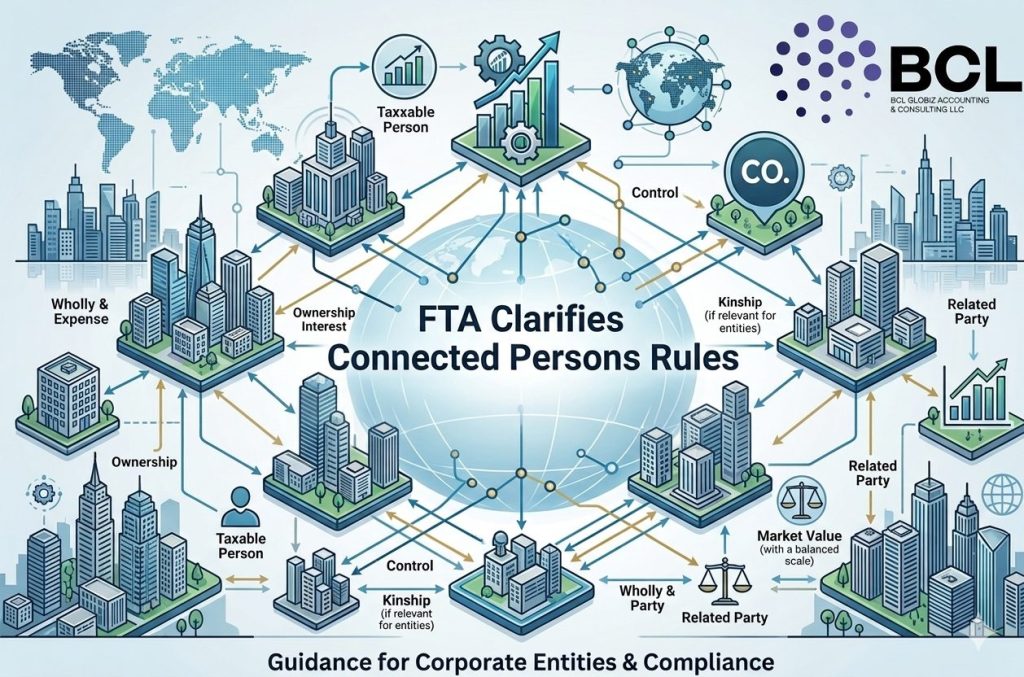
The latest clarification on Connected Persons shifts the focus from designation to actual decision-making authority — and many UAE businesses may need to reassess their structure. The UAE FTA has issued an important clarification under Article 36 of the Corporate Tax Law that every business operating in the UAE must pay attention to. The clarification addresses who qualifies as a “Director” or “Officer” for the purpose of identifying Connected Persons — and the answer may surprise you. It is not about your job title. It is about what you actually do. This clarification emerged from audit findings during the first year of UAE Corporate Tax filings, where inconsistent interpretations were identified across taxpayers. As businesses enter their second year of compliance, the FTA has stepped in to provide clear guidance. Here are the two critical updates every business must understand. 1. ‘Director’ and ‘Officer’ — It’s About Substance, Not the Title on Your Business Card For a long time, these terms were undefined in the law, leading to confusion about who should be treated as a Connected Person. The FTA has now clarified this: Director Officer What this means for you: Examples for who’s really running the business includes but not limited to when a consultant holds the CFO title, a silent name sits on the trade license, and management fees flow to a family member, the answer isn’t always clear 2. When Someone is Both a Connected Person and a Related Party — Related Party Takes Precedence This is a subtle but important clarification issued by the Federal Tax Authority Clarification No. CTP010, April 2026, and it has real implications for how businesses structure their management. Under UAE Corporate Tax Law, the definitions of “Connected Person” and “Related Party” overlap in certain situations. For example, an owner who also controls the business could technically fall under both categories. The FTA has now clarified: where a person qualifies under both definitions, they shall be treated as a Related Party for Corporate Tax purposes. The Related Party framework — which governs transactions based on capital, control, and significant relationships — takes precedence. However, it is important to note a nuance flagged by tax practitioners: What this means for you: The Bottom Line The FTA’s clarification reinforces a principle that is becoming central to modern tax administration: substance over form. Who you are in a company is defined by what you do, not what your business card says. Businesses must now look beyond titles, assess the real decision-making authority of their leadership, and ensure that all payments to Connected Persons are properly documented and benchmarked at arm’s length. The time to review your structures is now — before the auditors do it for you. Consequences of Non-Compliance Failure to correctly identify Connected Persons or to treat overlapping Related Party and Connected Person relationships appropriately can have serious consequences. Payments made to Connected Persons that are not at market value or not wholly and exclusively for business purposes may be disallowed as a deductible expense, directly increasing the taxable income of the business. Additionally, non-disclosure of such transactions where required under Article 55 of the Corporate Tax Law can attract penalties. In audit scenarios, misclassification or inadequate documentation could expose businesses to tax adjustments, interest on underpaid tax, and reputational risk. Given that the FTA is actively auditing first-year filings and issuing clarifications basis those findings, businesses that delay compliance risk being caught in the next wave of scrutiny. Businesses must ensure that all Connected Person transactions comply with the arm’s length principle in transfer pricing to avoid FTA adjustments and penalties. How BCL Globiz Can Help At BCL Globiz, we understand that navigating evolving tax regulations — especially in a relatively new Corporate Tax environment like the UAE — can be complex and time-sensitive. Our team of specialists can assist your business in: Do not wait for an audit notice to act. Reach out to us at BCL Globiz and let us help you stay ahead, compliant, and confident. Read the full clarification here: CTP010 Clarification Frequently Asked Questions (FAQs) My employee has “Director” in their title. Are they automatically a Connected Person? No. A title alone does not qualify someone. What matters is whether they actually exercise strategic decision-making authority. If they don’t, they fall outside the definition. Can an external consultant be treated as a Connected Person? Yes, if they effectively perform management or strategic functions and exercise control over the business — regardless of how they are engaged. Conduct takes precedence over the nature of engagement. Our shareholder is also a Related Party. Which rules apply? Related Party rules take precedence. Apply arm’s length pricing and disclosure requirements under Article 55. However, given the interpretational complexity, case-specific advice is recommended. What are the consequences of getting this wrong? Payments not at market value may be disallowed as a deduction, increasing taxable income. Non-disclosure can attract penalties. Misclassification in an audit could result in tax adjustments and interest on underpaid tax. How do we identify Connected Persons in our organisation? Review your organisational chart, trade license, MOA, and key contracts. Look for individuals who plan, direct, or control business activities — including C-suite, general managers, divisional heads, and anyone named on the trade license. Reach out to our experts at info@bcl.ae.
Arm’s Length Principle in Transfer Pricing: UAE Guide 2026
Under the UAE Corporate Tax Law (Federal Decree-Law No. 47 of 2022), every related-party and connected-person transaction must comply with the arm’s length principle. The Federal Tax Authority (FTA) is actively scrutinising these transactions. Non-compliance carries real financial consequences, including income adjustments, penalties, and potential double taxation. If you’ve been asking what an arm’s length transaction is and why it matters for your UAE business, this guide covers everything in one place: the definition, legal basis, OECD transfer pricing methods, UAE-specific rules, the tested party and arm’s length range mechanics, related parties versus connected persons, domestic mainland and free zone transactions, dispute prevention and resolution tools, practical examples with AED figures, a step-by-step compliance process, and penalties for getting it wrong. What Is the Arm’s Length Principle? Here’s a simple way to think about it. Company A sells goods to its subsidiary, Company B. The arm’s length principle states that the price should be the same as what Company A would charge an unrelated Company C under similar circumstances. This principle originated in international tax law. It is codified in Article 9 of the OECD Model Tax Convention. More than 140 countries follow it as the global standard for transfer pricing, including the UAE. It is not a theoretical concept. It is a legally enforceable requirement with real financial consequences. When your intercompany prices don’t reflect what independent parties would agree to, tax authorities have the power to adjust your taxable income accordingly. Arm’s Length Principle vs. Arm’s Length Transaction The principle is the rule. It is the standard requiring related-party transactions to be priced as if between independent parties. The transaction is the application. It is any specific deal conducted at arm’s length, either because the parties are genuinely independent, or because the pricing reflects what independent parties would agree to. An arm’s length transaction is simply a deal that meets this standard. Particulars Arm’s Length Principle Arm’s Length Transaction What it is The rule or standard A specific deal or transaction Scope Applies to all related-party dealings Refers to one particular transaction Usage Transfer pricing law, tax treaties, OECD guidelines Contract law, intercompany deals Example All intercompany prices must reflect market conditions This specific sale of goods was priced at market rate Why Does the Arm’s Length Principle Matter? Four reasons your business should take this seriously: Industries commonly affected include management consultancies with overseas parent companies, IT services firms with intercompany agreements, ecommerce businesses with related-party supply chains, and trading companies purchasing from related manufacturers. OECD Transfer Pricing Methods: the Five You Must Know UAE transfer pricing rules align with the OECD Transfer Pricing Guidelines and accept five recognised methods, consistent with Article 34(3) of the Corporate Tax Law. The FTA expects you to choose the most appropriate method for the transaction tested, and there is no strict hierarchy among the five. Method What it does When it works best Comparable Uncontrolled Price (CUP) Compares the price charged in your related-party transaction to the price charged in a similar transaction between independent parties. Commodity-like goods or services where comparable market data exists. Resale Price Method Tests the gross margin earned by a reseller against margins earned by independent resellers performing similar functions. Distributors and resellers without significant value-add. Cost Plus Method Tests the markup on costs against markups earned by independent parties for similar services. Routine services, contract manufacturing, and shared back-office services. Transactional Net Margin Method (TNMM) Compares the net profit margin, relative to costs, sales, or assets, earned by the tested party with margins earned by independents. Most common method in practice; default when CUP, RP, or CP data is weak. Profit Split Method Allocates combined profits of related parties based on their relative contributions of functions, assets, and risks. Highly integrated operations or where both parties contribute unique intangibles. Where none of the five methods can be reasonably or reliably applied, Article 34(4) allows the use of another method, provided it still satisfies the arm’s length principle. Tested Party Selection: Why It Matters Before any transfer pricing method can be applied, you need to decide which party in the transaction is the tested party. This is the entity whose results will actually be benchmarked against independent comparables. The tested party is normally the participant with the simpler functional profile, meaning the party that does not own valuable intangibles, does not take on significant risk, and performs relatively routine functions. A UAE distributor buying finished goods from a related overseas manufacturer, for example, is usually a cleaner tested party than the manufacturer itself, because distribution functions and risks are easier to find independent comparables for. Getting this wrong has real consequences. If you select the wrong tested party: Two questions decide tested party selection: which party’s functions, assets, and risks are least complex, and for which party is the most reliable comparable data available. Both should point in the same direction. When they do not, the functional analysis needs another look before you proceed to benchmarking. Transfer Pricing Documentation Requirements in the UAE The UAE follows a three-tiered documentation framework, set out in Article 55 of the Corporate Tax Law and Ministerial Decision No. 97 of 2023. Understanding the thresholds precisely, and how the two tests interact, is essential for compliance. Document Who Must Prepare Threshold Key Contents Disclosure Form All taxable persons with related-party transactions No entity revenue threshold, but triggered once aggregate related-party transactions exceed AED 40 million (AED 4 million per category); connected-person payments above AED 500,000 Summary of related-party transactions, amounts, and methods used Master File Constituent entities of an MNE Group Triggered where the MNE Group’s total consolidated revenue is AED 3.15bn or more, OR the entity’s own revenue is AED 200m or more Group structure,intangibles, intercompany financial activities, global TP policies Local File Taxable persons meeting either threshold below AED 200m+ entity-level revenue, OR being part of an MNE Group with AED 3.15bn+ consolidated revenue Detailed analysis of the UAE entity’s related-party transactions, comparability analysis, and method selection
UAE VAT: Advanced Calculation Guide
If you already know VAT is charged at 5 percent, this guide picks up from there. It works through the calculations that trip up otherwise VAT-literate businesses: reverse charge on imports and specific domestic supplies, the exact VAT payable formula, refund mechanics through EmaraTax, import VAT on the full landed value, mixed supplies and partial exemption, and the records an FTA audit actually checks. Every section carries a worked example with real numbers, and we have flagged the 2025 and 2026 rule changes, the end of self-invoicing, the five-year refund limit, and the new scrap metal reverse charge, so you are applying what is current rather than what was true a year ago. This guide from BCL Globiz reflects the calculations and questions we work through for clients filing VAT returns across the UAE every quarter. Reverse Charge Mechanism (RCM) In a normal sale, the supplier charges VAT and pays it to the FTA. The reverse charge mechanism flips that: the buyer accounts for the VAT instead of the supplier. It is governed by Article 48 of Federal Decree-Law No. 8 of 2017. The buyer records the same amount as both output VAT (tax owed) and input VAT (tax reclaimable, if eligible). For a fully taxable business this usually nets to zero cash, but it must still be reported correctly. RCM on imported services When you receive a service from a supplier based outside the UAE, for example overseas legal advice, foreign digital marketing or a software subscription, the foreign supplier does not charge UAE VAT. If you are VAT registered, you self-account for 5 percent under RCM. Worked example: imported service You buy consulting from a firm abroad for AED 100,000. Output VAT (self-charged): AED 100,000 x 5 percent = AED 5,000. Input VAT (reclaimable if fully taxable): AED 5,000. Net cash effect: AED 0, but both lines must appear in your return. RCM on imported goods For goods brought into the UAE, a VAT registered importer self-accounts for the import VAT through the return rather than paying it at the border. This is why import VAT for registered businesses is effectively a reporting entry rather than an upfront cash cost. Non registered importers, by contrast, pay VAT at the point of clearance. RCM has also been extended to certain domestic business to business supplies to reduce fraud. Supplies of ferrous and non ferrous scrap metal between registered businesses became subject to RCM from 14 January 2026 under Cabinet Decision 153 of 2025. Other categories such as hydrocarbons, certain electronic devices for resale and precious metals also fall under domestic RCM rules. Always check the latest Cabinet decisions before applying the treatment. 2026 update: self-invoicing no longer required What changed Businesses used to create an internal self-invoice for every RCM transaction. Under the 2025 VAT amendments, that self-invoicing step has been removed. You now retain the supplier invoice or customs documentation instead. Keep those records ready: the FTA can still ask to see them during an audit. VAT Payable: Formula and Worked Example VAT payable is what you send to the FTA for a tax period. It is the difference between the VAT you collected on sales (output VAT) and the VAT you paid on eligible purchases (input VAT, also called the input tax credit). VAT payable formula VAT Payable = Output VAT (on sales) minus Input VAT (on eligible purchases) If the result is positive, you pay the FTA. If the result is negative, you have excess input tax that can be refunded or carried forward. Item Amount (AED) Sales for the period (net) 500,000 Output VAT at 5 percent 25,000 Eligible purchases (net) 300,000 Input VAT at 5 percent 15,000 VAT payable (25,000 minus 15,000) 10,000 Remember that input VAT is only recoverable when you hold a valid tax invoice, you intend to pay the supplier, and the cost relates to a taxable business activity. Blocked items such as certain entertainment and personal use vehicles cannot be claimed, even with a valid invoice. VAT Refund: When It Applies and How to Claim When a refund applies A refund position arises when your input VAT for a period is greater than your output VAT, leaving excess recoverable tax. This is common for exporters and other businesses with large zero-rated sales, and for businesses in a heavy investment phase where purchases outweigh sales. How to claim through EmaraTax The five-year limit and transitional relief Do not let credits expire From 1 January 2026, excess input tax must be claimed within five years of the relevant tax period. Credits older than that lapse permanently, even if correctly recorded. A transitional window lets businesses recover eligible legacy credits from the early VAT years, but the claim must be filed before 31 December 2026. If you have been carrying forward old credits, review them now. VAT on Imports: CIF Value Plus Customs Duty Import VAT is not charged only on the price of the goods. It is charged on the full landed value. The base is the CIF value (Cost, Insurance and Freight to the UAE port of entry), plus any customs duty, plus excise tax where it applies. Import VAT formula Customs Duty = CIF Value x Duty Rate (5 percent for most goods) Import VAT = (CIF Value + Customs Duty + Excise if any) x 5 percent Step Amount (AED) Goods cost 100,000 Freight 7,000 Insurance 1,000 CIF value 108,000 Customs duty at 5 percent 5,400 VAT base (CIF + duty) 113,400 Import VAT at 5 percent 5,670 Duty rates are not universal. Most general cargo is 5 percent, many essential goods are 0 percent, and some products such as tobacco carry far higher rates. Classification under the correct HS code drives the outcome, so accuracy here protects both your duty cost and your VAT base. A VAT registered importer recovers the import VAT through the return, which is why correct classification and clean records matter for cash flow, not just compliance. VAT on Discounted Items and Advance
Best Corporate Tax Consultants in Dubai (2026): How to Choose, Verify, and Compare
Why Choosing the Right Corporate Tax Consultant in Dubai Matters Finding a trustworthy corporate tax consultant in Dubai is harder than it should be. UAE federal corporate tax, charged at 9% and in effect for financial years starting on or after 1 June 2023 under Federal Decree-Law No. 47 of 2022, means every business in Dubai now has to be registered, compliant, and filing. The market responded predictably. Dozens of firms now describe themselves as corporate tax specialists, and quality varies widely. The wrong choice can mean penalties, missed savings, or both. The right one keeps you compliant and finds legitimate tax-saving opportunities you would otherwise miss. This guide helps you tell the difference, and it gives you a repeatable way to verify and compare any firm, including ones not named here. How we evaluated firms for this guide: FTA tax-agent registration status, audited client portfolio, transparency of published pricing, depth of corporate-tax-specific services (registration, planning, return preparation, transfer pricing, and audit support), independent client reviews, and length of UAE presence. What Differentiates BCL Globiz Many firms are vague about how they price. BCL Globiz takes the opposite approach. Its packages are published, clear, and structured to suit businesses of almost every size and segment, so clients can see their expected cash outflow from day one with no hidden costs. BCL Globiz is also among the firms offering a 100% money-back guarantee if a client is not satisfied within the first three months. There are no revenue or transaction caps, which means businesses can scale without worrying that compliance fees will climb as they grow. Every client is assigned a dedicated Manager and Account Executive, and delivery follows documented standard operating procedures rather than ad-hoc handovers. What Corporate Tax Consultants in Dubai Actually Do Before evaluating firms, it helps to understand the full scope of the work. This lets you spot firms that only handle basic filing, and those that offer genuine end-to-end support. Corporate Tax Registration with the FTA Every taxable person must register on the EmaraTax portal and obtain a Corporate Tax Registration Number. Registration is mandatory even if your taxable income is nil or below the AED 375,000 threshold. A consultant handles the application, ensures correct entity classification, and tracks your specific deadline to avoid the AED 10,000 late-registration penalty. For the full process, see BCL’s guide to corporate tax registration in the UAE. Penalty Waiver Eligibility The FTA runs a late-registration penalty waiver. If a business files its first corporate tax return, or its first annual declaration in the case of exempt persons, within seven months of the end of its first tax period, the AED 10,000 penalty is waived automatically, with no separate application. For a company on a January to December financial year, whose first tax period ended 31 December 2025, the seven-month waiver window closes on 31 July 2026. The relief was introduced in April 2025 and applies retroactively to June 2023. It covers both businesses that already missed a past deadline and newly incorporated companies that may miss a future one. If a penalty has already been paid, a refund can be requested through EmaraTax once the condition is met. Because the window is time-limited, this is one area where prompt professional advice pays for itself. Tax Impact Assessment and Planning Consultants analyse your business structure, revenue streams, related-party transactions, and free zone status to determine your actual tax liability. They then identify legitimate tax-saving strategies. Not aggressive avoidance schemes, but sound planning that holds up under FTA scrutiny. Corporate Tax Return Preparation and Filing Consultants prepare your annual corporate tax return, ensure income and deductions are classified correctly per FTA guidelines, and file within the nine-month deadline. For a company with a 31 December 2025 year-end, that deadline falls on 30 September 2026. Filing and payment are a single obligation due on the same date, and there is no grace period. Late filing costs AED 500 per month for the first twelve months and AED 1,000 per month thereafter, with late-payment interest of 14% per annum on unpaid tax. Transfer Pricing Advisory and Documentation Businesses with related-party transactions must comply with the arm’s length principle. A transfer pricing specialist prepares the required documentation, which can include a Master File, a Local File, and, for large groups, a country-by-country report. Free Zone Tax Optimisation Free zone entities can benefit from 0% corporate tax on qualifying income, but only if they meet specific substance and compliance requirements. From 2025, every Qualifying Free Zone Person must also prepare audited financial statements. A consultant advises on eligibility, structuring, and maintaining qualifying status, including the de minimis rule that caps non-qualifying revenue at 5% of total revenue or AED 5 million, whichever is lower. FTA Audit Support and Dispute Resolution If the FTA opens an audit or raises queries, a consultant represents your business, prepares responses, and manages the dispute. Having an adviser already familiar with your filings is valuable during an audit, particularly given the FTA’s extended fifteen-year audit window where evasion or a deliberate failure to register is suspected. How to Verify Whether a Consultant Is FTA-Registered Only a tax agent registered with the Federal Tax Authority can legally represent your business before the FTA. Anyone can call themselves a tax consultant, so verification matters. Here is how to check before you rely on a firm’s claim. How to Choose the Right Corporate Tax Consultant, Key Evaluation Criteria These six criteria apply whether you are considering a firm on this list or any other UAE tax consultant. FTA Registration and Professional Credentials Verify that the consultant is a registered FTA tax agent, and confirm baseline qualifications such as CA, CPA, ACCA, or CMA. Use the verification steps above rather than taking a claim at face value. Industry Expertise and Client Portfolio Ask whether the firm has real experience in your sector, for example ecommerce, trading, consultancy, IT, or holding companies. UAE corporate tax carries industry-specific nuances around high-sea sales, management fees, and intercompany
UAE Corporate Tax Rate 2025-2026: Complete Guide to Rates & Exemptions
The UAE corporate tax rate is 9% on taxable income exceeding AED 375,000. The first AED 375,000 is taxed at 0%. Large multinationals with EUR 750 million or more in global revenue face a 15% minimum effective rate under the Domestic Minimum Top-up Tax (DMTT), effective from 1 January 2025. The UAE introduced federal corporate tax — effective for financial years starting on or after 1 June 2023 — to align with global standards while keeping one of the world’s most competitive business tax environments. It was a landmark shift for a country that had no federal corporate tax for decades. UAE Corporate Tax Rates for 2025–2026 (at a Glance) Rate Taxable Income Threshold Applicable To Effective Date 0% Up to AED 375,000 All taxable persons (or those electing Small Business Relief) 1 June 2023 9% Exceeding AED 375,000 All taxable persons (standard rate) 1 June 2023 15% Minimum effective rate MNEs with consolidated global revenue ≥ EUR 750m 1 January 2025 What Is UAE Corporate Tax? Corporate tax (CT) is a federal direct tax levied on the net income or profit of businesses operating in the UAE. For decades, the UAE had no federal corporate tax. Only emirate-level taxes on oil companies and foreign bank branches existed. That changed with Federal Decree-Law No. 47 of 2022, effective for financial years starting on or after 1 June 2023. The UAE introduced corporate tax to align with OECD Base Erosion and Profit Shifting (BEPS) standards, meet international tax transparency commitments, diversify government revenue beyond oil, and reinforce the country’s credibility as a global business hub. The UAE introduced corporate tax not to burden businesses, but to meet international standards that protect the country’s reputation as a legitimate, transparent business hub. This credibility benefits every company operating here. One critical clarification: the UAE does NOT levy personal income tax. Corporate tax applies only to business profits — not to salaries, wages, or personal investment returns. 0% Rate — Small Business Relief The first AED 375,000 of taxable income is taxed at 0% for all taxable persons. This isn’t an exemption — it’s a rate bracket. Small Business Relief is a separate mechanism. Businesses with revenue of AED 3 million or less (revenue, not profit) can elect to treat their entire taxable income as zero. That means zero CT liability and reduced compliance burden. This relief is available for tax periods starting before 1 January 2027 — it has an expiry date. Freelancers on freelance permits, sole proprietors, micro-businesses, and early-stage startups benefit most. Worked example — Small Business Relief A management consultancy with AED 2.4 million annual revenue elects Small Business Relief. Taxable income is treated as zero, CT liability is AED 0, and the entity files a simplified return. The relief expires for tax periods starting on or after 1 January 2027 — so plan ahead if you currently rely on it. 9% Standard Rate The 9% rate applies to taxable income exceeding AED 375,000. This is the rate the vast majority of UAE businesses will pay. It’s a flat 9% on the portion above AED 375,000 — not 9% on total income. At 9%, the UAE’s corporate tax rate is less than half the OECD average of approximately 23.5% and significantly lower than the UK (25%), US (21% federal), Germany (~30%), India (25.17%), and France (25%). Country Standard Corporate Tax Rate UAE 9% Singapore 17% Hong Kong 16.5% US 21% (federal) UK 25% India 25.17% Germany ~30% France 25% If you’re a freelancer earning AED 200,000/year, you fall in the 0% bracket. If you’re running a consultancy billing AED 3 million/year, the 9% rate applies to everything above AED 375,000. 15% Rate — Domestic Minimum Top-up Tax (DMTT) Effective for financial years starting on or after 1 January 2025, the UAE introduced a Domestic Minimum Top-up Tax aligned with the OECD’s Pillar Two Global Anti-Base Erosion (GloBE) Rules. This applies only to multinational enterprise (MNE) groups with consolidated global revenue of EUR 750 million or more in at least two of the four preceding fiscal years. The DMTT ensures these large MNEs pay a minimum effective tax rate of 15% on their UAE profits. If your business is not part of an MNE group with EUR 750 million+ in global revenue, the DMTT does not apply to you. The vast majority of UAE businesses — including SMEs, startups, and mid-market companies — are subject only to the 0%/9% rate structure. Who Is Subject to UAE Corporate Tax? UAE corporate tax applies to three broad categories of taxpayers. Resident Juridical Persons Both mainland and free zone companies are resident juridical persons. Free zone companies ARE subject to UAE corporate tax. Free zone status does not exempt a company from being a taxable person — it may qualify for a 0% rate on qualifying income, but it’s still within scope. Non-Resident Persons Foreign entities can be subject to UAE CT in two scenarios: PE examples include an office, branch, factory, building site exceeding 6 months, or a dependent agent habitually concluding contracts on behalf of the entity. The current withholding tax rate on UAE-sourced income is 0%. In practice, non-residents without a PE face no UAE tax liability on such income — but this rate could change via Cabinet Decision. Natural Persons (Freelancers & Sole Proprietors) If you operate as a freelancer, sole proprietor, or individual conducting business in the UAE, corporate tax may apply to you. Natural persons are subject to CT only if their total turnover from business or business activity exceeds AED 1 million in a calendar year. What’s NOT included: employment income (salary from an employer), personal investment income (dividends, capital gains, interest from personal holdings), and real estate income (unless conducted through a licensed business). Who Is Exempt from UAE Corporate Tax? While most businesses fall within the scope of UAE corporate tax, certain categories of entities are fully exempt. The UAE corporate tax exemptions fall into two groups. Automatically Exempt Entities Entities Exempt Upon Application
