

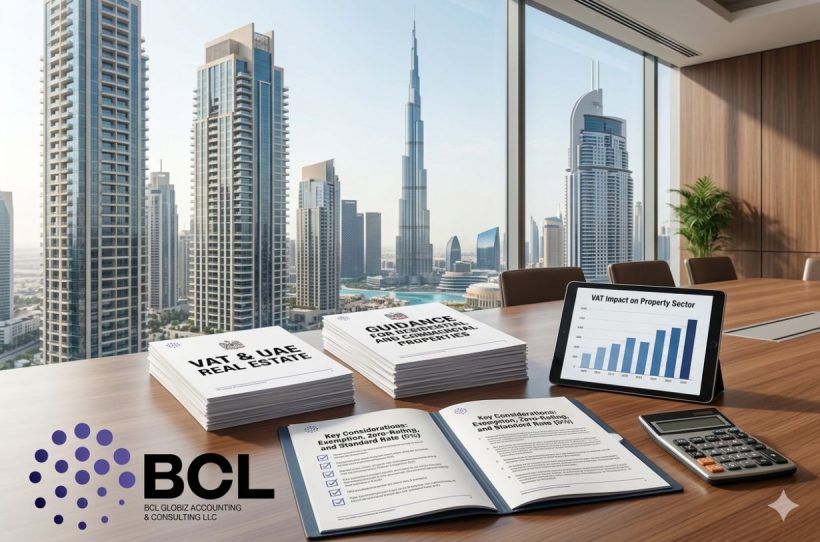
Whether you’re buying a Dubai apartment off-plan, leasing a Sharjah warehouse, re-selling a townhouse in Abu Dhabi, or building a new home as a UAE national – the VAT treatment changes the economics of every deal.
Dubai’s real-estate market recorded hundreds of billions of dirhams in property transactions in 2025, reflecting the scale and VAT relevance of UAE real-estate activity. VAT applies to a significant portion of those deals, and the rules on VAT for property sales in the UAE are more nuanced than most investors expect. Get the classification wrong by one tick and you either over-charge a buyer, under-claim recoverable input VAT, or expose yourself to an FTA reassessment.
This guide breaks down every VAT scenario you’ll meet in UAE real estate – commercial sales and leases, the first-supply residential window, resale, long-term and short-term residential rentals, mixed-use buildings, off-plan progress payments, free-zone and Designated Zone treatment, and the UAE Nationals VAT refund scheme for new homes – with worked AED examples and the FTA references for each.
– VAT on UAE Real Estate at a Glance
- Commercial property (sale & lease): 5% VAT – always.
- First supply of a new residential property within 3 years of completion: 0% (zero-rated).
- Subsequent supplies of residential property (resale, re-lease): exempt – no VAT but no input recovery.
- Bare land: exempt. Land with civil-engineering work: standard-rated 5%.
- Hotels, hotel apartments, serviced apartments, holiday homes: 5% – regardless of stay length.
- Brokerage and agency commissions: 5% – even when the underlying deal is exempt.
- Mixed-use buildings: apportion input VAT between taxable (commercial) and exempt (residential).
- UAE Nationals building their own home: claim a VAT refund within 12 months of completion via EmaraTax / Maskan.
How VAT Works in the UAE – Quick Refresher
VAT was introduced in the UAE on 1 January 2018 at a standard rate of 5%. It is administered by the Federal Tax Authority (FTA) and governed by Federal Decree-Law No. 8 of 2017 and its Executive Regulations (Cabinet Decision No. 52 of 2017, as amended).
There are three VAT categories: standard-rated (5%), zero-rated (0%), and exempt. The critical difference between zero-rated and exempt is the single most important concept for real-estate VAT in the UAE.
- Zero-rated suppliers CAN recover input VAT on related expenses.
- Exempt suppliers CANNOT recover input VAT on related expenses.
| Category | VAT charged to buyer? | Input tax recovery? | Real-estate example |
| Standard-rated (5%) | Yes | Yes | Commercial lease |
| Zero-rated (0%) | No | Yes | First sale of a new residential property |
| Exempt | No | No | Resale or long-term lease of a residential property |
Understanding the difference between VAT exemptions in the UAE and zero-rated VAT will save you real money. The table above is worth memorising.
VAT Categories for Real-Estate Transactions in the UAE
The VAT treatment of any real-estate transaction depends on two factors: the type of property (commercial vs. residential) and the nature of the supply (first supply vs. subsequent supply, sale vs. lease, residential vs. serviced).
| VAT category | Transaction types |
| Standard-rated (5%) | Commercial sales and leases; hotels and serviced apartments; short-term holiday homes; brokerage and agency commissions; property management and construction services |
| Zero-rated (0%) | First supply (by sale or lease) of a new residential property within 3 years of completion; first supply of buildings used by charities |
| Exempt | Subsequent supplies of residential property; long-term residential leases after the first supply; bare land |
Standard-Rated Real-Estate Supplies (5% VAT)
These transactions attract the standard 5% VAT rate:
- Sale of commercial property – offices, retail units, warehouses, industrial buildings, hotels.
- Lease of commercial property – every commercial rental agreement (VAT on rent in the UAE applies here).
- Hotels, hotel apartments and serviced apartments with ancillary services – taxable regardless of stay length (FTA VAT Public Clarification VATP003).
- Short-term holiday-home rentals (Airbnb-style) – standard-rated.
- Brokerage and agency commissions on ANY property transaction, even where the underlying deal is exempt.
- Property management fees – always standard-rated.
- Construction and renovation services – standard-rated regardless of the underlying property type.
Zero-Rated Real-Estate Supplies (0% VAT)
Zero-rated treatment is the golden advantage for developers. No VAT is charged to the buyer, but the developer can recover all input VAT on construction costs.
The first supply of a new residential property is zero-rated – whether by sale or by lease – provided the supply is made by the person who constructed or commissioned the building and within 3 years of completion. “Completion” is determined by the date on the completion certificate issued by the relevant authority (e.g., Dubai Municipality).
Charity buildings used solely by qualifying public-benefit entities are also zero-rated on first supply. Healthcare and educational buildings have their own specific rules – engage your advisor before assuming the rate.
Exempt Real-Estate Supplies (No VAT, No Recovery)
Exempt status is NOT a benefit – it’s often a cost trap for uninformed property owners. No VAT is charged to the buyer, but the supplier cannot recover input VAT on related expenses. Exempt transactions include:
- Subsequent supply (resale or re-lease) of residential property after the first supply has occurred.
- Long-term residential leases after the first supply.
- Bare land – supply of land with no completed buildings or partially completed buildings on it, and on which no civil-engineering works have been carried out.
VAT on Commercial Real Estate in the UAE
Commercial real estate is the most straightforward category for VAT on commercial property, but several nuances catch property owners off guard.
Selling Commercial Property
The sale of any commercial property (office, retail, warehouse, industrial, hotel) is standard-rated at 5% on the sale price. The seller must be VAT-registered, or must register if this transaction pushes them over the AED 375,000 threshold. A single commercial property sale will almost always exceed this.
VAT is charged on top of the sale price unless the contract explicitly states the price is VAT-inclusive. Check your Sale and Purchase Agreement (SPA) carefully. Dubai Land Department (DLD) transfer fees (typically 4% of the price) are government fees and fall outside the scope of VAT.
Worked Example – Commercial Sale
A retail unit in Business Bay sells for AED 3,000,000.
- VAT @ 5% on AED 3,000,000 = AED 150,000.
- Total buyer outlay (excluding DLD) = AED 3,150,000.
- DLD transfer fee (4%) = AED 120,000 – outside the scope of VAT.
- Total cash out for the buyer = AED 3,270,000.
Leasing Commercial Property
Commercial lease rent is standard-rated at 5%. The landlord must charge VAT on every rent invoice. Details that tend to trip up landlords:
- Security deposits are NOT subject to VAT – they are not consideration for a supply. If the deposit is forfeited (e.g., for damages), it may become consideration and VAT applies.
- Fit-out contributions by landlords require careful analysis. Whether a fit-out allowance is a separate supply or part of the lease consideration is a grey area – get an opinion before structuring.
- Service charges on commercial properties are standard-rated at 5%.
Input Tax Recovery for Commercial Property Owners
Commercial property owners making standard-rated supplies enjoy full input tax recovery on related expenses. Common recoverable expenses:
- Construction costs
- Maintenance and repairs
- Professional fees (legal, accounting, architectural)
- Marketing and advertising
- Agent / broker commissions
- Property management fees
One critical requirement: proper tax invoices must be obtained and retained for every expense. Without a valid tax invoice, the FTA will deny the input tax claim – even if the VAT was genuinely paid.
VAT on Residential Real Estate in the UAE
Residential real estate is where VAT on residential property gets complicated. The treatment depends on whether the property is new or previously supplied, whether the supply is a sale or a lease, and the nature of the accommodation. Getting the classification wrong is the number-one cause of VAT errors in the UAE property market.
First Supply of New Residential Property – Zero-Rated (0%)
This is the most important subsection for developers and investors buying off-plan or new-build. The first supply of a new residential property is zero-rated at 0% VAT. No VAT is charged to the buyer, but the developer CAN recover all input VAT on construction costs.
“First supply” means the first sale or first lease after construction is complete – whichever happens first. The supply must occur within 3 years of completion to qualify for zero-rating.
Worked Example – First Supply vs. Resale
A developer sells a new Dubai Marina apartment for AED 2,000,000. This is the first supply, within 18 months of the completion certificate.
- VAT to the buyer: AED 0 (zero-rated).
- Developer recovers input VAT on construction, design, marketing – fully recoverable.
Two years later the same buyer resells the apartment for AED 2,200,000.
- VAT to the new buyer: AED 0 (exempt – this is a subsequent supply).
- Seller cannot recover VAT on the agent’s commission, snagging report, or any improvement works.
- The agent’s commission itself is still 5% – billed on top of the agreed commission rate.
Long-Term Residential Lease – Exempt
Long-term residential leases (typical 1-year tenancy agreements) are exempt after the first supply. No VAT on the rent. No input recovery for the landlord on maintenance, fit-out, or property-management VAT.
Hotels, Hotel Apartments and Serviced Apartments – 5% Regardless of Stay Length
Per FTA VAT Public Clarification VATP003, hotels, motels, bed-and-breakfast establishments, and serviced apartments with ancillary services (cleaning, linen, reception) are NOT residential property for VAT purposes. They are standard-rated at 5% regardless of how long the guest stays – even if the stay exceeds 6 months and the guest holds an Emirates ID.
This is the most common misclassification we see when reviewing hospitality clients’ books.
Short-Term Holiday-Home Rentals – 5%
Holiday-home rentals (Airbnb, vacation rentals, short-stay apartments licensed under DTCM/DET) are standard-rated. Operators with taxable supplies above AED 375,000 in any rolling 12-month period must register for VAT and charge 5% on every booking.
VAT on Mixed-Use Properties in the UAE
Mixed-use properties contain both commercial and residential components – for example, a tower with ground-floor retail shops and upper-floor apartments. The VAT challenge is input-tax apportionment. When a property owner incurs expenses that relate to BOTH taxable supplies (commercial) and exempt supplies (residential), they cannot recover 100% of the input VAT. They must split it.
Three apportionment methods are commonly accepted:
- Floor-area method – allocate input VAT based on the ratio of commercial floor area to total floor area.
- Revenue / output-based method – allocate based on the ratio of taxable revenue to total revenue.
- Other fair-and-reasonable method agreed in advance with the FTA.
The FTA expects consistency. Once you choose a method, apply it consistently unless there is a valid reason to change – and document that reason.
VAT on Off-Plan Property Purchases in Dubai and the UAE
Dubai’s off-plan market accounts for a substantial share of residential transactions. Off-plan purchases have unique VAT considerations because the property doesn’t yet exist at the time of contract.
VAT treatment depends on the eventual nature of the supply. If the completed property will be residential and the developer’s sale falls within 3 years of completion, progress payments are zero-rated. If the completed property will be commercial, progress payments are standard-rated at 5%.
The date of supply (tax point) for each progress payment is the earlier of the date of payment or the date the developer issues a tax invoice. VAT is triggered as payments are made during construction, not at handover.
Practical buyer checklist for off-plan purchases:
- Confirm the developer’s TRN and verify it at tax.gov.ae/en/Search.aspx.
- Ensure every progress-payment invoice shows the correct VAT treatment (0% or 5%).
- Keep tax invoices for the full 5-year retention period – you’ll need them if you ever use the property for business.
VAT on Real Estate in UAE Free Zones and Designated Zones
One of the most persistent myths about UAE free zones is that they are “VAT-free”. This is incorrect – particularly for real estate and services.
Designated Zones for VAT purposes (currently including JAFZA, DAFZA, KIZAD, Hamriyah Free Zone, RAK Free Trade Zone, SAIF Zone, and others listed by Cabinet Decision) have special VAT treatment for the movement of GOODS. Transfers of goods between Designated Zones may fall outside the scope of VAT under specific conditions.
Services and real estate within free zones are generally subject to normal VAT rules. Leasing office space in a free zone is a commercial lease, standard-rated at 5%. Purchasing property in a free zone follows the same commercial / residential rules as the mainland. The “Designated Zone” benefit applies to goods movements, not to real-estate transactions.
VAT Refund Scheme for UAE Nationals Building a New Residence
This is the highest-value VAT topic for UAE national homeowners – and one of the most under-covered on competitor pages.
Under Federal Decree-Law No. 8 of 2017 and the FTA’s dedicated guide on VAT refunds for UAE Nationals building new residences (updated 10 April 2026), a UAE national can recover the VAT incurred on the construction of a new private residence intended solely for the use of the applicant or the applicant’s family.
Who Qualifies
- Natural person holding UAE nationality (evidenced by Emirates ID and Family Book).
- The building must be newly constructed and used solely as a residence for the applicant or their family – not as an investment property, not for rental.
What VAT Can Be Recovered
- VAT on building materials directly incorporated into the residence.
- VAT on contractor fees and related construction services.
- VAT on transport and clearing-agent fees for imported building materials used in the new residence.
- VAT on architect, engineer, and similar professional fees directly tied to the construction.
Application Deadline and Process
The refund application must reach the FTA within 12 months of the date of completion of the residence. The process is now digitised through the EmaraTax platform and the Maskan application – with real-time tracking and document upload.
Required documents typically include the Family Book, Emirates ID, the construction contract, the municipality completion certificate, and proof of occupancy (a DEWA / FEWA / SEWA bill works well).
BCL Globiz Practical Tip
Two practical points we routinely flag to UAE-national clients: (1) keep every tax invoice for the build – including small purchases like tiling, kitchen fittings, and landscaping – because reconstructing them after the fact is the single most common reason refund claims are partially denied; and (2) start your application within 9 months of completion, not 12 – the FTA frequently asks for additional documents, and you don’t want the 12-month deadline to expire while you’re sourcing one more invoice.
VAT Registration Thresholds for Property Owners
If you make taxable supplies in real estate (commercial sales or leases, serviced apartments, holiday homes, brokerage), you may need to register for VAT.
- Mandatory registration: if your taxable supplies (standard-rated + zero-rated) exceeded AED 375,000 in the previous 12 months, or are expected to exceed AED 375,000 in the next 30 days.
- Voluntary registration: available once taxable supplies or taxable expenses exceed AED 187,500.
- Late registration penalty: AED 10,000 (Cabinet Decision No. 49 of 2021).
Important: exempt supplies (residential resale, long-term residential lease, bare land) do NOT count toward the registration threshold. A landlord with AED 2 million of long-term residential rent and zero other taxable supplies is not required to register.
Property investors operating through SMEs should also review the Small Business Relief UAE tax return guide to understand how UAE corporate tax obligations may interact with real-estate income and VAT reporting.
Common VAT Mistakes in UAE Real Estate (BCL Globiz Experience)
The two errors we correct most often when onboarding real-estate clients:
1. Treating a serviced apartment as residential. Several clients arrive having charged 0% (or no VAT) on serviced-apartment leases on the assumption that 6+ months of stay makes it residential. Per VATP003 it does not. The FTA may reassess previous tax periods and impose penalties where VAT has been incorrectly treated.
2. Missing the 3-year first-supply window. A developer who completes a building in 2022 and only sells the last few units in 2026 has lost the zero-rated treatment on those late sales – they now fall under “subsequent supply” and are exempt, blocking the developer from recovering related selling-period input VAT. The fix is to track completion certificates against unsold inventory monthly and accelerate sales of older inventory before the 3-year mark.
Given the complexity of property VAT classifications, many developers and landlords rely on professional VAT compliance services in the UAE to avoid costly FTA penalties and input-tax recovery errors.
Penalties for Getting It Wrong
Under the published VAT penalty schedule (Cabinet Decision 49 of 2021, amending Cabinet Decision 40 of 2017):
| Trigger | Penalty |
| Late VAT registration | AED 10,000 |
| Late VAT-return filing – first offence | AED 1,000 |
| Late VAT-return filing – repeat within 24 months | AED 2,000 |
| Tax invoice errors | AED 5,000 first offence; AED 10,000 for repeats |
| Late VAT deregistration | AED 1,000 per month, capped at AED 10,000 |
| Late VAT payment | 14% per annum (applied monthly) |
FAQs About VAT on Real Estate in the UAE
Is there VAT on buying property in the UAE?
Yes, but the rate depends on the property type and transaction. Commercial property purchases are standard-rated at 5% VAT. The first supply of a new residential property within 3 years of completion is zero-rated at 0%. Resale of residential property is exempt – no VAT is charged, but the buyer should be aware of input-tax-recovery implications if they plan to use the property for business. See the Quick Reference Table above for a full breakdown.
What is the difference between zero-rated and exempt real estate for VAT in the UAE?
Both result in no VAT being charged to the buyer, but the implications for the seller are very different. Zero-rated means the seller can recover input VAT on related expenses (construction, maintenance, professional fees). Exempt means the seller CANNOT recover input VAT. A developer selling a new apartment (zero-rated) recovers construction VAT; a landlord re-leasing the same apartment (exempt) cannot recover maintenance VAT. This distinction directly impacts profitability.
Do I need to pay VAT on residential rent in the UAE?
Long-term residential leases (typical 1-year tenancy agreements) are exempt from VAT after the first supply. Hotel apartments, serviced apartments, and short-term holiday-home rentals are standard-rated at 5% regardless of stay length. Operators making more than AED 375,000 a year in taxable supplies must register for VAT.
Is VAT applicable to real-estate brokerage commissions in the UAE?
Yes. Brokerage and agency commissions are always standard-rated at 5%, regardless of whether the underlying property transaction is commercial, residential, zero-rated, or exempt. The broker must charge VAT on the commission invoice. The payer can recover this input VAT if the commission relates to a taxable supply they are making.
Can I recover VAT on construction costs for a new building in the UAE?
It depends on the intended use. If the building will be used for taxable supplies – commercial lease or sale, or first supply of residential within 3 years of completion – input VAT on construction costs is fully recoverable. If the building will be used for exempt supplies (long-term residential lease after the first supply), input VAT is NOT recoverable. For mixed-use buildings, apportionment applies based on the ratio of taxable to total supplies. Timing matters: missing the 3-year window after completion changes the treatment from zero-rated to exempt.
Can a UAE national get a VAT refund on building a new home?
Yes. UAE nationals can claim a refund of the VAT incurred on the construction of a new private residence for themselves or their family. The application must reach the FTA within 12 months of the date of completion of the residence, and is now filed digitally via the EmaraTax platform and the Maskan application. Eligible costs include building materials, contractor fees, and professional fees directly related to the build. Required documents include the Family Book, Emirates ID, construction contract, municipality completion certificate, and proof of occupancy.
Is VAT charged on free-zone property in the UAE?
Yes. The “Designated Zone” benefit for VAT only applies to the movement of goods, not to real estate. Leasing or buying property in a free zone follows the same commercial / residential VAT rules as the mainland UAE.
Reach out to our experts at info@bcl.ae.