



VAT Payment Guide for Businesses in Dubai
Since the UAE introduced value-added tax in January 2018, over 312,000 businesses have registered with the Federal Tax Authority (FTA). That number keeps climbing. Yet many business owners – especially those new to the UAE – still find the VAT payment process confusing, the deadlines tight, and the penalties steep. Understanding VAT in Dubai VAT is a consumption tax. The end consumer pays it. Your business collects it on behalf of the government. The UAE charges a flat 5% VAT rate on most taxable supplies, according to the Ministry of Finance. Some supplies – like certain financial services, residential property, and local passenger transport – are either zero-rated or exempt. The distinction matters because zero-rated supplies still allow you to recover input VAT, while exempt supplies do not. For businesses in management consultancy, IT, ecommerce, or trading, nearly all your revenue falls under the standard 5% rate. High sea sales and certain free zone transactions can have different treatment, but the default assumption should be: you owe 5% on what you sell, and you can reclaim 5% on what you buy for business purposes. As of 2025, Trading Economics projects the UAE VAT rate will remain at 5% through 2026. No increase is currently planned. Steps to register for VAT Check if you meet the threshold VAT registration in Dubai is mandatory if your taxable supplies and imports exceeded AED 375,000 over the past 12 months – or if you expect them to exceed that amount in the next 30 days. The voluntary registration threshold sits at AED 187,500. If you’re a new company with limited revenue, voluntary registration can still make sense. It lets you reclaim input VAT on setup costs, equipment, and professional services. Gather your documents The FTA requires specific documentation during VAT registration that Dubai businesses often overlook: Missing or inconsistent documents are the most common reason for registration delays. Submit through the FTA portal All VAT registration in the UAE happens through the FTA’s EmaraTax portal. You create an account, fill in the application, upload documents, and wait for approval. Processing typically takes 5–20 business days, though it can stretch longer if the FTA requests clarifications. Once approved, you receive a Tax Registration Number (TRN). This TRN must appear on every tax invoice you issue. How to file VAT returns Dubai VAT filing is where most businesses either build a clean compliance record or start accumulating problems. Know your Filing Frequency Businesses with an annual turnover below AED 150 million file quarterly. Those above file monthly. The FTA assigns your tax period during registration – you don’t choose it. Each return is due within 28 days of the tax period end. Miss that window, and you face an AED 1,000 fine for the first offence and AED 2,000 for each subsequent late filing within 24 months, per UAE Cabinet Decision No. 129 of 2025. Prepare your VAT Return Your VAT return (Form VAT 201) requires you to report: Accurate bookkeeping is non-negotiable here. Every figure on the return must tie back to your accounting records. The FTA can – and does – audit businesses and request supporting documentation. Submit and Pay You file through the EmaraTax portal. Once submitted, the system calculates your net VAT liability. Payment must happen before the same 28-day deadline. Accepted payment methods include e-Dirham cards, credit/debit cards, and direct bank transfers. The FTA does not accept cash or cheques. If your input VAT exceeds your output VAT, you can apply for a refund. The FTA processed over 3.2 million electronic tax refund applications between 2018 and 2019 alone – so the refund mechanism works, though processing times vary. Key features of UAE VAT compliance Understanding these elements keeps your business on solid ground: How to choose the right VAT support Look for UAE-specific expertise VAT rules differ by country. A firm that handles VAT registration in Dubai should understand FTA portal procedures, designated zone treatment, and sector-specific nuances for consultancy, IT, ecommerce, and trading businesses. Check for end-to-end service Registration alone isn’t enough. You need ongoing filing, reconciliation, and advisory support. Firms that bundle accounting, VAT, and Dubai corporate tax services into a single package tend to offer better consistency – your books and your tax returns stay aligned. Compare pricing transparently Some firms quote low monthly fees but charge extra for every filing, amendment, or phone call. Others offer all-inclusive packages. Get the full cost picture before signing. Frequently Asked Questions (FAQs) What is VAT, and how is it applied in Dubai? VAT is a 5% consumption tax applied to most goods and services in the UAE. Businesses collect it from customers at the point of sale and remit it to the Federal Tax Authority. Some categories – like certain financial services and residential property – are either zero-rated or exempt from VAT. How can businesses register for VAT in the UAE? You register through the FTA’s EmaraTax portal by submitting your trade license, Emirates ID, financial records, and business activity details. Registration is mandatory once your taxable supplies exceed AED 375,000 in 12 months. The process typically takes 5–20 business days, and late registration carries a flat AED 20,000 penalty. What is the VAT registration threshold in Dubai? VAT registration is mandatory in the UAE if your taxable supplies and imports exceed AED 375,000 in the previous 12 months or are expected to exceed that amount in the next 30 days. Businesses earning above AED 187,500 can apply for voluntary VAT registration. What happens if a business files VAT returns late in the UAE? Late VAT filing can attract penalties from the Federal Tax Authority (FTA). As per UAE regulations, the first late filing penalty is AED 1,000, and repeated violations within 24 months can result in AED 2,000 penalties per offence, along with possible additional fines for late payment. Can businesses claim VAT refunds in the UAE? Yes. If the input VAT paid on purchases exceeds the output VAT collected on sales, businesses can apply for
VAT consultants in Dubai – dedicated Manager & full compliance

VAT compliance in Dubai is expensive to get wrong. If you’re running a business in the UAE, the 5% VAT rate – in effect since January 2018 – comes with automatic FTA penalties, complex free zone rules, and zero-rated categories that trip up even experienced finance teams. Over 312,000 businesses have registered for VAT in the UAE since its implementation, and the Federal Tax Authority shows no signs of easing enforcement. Here’s the trust problem: many VAT consultants in the UAE quote low, deliver less, and surprise you with hidden fees. At BCL Globiz, every client is assigned a dedicated Manager and Account Executive – not a rotating team, not a call centre. Our all-inclusive packages cover VAT, accounting, and corporate tax with transparent pricing. No surprises. Why your business needs a VAT consultant in Dubai Before we talk about services, let’s talk about why professional VAT help matters. The decision comes down to three realities that most VAT consultants in Dubai don’t explain upfront. Three VAT categories apply to supplies: VAT returns are typically filed quarterly, though the FTA assigns some businesses to monthly periods. The rules are straightforward in principle. In practice – especially for free zone companies, international transactions, and mixed-supply businesses – they get complicated fast. Key UAE VAT facts at a glance When DIY VAT management becomes a risk There’s a tipping point where managing VAT yourself costs more than hiring a consultant. Five inflexion points tend to signal that moment: VAT Consultancy Services we offer in Dubai BCL Globiz provides end-to-end VAT consultancy services in Dubai – from initial registration through ongoing filing, advisory, and audit support. These services are available as standalone engagements or as part of our all-inclusive packages covering accounting, VAT, and corporate tax. Here’s what each service involves, step by step. VAT registration with the FTA VAT registration in Dubai is mandatory once taxable supplies exceed AED 375,000. Here’s how BCL handles FTA VAT registration: BCL also handles group VAT registration for businesses with multiple entities. Documents you’ll need: How to choose the right VAT consultant in Dubai With hundreds of firms offering VAT services in Dubai, choosing the right VAT consultants in Dubai can feel overwhelming. Here are five criteria that separate reliable firms from the rest. Check for FTA registration and credentials Verify that the firm is a registered Tax Agent with the FTA – the authority maintains a public register. Look for qualified professionals: chartered accountants (ACCA, ICAI, CPA) or certified tax advisors with specific UAE tax qualifications. Ask to see credentials, not just claims. As of 2020, only 454 tax agents had passed FTA qualification exams. Ask about their process and communication A reliable firm should explain its process clearly – how they collect data, who reviews returns, and how they handle deadlines. Ask: “Will I have a dedicated point of contact?” and “How will you communicate – email only, or WhatsApp and phone as well?” If they can’t answer clearly, that’s a red flag. Understand the pricing model Ask for a detailed quote specifying exactly what’s included. Beware of firms that quote a low base fee and then charge extra for “additional filings” or “FTA correspondence.” The most reliable firms offer all-inclusive pricing – one fee that covers everything you need. Evaluate their industry experience VAT treatment varies by industry. A firm experienced with e-commerce VAT may not understand high-sea sales. Ask whether they have clients in your specific industry and whether they understand the VAT nuances that apply to your business type. Look for integrated services VAT doesn’t exist in isolation. It’s connected to your accounting records, corporate tax obligations, and potentially your transfer pricing documentation. A firm that handles all of these together tends to deliver more consistent, reliable compliance than one that only handles VAT. Explore our end-to-end VAT compliance services in Dubai designed to help businesses manage registration, filing, advisory, and FTA compliance under one dedicated team. FAQ’s about VAT in Dubai Who needs to register for VAT in Dubai? Any business with taxable supplies and imports exceeding AED 375,000 over the past 12 months must register. Voluntary registration is available at AED 187,500. This applies to all businesses in Dubai, including free zone companies. Non-resident businesses making taxable supplies in the UAE must register from the first dirham – no threshold applies. VAT registration in Dubai is mandatory, not optional, once you cross the threshold. How much does a VAT consultant cost in Dubai? Costs vary based on business size, transaction volume, and scope of services. One-time VAT registration fees from consultants in Dubai typically range from AED 2,000 to 5,000, while monthly retainers for ongoing compliance range from AED 2,000 to 10,000+. Can a VAT consultant help during an FTA audit? Yes. A qualified VAT consultant can prepare all documentation the FTA requests, review past filings to identify and correct errors before the audit, represent your business during the process, and respond to FTA queries on your behalf. Proactive VAT health checks – like those BCL includes in its packages – reduce audit risk by catching issues before the FTA does. Vat audit support in Dubai is one of the most valuable services a consultant provides. What is the difference between VAT registration and VAT filing? VAT registration is the one-time process of applying to the FTA and obtaining a Tax Registration Number (TRN). Vat return filing Dubai is the ongoing obligation to submit returns – typically quarterly – reporting output tax collected on sales and input tax paid on purchases, with the net amount payable or refundable. Registration happens once. Filing happens every quarter (or month) for as long as the business is registered. Is corporate tax separate from VAT in the UAE? Yes. Corporate tax (introduced June 1, 2023, at 9% on taxable income exceeding AED 375,000) is a completely separate obligation from VAT. However, both rely on accurate accounting records, and inconsistencies between VAT returns and corporate tax filings can trigger FTA scrutiny. Reach out
VAT Deregistration UAE: Steps, Documents & Penalties (2026 Guide)
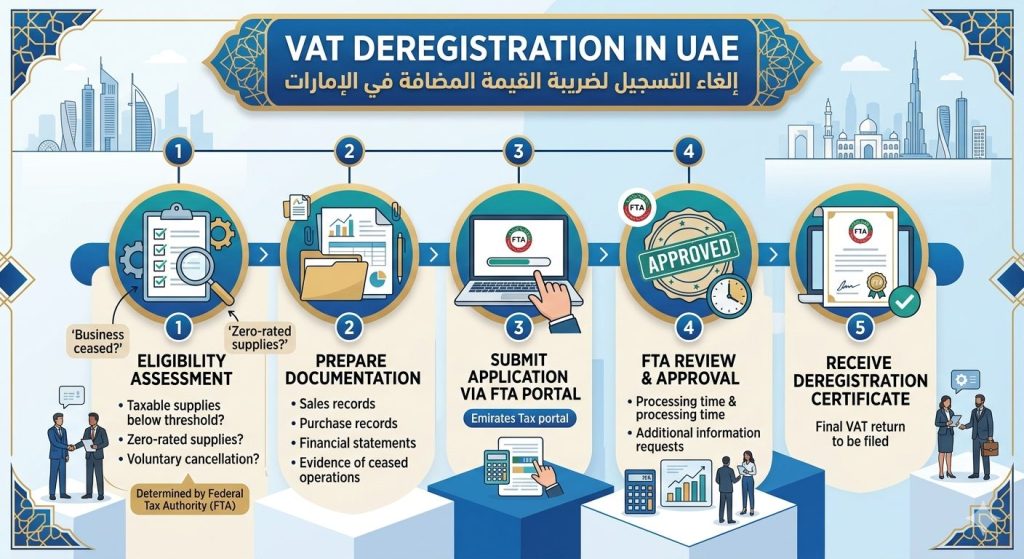
Your UAE company’s revenue dropped below AED 375,000 last year. You’re wondering whether you need to cancel your VAT registration – and what happens if you don’t. Here’s what happens: the FTA charges you AED 10,000 for late deregistration. VAT deregistration in the UAE is the formal process of cancelling your Tax Registration Number (TRN) with the Federal Tax Authority. It’s not automatic. It doesn’t happen when you close your trade license or stop invoicing clients. You have to apply for it – and if you’re required to apply, you face a hard deadline. What is VAT deregistration in the UAE? VAT deregistration – also referred to as VAT cancellation in the UAE – is the process by which a VAT-registered person or business applies to the FTA to cancel their TRN. Once approved, you’re no longer obligated to charge, collect, or remit VAT. But here’s the misconception most businesses have: UAE VAT deregistration does not mean your tax obligations disappear overnight. You must file all outstanding returns, pay any liabilities, and account for deemed supply on remaining assets before the process is complete. The legal basis sits in Federal Decree-Law No. 8 of 2017 on Value Added Tax and Cabinet Decision No. 52 of 2017 (Executive Regulations). Who is eligible for VAT deregistration? Eligibility depends on whether your situation triggers mandatory deregistration or qualifies for voluntary deregistration. The FTA distinguishes between the two, and getting this classification wrong is one of the top reasons applications are rejected. Mandatory VAT deregistration Two conditions trigger mandatory deregistration: You have 20 business days from the date the triggering condition is met to submit your FTA VAT deregistration application. This is not optional. Missing this deadline triggers the AED 10,000 penalty. Voluntary VAT deregistration Two tests determine VAT deregistration eligibility for voluntary cases: Either test qualifies you. If a business was voluntarily registered and its taxable supplies fall below AED 187,500 (based on the past 12 months and expected next 30 days), it is generally required to apply for VAT deregistration. One strategic note worth considering: voluntary deregistration is an option, not an obligation. Some businesses choose to stay registered even below the VAT deregistration threshold because it allows them to continue recovering input VAT on purchases. This is a legitimate tax planning consideration. VAT deregistration thresholds explained Three threshold figures determine your deregistration eligibility. Understanding which one applies to you is the first step. Threshold Amount Who It Applies To Deregistration Type Mandatory registration threshold AED 375,000 Mandatorily registered businesses whose supplies dropped below this Voluntary deregistration Voluntary registration threshold AED 187,500 Voluntarily registered businesses whose supplies dropped below this Voluntary deregistration Complete cessation AED 0 Any registered business that stops all taxable activities Mandatory deregistration When calculating taxable supplies for threshold purposes: include standard-rated and zero-rated supplies. Exclude exempt supplies. Two measurement windows apply – the backward-looking 12-month period and the forward-looking 30-day projection. Step-by-step process to deregister for VAT in the UAE The entire VAT deregistration process is handled through the FTA’s Emara Tax portal and typically involves seven steps. Having your documents ready before you start saves significant time. Step 1 – Assess your eligibility Before touching the portal, confirm your deregistration type: Step 2 – Gather required documents Direct your attention to the full document checklist in the next section. Gather everything before starting the online VAT deregistration application – this prevents timeouts and incomplete submissions. The most commonly missing document? A stock and asset inventory with current market valuations. You’ll need it for deemed supply calculation. Step 3 – Log into the EmaraTax portal Navigate to tax.gov.ae → click “EmaraTax” → log in with your registered email and password → go to “My Registrations” or “VAT” → locate the “Deregistration” option. Only the authorized signatory or a registered tax agent can submit the application. If your business uses a tax agent, the agent submits on your behalf through their own EmaraTax agent account. Step 4 – Complete the deregistration application form Key fields you’ll need to complete: Upload all supporting documents in PDF format, under 5MB per file. Accuracy matters – incorrect figures are a top reason for FTA rejection. Step 5 – Submit and track your application After reviewing all fields and uploads, submit. The portal generates a reference number – save it. Track status through the EmaraTax dashboard under “My Requests.” The FTA may come back with queries or requests for additional documents. Respond within 5 business days to avoid the application being closed or delayed. Step 6 – File your final VAT return This step trips up many businesses. You must continue filing VAT returns for every tax period until the FTA formally approves the deregistration. The final VAT return must include the deemed supply output VAT on any stock and assets on hand. Any outstanding VAT liability must be paid with or before the final return. Failure to file triggers the standard late-filing penalty: AED 1,000 for the first month, AED 2,000/month thereafter, up to AED 10,000. Step 7 – Receive deregistration confirmation Once the FTA approves, they issue a formal deregistration confirmation through the EmaraTax portal. The effective deregistration date is specified in the confirmation. Documents required for VAT deregistration in the UAE The FTA requires supporting documents to verify your eligibility and ensure all tax obligations are settled. Here’s the master checklist covering VAT deregistration requirements: Understanding deemed supply on VAT deregistration When you deregister for VAT, any goods (stock, inventory) and capital assets (equipment, vehicles, furniture) that you still hold – and on which you previously claimed input VAT – are treated as if you “sold” them to yourself at their current market value on the deregistration date. This means you owe output VAT (5%) on that market value. It’s payable in your final VAT return. Penalties for late or incorrect VAT deregistration The VAT deregistration penalty structure in the UAE is straightforward – and entirely avoidable with proper planning. Violation Penalty Legal Reference Late deregistration application (mandatory) AED
Zero-Rated VAT in UAE: The Complete Guide
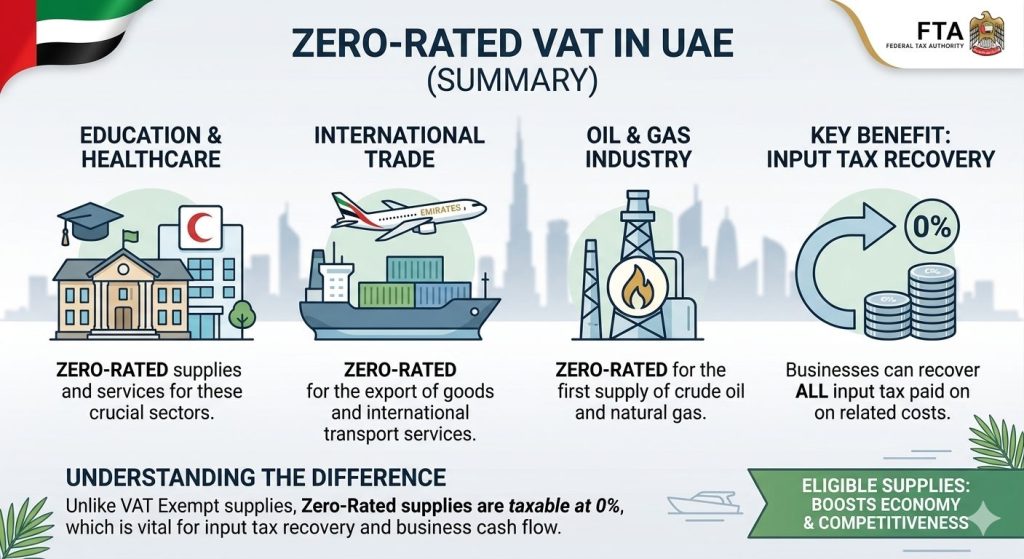
You just invoiced a UK client for consulting services. Now you’re staring at the VAT line on your invoice, unsure whether to charge 5% or 0%. Getting zero-rated VAT in UAE wrong cuts both ways – charge 5% when you shouldn’t and you lose competitiveness against local UK firms. Charge 0% when you don’t qualify and the Federal Tax Authority (FTA) reclassifies the supply, bills you the unpaid VAT and adds penalties on top. The UAE’s standard VAT rate of 5% has been in effect since January 2018. Over 312,000 businesses have registered for VAT, yet the FTA continues to find businesses misclassifying zero-rated supplies – leading to avoidable penalties and lost input tax refunds. What is zero-rated VAT in UAE? Zero-rated supplies are taxable supplies where VAT is charged at 0% instead of the standard 5% VAT rate in the UAE. The supplier charges nothing to the customer but remains fully within the VAT system. This means the supplier can recover all input VAT paid on business expenses. You file returns, you maintain records, you comply with FTA requirements – and in return, you claim back every dirham of VAT you’ve spent on rent, software, professional fees, and other costs. Legal basis – Federal Decree-Law No. 8 of 2017 Zero-rated supplies are defined under Article 45 of Federal Decree-Law No. 8 of 2017 (the UAE VAT law) and further detailed in Cabinet Decision No. 52 of 2017 (Executive Regulation). The Federal Tax Authority issues public clarifications – including VATP019 on exported services – to interpret how zero-rating rules apply in practice. Zero-rated vs. exempt VAT in UAE – What’s the difference? UAE VAT law recognizes three treatment categories. Zero-rated supplies carry 0% VAT, but the business stays in the VAT system and recovers all input tax. Exempt supplies carry no VAT at all, but the business cannot recover input tax on related expenses. Standard-rated supplies carry 5% VAT and input tax is fully recoverable. The key message: zero-rated is financially better than exempt. Exempt sounds like a benefit, but it’s actually a cost. Any VAT you pay on your business expenses becomes an irrecoverable expense when your supplies are exempt. Here’s a concrete comparison. If your business makes AED 500,000 in exempt supplies and incurs AED 25,000 in input VAT, that AED 25,000 is a dead cost. If those same supplies were zero-rated, you’d get the full AED 25,000 back. Criteria Zero-rated (0%) Exempt Standard-rated (5%) VAT charged to customer 0% No VAT 5% Input tax recovery Full recovery No recovery Full recovery Must register for VAT? Yes (if above threshold) Depends on supply mix Yes (if above threshold) Reported on VAT return? Yes Yes (separately) Yes Examples Exports, international transport, healthcare, education Local public transport, bare land, certain financial services Most domestic goods and services Complete list of zero-rated supplies in the UAE Now that you understand what zero-rated means and why it matters, here’s the complete list of supplies that qualify for zero-rating under UAE VAT law. These categories cover both goods and services and each has specific conditions that must be met. 1. Export of goods outside the GCC Goods physically shipped outside the UAE (and outside GCC states that have implemented VAT) are zero-rated. The key condition: goods must leave the UAE within 90 days of the date of supply. The supplier must retain documentary evidence of export. Example: A Dubai-based electronics trading company sells 500 laptops to a buyer in Germany. The shipment leaves Jebel Ali port within 30 days. The sale is zero-rated at 0% VAT and the trading company recovers input VAT on its procurement, warehousing and shipping costs. Required export documentation: 2. Export of services outside the GCC Services provided to recipients outside the UAE and GCC implementing states can be zero-rated, but only if specific conditions are met. These conditions are stricter than for goods exports. Three conditions must be satisfied: (1) the recipient has no place of residence in the UAE, (2) the recipient is outside the UAE at the time of supply and (3) the service doesn’t relate to UAE real estate or goods physically in the UAE. Example: A UAE-based IT consultancy develops a mobile app for a client headquartered in San Francisco with no UAE office. The service is zero-rated. 3. International transport of goods and passengers Transportation of goods or passengers is zero-rated when the journey starts or ends outside the UAE or when the UAE is a transit point on an international route. This includes international flights, international shipping and freight and related services such as loading, unloading and handling at ports and airports when connected to international transport. Example: A logistics company based in Jebel Ali ships a container of textiles from Dubai to Mumbai. The freight charge is zero-rated. The port handling fees at Jebel Ali, directly connected to this international shipment, are also zero-rated. 4. Supply and import of certain means of transport Aircraft and vessels designed and used for commercial international transport of goods or passengers are zero-rated. This extends to related goods and services: spare parts, maintenance, repair and conversion of qualifying aircraft and vessels. Private yachts, recreational boats and personal-use aircraft are standard-rated. Even if occasionally used for international travel, they do not qualify. 5. First supply of residential property (within 3 years) The first sale or lease of a newly constructed residential property is zero-rated, provided it occurs within 3 years of the building’s completion. After the first supply, or after the 3-year window, subsequent sales or leases of the same property become exempt – not zero-rated and not standard-rated. Converting a commercial property to residential use may also qualify the first supply for zero-rating. Example: A real estate developer in Dubai Marina completes a residential tower in March 2024. The developer sells Unit 501 to a buyer in January 2026 – this first sale is zero-rated. If the buyer resells Unit 501 in 2030, that resale is exempt. 6. Healthcare services and related goods Preventive
FTA VAT Registration in Dubai & UAE: A Complete Business Guide

When the UAE introduced Value Added Tax (VAT) in 2018 through Federal Decree-Law No. 8 of 2017, it changed how businesses handle pricing, invoicing, and compliance. For most companies, especially start-ups and SMEs, the first real step into the tax system is registering for VAT with the Federal Tax Authority (FTA). VAT registration is not just a legal formality. It affects how you invoice clients, how you recover costs, and how credible you look in the market. The good news is that once the process is broken down, it becomes very manageable. This guide walks through what VAT registration means, who needs it, how to apply through EmaraTax, and what happens afterwards. Throughout, the team at BCL Globiz shares the practical points we see most often when helping UAE businesses register. What Is FTA VAT Registration? FTA VAT registration is the process of officially registering your business with the UAE tax authority so you can charge VAT on your goods or services and report it to the government. Once your application is approved, you receive a unique Tax Registration Number (TRN), a 15-digit number that becomes part of your business identity. If you want a clearer foundation before starting the registration process, read our guide to what VAT means in the UAE. You will use your TRN when you: In short, VAT registration lets you operate within the UAE tax system legally and transparently. Do You Need to Register for VAT? Not every business must register. Whether you are required to depends on your annual taxable turnover. Mandatory Registration If your taxable supplies exceed AED 375,000 over a rolling 12-month period, or you expect to cross that figure within the next 30 days, you must register. This is a rolling calculation, not something tied to your calendar or financial year, so a single large contract can trigger it. Taxable supplies include: Exempt supplies are not included in this calculation. If you meet the threshold and do not register on time, a penalty applies. Voluntary Registration If your taxable supplies or taxable expenses are above AED 187,500, you can choose to register voluntarily. Many start-ups do this on purpose because it lets them recover VAT on setup costs, build credibility with larger clients, and prepare for growth. BCL Globiz often recommends voluntary registration for businesses with heavy early-stage spending, since the recoverable input VAT can outweigh the added admin. Who Counts as a Taxable Person: Natural Person Vs Legal Person VAT registration does not only apply to companies. The FTA applies the rules to any person carrying on a business, and it splits this into two categories. The registration provisions can apply even if the person holds no trade licence, so this distinction matters early. VAT Registration for a Natural Person A natural person is an individual, such as a freelancer or a sole proprietor operating in their own name. When a natural person registers, the turnover from all of that individual’s business activity is assessed together, not activity by activity. A natural person also cannot join a VAT group, since grouping is reserved for legal persons. VAT Registration for a Legal Person A legal person is an entity with a legal identity separate from its owners, such as an LLC, a One-Person Company LLC, or a joint stock company. Because a legal person is its own taxable person, registration is tied to the entity rather than to the individuals behind it. Legal persons under common ownership that meet the conditions can apply to register as a VAT group under a single TRN, which a natural person cannot do. VAT Registration Rules for Non-Resident Businesses Non-resident businesses follow a different rule from resident businesses, and it is one of the most misunderstood parts of the system. A non-resident is a person with no place of establishment and no fixed establishment in the UAE, who does not usually reside there. When a Non-Resident Must Register There is no registration threshold for non-resident businesses. If a non-resident makes a taxable supply in the UAE and no other party in the UAE is responsible for accounting for the VAT, the non-resident must register from the first taxable sale, regardless of value. This commonly captures foreign e-commerce sellers, SaaS and digital service providers, and service companies billing UAE customers directly, especially in business-to-consumer sales. When a Non-Resident Does Not Register Where the customer is a VAT-registered UAE business, the reverse charge mechanism usually shifts the VAT accounting to that customer. In that business-to-business situation, the non-resident supplier does not register and does not charge UAE VAT. The deciding question is always whether someone inside the UAE is already accountable for the VAT. Appointing a Representative and Using a Power of Attorney A non-resident registering in the UAE may need to appoint an FTA-authorised tax agent. Where a representative or authorised signatory acts for the business, the FTA expects a valid power of attorney proving that person is allowed to submit and manage the application. Preparing this early prevents the application from stalling during review, and BCL Globiz can act as your point of contact throughout. Do Sole Establishments Register Under One TRN? This is one of the most common questions from individuals who run several small businesses, and the FTA has addressed it directly through a public clarification. The FTA Position on Sole Establishments A sole establishment, sometimes called a sole proprietorship, is a business licence that is 100 percent owned by a natural person and has no legal personality separate from that owner. Because the owner and the establishment are treated as the same person, a natural person who owns several sole establishments obtains only one TRN covering all of them. Separate registrations for each establishment are not correct. This does not extend to a One-Person Company LLC or an LLC, because those structures have their own legal personality. How the Threshold Is Calculated Across Sole Establishments? The turnover test is applied collectively. The owner adds together the taxable supplies of the individual
VAT Penalties in UAE: Complete List of Fines, Violations & How to Avoid Them?
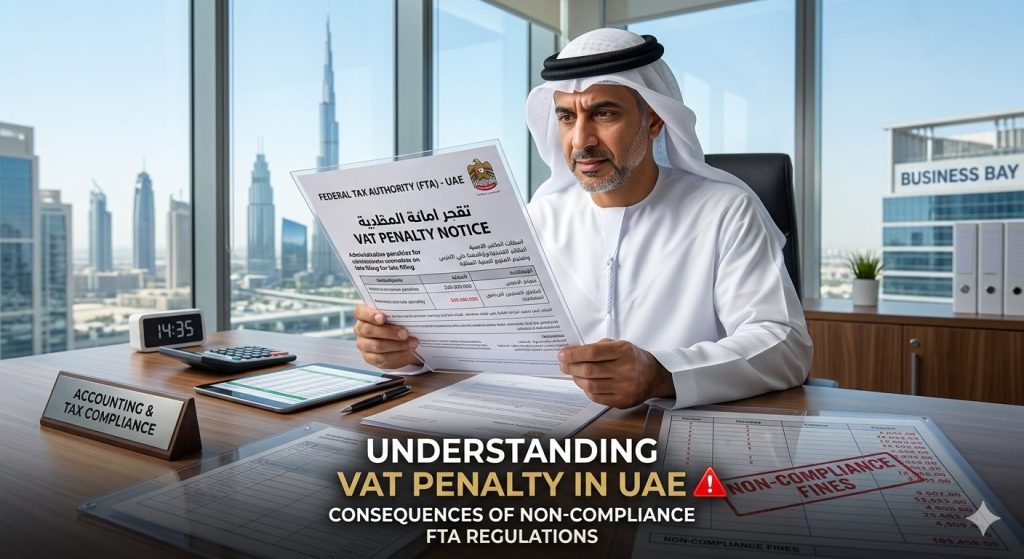
Late VAT payments cost more than most businesses expect. The late VAT payment penalty in the UAE starts at 2% of the unpaid tax on day one and can compound to a large amount under the old regime. Every VAT penalty in the UAE is now governed by Cabinet Decision No. 129 of 2025. Effective 14 April 2026, this decision replaces the previous penalty framework under Cabinet Decision No. 108 of 2021, including a shift to 14% per annum for late payments. Understanding every UAE VAT penalty – the exact amounts, the violations that trigger them and the steps to resolve them is not optional. It’s a financial necessity. Key Takeaways Overview of the UAE VAT penalty framework The UAE’s VAT penalty system sits within a clear legal structure. Understanding where the rules come from helps you navigate them with confidence. Key provisions relevant to UAE VAT penalties: Old penalties vs. new penalties – what changed? Cabinet Decision No. 129 of 2025 replaces Cabinet Decision No. 108 of 2021. Here is a direct comparison of key changes: Violation Old Penalty (CD 108/2021) New Penalty (CD 129/2025) Late VAT registration AED 10,000 AED 10,000 (unchanged) Late filing (first offense) AED 1,000 AED 1,000 (unchanged) Late filing (repeat within 24 months) AED 2,000 AED 2,000 (unchanged) Incorrect tax return (first offense) AED 1,000 AED 500 Failure to maintain records (first offense) AED 10,000 AED 1,000 per violation Failure to submit records in Arabic AED 20,000 AED 5,000 Failure to notify FTA of changes (first offense) AED 5,000 AED 1,000 per violation Late payment (monthly rate) 2% immediately + 4% monthly 14% per annum (applied monthly) Voluntary disclosure before audit 5%–40% fixed based on delay 1% monthly on the tax difference Voluntary disclosure after audit notification 50% fixed + 4% monthly 15% fixed + 1% monthly Maximum late payment cap 300% of unpaid tax No cap (flat annual rate) The new regime incentivises voluntary compliance and early self-correction, particularly through the significantly reduced voluntary disclosure penalties. Complete list of fixed VAT penalties in the UAE Fixed penalties in the UAE are denominated in AED and apply to specific violations. Penalties for VAT registration violations Violation Old Penalty (CD 108/2021) New Penalty (CD 129/2025) Failure to register for VAT when required AED 10,000 AED 10,000 (unchanged) Failure to submit deregistration application on time AED 1,000 per month AED 1,000 per month up to AED 10,000(unchanged) Penalties for VAT return filing violations The late filing penalty applies per return, not per day: Violation First Offense Repeat Offense (within 24 months) Late VAT return filing AED 1,000 AED 2,000 Incorrect VAT return submitted AED 500 AED 500 Note: No penalty applies for an incorrect return if the registrant corrects it within the filing deadline or submits a voluntary disclosure that results in no additional tax due. The filing deadline is the 28th day after the end of each tax period. Even a nil return filed late triggers the penalty. Avoid common filing errors that trigger penalties by reading our guide on VAT return filing mistakes in UAE. Penalties for record-keeping violations Violation Old Penalty (CD 108/2021) New Penalty (CD 129/2025) Failure to submit records in Arabic when requested AED 20,000 AED 5,000 Failure to maintain required records (first offense) AED 10,000 AED 1,000 per violation Failure to maintain required records (repeat within 24 months) AED 20,000 AED 20,000 Records that must be maintained include: Penalties for tax invoice violations The penalty is AED 2,500 per non-compliant invoice. This “per invoice” structure makes it one of the most financially dangerous VAT fines in the UAE. 50 non-compliant invoices means AED 125,000 in exposure. Penalties for failure to notify the FTA of changes Violation Old Penalty (CD 108/2021) New Penalty (CD 129/2025) Failure to notify FTA of required changes (first offense) AED 5,000 AED 1,000 per violation Failure to notify FTA of required changes (repeat within 24 months) AED 10,000 AED 5,000 Changes that must be reported within 20 business days: trade name, address, email, business activities, partnership structure or any other registration information. Penalties for non-cooperation with tax auditors AED 20,000. Under CD 129/2025, the scope of this violation has been broadened beyond just the person conducting business, it now applies more widely to any party failing to facilitate a tax auditor. Cooperation means providing FTA auditors with access to business premises, records, systems and personnel as requested. Other fixed penalties Percentage-based VAT penalties in the UAE Late VAT payment penalties Before 14 April 2026 (CD 108/2021): From 14 April 2026 (CD 129/2025): A flat rate of 14% per annum, calculated monthly on the outstanding unpaid tax balance. This aligns VAT late payment penalties with the Corporate Tax methodology. Voluntary disclosure penalties A voluntary disclosure is a self-correction filed with the FTA when you discover an error in a previously submitted tax return. Before the FTA notifies you of a tax audit (CD 129/2025): After the FTA notifies you of a tax audit (CD 129/2025): This represents a significant reduction from the old regime, which imposed a 50% fixed penalty plus 4% monthly after audit notification. What to do if you receive a VAT penalty in the UAE? Step 1 – Understand the penalty notice The FTA penalty notice typically includes: Step 2 – Pay the penalty or file a reconsideration request Path A – Pay the penalty within the specified timeframe (usually 20 business days) if you accept that the violation occurred. Path B – File an FTA penalty reconsideration request within 20 business days if you believe the penalty is unjust or incorrect. Log into the EmaraTax portal, submit a written explanation, attach supporting documentation and submit within the deadline. The FTA must respond within 20 business days. Step 3 – Escalate to the Tax Disputes Resolution Committee (TDRC) If the FTA rejects your reconsideration request or doesn’t respond within 20 business days, you can escalate to the TDRC within 20 business days of the FTA’s decision. Step 4 – Engage professional help Consider
VAT Exemption in the UAE: What Every Business Should Know
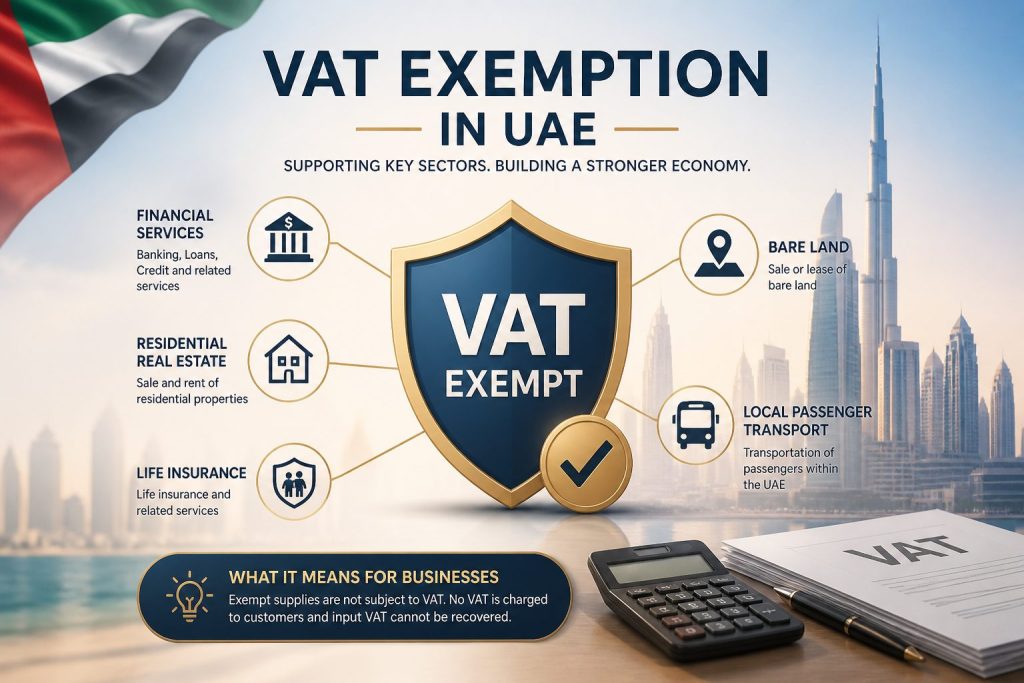
The introduction of Value Added Tax (VAT) in the UAE on January 1, 2018, via Federal Decree-Law No. 8 of 2017 and its accompanying Executive Regulation, fundamentally transformed the landscape of corporate financial management and operational compliance. While a standard 5% VAT rate governs the majority of commercial transactions, certain goods and services are specifically designated as VAT exempt, requiring businesses to carefully distinguish these items to ensure accurate tax reporting and avoid administrative penalties. At first glance, VAT exemption might seem like a benefit. After all, not having to charge VAT sounds like a relief. But in reality, it’s a bit more complex than that. For many businesses, VAT exemption can have both advantages and hidden costs. In this guide, we’ll walk you through what VAT exemption really means, which sectors it applies to, and how it affects your business in practical terms. Understanding VAT Exemption in Simple Terms Let’s start with the basics. A VAT-exempt supply is one where no VAT is charged to the customer. Sounds straightforward, right? But here’s the catch: businesses making exempt supplies cannot recover the VAT they pay on their own expenses. So, while your customers don’t pay VAT, your business ends up absorbing the VAT on costs like rent, utilities, and professional services. This is what makes VAT exemption very different from zero-rated supplies, even though both result in no VAT being charged to customers. If you’re new to VAT concepts, start with our detailed guide on what VAT is in the UAE to understand the fundamentals before exploring exemptions. VAT Exemption vs Zero-Rated Supplies: A Key Difference This is where many businesses get confused. Both exempt and zero-rated supplies appear similar from the outside, but they are treated very differently behind the scenes. With zero-rated supplies, VAT is charged at 0%, but businesses can still reclaim input VAT. This is why zero-rating is generally more favourable. With exempt supplies, there is no VAT at all—but input VAT cannot be recovered. Think of it this way: Understanding this distinction is crucial because misclassifying supplies can lead to compliance issues and financial losses. What Does the Law Say? VAT exemptions in the UAE are not flexible or open to interpretation. They are clearly defined under the country’s VAT laws and regulations. Only specific categories of goods and services qualify as exempt, and businesses must ensure they meet all the conditions before applying this treatment. If a supply doesn’t strictly fall within the defined categories, it is generally considered taxable—even if it seems similar to an exempt activity. Which Supplies Are VAT Exempt in the UAE? The UAE has kept its exemption list relatively narrow. This helps maintain clarity in the tax system, but it also means businesses need to be precise when determining their VAT treatment. Here are the main categories: 1. Financial Services A large portion of financial services is VAT exempt, particularly when the income is earned through margins rather than explicit fees. This includes services like: However, the moment a financial service involves a clear fee or commission, it may become taxable. This is an area where businesses often need expert guidance. 2. Residential Real Estate Residential property is another major category under VAT exemption. In most cases: However, the first sale of a newly constructed residential property is usually zero-rated, not exempt. This distinction is important for property developers and investors. 3. Bare Land The sale or lease of bare land—land without any buildings or structures—is also exempt from VAT. If the land is developed or includes infrastructure, the VAT treatment may change. 4. Local Passenger Transport Transporting passengers within the UAE is generally VAT exempt. This includes: For transport businesses, this means fares are VAT-free, but operational costs still include VAT that cannot be recovered. 5. Life Insurance Life insurance policies and related services are also exempt from VAT. This applies mainly to long-term protection policies, while other types of insurance may be treated differently. Why VAT Exemption Isn’t Always an Advantage? At first glance, VAT exemption might seem like a win—you don’t charge VAT, so your services appear more affordable. But there’s more to the story. 1. You Can’t Recover Input VAT This is the biggest drawback. Businesses incur VAT on everyday expenses such as: If your supplies are exempt, you cannot reclaim this VAT. Over time, these costs add up and directly impact your profitability. 2. It Affects Your Pricing Strategy Since you can’t recover input VAT, you have two choices: Either way, VAT exemption influences how you price your products or services. 3. It May Impact VAT Registration Businesses are required to register for VAT only if their taxable supplies exceed a certain threshold. Since exempt supplies are not considered taxable, businesses dealing purely in exempt activities may not need to register at all. While this reduces compliance requirements, it also means losing the ability to recover any input VAT. 4. Partial Exemption for Mixed Businesses Many businesses don’t fall neatly into one category. If your company provides both taxable and exempt supplies, you’ll need to apply partial exemption rules. This means: This is where professional advice becomes especially valuable. Real-Life Examples To make things clearer, let’s look at how VAT exemption works in practice. A Real Estate Company A company renting out apartments doesn’t charge VAT on rent. However, it cannot recover VAT paid on maintenance, repairs, or management services. A Bank A bank earning interest on loans doesn’t charge VAT on that income. But it cannot reclaim VAT on office expenses, technology, or consulting services. A Taxi Operator Taxi fares are VAT exempt. However, the operator still pays VAT on fuel, servicing, and vehicle purchases—without being able to recover it. How to Know If Your Supply Is Exempt? Determining whether your supply is exempt requires careful evaluation. Ask yourself: Even small differences in how a service is structured can affect its VAT treatment. Compliance Still Matters Even if your business deals only in exempt supplies, you still need to maintain proper records
VAT Registration Threshold in UAE: What Every Business Should Know
Introduction Understanding VAT regulations is a vital aspect of operating a business in the UAE. Since the introduction of Value Added Tax (VAT) via Federal Decree-Law No. 8 of 2017, which became effective on January 1, 2018, and its subsequent Executive Regulation, businesses across the country have been required to comply with the stringent rules established by the Federal Tax Authority (FTA). Whether you operate a startup, consultancy firm, trading company, e-commerce business, or freelance operation, knowing when to register for VAT is essential. Many businesses are unsure about the registration thresholds, when VAT becomes mandatory, and whether voluntary registration is beneficial. Failing to register on time can lead to penalties and compliance issues, while timely registration helps businesses maintain credibility, improve financial transparency and avoid unnecessary risks. This guide explains the VAT registration threshold in the UAE, including mandatory and voluntary registration, turnover calculations, registration procedures, penalties and common compliance mistakes businesses should avoid. What is VAT in the UAE? VAT, or Value Added Tax, is an indirect tax charged on most goods and services supplied in the UAE. The standard VAT rate is 5%. Businesses registered for VAT are responsible for: Although businesses collect VAT, the tax is ultimately paid by the end consumer. VAT impacts several areas of business operations, including accounting, invoicing, pricing and financial reporting. That is why understanding VAT obligations is important for businesses of every size. What is the VAT Registration Threshold in UAE? The VAT registration threshold refers to the minimum taxable turnover at which a business must or may register for VAT. In the UAE, there are two VAT registration categories: Registration Type Threshold Mandatory VAT Registration AED 375,000 Voluntary VAT Registration AED 187,500 If a business exceeds AED 375,000 in taxable turnover, VAT registration becomes mandatory. Businesses with turnover above AED 187,500 but below AED 375,000 may choose to register voluntarily. These thresholds apply to: When Does VAT Registration Become Mandatory? A business must register for VAT if: This means businesses must monitor both current and expected future revenue. For example, if a consultancy firm signs a major contract that will increase revenue above the threshold next month, VAT registration may already be required. Many businesses make the mistake of waiting until payment is received before registering, which can lead to penalties. What Counts Towards the VAT Threshold? Understanding taxable turnover is very important when calculating VAT obligations. Included in the Calculation The following are generally included: Excluded from the Calculation The following are generally excluded: For example, if a company earns: The taxable turnover becomes AED 410,000 because exports are included in the calculation. In this case, VAT registration becomes mandatory. This is why accurate bookkeeping and financial reporting are essential. Understanding Voluntary VAT Registration Businesses that do not meet the mandatory threshold can still register voluntarily if: Voluntary registration is often beneficial for startups, freelancers and growing businesses. Benefits of Voluntary VAT Registration Recovering VAT on Expenses VAT-registered businesses can recover VAT paid on business expenses such as: This helps reduce operating costs and improves cash flow. Improved Business Credibility Many clients and suppliers prefer working with VAT-registered businesses because it reflects professionalism and financial transparency. Having a Tax Registration Number (TRN) can improve trust with: Better Financial Planning Businesses that register early can establish proper accounting systems and invoicing procedures before turnover increases significantly. This makes future compliance easier and more organized. Understanding the Rolling 12-Month Rule One important point businesses must understand is that VAT thresholds are calculated using a rolling 12-month period. This means businesses should continuously monitor their turnover every month rather than checking revenue only at the end of the financial year. For example: Regular financial monitoring helps businesses avoid missing registration deadlines. VAT Registration Process in UAE The VAT registration process is completed online through the FTA’s EmaraTax portal. Step 1: Create an FTA Account Businesses must first create an account on the EmaraTax platform. Step 2: Prepare Required Documents The required documents generally include: Additional documents may be requested depending on the business activity. Step 3: Submit the VAT Application Businesses must provide details about: Accuracy is important because incorrect information may delay approval. Step 4: Receive the TRN Once approved, the FTA issues a Tax Registration Number (TRN), allowing the business to legally charge VAT. Penalties for Late VAT Registration and Payment Failing to register for VAT on time can result in serious financial penalties. The standard penalty for late registration is: Businesses may also face: Many companies underestimate how quickly penalties can increase, especially during periods of rapid growth. The standard penalty for late payment is: Common VAT Mistakes Businesses Make Delaying Registration Some businesses wait too long to register after crossing the threshold. Poor Bookkeeping Inaccurate records make it difficult to track taxable turnover properly. Confusing Taxable and Exempt Income Not all income is treated the same under VAT regulations. Misunderstanding revenue categories can lead to compliance issues. Missing VAT Filing Deadlines VAT compliance continues after registration. Businesses must: Failure to comply can result in additional penalties. To understand post-registration compliance requirements, read our detailed guide on VAT return filing in UAE. Why Professional VAT Support Matters? VAT compliance can sometimes be challenging, especially for: Professional financial consultants help businesses: Professional guidance also allows business owners to focus on growth while ensuring financial compliance is properly managed. Businesses can simplify compliance and avoid penalties with expert VAT compliance services in UAE tailored to their operations. Final Thoughts Understanding the VAT registration threshold in the UAE is essential for every business operating in the country. Whether registration is mandatory or voluntary, businesses must regularly monitor their turnover and maintain accurate financial records to remain compliant with FTA regulations. The key VAT thresholds businesses should remember are: Timely registration not only helps businesses avoid penalties but also improves financial transparency, operational efficiency and credibility. With proper planning and professional support, VAT compliance can become a smooth and manageable part of running a successful business in the UAE. Frequently Asked
BCL Globiz vs Virtuzone: Business Setup Company Comparison in Dubai

When it comes to company setup in Dubai, choosing the right business setup partner can significantly impact your business growth and compliance journey. Dubai has become a major business and financial hub in the Middle East due to its business-friendly policies, making it easier to set up a business in various jurisdictions. The initial stages of business formation are critical for long-term success, and selecting an established firm with expertise in the business setup industry is essential. Two prominent names in the UAE market are BCL Globiz and Virtuzone, both recognized firms assisting many entrepreneurs in registering and operationalizing their companies. As the entrepreneurial landscape expands, the demand for reliable business setup consultants in Dubai has surged, making the choice of the right partner crucial for success. Both offer comprehensive business setup services, but understanding their unique strengths can help entrepreneurs make an informed decision. Overview of BCL Globiz and Virtuzone BCL Globiz is a Dubai-based business setup firm known for its client-centric approach, offering comprehensive business solutions tailored to diverse business needs. As an established player in the business setup industry, the firm provides company registration, trade license procurement, visa processing, accounting services, and post setup support, making them a reliable one-stop shop for startups and SMEs. BCL Globiz tailors service packages based on transaction volume and specific tax applicability, ensuring clients receive solutions that fit their unique requirements. Client testimonials frequently highlight the firm’s responsiveness, support quality, and deep industry expertise. Virtuzone, established in 2009, is a leading business setup firm with a strong foothold in the UAE market and over 80,000 successful company formations. With extensive experience in the industry, they provide services including mainland company formation, free zone setup, offshore company formation, visa assistance, and corporate tax advisory. Virtuzone is recognized for its fast, tech-driven company formation process and strong regulatory relationships. The firm is also appreciated for its experienced consultants, multilingual support, and positive client testimonials that emphasize their support quality and industry knowledge. Business Setup Options: Mainland, Free Zone and Creative Zone Explained When planning your business setup in Dubai, selecting the right legal structure is a crucial first step. Entrepreneurs can choose between Mainland company formation, Free Zone setup, or establishing in a Creative Zone—each offering distinct advantages tailored to different business needs. Mainland company formation allows businesses to operate anywhere in the UAE market, providing maximum flexibility for those targeting both local and international clients. This option is ideal for companies seeking to expand across the Emirates, hire a larger workforce, or bid for government contracts. With the support of an experienced business setup partner, navigating the regulatory landscape and securing the necessary trade license becomes a streamlined process. Free Zone company formation is a preferred choice for international entrepreneurs and startups, offering 100% foreign ownership, full profit repatriation, and attractive tax benefits. Free Zones are designed to foster business growth by offering simplified company registration, sector-specific benefits, and proximity to key logistics hubs. This setup is especially advantageous for businesses focused on international trade, e-commerce, or those requiring a cost-effective solution with minimal local restrictions. Creative Zone caters to innovative ventures and creative industries, providing a supportive ecosystem for entrepreneurs seeking to launch unique business activities. With flexible licensing options and a focus on fostering creativity, the Creative Zone is an excellent choice for startups and SMEs aiming to differentiate themselves in Dubai’s dynamic business environment. Choosing the right setup in Dubai depends on your business goals, target market, and operational requirements. A knowledgeable business setup company can offer reliable guidance, helping you evaluate each option and ensuring your company formation aligns with your long-term vision. Why Choose BCL Globiz for Your Company Setup? 1. Comprehensive Business Solutions Under One Roof Regulatory compliance is a significant focus for accounting and tax advisory firms operating in the UAE, as businesses must adhere to evolving local laws. SMEs and startups in the UAE often require specialized accounting and tax advisory services to navigate these local regulations. BCL Globiz stands out as a firm with its holistic approach to business setup. Beyond company formation and licensing, the firm offers tailored accounting, VAT compliance, corporate tax advisory, transfer pricing services, VAT registration, legal structure planning and strategic business consulting. This integrated service model ensures seamless coordination and saves clients from juggling multiple service providers. 2. Client-Centric Approach and Reliable Guidance Entrepreneurs seeking personalized attention will find BCL Globiz’s client-centric approach highly beneficial. Their experienced consultants provide reliable guidance through every step of the setup process, from choosing the right business activity to navigating complex regulatory requirements. This proactive support reduces setup time and minimizes hidden fees. 3. Transparent Pricing and Cost-Effective Solutions BCL Globiz emphasizes pricing transparency, ensuring no hidden fees during company registration or visa processing. Their cost-effective solutions cater especially well to startups and SMEs looking to optimize budgets without compromising on service quality. 4. Strategic Location and Office Space Support Operating from Dubai’s prime business hubs, including Business Bay, BCL Globiz leverages strategic locations to assist clients in securing office space that aligns with their business needs. Their partnerships with free zone authorities and mainland jurisdictions enable smooth licensing and company formation. 5. Post Setup Support and Pro Services Understanding that company setup is just the beginning, BCL Globiz offers robust post setup support. This includes accounting services, VAT and corporate tax compliance, employee visas, Emirates ID processing and ongoing consulting to support business growth in the competitive UAE market. Businesses looking for a seamless setup experience can explore BCL Globiz’s business incorporation services in Dubai, designed to handle everything from company registration to compliance and post-setup support. Financial and Banking Essentials: Corporate Tax and Bank Account Setup A successful business setup in Dubai goes beyond company registration—it requires a solid foundation in financial and banking essentials. As a global business hub, Dubai offers a favorable environment for entrepreneurs, but understanding corporate tax obligations and setting up a corporate bank account are critical steps for compliance and operational efficiency. Corporate tax
Unlimited vs Per-Transaction Accounting: What’s Better for UAE Businesses?
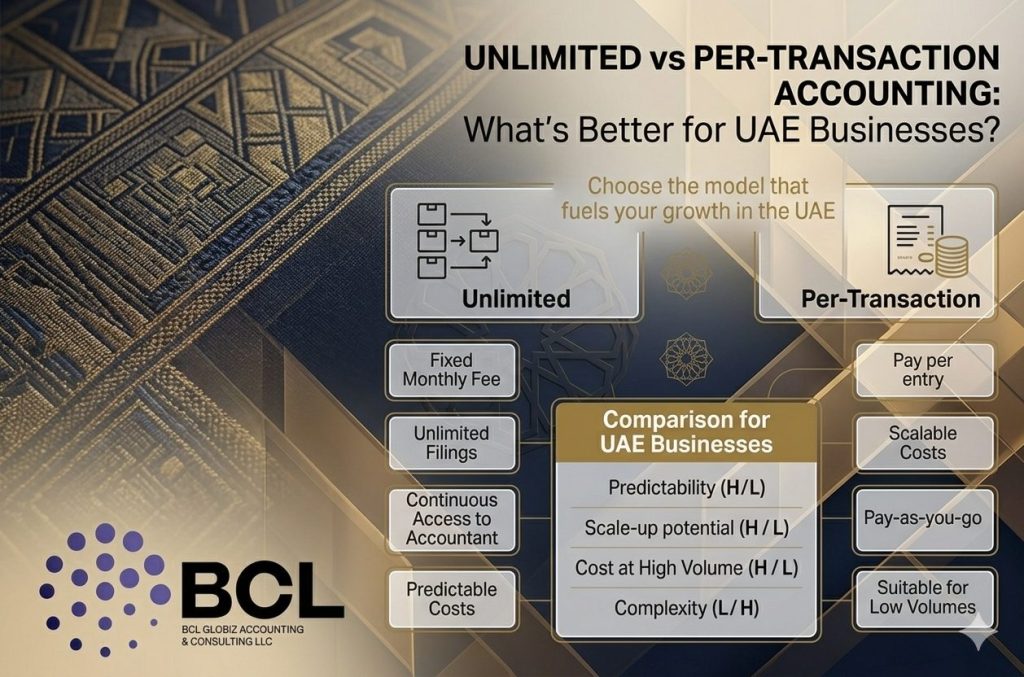
Choosing the right accounting system is crucial for businesses in the UAE aiming to maintain accurate financial records, ensure compliance, and support sustainable growth. Selecting the right accountant is also essential for ensuring financial accuracy and compliance. Among the key decisions is selecting between unlimited and per-transaction accounting models. Understanding the differences and benefits of each, as well as the importance of assets in financial statements, can help businesses, especially small and growing companies, optimize their bookkeeping services and financial management. Overview of Accounting Services For small businesses in the UAE, robust accounting services are the backbone of financial health and regulatory compliance. A dependable accounting system—built on principles like double entry bookkeeping—ensures every business transaction is accurately recorded, supporting the creation of essential financial statements and cash flow statements. These records are vital for understanding your business’s financial standing and making informed decisions. Modern accounting services go beyond simple record-keeping. Providers leverage advanced accounting software, such as QuickBooks, to streamline the management of financial transactions and generate timely financial reports. This technology-driven approach not only enhances accuracy but also provides valuable insights into day-to-day business operations. When evaluating accounting services, it’s important to consider your business size, transaction volume, and the complexity of your operations. Many firms offer flexible monthly packages tailored to the unique needs of each client, ensuring you only pay for the services you require. Whether you’re a startup with a handful of transactions or a growing company with increasing financial activity, choosing the right accounting system and service provider can help you stay compliant, optimize costs, and support your business’s long-term growth. What Is Per-Transaction Accounting? Per-transaction accounting charges businesses based on the number of financial transactions processed. Each business transaction—whether a sale, purchase, invoice, or payment—is counted, and fees are applied accordingly. This pricing model is common among traditional bookkeeping services and some accounting software providers. Per-transaction pricing requires businesses to track how many transactions they process, as this directly impacts their costs. While per-transaction accounting offers transparency in costs for low transaction volumes, it is best suited for low-volume, stable businesses, typically those with less than 40 transactions per month. However, it can become costly as the number of transactions increases. Some providers also offer hourly rates, typically ranging from $30 to $90 per hour, but this can result in unexpected costs if transaction volume increases or issues arise. Businesses experiencing growth or fluctuating transaction volumes often face unpredictable expenses, hidden costs, or extra charges for exceeding limits. This lack of pricing transparency can hinder effective budgeting and cash flow management. What Is Unlimited Accounting? Unlimited accounting, in contrast, offers a flat fee for handling all business transactions regardless of volume. Unlimited accounting is typically offered via flat-fee monthly subscriptions or free, unrestricted software plans. This model provides complete transparency and predictability in pricing, allowing businesses to process as many transactions as needed without worrying about extra charges. For UAE businesses, unlimited accounting services often include comprehensive bookkeeping, preparation of financial statements such as balance sheets and cash flow statements, and regular reporting. Unlimited accounting plans often include automated features such as auto-categorization of expenses and bank reconciliation. This approach supports accurate accounting and timely financial reports, helping businesses maintain a clear view of their financial standing and make informed decisions. Cost predictability and budget predictability are key advantages, as flat monthly fees ensure fixed, predictable expenses, aiding in financial forecasting and preventing surprise invoices. Businesses with fluctuating sales or high, volatile, or unpredictable transaction volumes benefit most from unlimited accounting, as it prevents spikes in accounting costs during busy periods. For businesses processing hundreds or thousands of transactions monthly, unlimited plans prevent cost prohibitive per-transaction fees, which is especially important for high-volume retailers with numerous small purchases. Which Model Is Better for UAE Businesses? Benefits of Unlimited Accounting Package Level BCL Globiz Typical Market Rates Entry Level (Accounting + CT) Essential – AED 5,000 AED 6,000 – 10,000 Standard (Accounting + CT + VAT) Grow – AED 7,500 AED 10,000 – 18,000 Professional (Accounting + CT + VAT + Audit support) Advanced – AED 10,000 AED 15,000 – 30,000 Premium / Elite (Full compliance + TP) Elite – AED 15,000 AED 25,000 – 60,000+ Limitations of Per-Transaction Accounting For businesses looking to scale without worrying about transaction limits or hidden costs, choosing the right provider is critical. Explore our accounting services in Dubai to access unlimited accounting, transparent pricing, and fully compliant financial management tailored for UAE businesses. Accounting Software and Modern Tools The rise of cloud-based accounting software has transformed how businesses in the UAE manage their financial transactions and bookkeeping services. Platforms like Xero, Zoho Books, and QuickBooks offer real-time access to your financial data from anywhere, making it easier than ever to stay on top of your accounting. These modern tools automate routine tasks such as invoice creation, payment processing, and reconciliation, allowing businesses to save time and minimize errors. With features designed for accurate accounting and complete transparency, cloud-based solutions help you monitor your financial standing, generate detailed financial reports, and ensure compliance with local regulations—reducing the risk of costly penalties. Scalability is another key advantage. As your business grows, cloud-based accounting software can easily adapt to increased transaction volumes and more complex operations. Integration with other business systems further streamlines processes, supporting efficient bookkeeping services and enabling you to focus on revenue growth and strategic decision-making. By investing in the right accounting software, UAE businesses can save time, reduce costs, and gain the confidence needed to drive sustainable growth. Hidden Costs and Red Flags When choosing accounting services, it’s crucial to look beyond the headline price and watch for hidden costs that can impact your bottom line. Some firms may charge extra for essential services like balance sheet preparation, detailed financial reporting, or handling rush jobs. Others might impose limits on the number of transactions or employees, leading to unexpected fees as your business expands. To avoid these pitfalls, prioritize accounting services that offer transparent pricing,
Tax Optimization for Free Zone Companies in UAE: QFZP Strategy, 0% Tax & Compliance Guide

Key Takeaways Introduction: Why Tax Optimization Matters for UAE Free Zone Companies Dubai, Abu Dhabi, and Northern Emirates free zones like DMCC, JAFZA, IFZA, RAKEZ, and ADGM were once tax-free havens. That era ended on 1 June 2023 when free zone entities became subject to the UAE’s federal corporate tax regime. Now, all must comply with corporate tax registration, VAT, transfer pricing, and substance rules—even if their effective tax rate is 0%.This guide helps CFOs, founders, and finance managers in UAE free zones design tax-efficient structures while staying compliant with FTA requirements. It explains what qualifies for 0%, what triggers 9%, and how to maximize qualifying income legally.Written by BCL Globiz, a Dubai-based accounting and tax advisory firm, we support free zone and cross-border clients facing these challenges daily. The New Reality: From “Tax-Free” Marketing to Regulated Corporate Tax Federal Decree Law No. 47 of 2022 introduced a 9% corporate tax rate on taxable profits above AED 375,000 for all UAE businesses—including free zone entities unless they qualify for relief under the UAE corporate tax law. Many companies operating in DMCC or JAFZA before 2023 assumed lifetime tax exemptions. That assumption was wrong. Then vs Now: Pre-2023 Reality Current Reality No federal corporate tax 9% standard corporate tax rate (0% if QFZP) No filings required Mandatory annual corporate tax returns Simple bank account opening Enhanced substance and reporting expectations Perpetual tax holidays marketed QFZP status must be proven annually Free zone Free zone incentives still exist—customs duty exemptions on certain imports, 100% foreign ownership, and unrestricted profit repatriation. But corporate tax is now layered on top. The question isn’t whether you’re covered by the corporate tax regime; it’s whether you qualify for the 0% rate. Understanding Free Zone Persons and Qualifying Free Zone Persons (QFZPs) A free zone person is any legal entity or branch registered in a UAE Free Zone—think RAKEZ FZE, DMCC LLC, or ADGM SPV. All FZPs fall under corporate tax rules automatically. A qualifying free zone person (QFZP) is the gateway to the 0% corporate tax rate on qualifying income. Without this status, you’re taxed at the standard corporate tax rate of 9%. Key QFZP Conditions: QFZP status is assessed annually for each relevant tax period. Breach the conditions, and you can lose preferential tax status for that year and potentially the next four tax periods. Criteria Free Zone Person (FZP) Qualifying Free Zone Person (QFZP) Definition Any entity registered in UAE Free Zone FZP meeting all qualifying conditions Corporate Tax Rate 9% on taxable income above AED 375,000 0% on qualifying income Filing Obligations Registration, returns, documentation Same, plus proof of QFZP conditions Substance Requirement General compliance Adequate economic substance required Qualifying vs Non-Qualifying (Taxable at 9%) Income Tax optimization for free zone companies depends on understanding which income categories enjoy 0% and which fall into the 9% bracket. Qualifying Income includes: Concrete qualifying activities: Excluded activities triggering 9%: Example Calculation: A JAFZA logistics company earns AED 3m from qualifying distribution activities and AED 400k from excluded mainland consulting. The consulting income exceeds the de minimis threshold, pushing that portion into the 9% bracket. Optimization would focus on restructuring or segregating that AED 400k. De Minimis Rule: Your Safety Margin for Non-Qualifying Income The de minimis test allows incidental non-qualifying revenue without forfeiting QFZP benefits. The formula: Non-qualifying income must not exceed 5% of total revenue OR AED 5 million per tax period—whichever is lower. Example: A RAKEZ trading company with AED 20m total revenue can have up to AED 1m non-qualifying revenue (5% threshold). But a larger company with AED 200m revenue hits the AED 5m absolute cap—not AED 10m. Exceeding this threshold in any tax period can cause loss of QFZP status, pushing the entity into the 9% regime for that year and potentially the following four years. Optimization tactics: BCL Globiz helps clients design dashboards tracking this ratio in real-time, catching issues before year-end closes. Substance Requirements: Building a Genuine Free Zone Presence Adequate substance means more than a registered address. The Federal Tax Authority requires genuine operations—not mailbox companies. Key Substance Indicators: Substance is vital for QFZP status and Economic Substance Regulations compliance. BCL Globiz helps clients review substance, advise on staffing and office needs, and align ESR, QFZP, and licensing. Core Tax Optimization Strategies for Free Zone Companies This section covers actionable, lawful strategies to reduce 9% tax exposure while complying with FTA and OECD rules. Tax optimization depends on your Free Zone type, markets, and group structure. BCL Globiz avoids artificial arrangements, focusing on robust, audit-proof structures. Structuring Group Operations Between Free Zone and Mainland Typical setup: Free Zone entity handles regional sourcing and B2B distribution; mainland LLC manages onshore customer sales. Key points: BCL Globiz assists in splitting Gulf operations to maximize 0% income in Free Zone and 9% tax only on mainland margins. Aligning Activities and Licensing with Qualifying Income Rules Many Free Zone businesses hold broad licenses misaligned with qualifying activities. Optimization steps: Examples: BCL Globiz maps income streams to qualifying lists and advises on license changes. Transfer Pricing and Intra-Group Pricing as Optimization Tools From FY starting 1 June 2023, transfer pricing documentation and arm’s length rules apply. Proper pricing of management fees, royalties, and margins keeps profits in 0% Free Zone entities. Warning: Aggressive pricing risks audits and loss of QFZP status. BCL Globiz conducts functional analyses, selects pricing methods, and prepares defensible documentation. Example: Free Zone parent charges 3% management fees to Indian subsidiary, supported by economic analysis and accepted by tax authorities. To ensure your intra-group transactions comply with arm’s length rules while optimizing profits within free zone structures, explore our transfer pricing services in Dubai for expert benchmarking, documentation, and audit-ready strategies. Using Holding, IP, and Treasury Free Zone Vehicles Free Zone holding companies can earn qualifying dividends and capital gains at 0% tax if QFZP conditions and substance are met. Opportunities: Limitations: Governance is key: UAE board meetings, documented decisions, clear dividend and loan policies. BCL Globiz coordinates cross-border
Transfer Pricing Litigation UAE: Why FTA Audits Are Turning Into Disputes?

What Is Transfer Pricing Litigation and Why Does It Matter Now? Imagine, an UAE holding company charges a routine management fee to its operating subsidiaries. No functional analysis. No intercompany agreement. No evidence the services were actually rendered at arm’s length. Three years ago, this was unremarkable. Today, it is the kind of arrangement that triggers a Federal Tax Authority enquiry — and tomorrow, it will be the kind that ends in litigation. Transfer Pricing (TP) litigation arises when the FTA challenges whether transactions between related parties — including directors, owners, and partners — are priced at arm’s length. Following the introduction of UAE Corporate Tax Law under Ministerial Decision No. 97 of 2023, these disputes centre on potential tax base erosion through non-market pricing of goods, services, loans, royalties, and management fees. The UAE is no longer a low-scrutiny jurisdiction. It is evolving into a substance-driven, audit-oriented tax system — faster than many businesses appreciate. As enforcement increases, businesses are increasingly relying on expert transfer pricing advisory services in Dubai to assess risk, strengthen documentation, and prepare for potential FTA scrutiny. What Businesses Are Already Experiencing? The indicators of enforcement are already visible. Businesses are receiving detailed related-party transaction questionnaires, requests for functional and economic analysis, and pointed questions about substance and decision-making authority. Challenges to profit margins and requests for Master Files, Local Files, and TP Disclosure Forms are becoming routine. “These are not compliance checks. They are the building blocks of future assessments.” It is also worth noting that the UAE’s definition of related parties and connected persons is broader than most international standards — capturing not just group companies but also directors, owners, and partners. This significantly widens the pool of transactions subject to scrutiny. The Structural Forces Driving More Disputes Several converging forces are making Transfer Pricing a high-impact audit priority. The FTA is building stronger enforcement capacity, supported by sophisticated benchmarking tools and cross-border data access. The UAE’s alignment with OECD standards — including BEPS Action Plans and Country-by-Country Reporting — means international enforcement practices are being adopted rapidly. TP reviews are also increasingly integrated within broader Corporate Tax audits, rather than treated in isolation. Importantly, while formal documentation requirements apply to MNE groups with revenues of AED 3.15 billion or more — or individual taxpayers above AED 200 million — THE ARM’S LENGTH OBLIGATION APPLIES TO ALL TAXPAYERS, REGARDLESS OF SIZE. Smaller businesses that assume they fall beneath the threshold are taking a risk. Understanding the Dispute Resolution Landscape When a dispute does arise, UAE businesses have several pathways available. The formal process typically begins with an administrative reconsideration request to the FTA, followed by escalation to the Tax Disputes Resolution Committee (TDRC) and, ultimately, the courts. Two additional mechanisms deserve attention: The Time to Act Is Before the Audit Begins Once a formal audit begins, the ability to revise documentation or restructure arrangements is severely constrained. Forward-thinking businesses are moving toward audit-ready frameworks: clear group structure mapping, robust functional and risk analysis, defensible pricing policies, properly executed intercompany agreements, and contemporaneous documentation aligned with UAE regulations and OECD standards. Real economic substance must be demonstrable — not merely stated. These are not administrative obligations. They are your first line of defence. Understanding how a transfer pricing audit in UAE works is critical, as most litigation cases begin with detailed FTA enquiries and documentation reviews. How BCL Globiz Approaches Transfer Pricing? At BCL Globiz, we treat Transfer Pricing as a strategic risk management function — not a documentation exercise. We help clients understand their genuine exposure, build structures that withstand scrutiny, and develop documentation that reflects economic reality. Our work spans functional and economic substance analysis, intercompany agreement design, pricing model development, APA and MAP support, and dispute readiness planning. Where clients are already facing FTA enquiries, we support them at every stage — from analysis through advocacy. The Opportunity Is in Preparation Transfer Pricing litigation in the UAE is no longer theoretical. The enforcement environment is being built now. In a tax landscape that has changed more in the last three years than in the previous three decades, preparation is not merely about compliance — it is about managing one of the most significant and underappreciated risks in the Gulf business environment today.
Transfer Pricing UAE: Rules, Documentation & Compliance Guide
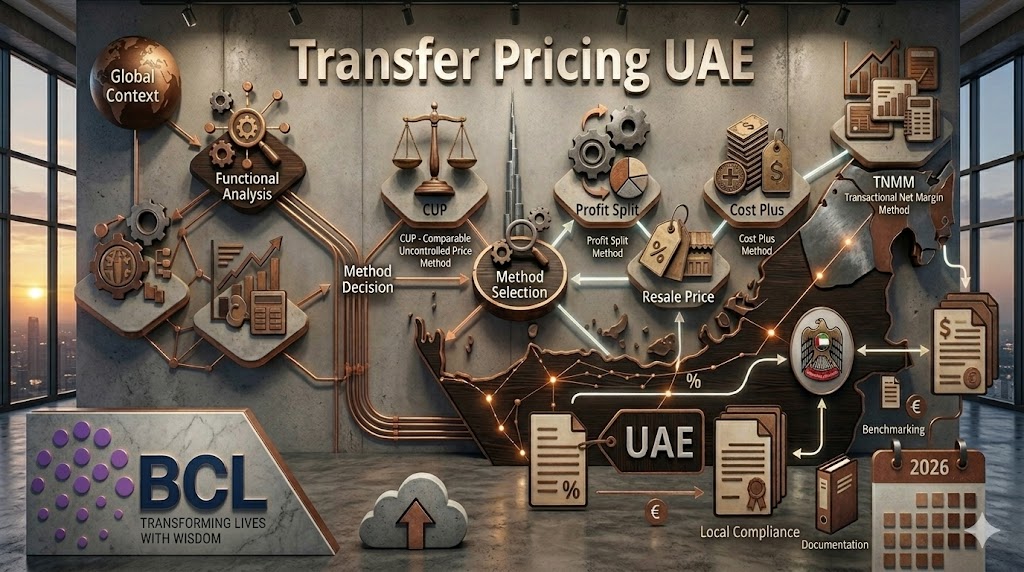
Key Takeaways Introduction: Why Transfer Pricing Matters Now in the UAE The United Arab Emirates entered a new era when corporate tax and transfer pricing regulations came into force from 1 June 2023. This shift transformed the country from a near-zero-tax environment into a rules-based corporate tax regime aligned with global standards. Transfer pricing governs how profits are allocated between group companies across Dubai, other Emirates, and abroad. These rules directly influence the 9% UAE corporate tax base applicable on taxable income exceeding AED 375,000. This article explains what you must do now: identify related parties, apply arm’s length pricing, prepare transfer pricing documentation, and manage potential TP audits. BCL Globiz, as a Dubai-based accounting and tax advisory firm, supports SMEs and multinational groups in building practical, defensible transfer pricing frameworks. Legal Framework: Core UAE Transfer Pricing Rules UAE transfer pricing provisions are contained in Federal Decree-Law No. 47 of 2022 on the Taxation of Corporations and Businesses. This primary legislation is supported by Cabinet Decisions, Ministerial Decisions, and FTA guidance documents that provide implementation details. Articles 34 to 36 of the UAE corporate tax law cover the arm’s length principle, transactions with related parties and connected persons, and transfer pricing methods. Article 55 and Ministerial Decision No. 97 of 2023 govern documentation and disclosure obligations. The rules apply to tax periods starting on or after 1 June 2023. Calendar-year taxpayers became fully in scope from 1 January 2024, with corporate tax returns due within nine months after year-end. The Federal Tax Authority serves as the enforcement body under Ministry of Finance oversight. Free zone entities benefiting from 0% CT on qualifying income must still comply with arm’s length pricing—TP non-compliance can jeopardize their tax incentives entirely. What Is Transfer Pricing and How Does It Work in the UAE? Transfer pricing refers to the pricing of goods, services, financing, and intangibles between entities under common control within a multinational or domestic group. These aren’t arbitrary internal prices—they carry real tax consequences. The arm’s length principle requires that controlled transactions reflect what unrelated parties would agree under comparable circumstances. Article 34 of the UAE CT Law embeds this principle directly, aligning with OECD TP Guidelines while incorporating local nuances. Practical UAE examples: Drawing from concepts used globally, transfer prices determine where profits are recognized across jurisdictions. Without proper pricing, you face risks of double taxation, profit adjustments, and disputes with tax authorities. Proper transfer pricing protects both the UAE tax base and taxpayers from arbitrary adjustments by ensuring a robust economic basis and documentation for intra-group prices. Scope: Related Parties, Connected Persons and Controlled Transactions The first practical task for UAE businesses is mapping who counts as a “related party” or “connected person.” This determines which transactions fall within scope of transfer pricing regulations. Key indicators of related parties under UAE CT Law: Connected persons include owners, directors, and related individuals who may receive payments not at arm’s length—such as management fees, rent, or interest from the business. Controlled transactions include: Both foreign and domestic transactions are in scope. Even transactions between two UAE entities or exempt segments require arm’s length pricing. BCL Globiz can prepare a related-party map and transaction inventory as the foundation for your transfer pricing risk assessment. Recognized Transfer Pricing Methods under UAE CT Law UAE law expressly recognizes five OECD transfer pricing methods, consistent with global best practice. Article 34(3) of the UAE CT Law requires use of the “most appropriate method” considering functions performed, assets used, and risks borne. BCL Globiz performs benchmarking studies using regional comparables across the GCC, Europe, or Asia as needed to support method selection. Comparable Uncontrolled Price (CUP) Method The CUP method compares the price in a controlled transaction with the price charged in a comparable transaction between independent parties involving identical or closely similar goods or services. This is conceptually the most direct method and is preferred when reliable comparable data exist—for example, standardized commodities or financial instruments traded in UAE or international markets. When applying CUP to UAE intra-group imports and exports, adjustments may be needed for differences in terms, volumes, contractual conditions, or markets. Internal CUP (transactions within the same group with third parties) is particularly valuable for UAE distributors. Resale Price Method (RPM) The resale price method starts from the resale price to independent customers and subtracts a gross margin that an independent distributor would earn in comparable circumstances. This method suits UAE buy-sell distributors of branded goods who purchase from related manufacturers abroad and resell in the GCC market. Benchmarking gross margins against independent UAE or regional distributors supports the arm’s length nature of the intra-group purchase price. RPM works best when the reseller doesn’t add significant value through manufacturing or unique intangibles. Cost Plus Method (CPM) CPM adds an arm’s length mark-up to the supplier’s direct and indirect costs to determine the transfer price. This method is commonly used for UAE shared service centers, routine contract manufacturers, and captive IT or back-office service providers in Dubai or free zones. The cost base definition (operating versus direct costs) must be clearly documented and consistent across periods. Mark-ups should be supported by benchmarking against independent service providers with similar functions and risk profiles. Transactional Net Margin Method (TNMM) The transactional net margin method tests whether the net profit margin relative to an appropriate base (costs, sales, or assets) in a controlled transaction aligns with comparable transactions by independent companies. TNMM is widely used when reliable gross margin data are unavailable or when the tested party performs simpler functions than its counterparty. It applies well to UAE distributors, low-risk manufacturers, or routine service providers. External databases provide regional comparables to support TNMM analysis, but the method still requires proper functional analysis—it cannot be applied mechanically. Profit Split Method (PSM) and Alternative Methods The profit split method allocates combined profits from a controlled transaction based on each party’s relative contribution of functions, assets, and risks. PSM suits highly integrated UAE operations such as joint development of intellectual
Transfer Pricing Methods UAE: Techniques, Selection & Practical Guide (CUP, TNMM, RPM & More)
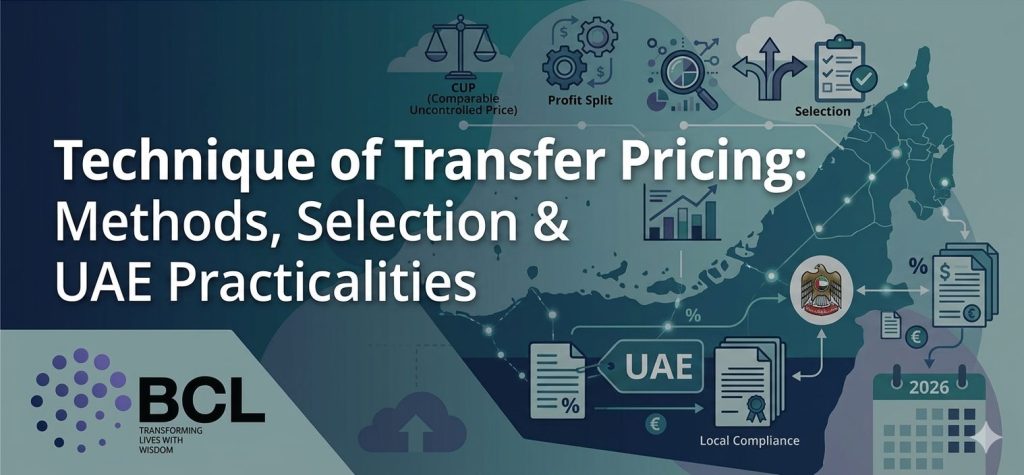
Key Takeaways Introduction to Transfer Pricing Techniques Transfer pricing determines how goods, services, intellectual property, and financing are priced between related parties within a multinational group or across UAE free zones and mainland entities. When your Dubai subsidiary sells products to your Oman branch, or your JAFZA company provides IT services to your Saudi affiliate, the prices you set directly impact where profits land—and how much tax follows. Since UAE Corporate Tax became effective for financial years starting on or after 1 June 2023, transfer pricing techniques have moved from optional planning tools to core compliance requirements. BCL Globiz, a Dubai-based accounting and tax advisory firm, supports SMEs and multinationals with transfer pricing policy design, implementation, and audit defence. For businesses unsure about selecting the most appropriate method, professional transfer pricing services in Dubai can help design defensible policies aligned with UAE Corporate Tax regulations. Arm’s Length Principle and UAE Regulatory Framework The arm’s length principle lies at the heart of every transfer pricing analysis. In plain terms: related-party prices should match what independent parties would agree under comparable conditions. If your group company charges more (or less) than an independent supplier would, tax authorities worldwide may challenge the arrangement. The UAE framework includes: Choosing and applying an appropriate transfer pricing technique is mandatory, not optional. The Federal Tax Authority (FTA) will review your arm’s length analysis in audits. BCL Globiz advises clients on matching their transfer pricing techniques to UAE substance, free zone regimes, and cross-border structures to minimise audit risk. Overview of Main Transfer Pricing Techniques (Methods) The OECD and UAE recognise five primary transfer pricing methods, grouped into two categories: Traditional Transaction Methods: Transactional Profit Methods: Tax advisers perform a functional analysis—mapping Functions, Assets, and Risks (FAR)—before selecting the most appropriate method based on data availability and transaction profile. The following sections explore each method with UAE-focused examples relevant to trading companies in JAFZA, service centres in Dubai mainland, and IP hubs in free zones. Traditional Transaction Methods Traditional transaction methods focus directly on price or gross margin comparisons for individual transactions. Tax authorities prefer these when reliable comparable data exists because they provide the strongest evidence of arm’s length pricing. These techniques suit relatively straightforward goods distribution, toll manufacturing, and standardised services commonly seen in UAE trading and logistics companies. Where high-quality internal or external comparables exist—for example, a Dubai-based entity selling both to related and unrelated customers—the FTA generally favours these methods. Comparable Uncontrolled Price (CUP) Method The Comparable Uncontrolled Price (CUP) method compares the price charged in a controlled transaction with the price charged for identical or highly similar products or services in an uncontrolled transaction between independent parties. Two CUP techniques exist: Type Description Strength Internal CUP Same taxpayer has independent dealings Stronger evidence, fewer adjustments needed External CUP Market data or database comparables Useful when internal data unavailable When CUP is most appropriate: UAE Example: A Dubai mainland company sells petroleum products to both third-party buyers and its related Oman subsidiary. The CUP technique compares those independent prices, adjusting for volume discounts (typically 5-10% for bulk), contract terms, and Incoterms delivery conditions. Advantages: Strong, direct market reference that’s difficult for tax authorities to challenge. Limitations: Finding truly comparable transactions is rare—small differences in credit terms, geography, or volumes require detailed adjustments. Only 10-20% of global applications use CUP, per industry reports. Resale Price Method (RPM) The resale price method starts from the price at which a product is resold to an independent customer, then subtracts an appropriate resale price margin to arrive at the arm’s length transfer price to the related supplier. RPM works best for limited-risk distributors and marketing entities that buy finished goods from group companies and resell them without major transformation. UAE Example: A UAE free zone distributor imports branded electronics from its group manufacturer in Asia and resells across the GCC. The gross profit margin is benchmarked against independent distributors in similar markets—typically 2-5% for low-risk distribution according to industry data. Factors influencing the resale margin: Pros: Suitable where reliable gross margins data exists; straightforward for routine resale. Cons: Less accurate when the reseller substantially modifies products or adds significant value through local intangible assets or brand creation. Cost Plus Method (CPM) The cost plus method sets the transfer price by adding an appropriate mark-up to the supplier’s direct and indirect costs incurred in providing goods or services. This technique suits contract manufacturers, captive service centres, routine back-office support, and intra-group IT or accounting services—common structures in UAE business hubs. UAE Example: A Dubai-based shared service centre provides accounting and HR support to subsidiaries in Saudi Arabia and Qatar. The transfer price equals fully loaded costs (salaries, rent, relevant costs prorated) plus an arm’s length mark-up of 8-12%, benchmarked from independent service providers. Cost base typically includes: Strengths: Transparent and works where price comparables are missing. Weaknesses: Sensitive to cost allocation choices; difficult where entities own valuable intangible assets or take significant risks. Transactional Profit Methods Transactional profit methods test overall profitability rather than individual prices for controlled transactions. They’re useful when detailed comparables at the price or gross margin level aren’t available. These methods focus on how much net profit each party earns from intercompany transactions, comparing it to what independent enterprises would earn under similar circumstances. They suit complex supply chains spanning multiple countries, integrated service offerings, or structures with unique intangibles held in UAE free zones. Transactional Net Margin Method (TNMM) The transactional net margin method compares the net profit margin (relative to sales, costs, or assets) of a controlled transaction with that of independent companies performing similar functions and bearing similar risks. Key concepts: UAE Example: A limited-risk contract manufacturer in Ras Al Khaimah produces goods exclusively for its parent company. TNMM benchmarks its net margin against independent manufacturers from commercial databases, targeting 3-4% operating margin within the interquartile range. Why TNMM dominates globally: According to PwC’s 2023 Transfer Pricing Report, TNMM is used in 70-80% of cases worldwide. It’s more tolerant of
Dubai Trade License Cost: Complete 2026 Guide to Mainland and Free Zone Fees
Ask five UAE business setup providers for a quote and you’ll get five different numbers – not because they disagree, but because most of them are quoting the licence fee alone, not the cost of actually getting your company open and operating through year one. The gap between an advertised “starting from” price and what founders actually spend is where most budgets go wrong. This guide breaks down every cost that goes into a UAE company registration – mainland and free zone – so you know exactly where your money goes before you commit. BCL Globiz helps you see the full picture before you sign anything. Key Takeaways What Is a Dubai Trade Licence and Why the Cost Matters A Dubai trade licence, also called a business licence, is issued by the Dubai Department of Economy and Tourism (DET), formerly known as the Department of Economic Development (DED), for companies operating on the mainland. It legally permits your business activities in Dubai and is essential for issuing invoices, hiring staff, sponsoring visas, and opening corporate bank accounts. Operating without a valid licence, or with an expired one, risks fines, forced closure, or blacklisting. Trade licence fees are only one layer of the total setup cost. The full first-year cost often exceeds the headline licence fee by two to three times once government charges, office rent, visa processing, and professional service fees are added. BCL Globiz integrates licence costs with VAT and corporate tax compliance so businesses can budget realistically from day one. Licence Cost vs Full Setup Cost vs First-Year Operating Cost These three figures are often confused in online quotes, and the gap between them is where most budgeting surprises happen. Licence-only cost This is the DET or free zone authority fee to issue the licence certificate itself: activity fee, trade name reservation, initial approval, and licence issuance. It does not include an office, a visa, or Emirates ID. Typical range: AED 8,000 to 18,000 depending on activity and jurisdiction. Full setup cost (first year, one-time) This adds everything needed to actually open and staff the company: office rent or flexi-desk fee, Ejari registration, Chamber of Commerce membership, establishment card, and the first visa and Emirates ID cycle. Typical range: AED 15,000 to 25,000 for a lean free zone setup, and AED 25,000 to 40,000+ for a mainland company with a physical office. First-year operating cost This is the full setup cost plus recurring obligations that begin almost immediately: accounting and bookkeeping, VAT registration where turnover exceeds AED 375,000, corporate tax registration, and any regulated-activity compliance. Businesses should budget AED 3,000 to 20,000 or more annually for compliance on top of the setup cost, depending on complexity. Confirm your specific figure with BCL Globiz. Types of Dubai Trade Licences and Typical Cost Ranges Dubai offers several licence types for different business activities. Fees vary by legal structure (LLC, sole establishment, civil company), licence category, and jurisdiction. Licence type Business activities Cost range (licence only) Commercial Trading, import/export, retail AED 15,000 to 25,000 (mainland) Professional Consultancy, IT, accounting, design AED 9,000 to 18,000 Industrial Manufacturing, food processing AED 20,000 to 30,000+ Tourism Travel agencies, hospitality AED 15,000 to 30,000 E-trader / virtual Home-based online sales Under AED 5,000 Figures are indicative; confirm exact fees for your activity with BCL Globiz. Commercial licence (trading and general trading) Required for buying, selling, importing, and exporting goods. A general trading licence covers multiple product lines, excluding restricted items such as pharmaceuticals and alcohol. Mainland commercial licence fees typically range AED 15,000 to 24,000, excluding visas and office costs. Free zones offer packages from AED 12,000 to 18,000. Adding general trading as an activity carries a materially higher activity fee than a single standard activity because it sits in a higher DET fee tier; treat it as a separate line item rather than folding it into the base licence quote, and confirm the exact add-on with BCL Globiz. In practice this add-on is often quoted nearer AED 15,000 alone, and total government fees for a general trading licence can reach approximately AED 29,000 to 30,000 once combined with the base licence fee, so treat the stated range as a floor rather than a ceiling. Common users include electronics traders, FMCG distributors, and retailers. BCL Globiz ensures correct activity codes to avoid costly rejections. Professional licence (consultancy and services) For service businesses such as consultants, accountants, designers, and IT firms, requiring less overhead and no physical inventory. Mainland professional licences cost AED 9,000 to 15,000; free zones offer packages from AED 10,000 to 18,000 including flexi-desk and visa quota. BCL Globiz bundles bookkeeping, VAT registration, and tax advisory with licence setup. Industrial licence (manufacturing and processing) For factories, food processing, and manufacturing, requiring physical facilities and environmental approvals. Licence fees start at AED 20,000 to 30,000, excluding warehouse rent and inspections. Free zones such as JAFZA offer industrial packages, but expect extra costs for security deposits and Civil Defence approvals. BCL Globiz coordinates approvals and tax structuring for manufacturing businesses. Tourism licence (travel, hospitality, and events) For hotels, travel agencies, guest houses, and other hospitality-related activities, with distinct compliance requirements. Fees range from AED 15,000 to 30,000, plus possible bank guarantees of AED 10,000 to 50,000. BCL Globiz helps factor in guarantees and tax costs while ensuring compliance with tourism regulations. E-trader and virtual licences (home-based and online) Affordable options for home-based entrepreneurs selling services online without a physical office, including the DET e-trader licence, designed for single-owner businesses that do not require Ejari documents. Fees are under AED 5,000 but are limited to single owners, restricted activities, and no physical retail. The Invest in Dubai portal’s instant licence option allows rapid issuance, sometimes within minutes. VAT and corporate tax registration may still apply as turnover grows. BCL Globiz supports compliance with minimal overhead. Government Fee Breakdown: Every DET and DED Line Item Online packages often quote only the headline licence fee and bury the rest. The real DET fee stack for a Dubai
The 11 Types Of Business Formation In Dubai

Navigating the UAE business landscape can be complex. BCL Globiz, a Dubai-based accounting and tax consulting firm, assists entrepreneurs with company formation in Dubai—a key step that affects legal, tax, and operational aspects. The UAE offers 11 distinct business structures across Mainland, Free Zone, and Offshore jurisdictions, each tailored to different needs. Recent reforms allowing 100% foreign ownership have boosted company registrations, making the UAE highly attractive for international investors. What Is Company Formation? Company formation is the legal process of registering a new business with government authorities, defining its structure, and fulfilling legal requirements like choosing a business name and purpose. For example, starting a tech firm might involve registering as a limited liability company (LLC) or corporation to operate legally. Once your UAE business structure is finalized, opening a corporate bank account becomes the next step. Many entrepreneurs explore modern options such as digital banking solutions available in the UAE for faster account setup. Types of Business Licenses In the UAE For Company Formations The UAE issues different business licenses based on the activities your company will conduct. The four main types are: Choosing the right license depends on your business activities. Understanding financial regulations is also important when starting a company. Businesses should be aware of the financial year structure in the UAE to maintain proper compliance and reporting standards. Jurisdiction-Based Company Formations & Types In The UAE You can set up a company in one of three jurisdictions: Mainland, Free Zone, or Offshore. Each jurisdiction has its own licensing authority. Each jurisdiction offers distinct company types and legal structures suited to different business needs. Mainland Company Mainland company formation in Dubai involves setting up onshore businesses licensed by the Dubai Department of Economic Development (DED). It offers operational freedom, access to the local market, and the ability to trade both within the UAE and internationally. Recent reforms allow expatriates and GCC nationals to own 100% shares in many sectors, though some activities still require UAE national ownership or a local service agent. Mainland licenses include professional, commercial, industrial, and tourism categories. LLCs and partnerships generally require two or more shareholders, providing limited liability and flexibility for foreign investors. Freezone Company Dubai free zones are designated areas offering attractive benefits to foreign investors and entrepreneurs establishing businesses registered in the UAE. They provide 100% foreign ownership, no import/export taxes, full profit repatriation, no currency restrictions, and long-term corporate tax exemptions. With over 35 free zones, including Dubai Multi Commodities Centre (DMCC), Jebel Ali Free Zone, Dubai Silicon Oasis, and Dubai Airport Free Zone, these companies must rent office space within the zone and typically operate only inside the free zone or internationally, not directly in mainland UAE. Offshore Company Offshore company formation in Dubai is intended for those conducting business internationally. These companies are registered in the UAE but do not operate within the country. Common offshore jurisdictions include Jebel Ali Offshore, Ras Al Khaimah, and Ajman. Advantages include no corporate tax, full foreign ownership, confidentiality, asset protection, multi-currency bank accounts, and virtual office facilities—facilitating international business and asset management. The 11 Business Structures or Company Formations In the UAE Here is an overview of the main business structures available. The UAE offers various types of companies, each with distinct legal structures, ownership requirements, and operational implications for both local and foreign investors: These company structures are suitable for both new setups and for expanding an existing business in Dubai or the wider UAE. Branch Company Formations A branch office operates under the parent company’s name and legal identity but cannot import products independently. It requires a UAE national as a service agent. Representative offices have limited roles, mainly promoting the parent company’s activities. Civil Company Formations Civil companies are professional partnerships with unlimited owner liability. Foreign companies can participate if in the same profession, typically requiring UAE national service agents. Limited Liability Company (LLC) Formations LLCs are popular for UAE business, allowing 1 to 50 shareholders with liability limited to their capital. Foreign investors can now have 100% ownership in many sectors, and minimum capital requirements are flexible. Joint Stock Company Formations Joint stock companies raise capital through shares, offering limited liability. Types include: Available in mainland and free zones like DIFC and ADGM, these companies support local and international investors. What is a Representative Office in the UAE? A representative office in the UAE lets foreign companies establish a presence without forming a separate legal entity or conducting direct sales. It handles activities like market research and promotion but cannot sign contracts or generate revenue. Setting up requires a license and a local service agent, offering a low-cost way to explore the UAE market with minimal commitments. Conclusion The UAE offers a diverse range of company formations across Mainland, Free Zone, and Offshore jurisdictions. This flexibility allows entrepreneurs to tailor their business structures to their goals and preferences. BCL Globiz is here to guide you through company formation, accounting, tax compliance, and business advisory to ensure your success in the UAE market. Frequently Asked Questions (FAQs) Q1: What is the difference between a Mainland company and a Free Zone company?Mainland companies can operate anywhere in the UAE and internationally without restrictions, while Free Zone companies are limited to operating within their free zone or internationally but not directly in the mainland. Free Zone companies offer full foreign ownership and tax benefits. Q2: Can foreigners own 100% of a company in the UAE?Yes, recent reforms allow 100% foreign ownership in many sectors in Mainland companies, Free Zone companies, and Offshore companies. Q3: What is a Limited Liability Company (LLC)?An LLC is a common business structure where liability is limited to shareholders’ capital. It requires 1-50 shareholders and can conduct a wide range of business activities. Q4: What are the benefits of setting up an Offshore company in the UAE?Offshore companies provide tax benefits, asset protection, confidentiality, and ease of international business but cannot operate within the UAE. Q5: What is a Private Joint Stock Company?It
