



What Makes an Accounting Firm Worth Staying At? It Starts With How You Treat People.

By BCL Globiz | Workplace Culture | People First If you work in accounting in the UAE, you already know the drill. Deadlines that do not move. Tax seasons that blur into each other. A profession that rewards precision but rarely pauses to ask: are the people doing this work actually okay? The numbers on accountant wellbeing are not comfortable reading. Nearly half of all accounting professionals globally cite burnout and poor work-life balance as the reason they leave their firms. And here is the part that should make every employer pause: 36% of those who leave say workplace culture was the real reason but only 10% of employers ever suspect it. The gap between what firms think they offer and what employees actually experience is where talent quietly walks out the door. At BCL Globiz, we have spent a lot of time thinking about that gap and actively trying to close it. We Built a Place Where People Are Not Just Resources BCL Globiz is an accounting and tax consulting firm based in Dubai. We work with over 1,000 clients across the UAE, handling everything from corporate tax and VAT compliance to transfer pricing and business incorporation. Our team of 300+ professionals is the reason we can do any of that. And we are very clear-eyed about something many firms are not: if your people are running on empty, your client work suffers. If your culture is all deadlines and no dignity, your best people leave. And in accounting where expertise takes years to build, that is an expensive lesson to learn the hard way. So we have deliberately built a workplace that takes the human side of this profession seriously. That means flexible support during high-pressure times. It means a culture where people can speak up without fear. It means recognising that our team members have lives, bodies, and needs that exist outside of spreadsheets and compliance calendars. One of the policies we are most proud of is one we rarely lead with but probably should talk about more: our menstrual leave policy. Why an Accounting Firm Has a Menstrual Leave Policy This might not be what you expected to read on an accounting firm’s blog. But stay with us, because the logic is straightforward. A meaningful portion of our team and of the accounting profession broadly is made up of women. Many of them experience real, physical discomfort during their menstrual cycle. Cramps, migraines, fatigue, and conditions like endometriosis or PCOS do not take a day off just because there is a VAT return due. For years, the standard approach in most professional firms has been: take a sick day if you must, but do not make it a conversation. The result is that women burn through their sick leave for something entirely predictable, feel uncomfortable disclosing why, and often push through pain just to appear committed. We decided that was not good enough for our team. At BCL Globiz, women are entitled to menstrual leave, separate from sick leave, no medical certificate required, no explanation needed. Because we trust our team. And because we believe that a firm that asks its people to deliver accuracy and precision every day owes them, at minimum, the dignity of not having to justify their biology. This Is Not a Soft Policy: It Is a Smart One Let us put this in language every accountant understands: this is about managing attrition risk, engagement cost, and long-term productivity. Progressive firms globally and now, by law, in markets like Karnataka, India are recognising that menstrual health is a workplace issue, not a personal inconvenience to be managed quietly. The UAE’s evolving approach to employee welfare points in the same direction. What Our Culture Means for You as a Client When you hire an accounting firm, you are not just buying a service you are trusting a team with your compliance, your numbers, and your deadlines. So here is what BCL Globiz’s internal culture actually means for you: The menstrual leave policy, the open culture, the focus on wellbeing, none of this is separate from the quality of work you receive. It is the reason for it. A firm that genuinely cares for its people builds a team that genuinely cares for its clients. That is not a slogan. It is how good accounting actually works. The Standard We Hold Ourselves To At the end of the day, choosing an accounting firm is a question of trust. And trust is rarely built on credentials alone, it is built on the small decisions a firm makes when nobody is watching. Introducing menstrual leave was one of those decisions for us. No mandate required it. No client asked for it. We did it because it was the right thing to do for the people on our team and because we believe that a firm willing to show that level of care for its own people will bring that same care to your business.It is a small policy. But small policies reveal big values. At BCL Globiz, we are still building, still learning what it means to be a firm that people are genuinely proud to work at and genuinely happy to work with. But we know the direction we are heading in. And we think that counts for something. If that sounds like the kind of firm you want handling your accounts, we would love to hear from you. What It Actually Feels Like: A Voice From the Team Policy language can only say so much. Here is what a member of our team shared, anonymously, when asked what the menstrual leave policy meant to her in practice: “Before this policy existed, I used to send a message saying I had a headache or wasn’t feeling well. Technically true, but also a small lie I told every month. The first time I just wrote ‘taking my menstrual leave today’ and hit send, I sat there waiting for some kind of reaction. There wasn’t one.
UAE E-Invoicing: ASP Deadline Extended to October 2026 but the January 2027 Go-Live Stands Firm
The UAE Ministry of Finance has officially extended the deadline for businesses to appoint an Accredited Service Provider (ASP) under the country’s new Electronic Invoicing System (EIS). Large businesses with annual revenues exceeding AED 50 million now have until 30 October 2026 to complete their ASP appointment pushed back from the earlier deadline of 31 July 2026. But here is the critical takeaway every UAE business owner and CFO must understand: the mandatory e-invoicing go-live date of 1 January 2027 has not moved a single day. This distinction matters enormously. The extension gives you more time to choose your provider not more time to prepare. If your business falls within Phase 1 of the UAE e-invoicing rollout, the clock is still ticking. What Changed and What Didn’t The UAE Ministry of Finance announced targeted amendments to Ministerial Decision No. 244 of 2025, introducing the following key update: Milestone Previous Deadline Updated Deadline E-Invoicing Pilot Phase Begins 1 July 2026 1 July 2026 (unchanged) ASP Appointment Deadline (Phase 1) 31 July 2026 30 October 2026 ✓ Mandatory Go-Live Large Businesses (AED 50M+) 1 January 2027 1 January 2027 (unchanged) ASP Appointment Deadline Smaller Businesses 31 March 2027 31 March 2027 (unchanged) Mandatory Go-Live Smaller Businesses 1 July 2027 1 July 2027 (unchanged) Government Entities Mandatory Go-Live 1 October 2027 1 October 2027 (unchanged) The Ministry confirmed that this extension followed a comprehensive assessment of market readiness and direct feedback from the UAE business community, particularly concerns around the need for broader technical options and more competitive pricing for e-invoicing services. Why the Extension Was Granted The Ministry of Finance’s decision was not arbitrary. Several factors contributed to this targeted relief for large businesses: Despite these accommodations, the Ministry reaffirmed its commitment to a stable regulatory environment and made clear that the overall e-invoicing mandate timeline remains on track. Understanding the UAE E-Invoicing System (EIS) For businesses still getting up to speed, here is a concise overview of what UAE e-invoicing actually requires. What Is an E-Invoice Under the UAE Framework? A UAE e-invoice is not a PDF sent by email. Under the new Electronic Invoicing System, a valid e-invoice must be: Traditional PDF invoices, scanned documents, and Word files will not qualify as valid e-invoices under this system even if they contain all required VAT data. What Is the DCTCE Model? The UAE has adopted a Decentralised Continuous Transaction Control and Exchange (DCTCE) model. This is a five-corner Peppol-based architecture where: This model gives the government full regulatory visibility without directly interrupting commercial invoice flows between trading partners. What Transactions Are in Scope? What Is an Accredited Service Provider (ASP)? An Accredited Service Provider is a government-approved technology partner that connects your business to the UAE’s e-invoicing network. The role of the ASP goes well beyond being a software vendor, it is a compliance-critical function. Your ASP will: Important: You cannot go live on 1 January 2027 without an appointed ASP. Provider selection is not just a compliance checkbox, it is a technical, operational, and commercial decision that requires careful evaluation. Peppol certification is mandatory for all ASPs. Penalties for Non-Compliance The UAE government has introduced a clear enforcement framework. Businesses that fail to comply face the following penalties: Violation Penalty Failure by the Issuer to implement the Electronic Invoicing System, including failure to appoint an Accredited Service Provider within the prescribed timeline AED 5,000 per month (or part thereof) Failure by the Issuer to issue and transmit an Electronic Invoice within the prescribed timeline AED 100 per invoice (capped at AED 5,000 per calendar month) Failure by the Issuer to issue and transmit an Electronic Credit Note within the prescribed timeline AED 100 per credit note (capped at AED 5,000 per calendar month) Failure by the Issuer to notify the FTA of a System Failure within the prescribed timeline AED 1,000 per day (or part thereof) Failure by the Recipient to notify the FTA of a System Failure within the prescribed timeline AED 1,000 per day (or part thereof) Failure by the Issuer or Recipient to notify the appointed ASP of changes to data registered with the Authority within the prescribed timeline AED 1,000 per day (or part thereof) These six violations and their penalties are set out verbatim in the annex to Cabinet Decision No. 106 of 2025. Voluntary adopters of the system are exempt from these penalties until they become mandatorily subject to e-invoicing. Note that partial months and partial days still attract the full monthly or daily penalty respectively. What Should Your Business Be Doing Right Now? The extension to 30 October 2026 does not mean you should delay. You have roughly four months to appoint your ASP and then only two more months after that before mandatory implementation begins. That is an extremely tight integration window. (See the Penalties for Non-Compliance section above for the full enforcement framework.) Here is a practical compliance roadmap for Phase 1 businesses: Step 1: Confirm Your Scope (Now) Verify whether your annual revenues exceed AED 50 million and confirm all VAT-registered entities within your group structure that fall within Phase 1. Step 2: Assess Your ERP and Billing Systems Your ERP must be capable of generating invoices in XML format compliant with the PINT AE data dictionary. Conduct a gap assessment immediately. Cloud ERP users typically integrate via API connectors; on premise users may require middleware adapters. Cleanse your master data ,TRNs, customer records, tax codes and map them to PINT AE requirements. Step 3: Evaluate and Appoint an ASP (By 30 October 2026) Assess providers based on: Step 4: Complete Integration and Testing (October – December 2026) Once your ASP is appointed, begin the technical integration, conduct end-to-end testing, and participate in the pilot phase where possible. Do not leave this until December. Step 5: Go Live 1 January 2027 All eligible Phase 1 businesses must be fully operational on the e-invoicing system from this date. There is no grace period. A Note for Smaller Businesses If your
Bookkeeper vs CPA in UAE: Differences, Costs & When to Hire
A Complete Guide for UAE Business Owners- VAT, Corporate Tax, Freezones & More If you own or manage a business in the UAE, you have likely asked: Do I need a bookkeeper or a CPA (Certified Public Accountant) or both? Since the introduction of VAT and Corporate Tax, getting this decision right has never been more important. Hiring the wrong professional or skipping one entirely can result in FTA penalties, missed tax savings, or flawed investor reporting. This guide breaks down exactly what each professional does in the UAE context, with real-world examples from Dubai, Abu Dhabi, and UAE freezones, a detailed side-by-side comparison, and answers to the questions UAE business owners ask most. What is Bookkeeping? A bookkeeper is the financial record-keeper of your business. In the UAE, this means accurately tracking every dirham that flows in and out-sales, expenses, supplier payments, employee costs and ensuring that all records are clean, current, and ready for VAT filing and audit. Think of them as the person maintaining your business’s financial diary, day in and day out. For growing SMEs, maintaining accurate financial records is essential. Learn more about accounting and bookkeeping for small businesses in Dubai and how proper bookkeeping supports business growth and compliance. Core Responsibilities of a Bookkeeper in the UAE Real-World Example: Bookkeeper in Action Example: Fatima’s Fashion Boutique in Dubai Mall Fatima runs a retail clothing boutique in Dubai with around 200 transactions per week. She hired a part-time bookkeeper to record every sale on Zoho Books, reconcile her Emirates NBD account each month, categorize VAT-applicable and VAT-exempt purchases, and keep supplier invoices organized. By the time her CPA sat down to file the quarterly VAT return, every figure was accurate and traceable, no last-minute scrambling, no FTA penalties. Skills & Qualifications What is a CPA / Auditor in the UAE? In the UAE, the professional equivalent of a CPA is typically a Chartered Accountant (ACCA, CA, ICAEW) or a licensed auditor registered with the relevant UAE authority (such as the Ministry of Economy or free zone regulators). Unlike a bookkeeper, a CPA does not just record what happened, they interpret it, provide strategic advice, ensure regulatory compliance, and represent your business before authorities like the Federal Tax Authority (FTA). With the introduction of UAE Corporate Tax at 9% the role of a CPA has become significantly more important for businesses operating in the UAE including freezone entities that previously enjoyed tax-free status. With the introduction of Corporate Tax, businesses must understand their compliance obligations. Explore our comprehensive UAE Corporate Tax Guide to learn about registration, filing requirements, and tax planning strategies. Core Responsibilities of a CPA / Auditor in the UAE Real-World Example: CPA in Action Example: Khalid’s Trading Company Expanding from DMCC to Mainland Dubai Khalid runs an import-export business in the DMCC freezone in Dubai. When his business started making over AED 5 million a year, things got complicated fast. He had three big problems he couldn’t solve alone: First, the UAE introduced a new business tax (Corporate Tax) and he had no idea if his freezone company had to pay it or not. Second, he was owed AED 180,000 back from the government on import costs but didn’t even know he could claim it. Third, his bank was asking for official financial reports before approving his loan. His CPA stepped in and sorted everything out. He got Khalid registered for the new tax, figured out that Khalid’s freezone business qualified to pay 0% tax instead of 9% saving him a significant amount of money. He then filed the right paperwork to get that AED 180,000 refund back. Finally, he prepared the proper financial reports the bank needed, and the loan was approved. Skills & Qualifications Bookkeeper vs CPA in the UAE: Side-by-Side Comparison Factor Bookkeeper CPA / Auditor Education No formal degree required; accounting diploma or Association of Accounting Technicians helpful Bachelor’s in Accounting/Finance + professional qualification (ACCA, CPA, CA) Certification Not mandatory ACCA, CPA, CA, or ICAEW certification required Day-to-Day Tasks Recording transactions, reconciling bank accounts, payroll entries Auditing, corporate tax planning, VAT advisory, financial strategy VAT Role Records VAT on invoices; prepares data for VAT return Reviews, finalizes, and submits VAT returns to the FTA; handles disputes Corporate Tax Role Tracks deductible expenses for Corporate Tax preparation Plans and files UAE Corporate Tax returns; ensures compliance Legal Authority None Can represent clients before the FTA and UAE regulatory bodies Strategic Role Limited focused on accuracy of records High advises on growth, freezones, tax optimization, restructuring Best For Daily financial tracking and record-keeping VAT filing, CT, audits, investor reporting, financial planning When Does Your UAE Business Need a Bookkeeper? Hire or outsource a bookkeeper when: When Does Your UAE Business Need a CPA / Auditor? Engage a CPA when: How Bookkeepers and CPAs Work Together in the UAE The most financially healthy UAE businesses treat these roles as complementary, not interchangeable. Here is how the ideal financial system works: A bookkeeper without a CPA leaves you exposed to compliance risk. A CPA without a bookkeeper is spending expensive hours cleaning up messy data instead of advising you strategically. Together, they form a complete financial system. Industry-Specific Examples in the UAE E-commerce & Online Retail (Dubai) Restaurant & F&B Business (Abu Dhabi) Real Estate & Property Management (Dubai) Freezone Tech Startup (Dubai Internet City or DMCC) Frequently Asked Questions (FAQ) Q1: Is bookkeeping mandatory for UAE businesses? Yes, bookkeeping is mandatory for businesses in the UAE. Under the UAE Commercial Companies Law and VAT regulations, all businesses are required to maintain proper accounting records.Additionally, companies registered with Free Zone authorities such as DMCC, DIFC, and ADGM must prepare and submit annual audited financial statements.Failure to maintain organized and accurate records can result in penalties imposed by the Federal Tax Authority (FTA), which may reach up to AED 50,000 or more. Q2: Can a bookkeeper file our VAT return with the FTA? A bookkeeper can prepare the VAT data, reconcile transactions, and
Importance of Accounting for Business: 10 Reasons Why Proper Accounting Is Essential for Success
— And the Real Cost of Ignoring It — Meet Ravi, A Business Owner Flying Blind Ravi runs a small retail shop in his city. His store sees customers every day. Sales are regular. On the surface, his business looks like a success story. Yet at the end of every month, Ravi struggles to pay his rent, settle supplier invoices, and keep the lights on. The problem is not a lack of sales. The problem is a lack of accounting. Ravi has no system to track where his money comes from, where it goes, or how much he truly earns after expenses. Every financial decision he makes is a guess. And those guesses are quietly draining his business. Ravi’s story is not unique. According to research, over 80% of small businesses make accounting mistakes that cost them money, time, and stress and most of these mistakes are completely preventable. This blog explores why accounting is not just a back-office task, but the very foundation on which sustainable businesses are built and what really happens when business owners choose to ignore it. 📊 Did You Know? Nearly 50% of new businesses fail within their first five years and weak financial management is consistently identified as one of the leading causes. Accounting is not a luxury. It is survival. What Accounting Really Means (Beyond Bookkeeping) Most people associate accounting with filing taxes once a year or maintaining a ledger of transactions. While those tasks matter, they only scratch the surface of what accounting does for a business. At its core, accounting is a system that gives you complete visibility and control over your financial activity. It collects, records, and interprets financial data so that business owners understand exactly where their money is, where it is going, and whether the business is genuinely profitable. A business operating without accounting is like driving at night without headlights. You may know where you want to go but you cannot see the road ahead. Understanding the difference between bookkeeping and accounting is crucial for business growth. Learn more about accounting and bookkeeping for small businesses in Dubai and how they work together to improve financial performance. 10 Reasons Accounting Is Non-Negotiable for Business Success 1. Financial Clarity and Transparency Accounting answers the questions every business owner needs to know: Without these answers, business decisions become guesswork. Ravi, for instance, had no idea his packaging and logistics costs had quietly grown to consume 40% of his revenue because he had never tracked them. 2. Healthy Cash Flow Management Cash flow is the lifeblood of any business. Even profitable companies can collapse if cash is mismanaged. Accounting tracks every inflow and outflow, highlights timing gaps between income and expenses, and prevents businesses from running out of cash before their next payment arrives. Many businesses focus only on profit and completely ignore cash flow timing and it creates serious operational crises, especially for seasonal businesses or those extending credit to customers. 3. Smarter, Data-Driven Decision Making Should Ravi expand into new product lines? Should he hire a second employee? Can he afford to open another outlet? Every one of these decisions carries financial consequences and none of them can be evaluated well without solid accounting data. Accounting transforms business decisions from gut feelings into informed strategies backed by real numbers. 4. Budgeting and Future Planning Accounting gives businesses the data they need to build meaningful budgets, forecast revenue, allocate resources efficiently, and plan for lean periods. A well-maintained budget is one of the most powerful tools for business sustainability it tells you when to spend, when to hold back, and where opportunities lie. 5. Regulatory Compliance and Tax Accuracy For businesses operating in regulated markets, maintaining accurate financial records is a legal requirement. Whether it is VAT compliance, income tax, payroll obligations, or industry-specific regulations, proper accounting ensures that filings are accurate, on time, and audit-ready. Non-compliance does not just mean financial penalties. It can trigger legal action, frozen accounts, and lasting damage to your business reputation. 6. Building Investor and Lender Confidence If Ravi ever wants to take a business loan, bring in a co-investor, or sell his business, the first thing any bank or investor will ask for is clean financial statements. Investors feel secure when they have access to reliable, transparent financial data and accurate reporting minimizes the risk of errors that can damage trust. Poor financial records are one of the most common reasons small businesses are rejected for funding regardless of how good the business idea is. 7. Accurate Business Valuation Your business’s financial statements are what determine its value not your instincts about it. When businesses seek investment, plan mergers, or prepare for exit, every number gets scrutinised. A business with clean, well-maintained accounts commands a significantly higher valuation than one with messy or incomplete records. 8. Identifying What Drives Profit Not all products, customers, or services are equally profitable. Accounting gives you the granular data to identify which parts of your business are truly making money and which are quietly draining resources. For Ravi, this insight alone could change everything. Maybe one product line consistently outperforms others. Without accounting, he would never know. 9. Cost Optimisation By regularly reviewing expense data, businesses can identify inefficiencies and eliminate unnecessary costs. Small savings, even a few thousand rupees a month compound significantly over time and directly improve profitability. 10. Fraud Prevention and Financial Control Businesses without accounting systems are far more vulnerable to internal fraud, billing errors, and unauthorised spending. Regular reconciliation, documented approvals, and clear financial records create accountability — and make it far harder for financial irregularities to go unnoticed. The Real Cost of Neglecting Accounting Many businesses treat accounting as an optional expense. The reality is that the true cost shows up only when it is too late and it is far higher than the cost of doing it right from the start. Financial Confusion and Hidden Losses Without tracking income and expenses, profitability becomes invisible. Cash leakages small, unnoticed
How UAE DMTT Is Reshaping Corporate Tax Compliance for Multinational Groups
The global tax landscape is undergoing its most significant shift in decades and the UAE is no exception. For years, multinational enterprises chose the UAE not just for its strategic location and business-friendly environment, but for its historically low-tax regime. That era is evolving. With the UAE Domestic Minimum Top-Up Tax (DMTT) now in effect for financial years beginning on or after January 1, 2025, large multinational groups operating in the UAE face a new compliance reality. Introduced as part of the OECD’s Pillar Two framework, the DMTT enforces a global minimum corporate tax rate of 15% meaning that simply booking profits in a low-tax jurisdiction is no longer enough. For multinationals, this isn’t just about paying more tax. It triggers a fundamental rethink of data management, reporting structures, governance frameworks, and long-term business strategy. The question is no longer whether your group is affected, if your consolidated global revenues exceed €750 million, you almost certainly are. The question is how well-prepared you are. Understanding UAE DMTT The UAE Domestic Minimum Top-Up Tax is a component of the OECD’s Global Anti-Base Erosion (GloBE) Rules under Pillar Two. The primary objective is straightforward: Ensure that large multinational enterprises pay a minimum effective tax rate (ETR) of 15% in every jurisdiction where they operate. Under the UAE DMTT regime: This framework ensures that profits generated in low-tax jurisdictions can no longer benefit from significantly reduced tax rates below the globally agreed minimum threshold. Real-Life Example: How Does This Affect a Business? Think of it this way. Imagine your company is part of a large multinational group — say, a global logistics firm with its Middle East hub registered in a Dubai free zone. For years, the free zone offered 0% tax, so the group booked most of its regional profits here. Under DMTT, if that group earns over €750 million worldwide, the UAE will now check: is this company paying at least 15% tax on its UAE profits? If not, the UAE government collects the difference as a “top-up” tax. The free zone benefit doesn’t disappear, but the zero-tax advantage shrinks significantly. Why the UAE Introduced DMTT The implementation of DMTT is not merely a domestic tax reform. It is part of a broader international effort to address: Historically, multinational groups could allocate profits to jurisdictions with little or no taxation, significantly reducing their global tax burden. The OECD’s Pillar Two framework seeks to eliminate this advantage by ensuring that large multinational enterprises pay at least 15% tax regardless of where profits are booked. The introduction of DMTT builds upon the UAE’s broader corporate tax framework. Businesses unfamiliar with the fundamentals should first explore our comprehensive UAE Corporate Tax Guide to understand the foundation of the country’s evolving tax landscape. For the UAE, adopting DMTT provides several strategic benefits: Alignment with Global Standards The UAE has been steadily strengthening its international tax credentials — from joining the OECD’s Inclusive Framework to introducing Corporate Tax in 2023. DMTT is the next step, signaling to global investors and trade partners that the UAE is committed to transparent, internationally compliant tax practices. Protection of Tax Revenue Without DMTT, if a UAE-based multinational is under-taxed, another country (such as the parent company’s home jurisdiction) could collect the top-up tax instead — under mechanisms like the Income Inclusion Rule (IIR). By implementing DMTT domestically, the UAE ensures that revenue stays within its borders rather than flowing to foreign tax authorities. New Compliance Responsibilities for Multinational Groups 1. Effective Tax Rate Calculations One of the biggest changes involves calculating the jurisdictional Effective Tax Rate (ETR). Unlike traditional corporate tax calculations, the DMTT requires companies to determine whether their overall UAE operations meet the 15% minimum threshold under OECD methodologies. This process involves: Many organizations are finding that standard tax accounting systems are insufficient to handle these calculations. Real-Life Example: What Does ETR Calculation Actually Mean? Let’s say your UAE subsidiary made AED 10 million in profit last year. You paid AED 900,000 in corporate tax — that’s an effective tax rate of 9%. Since 9% is below the 15% minimum, the UAE can charge you an additional AED 600,000 as a top-up tax (the 6% gap on AED 10 million). The tricky part? This 15% isn’t calculated like your normal tax return. It uses a special OECD formula that adjusts your profits and taxes in specific ways — which is why many businesses in the UAE are now working with specialist tax advisors to run these numbers carefully before filing. 2. Data Collection and Reporting Pillar Two compliance requires substantially more data than traditional corporate tax reporting. Companies must collect information from: Data quality and consistency become critical because even minor inaccuracies can affect ETR calculations. Many multinational groups are investing heavily in technology solutions to automate compliance processes. Real-Life Example: Why Data Management Matters for UAE Businesses Picture a holding company based in DIFC with subsidiaries in Abu Dhabi, Saudi Arabia, and India. Each entity keeps its financial records differently — some in SAP, some in QuickBooks, some in Excel. When it’s time to calculate the group’s UAE effective tax rate under DMTT, the finance team needs to pull salary data, intercompany charges, deferred tax entries, and more — all from different systems. If even one figure is slightly off, the ETR calculation changes, and you could end up with an unexpected tax bill. This is why UAE-based groups are now investing in centralised data tools and assigning a dedicated person to own the Pillar Two numbers across all entities. 3. Documentation Requirements Tax authorities worldwide are increasing their focus on transparency. Companies must maintain extensive documentation supporting: The UAE DMTT reinforces the need for robust tax governance frameworks. 4. Cross-Border Coordination Multinational groups can no longer manage tax compliance on a country-by-country basis. Instead, tax teams must coordinate globally because Pillar Two calculations depend on consolidated group information. This requires stronger collaboration between: Impact on UAE Free Zone Businesses One of the most discussed aspects
UAE’s new salary deadline: what changed on June 1 and what most employers are still getting wrong

On June 1, 2026, the UAE private sector moved to a single salary deadline: the 1st of every month. No grace period. No contract-based exceptions. And enforcement that kicks in on Day 2. Ministerial Resolution No. 340 of 2026 replaced the previous framework (Resolution No. 598 of 2022). The headlines covered the deadline change. What most employers missed are the details that actually create compliance risk — the 85% rule, new employees, deduction limits, and who gets automatically excluded. What changed and what stayed the same? The old system let companies set salary dates in employment contracts and gave a 15-day buffer before MOHRE enforcement began. Both are gone. From June 1, wages for the preceding Gregorian month must be transferred through WPS — or another MOHRE-approved channel — by the 1st. Any transfer after that date is recorded as late. One thing worth knowing: paying early is fine. If you process payroll on the 28th or the last working day before the 1st, that counts as compliant. The resolution doesn’t state this explicitly, but its intent is to protect workers from late payment, not penalise early transfers. Employment contracts specifying a mid-month payment date don’t need to be rewritten — the resolution overrides contract-based due dates for WPS purposes. A client of ours was paying on the 15th of each month. Their contracts said that. We flagged it in a compliance review two weeks before June 1 — enough time to move the payroll run date without changing a single contract. Employers unfamiliar with Wage Protection System requirements should also review our comprehensive guide on WPS UAE Compliance to understand payroll obligations, salary processing requirements, and common compliance mistakes. The enforcement timeline Enforcement starts the moment the 1st passes without a completed transfer. Day What happens Day 1 Electronic monitoring begins for establishments that haven’t transferred wages Day 2 MOHRE issues warnings to non-compliant establishments Day 5 New work permit applications frozen Day 11 Administrative fines issued. Repeated violations within 6 months trigger Third Category reclassification Day 16 MOHRE automatically registers labour disputes on behalf of affected workers — no employee complaint required Day 21 Precautionary asset attachment, travel bans on responsible individuals, referral to Public Prosecutor The Day 16 change matters most. Under the old resolution, a worker had to file their own labour complaint to trigger a dispute. From June 1, MOHRE registers it on their behalf. Employers in construction, transport, security, cleaning, and recruitment are specifically flagged as higher risk under the resolution — if 25 or more employees go unpaid, MOHRE can register collective disputes at Day 16. The 85% rule – both levels Compliance is measured at two levels, and both need to pass. Company level: at least 85% of total wages due across all workers must be transferred by the 1st. This threshold was raised from 80% under the previous resolution. Individual level: each worker must receive at least 85% of their entitled wage. This is the one that catches most employers off guard. UAE Labour Law permits salary deductions of up to 50% in certain circumstances. For WPS purposes, that doesn’t matter. If the net transfer falls below 85% of the employee’s entitled wage, it is recorded as non-compliant — regardless of whether the deduction was lawful. Employees carrying loan repayments, salary advances, or penalty deductions should be reviewed before the end of each month. As businesses review payroll structures to meet the new WPS requirements, conducting proper salary benchmarking in the UAE can help ensure competitive compensation while maintaining payroll compliance. A company-level pass doesn’t protect you from disputes filed by individual workers who were paid below the threshold. New employees: no more 30-day exemption Under the old rules, new joiners had a 30-day window before WPS obligations applied. That exemption is removed. From June 1, a new employee’s salary is subject to WPS from their first day of employment. If someone joins on the 28th, their wages for those few days must be captured and submitted within the same monthly cycle — not deferred to the following run. This catches HR teams that process payroll in batches and leave new joiners to the following month. That’s no longer compliant. When late payment is not treated as a violation? The resolution carves out specific situations where delayed salary does not count as a WPS violation. These are: These employees should be flagged in payroll records so they are correctly excluded from violation calculations. A clean audit trail matters here — MOHRE can request documentation. Who does this apply to? The resolution covers all private sector companies registered with MOHRE. If your employees’ labour contracts are registered with MOHRE, you’re in scope. Free zones: applicability depends on the governing authority. DIFC and ADGM operate under entirely separate employment frameworks and are not subject to Resolution 340. Other free zones that issue MOHRE-registered contracts are in scope. Free zones with their own WPS frameworks — such as DMCC and JAFZA — have not yet confirmed whether they will align to the new resolution. Check directly with your free zone authority. Third-party payroll providers: delegation to a payroll provider is now formally recognised, but the employer retains full legal responsibility for timely payment and compliance. MOHRE must be informed of the arrangement. Summary: the short version Frequently Asked Questions (FAQs) Do employment contracts need to be changed to reflect the new salary date? No. Resolution No. 340 of 2026 overrides contract-based due dates for WPS purposes. You don’t need to amend contracts — but your payroll cycle must shift so transfers clear by the 1st of each month. Is paying salary before the 1st considered compliant? Yes. Early payment is compliant. The resolution’s intent is to protect workers from late payment, not penalise employers who pay early. Processing payroll on the 28th or the last working day of the month is standard practice and is not flagged. An employee has a deduction that brings their net pay below 85%. Is that a WPS
Why small business owners in the UAE run out of cash even when sales are good?

Mr. Ahmed runs a clothing business in Dubai. Steady customers, consistent sales, decent margins on paper. But at the end of every month, he’s scrambling – rent is due, the supplier needs paying, and somehow the bank account doesn’t reflect what the sales figures suggested it would. He’s not alone. This is one of the most common problems small businesses face in the UAE, and it rarely comes down to a lack of revenue. It comes down to a lack of visibility. That’s what accounting actually does. Not just the year-end filing, not just the VAT return. It tells you where your money is, where it went, and whether you’re running a sustainable operation or just a busy one. What most business owners think accounting is (and what it actually is)? Ask most SME owners about accounting and they’ll mention their bookkeeper, their tax filings, maybe their auditor at year-end. These things matter. But they’re the outputs of a system, not the system itself. Accounting is financial visibility. It tracks what comes in, what goes out, when, and why. Without it, you’re making decisions based on gut feeling about how the month went – which is almost always wrong, usually in the optimistic direction. Ahmed thought he was profitable. He was making sales. What he wasn’t tracking was the gap between when he invoiced and when he actually got paid, the slow leak of small expenses he’d stopped noticing, and the fact that two of his suppliers had quietly raised prices six months earlier. None of that shows up in your head. It only shows up in the records. Many cash flow challenges can be avoided with proper financial record-keeping and reporting. Learn more about the importance of accounting and bookkeeping for small businesses in Dubai. The cash flow problem nobody talks about Profitability and cash flow are not the same thing. A business can show profit on paper and still run out of money. This happens more than most people admit. If you invoice a customer in March and they pay in May, that revenue exists in your accounts but not in your bank. Meanwhile, rent was due in April. Your landlord doesn’t care about your accounts receivable. Proper accounting tracks the timing of money, not just the amount. What do I owe this week? What am I owed? Is there enough in the account to cover the gap? For Ahmed, answering those questions with real numbers – not estimates – would have changed how he managed his inventory orders and when he chased overdue payments. He wasn’t bad at business. He just didn’t have the information he needed. Poor financial visibility often stems from avoidable errors. Explore the most common accounting mistakes businesses make and how to prevent them before they impact your cash flow. How the numbers change the decisions you make? Every business decision has a financial consequence. Hiring someone, ordering more stock, moving to a bigger space – all of these look different once you actually have the numbers in front of you. Ahmed had been thinking about opening a second outlet. He felt like the business was doing well. But “feeling like” is not a financial plan. With proper records, those questions get sharper fast. Can you cover the rent on a second location if sales take three months to ramp up? What does your margin look like after staffing costs? How long can you absorb the overheads if the first two months are slow? These aren’t hard questions. They just need data to answer honestly. The UAE context: compliance is not optional Operating in the UAE adds a layer that doesn’t exist in every market. VAT has been in place since 2018. Corporate tax came into effect in 2023. Both require accurate, up-to-date financial records – not reconstructed ones at filing time. Getting this wrong is not just inconvenient. The Federal Tax Authority issues penalties for late filings, errors in VAT returns, and incomplete record-keeping. For a small business running on thin margins, a fine of a few thousand dirhams can be genuinely disruptive. Many SME owners discover they needed better accounting six months ago. The compliance deadline is often the first moment they realise what they’ve been missing. What poor accounting actually costs you? People frame accounting as an expense. The software subscription, the accountant’s fees, the hours spent organising records. Fair enough. But that’s not where the real cost sits. The real cost is the business decisions you make badly because you don’t have accurate numbers. The supplier you overpaid for a year because no one reconciled the invoices. The slow-paying customer you kept extending credit to because you didn’t spot the pattern. The product line that looked profitable because you were allocating costs wrong. Ahmed’s cash problem wasn’t caused by bad sales. It was caused by not knowing which parts of his business were making money and which were quietly draining it. That’s an accounting problem, not a sales problem. Where to start if you’ve been doing this informally? You don’t need a complex system on day one. Record every transaction when it happens – not weekly, not “when you get round to it.” That one habit alone will surface more problems than most other changes combined. Keep invoices and receipts in one place. Even a shared Google Drive folder works. The discipline matters more than the tool at this stage. Then set aside an hour a week to look at the numbers. Not to analyse anything complicated. Just to know what’s happening. Most business owners who do this for the first time are surprised by what they find. From there, monthly profit and loss reviews, cash flow forecasts, and proper tax reconciliations are all much easier because the underlying data is clean. When to bring in a professional? There’s a point where managing your own accounting stops being practical – not because the work is too difficult, but because your time is worth more spent elsewhere. For most
Free Zone Visa Cost in UAE: Complete 2026 Guide
A UAE free zone visa in 2026 typically costs AED 3,400 to 6,500 per person all-in for a two-year residence visa, covering the entry permit, medical fitness test, Emirates ID, visa stamping and basic health insurance. The exact figure depends on the free zone you choose, whether you apply from inside or outside the country, and whether the visa is for an investor or an employee. On top of the per-visa cost, every free zone company also needs an establishment card and an immigration card, at roughly AED 1,500 each per year, before it can sponsor a single visa. This guide breaks down the real cost of a free zone visa component by component, ranks the cheapest and most expensive free zones, gives a zone-by-zone comparison for eight of the most popular authorities, and explains the hidden fees that rarely appear in a headline quote. Every figure below reflects 2026 government fee schedules and typical free zone service charges, and we explain exactly how we verify them at the end. What Does a UAE Free Zone Visa Cost? A free zone visa is a UAE residence visa sponsored by a free zone company. It is usually valid for two years, though some zones offer three-year packages. The total cost is made up of several separate fees paid to different authorities, which is why a single all-in number is hard to find until you are partway through an application. Cost Component Indicative AED (2026) Notes Entry permit 1,100 to 2,200 Lower if applying inside the UAE, higher from outside Change of status (inside UAE) 500 to 700 GDRFA status amendment plus typing charges Medical fitness test 270 to 1,020 Standard, fast-track or VIP processing Emirates ID 370 (2-year), 470 (3-year) Federal ICP fee Visa stamping 850 to 1,500 Final residence visa, investor or employee Basic health insurance 1,000 to 2,000 Mandatory on every visa; rises with age Indicative all-in, inside UAE 3,400 to 5,500 Per person, two-year visa Indicative all-in, outside UAE 4,500 to 6,500 Per person, two-year visa Some free zones bundle these items into a single per-visa fee, while others charge each line separately. Always confirm the exact inclusion list against your specific zone quote, because a package advertised as visa included sometimes excludes the medical test, Emirates ID or insurance. Free Zone Cost Index: The Exact All-In Cost Per Visa The BCL Free Zone Cost Index below turns the component fees into a single planning figure. It reflects the total government-collected cost plus standard free zone service charges for one two-year residence visa, and separates the true all-in per-visa cost from the one-time, company-level charges that founders often forget. Read the per-visa figure and the company-level figure as two separate budgets. A single founder sponsoring only their own investor visa still pays both the per-visa cost and the full card cost, which is why the first visa in any free zone always looks more expensive than the second or third. Zone-by-Zone Free Zone Visa Cost Comparison Free zone pricing is competitive and changes often, so treat the table below as an indicative 2026 comparison rather than a fixed quote. Starting license prices are for a zero-visa package. The one-visa Year 1 figure is the typical all-in including license, flexi-desk, cards, visa processing, medical, Emirates ID and basic insurance. Free Zone Emirate License From (AED) Indicative 1-Visa Year 1 (AED) Typically Suited For IFZA Dubai 12,900 19,500 to 21,500 Consultancy, trading, holding, Dubai address Dubai South Dubai 12,500 19,000 Logistics, aviation, digital-first setups JAFZA Dubai 25,000+ 45,000 to 100,000+ Large trading, warehousing, strong banking RAKEZ Ras Al Khaimah 6,000 14,000 Industrial, warehousing, dual licensing SHAMS Sharjah 5,750 12,000 to 14,000 Media, freelancers, service businesses SPC Free Zone Sharjah 6,500 12,000 to 14,500 Instant license, multiple activities KIZAD (KEZAD) Abu Dhabi 9,450 16,000 to 20,000 Manufacturing, logistics, Khalifa Port access UAQ FTZ Umm Al Quwain 5,500 12,500 Budget general trading and services Note that the per-visa cost itself is broadly similar across zones because most of it is federal government fee. The large gaps you see between zones are driven mainly by the license and office component, not by the visa. A Dubai address from IFZA or Dubai South carries a premium that matters for client perception and banking, while the northern-emirate zones trade some of that prestige for a materially lower entry price. Cheapest Free Zones for Visas For founders optimising purely for cost, the most affordable routes in 2026 are consistently the northern-emirate and Sharjah zones. Most Expensive Free Zones for Visas At the other end of the range sit the premium zones, where the higher cost buys reputation, banking access and specialised infrastructure rather than a more expensive visa as such. All-In Versus Excluded Costs: Our Methodology A visa quote is only useful if you know what it does and does not contain. To keep the figures in this guide honest and comparable, BCL Globiz applies a consistent all-in definition across every zone. What Our All-In Figure Includes What We List Separately, Not Inside the Per-Visa Figure Whenever a free zone advertises a low bundled number, we recommend asking for the same all-in breakdown, so you are comparing like with like rather than one zone’s sticker price against another zone’s true cost. Prerequisites: Cards You Need Before Sponsoring Any Visa Before a free zone company can sponsor even one visa, it needs two active cards. If either lapses, existing visas cannot be renewed and new ones cannot be issued until the card is restored, usually with a late penalty on top. Combined, these come to about AED 3,000 per year regardless of how many people you sponsor. Some zones, such as Ajman Free Zone, also require a one-time e-channel registration of around AED 2,300 and a refundable establishment deposit that is returned when the file is closed. Investor or Partner Visa Versus Employee Visa Feature Investor or Partner Visa Employee Visa Sponsored by Own free zone company Free zone company as employer Validity 2 years, some
Dubai Free Zone Trade Licence Cost: Complete 2026 Guide
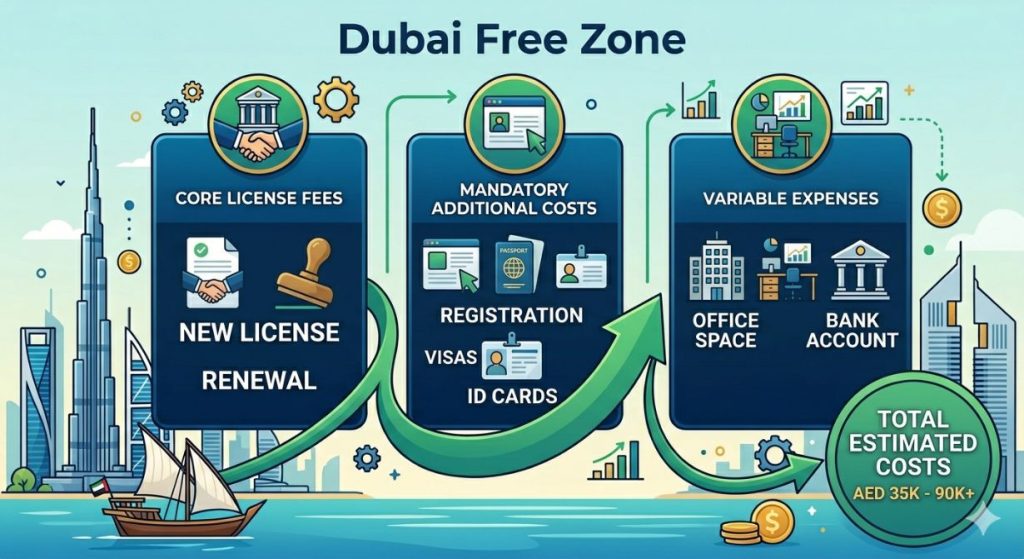
Dubai free-zone trade-licence costs range from approximately AED 12,500 at Meydan to AED 50,000+ at DIFC. The difference comes down to the zone, the licence type, and the office and visa add-ons. Most published cost figures cover only the headline licence fee — the true first-year total is typically 1.5x–2x the headline. This guide breaks down indicative 2026 trade-licence costs across major Dubai free zones, the cost components most lists miss, and three worked total-cost scenarios. What Is a Dubai Free Zone Trade Licence? A trade licence is the formal authorisation issued by a free-zone authority that permits a company to carry out specific commercial activities. Each Dubai free zone (DMCC, JAFZA, IFZA, DAFZA, etc.) issues its own trade licences and sets its own fee structure. Most Dubai free zones offer four main licence types: Indicative Dubai Free Zone Trade Licence Costs (2026) Free Zone Starting Licence (AED) Notes Meydan ~12,500+ Cost-conscious multi-activity IFZA (Dubai Silicon Oasis) ~12,900+ Multi-activity, fully digital setup Dubai South ~12,000+ Logistics, aviation, e-commerce Dubai CommerCity ~15,000+ E-commerce, designated zone Dubai Internet City ~25,000+ Tech, SaaS, IT Dubai Media City ~20,000+ Media, advertising, content DMCC ~20,000+ Commodities, trading, services JAFZA ~25,000+ Trading, logistics, designated zone DAFZA ~25,000+ Aviation, logistics, designated zone Dubai Healthcare City ~25,000+ Healthcare, pharma, wellness DIFC ~50,000+ Financial services, fintech Numbers are starting licence fees and exclude office, establishment card, immigration card, visas, and insurance. Confirm against the zone’s quote. Businesses looking at premium trading and commodities-focused jurisdictions can also explore our detailed DMCC business setup guide for licensing, office requirements, and visa structures. What the Headline Licence Cost Does NOT Include? Three Worked Total-Cost Scenarios Scenario A – Solo Founder in Meydan or IFZA, 1 Visa, Flexi-Desk Indicative total: ~AED 25,000–26,000. Scenario B – DMCC Service Company, 2 Visas, Office Package Indicative total: ~AED 48,500. Scenario C – JAFZA Trading Company with Warehouse, 4 Visas Indicative total: ~AED 100,000+. Tax Position All Dubai free-zone entities are subject to UAE corporate tax under Federal Decree-Law No. 47 of 2022 (9% above AED 375,000). They can qualify for 0% on qualifying income under the QFZP regime (Cabinet Decision No. 100 of 2023; Ministerial Decision No. 265 of 2023). Corporate-tax registration on EmaraTax is mandatory regardless of revenue. Flat AED 10,000 late-registration penalty applies. VAT registration is mandatory above AED 375,000 in taxable supplies; voluntary above AED 187,500. What We See Most Often (BCL Globiz Experience)? Most clients budget the headline licence fee and underestimate the rest. A common AED 12,900 IFZA setup actually lands at AED 25,000–31,500 in true first-year cost once office, cards, visas, and insurance are added. Always price the full package, not just the licence. Activity-add traps catch cost-driven clients. They pick the cheapest licence, find the activity list is too narrow for actual invoicing, and pay AED 1,000–2,500 per activity to expand. Map the 12-month invoicing plan to the activity list before signing. Frequently Asked Questions How much does a Dubai free-zone trade licence cost in 2026? Starting licence fees range from approximately AED 12,500 (Meydan) and AED 12,900 (IFZA) for cost-conscious multi-activity packages, up to AED 50,000+ for DIFC. Mid-tier zones like DMCC start around AED 20,000. What’s the cheapest Dubai free-zone trade licence? Meydan and IFZA offer the lowest starting licence fees among Dubai free zones, from approximately AED 12,500–12,900. Dubai South Free Zone also offers competitive starting packages. Does the trade-licence fee include visas? No. Visas are charged separately at approximately AED 4,000–5,000 per visa, plus the establishment card (~AED 1,500) and immigration card (~AED 1,500). How long is a Dubai free-zone trade licence valid? Most Dubai free-zone trade licences are issued for one year and must be renewed annually. Some zones offer multi-year discounted renewal options. Do Dubai free-zone companies pay corporate tax? Yes. They’re subject to UAE corporate tax under Federal Decree-Law No. 47 of 2022. They may qualify for 0% on qualifying income under the QFZP regime (Cabinet Decision No. 100 of 2023; Ministerial Decision No. 265 of 2023). Non-qualifying income is taxed at 9% above AED 375,000. Reach out to our experts at info@bcl.ae.
UAE Free Zones: The Complete 2026 Guide for Entrepreneurs and Global Businesses
The UAE has more than 45 active free zones across all seven emirates, which is more than any other country in the Middle East. Each zone runs under its own authority, with its own fee structure, activity list, and industry focus. The zone you choose affects your setup cost, your banking timeline, your tax position, and how easily you can scale. This guide walks through what free zones are, why founders choose them, a full list by emirate, how to match a zone to your industry, the current corporate-tax and VAT rules, indicative 2026 costs, the documents and timelines involved, and how to get bank-ready. What Is a UAE Free Zone? A free zone is a designated economic area that operates under its own free-zone authority, separate from the mainland Department of Economy and Tourism (DET) or the equivalent emirate-level licensing body. Each authority sets its own licensing fees, activity list, visa quotas, and physical-presence requirements. The country’s first free zone, Jebel Ali Free Zone (JAFZA), launched in 1985 to make use of Jebel Ali Port. Today free zones stretch across Dubai, Abu Dhabi, Sharjah, Ras Al Khaimah, Ajman, Fujairah, and Umm Al Quwain, and several are governed by dedicated creative and technology authorities such as the Dubai Development Authority (DDA), which oversees Dubai’s media, tech, design, and science communities. Core Benefits of UAE Free Zones Full Free Zone List by Emirate The list below groups the most widely used free zones by emirate. It is not exhaustive, because authorities add and rebrand zones over time, but it covers the zones most founders will shortlist. Dubai Dubai has the largest concentration of free zones in the country. Frequently used options include: Abu Dhabi Sharjah Ras Al Khaimah Ajman Fujairah Umm Al Quwain Comparison snapshot by emirate The table below is a high-level orientation. Always confirm current fees and rules with the zone authority before committing. Emirate Number of zones Best known for Typical positioning Dubai 30+ Trading, tech, media, finance Widest choice, strongest banking recognition, higher cost range Abu Dhabi 8+ Industry, finance, media Large-scale industrial and finance, capital-city presence Sharjah 6 Manufacturing, media, publishing Mid-cost, strong for light industry and creative work Ras Al Khaimah Several Industry, trading, holding Very cost-effective, popular for SMEs and holding vehicles Ajman 2 Freelancers, small trading Among the lowest-cost starting licences Fujairah 3 Oil, logistics, media East-coast access, niche industrial and creative options Umm Al Quwain 1 Trading, light industry Low-cost, straightforward general licences Categories of UAE Free Zones Beyond location, zones are easiest to compare by the type of business they are built for. General-purpose zones Broad activity lists covering most services, trading, and consultancy. Examples include DMCC, IFZA, and Meydan in Dubai, Shams in Sharjah, Ajman Free Zone, and RAKEZ in Ras Al Khaimah. Industrial and manufacturing zones Heavy infrastructure for production and assembly. Examples include HFZA in Sharjah, KEZAD and KIZAD in Abu Dhabi, RAK industrial zones, Dubai Industrial City, and FOIZ in Fujairah. Aviation and logistics zones Located beside airports and ports. Examples include JAFZA and DAFZA in Dubai, SAIF Zone in Sharjah, Abu Dhabi Airport Free Zone, and RAK Airport Free Zone. Technology zones Ecosystems built for technology and software businesses. Examples include Dubai Internet City, Dubai Silicon Oasis, DTEC, and Masdar City in Abu Dhabi. Media and creative zones Homes for content, broadcast, design, and publishing. Examples include Dubai Media City, Dubai Studio City, Dubai Design District, Shams, twofour54 in Abu Dhabi, Sharjah Publishing City, Fujairah Creative City, RAK Media City, and Ajman Media City. Many of Dubai’s creative and broadcast communities sit under the Dubai Development Authority. Financial zones Common-law financial centres with independent regulators. The two are DIFC in Dubai and ADGM in Abu Dhabi. E-commerce and specialised zones Purpose-built zones for online retail and niche sectors. Examples include Dubai CommerCity, DUCAMZ, Dubai Textile City, and International Humanitarian City. Best Free Zones by Industry There is no single best free zone. The right answer depends on your activity, your customers, and whether you move physical goods. The table below is a practical starting shortlist, not an exhaustive ranking. Industry Commonly shortlisted zones Why Trading and general commerce DMCC, IFZA, Meydan, RAKEZ, UAQ FTZ Broad activity lists and flexible cost tiers Logistics and warehousing JAFZA, DAFZA, KEZAD, SAIF Zone Port and airport access, warehouse infrastructure Manufacturing and industry KEZAD, HFZA, Dubai Industrial City, RAK zones Industrial plots, power, and heavy-load facilities Technology and software Dubai Internet City, Dubai Silicon Oasis, DTEC, SRTIP Tech ecosystems and talent networks Media and creative twofour54, Dubai Media City, d3, Shams, Fujairah Creative City Media licences and creative communities Healthcare and life sciences Dubai Healthcare City, Dubai Science Park Sector regulators and specialised approvals Financial services DIFC, ADGM Common-law regimes and independent regulators E-commerce Dubai CommerCity, IFZA, Meydan E-commerce activity lists and fulfilment support Holding and structuring RAK ICC, ADGM, DIFC Recognised holding and corporate-structuring vehicles Freelancers and solo consultants Shams, RAKEZ, Fujairah Creative City, Ajman Free Zone Low-cost freelancer permits Designated Zones for VAT What a designated zone is? A designated zone is a specific subset of free zones that holds special VAT status under the VAT law (Federal Decree-Law No. 8 of 2017 and Cabinet Decision No. 59 of 2017, as amended). All designated zones are free zones, but not all free zones are designated zones. As of 2026 there are roughly two dozen designated zones across the seven emirates, with the largest concentrations in Dubai and Ras Al Khaimah. Widely cited examples include JAFZA, DAFZA, KIZAD, HFZA, SAIF Zone, Dubai CommerCity, Ajman Free Zone, RAK Maritime City, RAK Airport Free Zone, and FOIZ. How to identify a designated free zone in practice? Zone marketing often blurs the line between free zone and designated zone, so verify it yourself before you rely on the VAT treatment. Practical checks: VAT designated zones and out-of-scope supplies The reason designated-zone status matters is that certain movements of goods are treated as outside the scope of UAE VAT. Based on the VAT
Dubai Free Zone Company Formation Cost in 2026
Compare Dubai free zone company formation costs in 2026, including license fees, registration, visas, office space, renewals, hidden charges, and setup package exclusions. In 2026, setting up a company in a Dubai free zone costs approximately AED 12,500–AED 20,000 for a basic 0-visa package and AED 25,000–AED 55,000 or more when investor visas, office space, and professional support are included. The total depends on the free zone, license type, visa count, facility arrangement, and whether compliance costs are factored in from day one. Figures below are indicative 2026 estimates; contact BCL for a quote specific to your activity and free zone. Key Takeaways BCL helps founders compare free zone company formation cost transparently and plan the full operating cost, including incorporation, accounting, VAT, corporate tax, and compliance readiness. Dubai Free Zone Company Formation Cost In 2026: Quick Answer In 2026, a Dubai free zone setup starts around AED 12,500–AED 20,000 for a basic 0-visa package covering registration, license, and a minimal facility such as a flexi-desk. Adding an investor visa, establishment card, office space, and professional support raises the realistic first-year total to AED 25,000–AED 55,000 or more, depending on the free zone and business profile. The “real” cost depends on: What a setup cost usually includes Trade or service license fee; initial approval/registration fee; name reservation, where applicable; incorporation documents (AOA/MOA); flexi-desk or office package, if bundled; establishment card, if included; visa allocation, if the package includes visas; and consultant/professional service fee. Ask for official fees and consultant fees to be quoted separately so you can compare like for like. What is usually not included in headline prices Visa stamping stages, medical test and medical centre fee, Emirates ID, establishment card, office deposit or facility upgrade, activity-specific third-party approvals, extra shareholder/manager document fees, attestation and legal translation, bank account support, accounting/VAT/corporate tax setup, renewal-year charges, and post-incorporation amendments. Dubai Free Zone Company Formation Cost Breakdown By Fee Component Indicative 2026 ranges below are drawn from DMCC official pricing, Dubai South published guides, and UAE free zone market comparisons. Cost item What it means One-time or recurring? Typical payer Indicative 2026 range Notes License fee Permission to conduct approved activity Annual Free zone authority AED 12,000–AED 30,000+ Depends on license type and zone Registration fee Company incorporation charge Usually one-time Free zone authority AED 5,000–AED 9,500 DMCC: AED 9,020; varies by zone Establishment card Immigration file for visa processing Annual/renewable Immigration/free zone AED 1,500–AED 2,000+ DMCC: AED 1,825/year Visa processing Investor/employee residency visa Per visa Immigration/government AED 3,500–AED 4,500 per visa Includes multiple stages Medical test UAE residency medical screening Per visa Government/approved centre AED 300–AED 500 Required for residency Emirates ID UAE identity card Per visa ICP/government AED 370–AED 500+ Validity and channel affect fee Office/flexi-desk Workspace or registered address Annual Free zone/landlord AED 5,000–AED 20,000+ DMCC flexi-desk: AED 15,000–AED 20,000 Consultant fee Professional service and coordination One-time or package-based Consultant Varies Must be separated from official fees Renewal fee Annual continuation of license Annual Free zone authority Varies; may differ from setup year Check promotional vs standard renewal Dubai free zone license cost The Dubai free zone license cost depends on license category and issuing zone: consultancy/service, approximately AED 12,000–AED 20,000/year; standard trading licence, approximately AED 15,000–AED 30,000+/year (DMCC’s standard trading/service licence example is AED 20,285/year); e-commerce, broadly similar to trading or slightly lower; industrial, often higher due to facility and regulatory requirements. A full General Trading licence, which allows unrestricted trading across categories, is priced separately and higher at most zones at DMCC specifically it is AED 50,265/year. Adding activities typically adds AED 1,000–AED 2,500 per activity, and regulated activities (financial services, commodities, health) tend to attract higher costs or separate approvals confirm categories and licence scope with the free zone before incorporation. Dubai free zone registration fee The registration/incorporation fee covers the formal creation of the company and is usually a separate, one-time charge distinct from the annual license fee. DMCC itemises registration at AED 9,020 per application, plus an AED 1,035 processing fee and an AED 2,020 Articles of Association fee. Confirm whether name reservation, initial approval, and incorporation documents are included or charged as extras. Establishment card and immigration card fees The establishment card creates the company’s immigration file and is required before processing any investor or employee visa. It recurs annually – DMCC charges AED 1,825/year and is commonly excluded from 0-visa or license-only packages since it’s only needed once the company sponsors visas. Both the establishment card and visa costs apply when upgrading later. Dubai free zone visa cost The full Dubai free zone visa cost typically covers: visa quota eligibility, entry permit, status change (if already in the UAE), medical test (AED 300–AED 500), Emirates ID (AED 370–AED 500+), residency visa issuance, and mandatory health insurance. Investor and employee visa costs are broadly similar; investor visas are self-sponsored through the company. A realistic total per-visa band in 2026 is AED 3,500–AED 4,500, separate from the establishment card fee. Dubai free zone office cost Office type Best for Cost level Visa quota impact Suitable for Virtual address/license only Remote or holding structures where allowed Low None to very limited Select remote or 0-visa structures Flexi-desk Solo founders and consultants Low to moderate Typically 1–3 visas Consultants, IT, small service firms Shared desk/co-working Small teams Moderate May allow more visas Service businesses, small agencies Private office Growing teams Higher Higher quota possible Trading, team operations, banking substance Warehouse/retail unit Activity-specific High Case-specific Logistics, industrial, retail Facility type directly affects visa quota and how banks view operational substance. A flexi-desk is often sufficient for a solo consultant but may not support multiple visas or satisfy a bank’s expectations for trading or higher-transaction-value businesses. Share capital requirements Some zones specify minimum share capital in incorporation documents — DMCC cites an average of AED 50,000, while others have no minimum. In practice, many zones do not require founders to deposit share capital for small service-based businesses. Requirements vary by zone and activity; confirm directly with
Ajman Free Zone: 2026 Complete Guide for Entrepreneurs
Ajman Free Zone (AFZ) is one of the UAE’s most cost-competitive free zones. Adjacent to Ajman Port, approximately 45 minutes from Dubai and 30 minutes from Sharjah, it offers 100% foreign ownership, designated-zone status for VAT on goods movements, and starting licence costs from approximately AED 5,500–6,000 — among the lowest in the country. This guide covers what AFZ is, why entrepreneurs choose it, the licence and office options available in 2026, indicative costs, the step-by-step setup process, and the corporate-tax obligations that apply from day one. What Is Ajman Free Zone? Ajman Free Zone was established in 1988 — making it one of the UAE’s oldest free zones. It hosts thousands of businesses across trading, services, manufacturing, and e-commerce. AFZ operates under its own free-zone authority, separate from the Ajman Department of Economic Development (which handles mainland Ajman companies). AFZ is a designated zone for VAT purposes under the original Cabinet Decision No. 59 of 2017 and subsequent amendments — favourable treatment on goods movements between designated zones. Why Choose Ajman Free Zone? Entrepreneurs comparing different UAE jurisdictions should also read our detailed guide on Free Zone vs Mainland UAE to understand licensing, ownership, taxation, and operational differences before choosing AFZ. Licence Types in Ajman Free Zone Service / Professional Licence Covers consulting, IT services, marketing, management advisory, education, training. Starting from approximately AED 6,500–10,000/year. Supports employee visa sponsorship. Commercial / Trading Licence Covers import/export, wholesale, ecommerce, and trading of physical goods. Starting from approximately AED 9,000–15,000/year. Custom import/export code available. Industrial Licence For manufacturing, processing, and assembly. Starting from approximately AED 12,000+/year plus facility costs. E-commerce Licence For purely online businesses. Starting from approximately AED 5,500–8,000/year. Freelance / Individual Professional Solo professionals — designers, developers, consultants, creators. Starting from approximately AED 5,500/year. Office Options in Ajman Free Zone Indicative First-Year Setup Costs (2026) Configuration Indicative Total (AED) Notes Freelancer permit + 1 visa ~16,000–20,000 Smart / virtual office Service licence + flexi-desk + 1 visa ~22,000–26,000 Trading licence + executive office + 2 visas ~36,000–44,000 Industrial / warehouse + 4 visas ~95,000–130,000+ Warehouse + facility costs Includes establishment + immigration cards, per-visa costs, and basic health insurance. Confirm against the current AFZ quote. Tax Position AFZ entities are subject to UAE corporate tax under Federal Decree-Law No. 47 of 2022. They can qualify for 0% on qualifying income under the QFZP regime (Cabinet Decision No. 100 of 2023; Ministerial Decision No. 265 of 2023). Non-qualifying income is taxed at 9% above AED 375,000. AFZ’s designated-zone status applies to goods movements between designated zones, not to services or real estate inside the zone. VAT registration is mandatory above AED 375,000 in taxable supplies; voluntary above AED 187,500. Step-by-Step Setup Process What We See Most Often (BCL Globiz Experience) AFZ’s strength is cost. The trade-off most clients underestimate is banking — tier-1 UAE banks treat Ajman-based entities more conservatively than DMCC or DIFC entities. Many AFZ setups start with a digital bank (Wio, Mashreq Neo) and migrate to a tier-1 bank after 6 months of operating history. Corporate-tax registration on EmaraTax catches most clients out. It applies to every AFZ entity regardless of revenue, with a flat AED 10,000 late-registration penalty. Complete this within 30 days of receiving the trade licence. Frequently Asked Questions What is Ajman Free Zone? Ajman Free Zone is a UAE free zone established in 1988, located adjacent to Ajman Port. It is a designated zone for VAT and offers 100% foreign ownership, a range of licence types, and some of the lowest starting fees in the UAE. How much does an Ajman Free Zone licence cost? Starting licence fees range from approximately AED 5,500 (freelance permit, e-commerce) to AED 15,000+ (trading). Total first-year cost including office, cards, and one visa typically lands at AED 16,000–44,000 depending on package. Is Ajman Free Zone a designated zone for VAT? Yes. Ajman Free Zone holds designated-zone status under the VAT law. The benefit applies to movements of goods between designated zones, not to services or real estate inside the zone. Can I get a UAE residence visa through Ajman Free Zone? Yes. AFZ supports residence-visa sponsorship. Each visa costs approximately AED 4,000–5,000 plus the establishment card (~AED 1,500) and immigration card (~AED 1,500). Do Ajman Free Zone companies pay UAE corporate tax? Yes. AFZ entities are subject to UAE corporate tax under Federal Decree-Law No. 47 of 2022. They may qualify for 0% on qualifying income under the QFZP regime (Cabinet Decision No. 100 of 2023; Ministerial Decision No. 265 of 2023). Non-qualifying income is taxed at 9% above AED 375,000. Reach out to us at info@bcl.ae.
Ajman Free Zone Office Facilities (Including C1 Building): 2026 Guide for Entrepreneurs
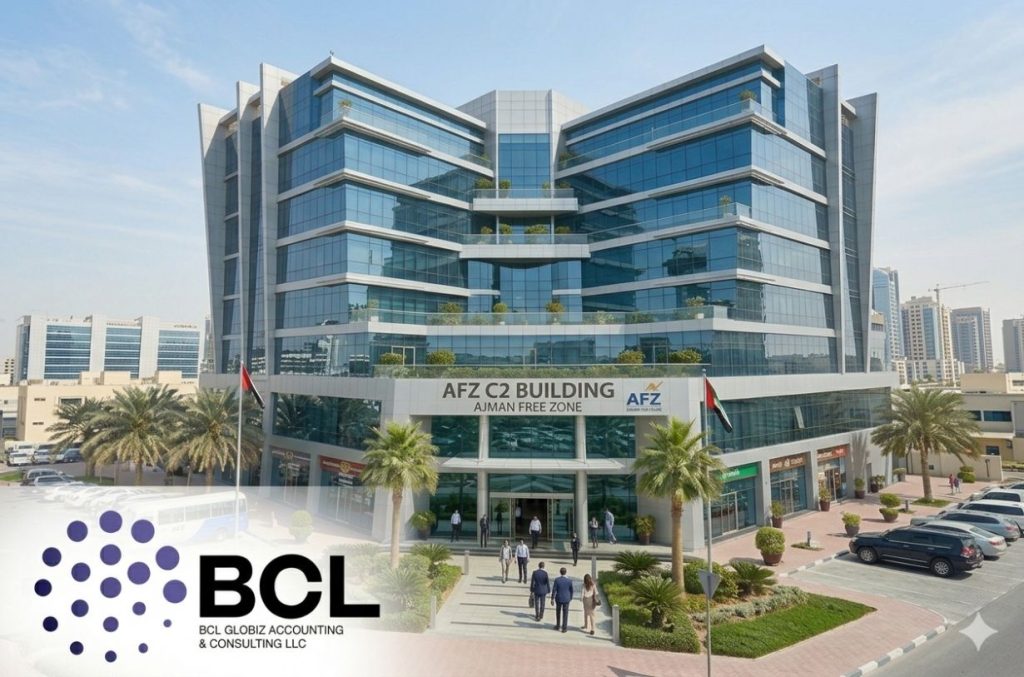
Ajman has quietly become one of the UAE’s most affordable business hubs. Ajman Free Zone (AFZ) sits adjacent to Ajman Port, approximately 45 minutes from Dubai and 30 minutes from Sharjah. It is a designated zone for VAT, and it consistently lands among the cheapest free zones in the UAE. Within AFZ, several commercial buildings host business centres, offices, and warehouses. The C1 building is one of these commercial blocks — frequently referenced by founders evaluating cost-effective office options in AFZ. This guide covers the practical question: what office options does Ajman Free Zone offer, how do they fit different business sizes, and what does the total setup look like in 2026? Note: building names and configurations inside Ajman Free Zone change over time. Confirm specific room availability, current rates, and exact location with the AFZ admin or your business-setup consultant before signing a contract. What Is Ajman Free Zone? Ajman Free Zone, established in 1988, is one of the UAE’s oldest free zones. It hosts thousands of businesses across trading, services, manufacturing, and e-commerce. AFZ is a designated zone for VAT — favourable treatment on goods movements between designated zones. Key advantages of AFZ: Entrepreneurs comparing AFZ with other jurisdictions can also explore our detailed guide on the list of free zones in UAE to understand cost differences, visa options, and industry-specific advantages across the Emirates. Office Options Inside Ajman Free Zone Smart / Virtual Office Cheapest option — for visa-eligible licences without physical workspace needs. Starting from approximately AED 5,000–8,000/year. Best for service businesses, consultants, and freelancers. Shared / Flexi-Desk Hot-desk in a shared business centre. From approximately AED 8,000–12,000/year. Supports 1–3 visas. Best for early-stage SMEs. Executive / Smart Office Dedicated furnished private office within a business centre (typically what buildings like C1 offer). Starting from approximately AED 15,000–25,000/year depending on size and configuration. Supports more visas and provides a fixed business address. Standard Office Larger private office leased from AFZ. Starting from approximately AED 25,000+/year. Best for SMEs with multiple employees needing dedicated space. Warehouse / Industrial Unit For trading, manufacturing, and assembly. Highly variable by size and configuration; pricing starts from approximately AED 50,000+/year for small units. About the C1 Building “C1” is one of several commercial building references inside Ajman Free Zone. Buildings of this type typically host: Indicative rates for an executive office inside an AFZ business-centre building range from AED 15,000–25,000/year depending on office size, number of visas required, and whether it’s a smart office or larger configuration. AFZ’s commercial buildings are typically used by: Confirm the current configuration, available offices, and price with AFZ or your consultant before signing. Why Entrepreneurs Choose Ajman Free Zone Indicative First-Year Setup Costs in AFZ (2026) Configuration Licence + Office (AED) Total First-Year (1 visa) Smart office + service licence + 1 visa ~14,000–17,000 ~20,000–24,000 Executive office + service / trading licence + 2 visas ~24,000–32,000 ~36,000–44,000 Standard office + 4 visas ~35,000+ ~55,000+ Warehouse + trading licence + 4–6 visas ~70,000+ ~95,000–130,000+ Includes establishment + immigration cards, visa cost, and basic health insurance. Confirm with the current AFZ quote. Tax Position Ajman Free Zone is a designated zone for VAT — favourable treatment on movements of goods between designated zones. Services and real estate inside AFZ follow normal VAT rules. AFZ entities are subject to UAE corporate tax under Federal Decree-Law No. 47 of 2022. They can qualify for 0% on qualifying income under the QFZP regime (Cabinet Decision No. 100 of 2023; Ministerial Decision No. 265 of 2023). Non-qualifying income is taxed at 9% above AED 375,000. Setup Process in AFZ (Including Office in C1 or Similar Building) What We See Most Often (BCL Globiz Experience) AFZ’s strength is cost. The trade-off most clients underestimate is banking: tier-1 UAE banks (Emirates NBD, ADCB, HSBC) are more conservative with Ajman-based entities than with DMCC or DIFC entities. Many setups start with a digital bank (Wio, Mashreq Neo) as a first account, then migrate to a tier-1 bank after 6 months of operating history. Office-name traps: building names and numbers inside AFZ are sometimes updated or re-allocated. Always confirm with AFZ admin (or your consultant) which specific office you’re being quoted on, what’s included (signage, meeting-room hours, parking), and whether the building has had any address changes. Many Ajman Free Zone startups initially choose digital banking solutions for faster onboarding — here’s our practical guide to Wio bank account opening Dubai for UAE entrepreneurs and free-zone businesses. Frequently Asked Questions What is the Ajman Free Zone C1 building? “C1” is one of the commercial building references inside Ajman Free Zone, typically hosting business-centre offices, executive offices, and shared facilities. Building names and configurations are updated periodically; confirm current availability with AFZ admin before signing. How much does an office in Ajman Free Zone cost? Indicative rates in 2026: smart / virtual office from approximately AED 5,000–8,000/year; flexi-desk from approximately AED 8,000–12,000/year; executive office from approximately AED 15,000–25,000/year; standard office from approximately AED 25,000+/year; warehouse from approximately AED 50,000+/year. Is Ajman Free Zone a designated zone for VAT? Yes. Ajman Free Zone is a designated zone for VAT. The benefit applies to movements of goods between designated zones, not to services or real estate inside the zone. Can I get a UAE residence visa through an Ajman Free Zone company? Yes. AFZ supports residence-visa sponsorship. Each visa requires the establishment card (~AED 1,500/year) and immigration card (~AED 1,500/year) to be in place, and the office package must support the number of visas you need. Does an Ajman Free Zone company pay UAE corporate tax? Yes. AFZ entities are subject to UAE corporate tax under Federal Decree-Law No. 47 of 2022. They may qualify for 0% on qualifying income under the QFZP regime; non-qualifying income is taxed at 9% above AED 375,000. Corporate-tax registration on EmaraTax is mandatory regardless of revenue. Reach out to our experts at info@bcl.ae.
FZE Companies in Dubai: Complete 2026 Setup, Compliance and Tax Guide
An FZE, short for free zone establishment, is a company formed within a UAE free zone and owned by exactly one shareholder. It remains the most common structure for solo founders, holding companies, and single-shareholder corporate setups. This guide covers what an FZE is, how it compares with an FZCO and a mainland LLC, the shareholder rules, the document checklist, a step-by-step setup process referencing a named free zone authority, zone-specific paths across JAFZA, DWTC, IFZA and similar authorities, banking and KYC requirements, and the current UAE corporate tax position, including 2026 updates to the Qualifying Free Zone Person regime and Small Business Relief. What Is an FZE Company An FZE is a free zone entity owned by exactly one shareholder. The shareholder can be: An FZE has separate legal personality and limited liability, and it operates under the specific free zone authority where it is registered, such as DMCC, JAFZA, IFZA, or DWTC Authority. FZE vs FZCO: Which Structure Should You Choose Feature FZE FZCO Shareholders Exactly 1 2 or more Legal personality Separate Separate Liability Limited Limited Best for Solo founder, holding company, branch of single-shareholder entity Co-founder team, corporate-backed joint venture Conversion cost AED 2,000 to 5,000+ and 2 to 4 weeks to add a shareholder (FZE to FZCO) Not applicable Practical rule: if you anticipate any chance of bringing in a co-founder in the next 12 to 24 months, start as an FZCO. The conversion fee and processing time after the fact are not free. FZE vs Mainland LLC in Dubai Feature FZE (Free Zone) Mainland LLC (DET) Foreign ownership 100% always Up to 100% for most activities (since 1 June 2021) Direct mainland trading Restricted; needs a dual licence or a Dubai Unified License based permit Unrestricted Corporate tax 0% on qualifying income if a Qualifying Free Zone Person; 9% above AED 375,000 on non-qualifying income 9% above AED 375,000 Office requirement Flexi-desk often sufficient Physical office typically required Starting cost (AED) From approximately 12,500 (confirm with BCL) From approximately 15,000 to 25,000 (confirm with BCL) Foreign ownership for mainland companies was liberalised for most commercial and industrial activities from 1 June 2021; a limited list of strategically important activities can still require UAE shareholding. Confirm activity-specific ownership rules with BCL. If you are still comparing legal structures before incorporation, read our detailed guide on Types of Company Registration in Dubai to understand how FZE entities compare with mainland LLCs and other UAE business structures. Benefits of an FZE Setup Free Zones for FZE Company Setup: 2026 Costs Free Zone Starting Licence (AED) Notes IFZA (DSO) From approximately 12,900 Multi-activity; cost-conscious Meydan From approximately 12,500 Multi-activity; cost-conscious DMCC From approximately 20,000 Strong banking relationships; broad activity list JAFZA From approximately 25,000 Designated zone; port and logistics access DAFZA From approximately 25,000 Designated zone; airport access DWTC Authority From approximately 5,750 Commercial, professional and event licences; central Dubai location DIFC From approximately 50,000 Financial services only Dubai Internet City From approximately 25,000 Technology ecosystem Dubai CommerCity From approximately 15,000 E-commerce; designated zone Shams (Sharjah) From approximately 12,000 Sharjah equivalent; different suffix rules RAKEZ From approximately 11,400 Ras Al Khaimah equivalent; lower cost These figures are indicative starting packages only. Actual pricing depends on activity, visa quota, office type, and periodic changes to each authority’s fee schedule. Always confirm current fees with BCL before budgeting. JAFZA, DWTC, IFZA and Other Free Zone Setup Paths Compared Each free zone authority runs its own registration process, document list, and activity list, so the setup path for an FZE differs by zone even though the underlying legal concept, a single-shareholder entity, stays the same. JAFZA (Jebel Ali Free Zone Authority) JAFZA is a designated zone for VAT purposes with direct port access, which makes it a common choice for trading, logistics, and industrial FZEs. Applications are submitted through JAFZA’s own registration channel, and JAFZA issues its own trade licence and activity list separate from DET’s mainland list. DWTC Authority (Dubai World Trade Centre) DWTC Authority licenses FZEs directly under its own framework, with commercial, professional, and event management licence categories. Its FZE registration is commonly described as a five-step process starting with an application and an initial document set. Where the shareholder is a non-individual, DWTC Authority asks for a board or shareholder resolution to establish the FZE, appointment of a general manager, a certified true copy of the shareholder’s certificate of incorporation or registration, and the shareholder’s own memorandum and articles of association, together with the FZE’s memorandum and articles of association attested by DWTC Authority itself. IFZA (International Free Zone Authority) IFZA, based in Dubai Silicon Oasis, is known for cost-conscious multi-activity packages and a largely digital registration flow, which is why it is a common starting point for solo founders comparing costs across zones. Setup paths, minimum activity requirements, and document lists change from time to time at each authority. Confirm the current process for your chosen zone with BCL before applying. Shareholder Eligibility and Role Rules Free zone authorities distinguish between individual and corporate shareholders, and the document burden is materially different between the two. Individual shareholder Corporate shareholder A corporate shareholder’s documents typically need attestation, either through the shareholder’s home-country chamber of commerce, foreign ministry, and the UAE embassy, or through an apostille where the shareholder’s jurisdiction is party to the Hague Apostille Convention, followed by attestation at the UAE Ministry of Foreign Affairs. Requirements vary by shareholder jurisdiction and by free zone authority, so confirm the applicable attestation chain with BCL before starting the process. Document Checklist for FZE Incorporation A representative FZE incorporation file, illustrated using DWTC Authority’s published requirements, generally includes: This checklist is illustrative. JAFZA, DWTC, IFZA, DMCC and other authorities each publish their own exact document list, and the list can change. Confirm the authority-specific checklist with BCL before submission. Step-by-Step FZE Setup Process Step 1: Choose your free zone authority Match the zone to your business profile. DMCC suits trading, DIFC suits financial services, Dubai Internet City suits
FZCO Company in Dubai: Complete 2026 Setup Guide
Dubai has many free zones, collectively hosting tens of thousands of registered companies. If you’re considering a Dubai free zone setup with one or more business partners, the FZCO structure is almost certainly on your shortlist. This guide covers FZCO meaning, FZE vs FZCO differences, comparison with a mainland LLC, benefits, which free zones offer FZCO structures (with real cost ranges), the setup process, remote incorporation requirements, office solutions, UBO and shareholder documentation, a first year cost breakdown, tax implications under the UAE corporate tax regime, ongoing compliance, common mistakes, and a decision framework before you commit capital. What Is an FZCO Company? FZCO stands for Free Zone Company. That’s the FZCO full form. An FZCO is a type of legal entity established within a UAE free zone that allows two or more shareholders. Shareholders can be individuals, corporate entities, or a combination, including a branch of a foreign company registered as a corporate shareholder. An FZCO has its own legal personality. It can enter into contracts, own assets, sue, and be sued, independently of its shareholders. Shareholders enjoy limited liability; personal assets are protected beyond the capital contribution. FZCOs operate under the jurisdiction of the specific free zone authority where they’re registered (DMCC Authority, JAFZA Authority, and so on), not under the mainland Commercial Companies Law. FZE vs FZCO: Quick Comparison Feature FZE (Free Zone Establishment) FZCO (Free Zone Company) Shareholders Exactly 1 2 or more Legal personality Separate Separate Liability Limited Limited Conversion to add a partner Convert to FZCO (AED 2,000-5,000+ fees, 2-4 weeks) Already supports multiple Typical use Solo founder, holding entity Co-founder team, corporate-backed Setup complexity Slightly simpler Same general process FZCO vs Mainland LLC Feature FZCO (Free Zone) Mainland LLC (DET) Foreign ownership 100% always 100% for most activities (since 1 June 2021) Direct mainland trading Restricted; needs dual licence Unrestricted Corporate tax Potential 0% on qualifying income (QFZP); 9% above AED 375,000 on non-qualifying 9% above AED 375,000 Office requirement Flexi-desk often sufficient Physical office typically required Starting cost (AED) From ~12,500 From ~15,000-25,000 Still evaluating the right structure? Read our complete comparison of Free Zone vs Mainland UAE business setup to compare ownership, taxation and operational flexibility. Mainland sales limitations and the dual-licence workaround An FZCO cannot sell directly into the UAE mainland market under its free zone licence alone. This is the single biggest limitation founders underestimate. Selling goods or services to mainland customers generally requires one of the following: Goods movement through a designated zone (JAFZA, Dubai CommerCity, Dubai South) is treated differently for VAT purposes than services, so the workaround that fits depends on whether you’re selling goods or services, and to whom. Benefits of an FZCO Setup 100% foreign ownership No local sponsor or Emirati partner required. Co-shareholders own 100%. Multi-shareholder flexibility FZCO supports up to the free zone’s maximum number of shareholders (typically 5-50 depending on the zone). Shareholders can be individuals, corporate entities, or a mix. Limited liability Shareholders are protected beyond their capital contribution. Personal assets are not exposed to company creditors. Tax position Free Zones That Offer FZCO Structures Free Zone Starting Licence (AED) Notes DMCC ~20,000 Strong banking, broad activity list JAFZA ~25,000+ Designated zone, port access DAFZA ~25,000+ Designated zone, airport access DIFC ~50,000+ Financial services only Dubai Internet City ~25,000+ Tech ecosystem IFZA (DSO) ~12,900+ Cost-conscious multi-activity Meydan ~12,500+ Cost-conscious multi-activity Dubai CommerCity ~15,000+ E-commerce, designated zone Dubai South ~12,000+ Logistics, parts designated Figures are indicative starting packages; verify current pricing with BCL before budgeting. If you’re considering a premium free zone setup, explore our detailed DMCC business setup guide to understand licensing costs, banking advantages and compliance requirements for FZCO companies. Do You Need to Be Physically in the UAE to Set Up an FZCO? No. Most free zones support full remote incorporation. Documents can be submitted digitally, name reservation and initial approval happen online, and the trade licence itself is typically issued without any in-person step. What can still require a visit or a workaround: Practical takeaway: you can own and license an FZCO entirely from abroad. The moment you or a shareholder wants a UAE residence visa or a tier-1 bank account, budget for at least one short trip. FZCO Setup Process: Step by Step Step 1: Choose free zone Match the zone to your business profile. DMCC for trading; DIFC for finance; Internet City for tech; IFZA and Meydan for cost-conscious SMEs; JAFZA for logistics. Step 2: Define shareholders and activity list Confirm the shareholder structure (number of shareholders, individual or corporate, share percentages). Map the 12-month invoicing plan to the activity list before incorporating; adding activities later costs AED 1,000-2,500 each. Step 3: Reserve company name Name must end in the correct suffix (FZCO, FZ-LLC, depending on the zone) and comply with the zone’s naming rules. Step 4: Submit documents (resident vs non-resident requirements) Standard documents for individual shareholders, managers, and director roles: For corporate shareholders, including a branch of a foreign company acting as shareholder, the corporate shareholder attestation requirements are more involved: certificate of incorporation, MOA, board resolution approving the UAE entity, and certificate of good standing, all duly attested (notarised in the home country, then legalised by the UAE Embassy or Consulate and the UAE Ministry of Foreign Affairs, or apostilled where the home country is a Hague Convention member). UBO disclosure and corporate shareholder attestation workflow Every UAE company, including FZCOs, must identify and register its Ultimate Beneficial Owner (UBO), the natural person or persons who ultimately own or control 25% or more of the company, or who otherwise exercise ultimate control, per Cabinet Decision No. 58 of 2020 (as amended). This applies even where the immediate shareholder is a corporate entity; the free zone will trace ownership up the chain until it reaches a natural person. DIFC and ADGM entities follow their own equivalent beneficial-ownership frameworks rather than Cabinet Decision No. 58 of 2020 directly, so confirm the applicable process with the relevant authority if you’re incorporating there. Typical UBO
Free Trade Zones in Dubai & UAE: A Complete 2026 Guide
Free trade zones are designated economic areas operating under their own legal and tax framework, separate from the mainland commercial system. The UAE has 45+ active free trade zones across all seven emirates, the highest concentration of any country in the Middle East. This guide covers what a UAE free trade zone is, the categories of zones available, the headline benefits, the corporate-tax position under the QFZP regime, and how to choose the right zone for your business. What Is a Free Trade Zone? A free trade zone (also called a free zone) is a designated geographic area in the UAE where companies operate under their own free-zone authority — not the Department of Economy and Tourism (DET) or other mainland licensing body. Each zone sets its own licensing fees, activity list, visa quotas, and physical presence requirements. Free trade zones were created to attract foreign investment, encourage exports, and develop specific industries. Today they host tens of thousands of companies across trading, manufacturing, services, technology, finance, media, healthcare, and more. Brief History The UAE’s first free zone — Jebel Ali Free Zone (JAFZA) — was launched in 1985 to leverage the Jebel Ali Port. Today, the UAE has more than 45 free zones, each designed to support specific industries and business types — from commodities trading at DMCC to finance at DIFC and ADGM, media at Dubai Media City and twofour54, e-commerce at Dubai CommerCity, and heavy industry at HFZA and KIZAD. Key Benefits of UAE Free Trade Zones 100% Foreign Ownership Free trade zones have always allowed 100% foreign ownership. No local sponsor or partner required. 0% Personal Income Tax The UAE has no personal income tax on employment income, dividends, or capital gains. Corporate Tax (Potentially 0% Under QFZP) Free-zone companies are subject to UAE corporate tax under Federal Decree-Law No. 47 of 2022 (9% above AED 375,000), but may qualify for a 0% rate on qualifying income under the QFZP regime — Cabinet Decision No. 100 of 2023 and Ministerial Decision No. 265 of 2023. Full Repatriation of Profits and Capital No restrictions on repatriating 100% of profits and capital out of the UAE. No foreign-exchange controls. Customs Duty Suspension Goods imported into a free zone for storage, processing, or re-export are not subject to the 5% UAE customs duty. Duty applies only when goods enter the UAE mainland for local consumption. Designated-Zone VAT Treatment for Goods A subset of free zones (27+ designated zones) have favourable VAT treatment for movements of goods between zones. Services and real estate inside designated zones follow normal VAT rules. Categories of UAE Free Trade Zones General-Purpose Zones Broad activity lists covering most service, trading, and consultancy businesses. Examples: DMCC, IFZA, Meydan, Shams, Ajman Free Zone, RAKEZ. Industrial / Manufacturing Zones Heavy infrastructure for production and assembly. Examples: HFZA, KIZAD, RAK industrial zones, Dubai Industrial City, FOIZ. Aviation & Logistics Zones Adjacent to airports and ports. Examples: JAFZA, DAFZA, SAIF Zone, Abu Dhabi Airport Free Zone, RAK Airport Free Zone. Technology Zones Tech and SaaS ecosystem. Examples: Dubai Internet City, DTEC, Masdar City (clean tech). Media & Creative Zones Examples: Dubai Media City, Dubai Studio City, Shams, twofour54, Fujairah Creative City, Ajman Media City, Sharjah Publishing City. Financial Zones Common-law financial regulators. Examples: DIFC (Dubai), ADGM (Abu Dhabi). E-commerce & Specialised Zones Examples: Dubai CommerCity (e-commerce, designated), DUCAMZ (automotive, designated), Dubai Textile City (textiles, designated), International Humanitarian City. Explore our detailed breakdown of the top Dubai free zones to compare licensing costs, business activities and visa options before choosing the right setup. Entity Types in UAE Free Trade Zones Indicative Setup Costs (2026) Tier Indicative Licence (AED) Examples Budget freelancer ~5,750 Shams, RAKEZ, Ajman FZ Budget company ~9,000–15,000 Shams Business, IFZA, Meydan, FFZA Mid-tier ~20,000–30,000 DMCC, Dubai Internet City, Dubai CommerCity Premium / Industrial ~25,000–50,000+ JAFZA, DAFZA, KIZAD Financial services ~50,000+ DIFC, ADGM Total first-year cost (licence + cards + flexi-desk + 1 visa + insurance) typically lands at 1.5x–2x the headline licence cost. Confirm against the zone’s quote. Setup Process — Overview The same 8-step process applies to most UAE free trade zones: Total realistic timeline from kickoff to operational bank account: 4–8 weeks. Tax Position — Detailed Free-trade-zone companies are subject to UAE corporate tax under Federal Decree-Law No. 47 of 2022 (effective 1 June 2023). To benefit from 0% corporate tax on qualifying income (QFZP), an entity must meet ALL of these conditions under Cabinet Decision No. 100 of 2023 and Ministerial Decision No. 265 of 2023: De-minimis threshold for non-qualifying revenue: the lower of AED 5 million or 5% of total revenue. Exceed this and you lose QFZP status for the tax period. VAT: registration mandatory above AED 375,000 in taxable supplies; voluntary above AED 187,500. What We See Most Often (BCL Globiz Experience) Clients self-select free zone for cost reasons before checking customer mix. The real trigger: if more than 60% of your revenue will come from overseas customers or other free-zone entities, free zone with QFZP makes sense. If most revenue comes from UAE mainland B2B / B2C customers, a mainland licence often nets out cheaper. Corporate-tax registration on EmaraTax is the most-missed step. It applies to every free-zone entity regardless of revenue, with a flat AED 10,000 late-registration penalty. Still deciding between mainland and free zone setup? Read our complete guide on Free Zone vs Mainland UAE to understand tax impact, ownership rules, and operational flexibility. Frequently Asked Questions How many free trade zones does the UAE have? The UAE has 45+ active free trade zones across all seven emirates as of 2026. Dubai has the most (30+), followed by Abu Dhabi (8+), Sharjah (6), and others across RAK, Ajman, Fujairah, and Umm Al Quwain. Are free trade zone companies tax-free in the UAE? Not automatically. Free-zone companies are subject to UAE corporate tax under Federal Decree-Law No. 47 of 2022 (9% above AED 375,000). They may benefit from a 0% rate on qualifying income if they meet QFZP conditions. The UAE
Dubai Free Zones Comparison 2026: Best UAE Free Zones by Cost, Activity, and Business Type
Dubai has more than 40 free zones, and each one sets its own licence fees, activity list, visa quota, office rules, and reputation with banks. Choosing the wrong zone can mean paying for activities you never use, waiting weeks longer than needed on a bank account, or amending your licence in month three. This comparison ranks and profiles the most-used Dubai free zones for 2026, shows year-one and renewal costs side by side, and points you to the right zone by budget and by business type. Every regulatory point is tied to the current source, and all figures are indicative for 2026, so confirm the final number in the zone’s own written quote before you sign. How to Use This Comparison? Read it in three passes. First, scan the side by side table to shortlist zones on cost, renewal, visa quota, office requirement, setup speed, and banking access. Second, use the ranked winners and the by use case section to match a zone to what you actually do. Third, read the individual profile of your shortlisted zones and check the designated zone, banking, and renewal notes before you commit. If you are still deciding between a free zone and a mainland licence, the free zone versus mainland section sets out the criteria that matter most for UAE customers. Dubai Free Zones at a Glance: Side by Side Comparison The table below compares the most commonly used Dubai free zones on the six factors founders ask about first. Starting licence figures exclude visas, establishment card, and office unless the office is bundled into the package. Visa quota depends on the package and office type you choose, so the entries show the typical range rather than a hard cap. Zone Year one licence (AED) Renewal (AED) Visa quota Office Setup speed Banking access IFZA (in DSO) from ~12,900 ~11,000 to 13,000 0 to 6+ Flexi desk included 1 to 5 days Broad: ENBD, Mashreq, Wio, ADCB Meydan from ~12,500 ~10,000 to 12,500 0 to 3 Flexi desk included 3 to 5 days Good: often challenger banks first Dubai South from ~12,000 ~11,000+ Scalable Flexi to warehouse 1 to 2 weeks Good DMCC from ~20,000 ~15,000 to 20,000 Scalable Flexi to office 1 to 2 weeks Strong: tier one banks JAFZA from ~25,000 ~20,000+ Scalable Office or warehouse 2 to 4 weeks Strong DAFZA (DAFZ) from ~25,000 ~20,000+ Scalable Office 2 to 4 weeks Strong DWTC ~15,000 to 25,000 ~15,000 to 20,000 Scalable Flexi to Grade A 1 to 4 weeks Strong: central CBD Dubai Internet City from ~25,000 ~20,000+ Scalable Office 2 to 4 weeks Strong Dubai CommerCity from ~15,000 ~14,000+ Scalable Office or warehouse 2 to 4 weeks Good Dubai Science Park from ~15,000 ~14,000+ Scalable Lab, office, warehouse 2 to 4 weeks Good with strong profile Expo City Dubai from ~5,000 to 18,000 ~15,000+ Scalable Flexi to pavilion 1 to 3 weeks Developing DIFC from ~10,000 to 50,000+ High Scalable Office 2 to 6 weeks Strong: financial Figures are indicative for 2026 and vary with activity, visa count, office type, and shareholder profile. Treat the table as a shortlist tool, then confirm against a written quote. Best Free Zones in Dubai 2026: Ranked with a Clear Scoring Method How We Scored the Zones There is no single best free zone, only the best zone for a given business. To make the ranking honest rather than a popularity list, we scored each zone from 1 to 5, where 5 is strongest, on five factors that decide most setups: Scores below reflect BCL Globiz observations across recent client setups rather than a lab test, so treat them as an experienced starting point and confirm the details that matter for your case. Zone Cost Setup Activity Banking Ecosystem Strongest for IFZA (in DSO) 5 5 5 4 3 Budget SMEs, consultants, freelancers Meydan 5 4 4 3 3 Budget trading and services Dubai South 4 3 4 4 4 Logistics, aviation, ecommerce DMCC 3 4 5 5 5 Trading, commodities, credibility DWTC 3 4 4 5 4 Events, consulting, virtual assets Dubai CommerCity 3 3 3 4 4 Cross border ecommerce JAFZA 2 3 4 5 5 Logistics, manufacturing, re-export Dubai Internet City 2 3 3 5 5 Tech and SaaS Dubai Science Park 3 3 3 3 4 Healthcare and life sciences DIFC 1 3 3 5 5 Financial services and fintech Overall Winners by Category Cheapest Dubai Free Zones: Year One and Renewal Ranges For a Dubai issued licence, the lowest entry points in 2026 are Meydan and IFZA. Nearby Sharjah and Ajman zones such as Sharjah Media City start lower still, from roughly AED 5,750, and many Dubai based founders use them for cost reasons, but the licence is then a Sharjah entity rather than a Dubai one. The ranges below are for the licence only unless noted, and they show why the renewal figure matters as much as the first year headline. Zone Year one range (AED) Renewal range (AED) Meydan (Dubai) 12,500 to 18,000 10,000 to 12,500 IFZA, in DSO (Dubai) 12,900 to 21,000 with 1 visa 11,000 to 13,000 Dubai South (Dubai) 12,000 to 20,000 11,000 to 14,000 Expo City Dubai 5,000 (Expo Fellow) to 18,000 15,000+ standard route Sharjah Media City (SHAMS) from ~5,750 roughly 80 to 90% of setup Ajman Free Zone from ~5,000 roughly 80 to 90% of setup Best Free Zones by Use Case The right zone follows the work you actually do. These picks pair the activity with the zone that fits it best on cost, ecosystem, and banking. Trading and Re-export JAFZA for container volume and re-export, thanks to direct access to Jebel Ali Port and designated zone status for VAT on goods. DMCC for general and commodities trading with the widest activity list and the smoothest tier one banking. Budget traders can start at Meydan or IFZA and upgrade later. Ecommerce Dubai CommerCity was the first zone built for ecommerce and holds designated zone status, which helps cross border
How to Set Up a Dubai Free Zone Company in 2026: Step-by-Step
This guide focuses on the setup process for a Dubai free-zone company in 2026. For a side-by-side directory of the 21 most-used Dubai free zones, see our comparison article. Here the focus is on the actual mechanics: choosing the structure, the document pack, the timeline, banking, and the post-setup compliance that catches most clients out. Entity Types Available Free Zone Establishment (FZE) Single shareholder — either an individual or a corporate entity. Separate legal personality, limited liability. Cleanest structure for solo founders. Free Zone Company (FZCO / FZ-LLC) Two or more shareholders — individuals, corporates, or a mix. Separate legal personality, limited liability. Standard structure for partnerships and corporate-backed entities. Branch of a Foreign Company Extension of an existing overseas company. No separate legal personality — the parent remains liable. Suits expansion of an established overseas business. Free Zone Setup — Tax Position Free-zone companies are subject to UAE corporate tax under Federal Decree-Law No. 47 of 2022 (effective 1 June 2023). The default rate is 9% on taxable income above AED 375,000. Free-zone companies that qualify as a Qualifying Free Zone Person (QFZP) pay 0% corporate tax on qualifying income under Cabinet Decision No. 100 of 2023 and Ministerial Decision No. 265 of 2023. Conditions in brief: adequate economic substance in the UAE, qualifying income, transfer-pricing compliance, audited financial statements, and no election to the standard rate. Non-qualifying revenue must not exceed the lower of AED 5 million or 5% of total revenue (de-minimis threshold). VAT: registration is mandatory above AED 375,000 in taxable supplies; voluntary above AED 187,500. Setup Process — Step by Step Step 1 — Decide Free Zone vs Mainland Free zone if: >60% of revenue is from overseas customers OR other free-zone entities; you want the 0% rate on qualifying income; you don’t need physical retail or direct mainland-consumer sales. Mainland if: most clients are UAE mainland B2B/B2C; you need a physical retail presence; government contracts are central. Step 2 — Pick the Right Free Zone Match the zone to your activity. DMCC for trading and commodities; JAFZA / Dubai South for logistics; Internet City or DTEC for tech; DIFC for financial services; IFZA or Meydan for cost-conscious SMEs. See our 21 Dubai free zones comparison. Not sure which zone fits your business model? Explore our detailed guide to the different Dubai free zones in UAE before making your final decision. Step 3 — Choose Entity Type and Activity List FZE for single-shareholder, FZCO for multi-shareholder. Map your 12-month invoicing plan to the activity list before incorporating — adding activities later costs AED 1,000–2,500 each. Step 4 — Reserve Company Name Reserve through the zone’s portal. Name must include the correct suffix (FZE, FZCO, FZ-LLC depending on zone) and comply with naming rules. Step 5 — Document Pack Standard documents: passport copies of all shareholders and directors, passport-size photographs, brief business plan or activity description, proof of address (utility bill or bank statement, ≤3 months old). Corporate shareholders also need: certificate of incorporation, MOA / AOA, board resolution approving the UAE entity, certificate of good standing, all duly attested. Step 6 — Initial Approval and MOA Signing Initial approval typically issues in 1–3 business days. Once approved, sign the MOA / AOA — most zones now offer e-signature. Step 7 — Pay Licence Fees, Receive Trade Licence Licence is typically issued digitally within 24–48 hours of payment confirmation. Step 8 — Establishment Card and Immigration Card Both required for visa sponsorship. Approximately AED 1,500 each annually. Step 9 — Apply for Visas Process: entry permit → enter UAE → medical examination → Emirates ID biometrics → visa stamping. 2–4 weeks per visa. Investor / partner visa first, then employee visas. Step 10 — Open Corporate Bank Account Documents typically required: trade licence, MOA / AOA, passport and visa copies of all shareholders, proof of business activity (sample invoices, contracts, website), proof of address, initial deposit. Approval timeline 2–6 weeks. Tier-1 banks (Emirates NBD, ADCB, Mashreq, HSBC) prefer DMCC, DIFC, JAFZA, and DAFZA companies; cheaper free zones often route to challenger banks first. Step 11 — Register for VAT and Corporate Tax VAT registration on EmaraTax if taxable supplies exceed AED 375,000. Corporate-tax registration on EmaraTax is mandatory for every free-zone entity within the deadline matched to your trade-licence issuance date (FTA Decision No. 3 of 2024). Late registration: flat AED 10,000 penalty regardless of revenue. Indicative Costs for a Dubai Free Zone Setup (2026) Cost Component Indicative AED Notes Licence fee (budget zone) 12,000–15,000 IFZA, Meydan, Dubai South Licence fee (mid-tier) 20,000–25,000 DMCC, Internet City, Media City Licence fee (premium) 25,000–50,000+ DAFZA, DIFC Flexi-desk / virtual office 5,000–10,000 Annual Establishment card ~1,500 Annual Immigration card ~1,500 Annual Visa (per person) 4,000–5,000 Plus medical and Emirates ID Bank account setup 0–1,000 Initial deposit varies AED 0–50,000 Total First-Year Cost — Indicative Scenarios What We See Most Often (BCL Globiz Experience) Corporate-tax registration on EmaraTax is the most-overlooked step. It applies to every free-zone entity regardless of revenue or qualifying status, and the AED 10,000 late-registration penalty is a flat fee that doesn’t get waived. We complete corporate-tax registration in the first 30 days of every setup engagement. Banking sequencing: tier-1 banks reject roughly 30–40% of free-zone applications on first submission. The fix is to either (a) start with a digital-bank account (Wio, Mashreq Neo) and migrate to a tier-1 bank after 6 months of operating history, or (b) use a consultant with established banking relationships. Frequently Asked Questions How long does it take to set up a Dubai free zone company? Licence issuance: 3–5 business days. Visa processing: 2–4 weeks per visa. Bank-account opening: 2–6 weeks. Total realistic timeline from kickoff to operational bank account: 4–8 weeks. What is the cheapest Dubai free zone? Starting licence costs are lowest at Meydan and IFZA, from approximately AED 12,500–12,900. Shams (Sharjah) starts even lower at approximately AED 5,750 if you can use a Sharjah-licensed entity. Can a Dubai free zone company sell to mainland customers? Yes for
Designated Zones in UAE: VAT and Corporate Tax Guide
The UAE has more than 45 free zones, but only a specific subset hold designated zone status under the VAT law. This matters because designated zones carry special VAT treatment for the movement of goods, and that treatment is often misunderstood. This guide covers what a designated zone actually is, the current list across the seven emirates, when designated zone status helps (goods movement) and when it does not (services and real estate), how VAT recovery, reverse charge and VAT grouping work for these businesses, and how the status interacts with the UAE corporate tax regime. What Is a Designated Zone A designated zone is a specific UAE free zone that has been formally designated under Federal Decree-Law No. 8 of 2017 on VAT, and Article 51 of the UAE VAT Executive Regulations (Cabinet Decision No. 52 of 2017), as effectively outside the UAE for VAT purposes for the movement of goods. The original list of qualifying zones was set out in Cabinet Decision No. 59 of 2017 and has been amended by the Cabinet on several occasions since. Article 51(1) sets three conditions a zone must meet to keep this status: it must be a specific fenced geographic area with security measures and customs controls monitoring the entry and exit of people and goods, it must have internal procedures for keeping, storing and processing goods, and its operator must comply with the procedures set by the Federal Tax Authority. Critically, designated zone status applies to goods, not to services. Supply of services within a designated zone is treated like any other UAE supply for VAT. Real estate inside designated zones also follows normal VAT rules. Goods movements into, out of and within designated zones also sit alongside customs procedures under the GCC Common Customs Law, the unified framework that governs customs treatment across the Gulf Cooperation Council customs union. VAT treatment under Article 51 operates in addition to these customs rules, not instead of them, so a movement can carry customs obligations even where it qualifies for outside the scope VAT treatment. For the official position on any specific zone or transaction, always check the current designated zones list and related public clarifications published by the Federal Tax Authority at tax.gov.ae. How a Designated Zone Differs From Other Free Zones Current Designated Zones List (2026) Public sources differ on the exact current count of designated zones, with figures ranging from the low twenties to high twenties depending on when the source was last updated and how amendments have been tracked. Rather than repeat a number that may already be out of date, treat the list below as a starting point and always confirm the current, official list on the FTA’s designated zones page before relying on it for a specific transaction. Designated zones in Abu Dhabi Designated zones in Dubai Designated zones in Sharjah Designated zones in Ajman Designated zones in Umm Al Quwain Designated zones in Ras Al Khaimah Designated zones in Fujairah Explore the complete Dubai free zone list to compare designated and non-designated free zones for trading, logistics, e-commerce and industrial activities. A common misconception: DMCC and ADGM DMCC (Dubai Multi Commodities Centre) and ADGM (Abu Dhabi Global Market) do not appear on the FTA’s list of designated zones, and this is one of the most common points of confusion we see at BCL, precisely because both are large, well known free zones. DMCC’s physical footprint does not meet the fenced, customs-controlled criteria in Article 51, and ADGM is a financial free zone built around services rather than goods, so designated zone treatment has little practical application there. Businesses operating from either zone should apply normal UAE VAT rules to their supplies of goods and services, and should not assume designated zone benefits apply simply because the zone is prominent or well established. VAT Treatment in Designated Zones: Goods Versus Services This is the most misunderstood part of designated zone treatment. The benefits apply only to goods movements. Goods movements More examples of goods consumed versus incorporated or resold The override rule in Article 51(5) of the Executive Regulations is the dividing line between outside the scope treatment and standard VAT within a designated zone. A few illustrative scenarios: The common thread across these examples is that designated zone relief depends on the fate of the goods, not the location of the warehouse. Confirm the treatment of specific product flows with BCL before applying outside the scope treatment to a transaction. Services in designated zones Services supplied within a designated zone are subject to normal UAE VAT rules. There is no designated zone benefit on services. A consultancy operating inside JAFZA charges 5% VAT on services to UAE customers in exactly the same way as a mainland consultancy. Real estate in designated zones Real estate inside designated zones follows normal UAE VAT rules. Commercial leases are 5%, residential first supply is zero rated within three years of completion, and resale is exempt. Designated zone status has no effect on real estate VAT. How VAT Recovery Works for Designated Zone Businesses A business operating in a designated zone is legally established onshore in the UAE for VAT purposes. Article 51(9) of the Executive Regulations confirms that any person established, registered, or resident in a designated zone is deemed to have a place of residence in the UAE. Normal input VAT recovery rules under Federal Decree-Law No. 8 of 2017 and its Executive Regulations therefore apply to designated zone entities in the same way as they apply to any other UAE-registered business. Because a designated zone business may make a mix of supplies, some standard rated, some zero rated, and some goods movements treated as outside the scope of VAT, apportionment can get complicated. A goods movement that is outside the scope of VAT is not the same as an exempt supply, and the two are treated differently for recovery purposes. Businesses making mixed supplies should model their recovery position carefully, and confirm the applicable apportionment method
Withholding Tax in the UAE : Complete 2026 Guide to Rates, Article 45, and DTA relief
The UAE applies a 0 percent withholding tax rate to virtually all domestic and cross-border payments, which is one of the reasons the country is regarded as a highly tax-efficient jurisdiction. That does not mean UAE businesses can treat withholding tax as irrelevant. The legal basis for a UAE withholding tax already exists in the Corporate Tax Law, foreign countries still withhold tax on payments flowing into the UAE, and the rules around double tax treaties, permanent establishment, and foreign tax credits affect almost every UAE business with cross-border income. Withholding tax, or WHT, is tax that a payer deducts at source before a payment reaches the recipient, and remits directly to a tax authority. The UAE itself withholds nothing under its own law today, but two groups are still affected: non-resident persons who earn UAE-sourced income, and UAE entities that receive payments from foreign counterparties whose own countries do apply withholding tax. Key Takeaways What Is Withholding Tax (WHT) Definition and basic mechanism WHT is a tax deducted at the source of a payment. The payer withholds a percentage of the payment and remits it to the relevant tax authority, and the recipient receives the net amount after deduction. In many jurisdictions the recipient can later claim a credit or refund for the amount withheld when filing their own tax return. A simple illustration: a company in Country A pays 100,000 US dollars in royalties to a company in Country B. Country A applies a 10 percent WHT. The payer sends 10,000 US dollars to Country A’s tax authority and 90,000 US dollars to the recipient. The withheld amount never reaches the recipient’s account directly. WHT typically applies to specific categories of income, including dividends, interest, royalties, management and technical service fees, rent, and certain other payments made to non-residents. Why withholding tax exists Governments generally impose WHT for three reasons. It secures revenue by collecting tax at the point of payment instead of relying on the recipient to self-report later. It reduces tax evasion, which matters most for cross-border payments where the recipient sits outside the taxing country’s enforcement reach. It also shifts the administrative burden of collection onto the payer, who is easier to identify and audit than a recipient based overseas. Domestic withholding, such as employer payroll withholding in some countries, is a different mechanism from international withholding on payments to non-residents. For UAE businesses, the cross-border model is the one that matters, since rates vary by country and are frequently reduced through bilateral double tax treaties. Who Is Affected By Withholding Tax In The UAE Three groups of taxpayers need to understand UAE WHT rules, even while the domestic rate sits at 0 percent. UAE-Sourced Income And How Article 13 Relates To WHT Article 13 of the Corporate Tax Law defines what counts as State Sourced Income, and this definition is the anchor for Article 45. Broadly, income is treated as UAE-sourced when it is derived from a resident person, when it is paid or accrued in connection with a non-resident’s permanent establishment in the UAE, or when it otherwise arises from activities performed, assets located, capital invested, rights used, or services rendered or benefited from in the UAE. Article 45 applies withholding tax to UAE-sourced income that is not attributable to a PE, at the current rate of 0 percent. In other words, a non-resident person without a UAE PE who receives UAE-sourced income, such as certain interest, dividends, royalties, or other payments defined by Cabinet Decision, falls within the scope of Article 45, even though no tax is currently deducted. Domestic Withholding Versus Foreign Withholding Exposure It helps to separate two directions of exposure. The first is domestic and outbound: a UAE entity paying dividends, interest, royalties, or fees to a resident or non-resident, anywhere in the world. Under current UAE law this carries a 0 percent withholding tax rate regardless of the recipient’s location or residency status. The second is inbound and foreign: a UAE entity receiving payments from a foreign counterparty whose own country applies domestic withholding tax on the outbound payment. This second category is where UAE businesses actually experience withholding tax in practice, and where double tax treaties, TRCs, and foreign tax credits do the real work. What Happens If The Cabinet Introduces A Positive WHT Rate The Ministry of Finance and the Cabinet have the legal authority to introduce a positive WHT rate through a Cabinet Decision, without needing new primary legislation from the Federal National Council. As of this update, no such decision has been issued, and the rate remains 0 percent across all income categories. Businesses should not treat a 0 percent rate as a permanent feature of the law. The framework is already built into Article 45, so a rate change could, in principle, take effect through a single Cabinet Decision. Monitoring announcements from the Federal Tax Authority (FTA) and the Ministry of Finance, and building basic WHT awareness into payment and invoicing processes now, is a reasonable precaution even while the rate sits at zero. Registration Or Filing Obligations If WHT Changes Under the current 0 percent rate, Article 45 does not carry any reporting or filing obligation, and UAE businesses do not need to register as withholding agents, deduct WHT, or file WHT returns. If the Cabinet activates a positive rate, this would be expected to change. Typically, a payer required to withhold tax would need to register with the FTA in a withholding agent capacity, deduct the applicable amount at the time of payment, remit it to the FTA within a prescribed deadline, and file periodic WHT returns disclosing the payments and amounts withheld. The exact mechanics, thresholds, and deadlines would depend on the specific Cabinet Decision and any accompanying FTA guidance, so businesses should not assume today’s process-light environment will continue unchanged if the rate moves above zero. Withholding Tax In The UAE: Current Rules For 2026 The UAE’s 0 percent withholding tax rate The UAE currently imposes a 0
