

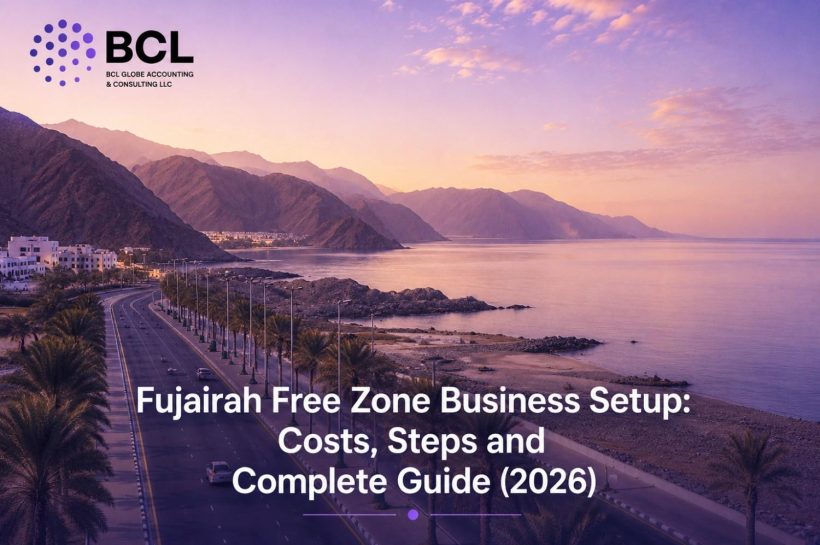
Fujairah is the only UAE emirate on the Gulf of Oman, with direct access to the Indian Ocean and bypassing the Strait of Hormuz. That geography matters: Fujairah Port is one of the world’s top three bunkering hubs, and the emirate’s free zones cater to maritime, oil and gas, trading, and increasingly to services and digital businesses.
This guide covers what you need to decide: which Fujairah based free zone fits your business, indicative 2026 costs, the step by step setup process, the document checklist by entity type, and the corporate tax obligations that apply from day one.
If you’re still comparing mainland and free-zone structures in the UAE, read our detailed guide on Free Zone vs Mainland Company Setup in the UAE before deciding on the right jurisdiction.
Important Note on IFZA
A common point of confusion: IFZA (International Free Zone Authority) was originally established in Fujairah in 2018, but it relocated to Dubai (Dubai Silicon Oasis) in August 2020 and now operates under the Dubai Silicon Oasis Authority. IFZA is a Dubai free zone, not a Fujairah one. The rest of this guide covers the genuinely Fujairah based options.
Fujairah-Based Free Zones
Fujairah Free Zone Authority (FFZA)
Established in 1987 by Emiri Decree, the original government free zone operating under the Fujairah government. Direct access to Fujairah Port and Fujairah International Airport. Covers a broad activity list spanning trading, services, light manufacturing, and consultancy.
Fujairah Creative City Free Zone
Specialised free zone for media, content, marketing, consultancy, and creative services. Competitive packages for freelancers and solopreneurs. Streamlined remote setup.
Fujairah Oil Industry Zone (FOIZ)
Designated zone for oil storage, refining, and energy sector operations. Critical to the UAE’s energy infrastructure. Not relevant for most SMEs, included here for completeness.
Key Benefits of a Fujairah Free Zone Setup
100% foreign ownership
Foreign nationals can own 100% of their Fujairah free zone company. No local sponsor, partner, or service agent required. Applies to all entity types: FZE, FZC, branch, and freelance.
Tax position
Personal income tax: 0%. The UAE has no personal income tax. Corporate tax: 9% federal rate above AED 375,000, in effect since 1 June 2023. Fujairah free zone companies may qualify as Qualifying Free Zone Persons (QFZPs) and benefit from a 0% rate on qualifying income, subject to substance, qualifying income, transfer pricing, and audit conditions under Cabinet Decision No. 100 of 2023 and Ministerial Decision No. 265 of 2023. Small Business Relief is available separately for eligible entities with revenue at or below AED 3 million, for tax periods ending on or before 31 December 2026 (see the corporate tax section below for an important condition on how this interacts with QFZP status).
Cost advantage
Fujairah free zone packages generally undercut Dubai equivalents, with indicative starting licence costs from approximately AED 9,000 to 15,000 for service and consultancy entities. Total first year cost, including licence, flexi-desk, one visa, and cards, typically lands at AED 20,000 to 30,000.
Strategic location
Only UAE emirate on the Gulf of Oman with direct access to the Indian Ocean. Top three global bunkering hubs. Dubai is a 1.5 hour drive. Sharjah is approximately 1 hour.
Cost Breakdown (FFZA, 2026)
| Item | Indicative AED | Notes |
| Service / consultancy licence | 9,000 to 15,000 | Activity dependent |
| Trading licence | 12,000 to 20,000 | May require warehouse for some activities |
| Industrial licence | 20,000+ | Plus facility costs |
| Flexi-desk / virtual office | Approx. 5,000 | Annual |
| Establishment + immigration cards | Approx. 3,000 | Annual |
| Visa (per person) | Approx. 4,000 to 5,000 | Including medical and Emirates ID |
Indicative for 2026. Confirm against the current FFZA or Fujairah Creative City quote before signing.
License Types Available
Trading license
Import, export, distribution, and wholesale trading of physical goods. Custom import and export codes are available.
Service / consultancy license
Professional services, IT, marketing, management consultancy, education, and training.
Industrial license
Light manufacturing, processing, and assembly. Requires a dedicated facility.
Freelance / individual professional
Solo professionals operate under a single activity. Typically, one visa.
License Comparison: Trading, Service, Industrial, Warehousing and E-Commerce
Each license type is tied to a specific facility requirement and activity scope. Choosing the wrong one at application stage is the most common, and most expensive, correction to make later, since amending activities or license type after issuance carries its own fee.
| Licence type | Permitted activity | Facility requirement | Typical use case |
| Trading | Import, export, distribution, and wholesale of physical goods; a defined number of activities per licence | Flexi-desk for invoicing-only trade; warehouse where physical stock is held | Import/export businesses, distributors |
| Service / consultancy | Professional services, IT, marketing, management consultancy, education and training | Flexi-desk or office | Consultants, agencies, professional firms |
| Industrial | Light manufacturing, processing, assembly of goods | Dedicated industrial facility or land plot, sized to the process | Manufacturers, processors, assemblers |
| Warehousing | Storage, handling, and redistribution of goods on behalf of the license holder or third parties | Warehouse unit sized to storage volume; cold storage available for specific goods categories | Logistics operators, distributors holding stock |
| E-commerce | Online sale of goods or services through a digital storefront, with UAE or cross-border delivery | Flexi-desk is typically sufficient; a warehouse is added only if physical inventory is held locally | Online retailers, digital marketplaces, UAE-routed drop shipping models |
Confirm exact activity codes and permitted activity combinations with FFZA or Fujairah Creative City before application, since these are updated periodically.
Facility Requirements by License Type
Flexi-desk
A shared desk arrangement within the free zone authority’s own building. Sufficient for service, consultancy, and most e-commerce licenses where the business does not need to receive visitors or hold physical stock. Usually the cheapest and fastest facility option to activate.
Office
A dedicated, lockable office unit, required where the license mandates a private workspace, where the visa quota exceeds what a flexi-desk supports, or where the business receives clients on site. Office sizes scale with the number of visas applied for.
Warehouse
Required for trading activities that hold physical stock, for the warehousing license, and for most industrial licenses involving storage of raw materials or finished goods. Warehouse allocation is typically sized in square metres against the declared activity and stock volume.
Land use
Available for larger industrial or manufacturing setups that need a purpose built facility rather than a standard warehouse unit. Land allocation involves a separate agreement with the free zone authority and a longer setup timeline, since construction or fit-out follows the land handover. Facility choice is not purely a cost decision: it is checked against the activity and visa quota during licensing, so an undersized facility for the declared activity is a common cause of application queries.
Document Checklist by Entity Type
Document requirements differ depending on whether the applicant is an individual shareholder, a corporate shareholder, or a branch of an existing company. Reviewing the correct list before submission avoids the most common cause of delay: resubmission after a missing document is flagged mid-process.
Individual shareholder
- Passport copy, valid 6+ months, for each shareholder and manager
- Passport-size photograph
- Trade name reservation certificate, confirming the proposed company name is available and compliant with naming rules
- Initial approval from the free zone authority to proceed with registration
- Application form and a brief business plan or activity description
- Proof of residential address
- Letter of intent, where the authority requires a signed statement of intended business activity ahead of full licensing
- Registry Identification Code (RIC) form, used to register the shareholder or manager in the free zone’s registry system
- Specimen signature form, typically notarised, for banking and registry records
Corporate shareholder
Where the shareholder is itself a company rather than an individual, the free zone authority requires evidence that the parent entity is validly incorporated and authorised to invest.
- Certificate of incorporation of the parent company, attested and, for foreign entities, legalised through the UAE embassy in the country of origin
- Memorandum and Articles of Association, or equivalent constitutional documents
- Board resolution for manager/director, authorising the specific individual to sign on the parent company’s behalf and appointing the manager of the Fujairah entity
- Power of attorney, where a representative other than a director is signing documents locally
- Certificate of good standing, confirming the parent company is active and compliant in its home jurisdiction, usually required within 3 to 6 months of issuance
- Audited financial reports for corporate shareholders, typically the most recent full year set, also requested by the bank during account opening
- Passport copies of the ultimate beneficial owners holding 25% or more
Branch of an existing company
A branch does not create a new legal entity; it extends an existing one into Fujairah, which changes the document set slightly.
- Certificate of incorporation and trade licence of the parent company, attested
- Board resolution for manager/director, specifically authorising the branch’s establishment and naming the branch manager
- Power of attorney in favour of the branch manager or PRO handling local formalities
- NOC from current sponsor, where the appointed branch manager is already sponsored under another UAE employer or free zone entity and needs a release before transfer
- Board-approved activity list confirming the branch will operate within the parent company’s licensed scope
Facility-related documents, all entity types
- Lease agreement for the chosen facility, whether flexi-desk, office, or warehouse
- Unit title deed copy, where the applicant owns rather than leases the facility, or where the facility is held by a related party
Initial Approval, Registration and Licensing: What Each Stage Involves
The setup process is often summarised as a single flow, but it runs through three distinct stages, each with its own documents and its own point of no return.
Stage 1: Initial approval
The free zone authority reviews the proposed activity, name, and shareholder structure, and issues initial approval confirming there is no objection to proceeding. This is not yet a license and does not permit trading. At this stage, the authority checks the trade name reservation certificate against naming rules and confirms the activity is permitted under the license type requested.
Stage 2: Registration
With initial approval granted, the applicant submits the full document set, signs the lease agreement for the chosen facility, and completes the Registry Identification Code (RIC) form and specimen signature formalities. Corporate shareholders submit their certificate of incorporation, board resolution for manager/director, and certificate of good standing at this stage.
Stage 3: Licensing
Once registration is verified and fees are paid, the free zone authority issues the trade licence. This is the point at which the company can legally begin trading, apply to open a corporate bank account, and apply for visas. License issuance is typically 3 to 5 business days from a clean, complete file; incomplete corporate shareholder documentation is the most common cause of delay beyond this window.
Step-by-Step Setup Process
Step 1: Choose free zone and activity
FFZA suits trading and broader operations; Fujairah Creative City suits media, content, and consultancy. Define activities carefully, since adding activities later costs AED 1,000 to 2,500 each.
Step 2: Reserve company name
The name must comply with the zone’s naming rules: no offensive terms, no duplicates, and the correct suffix (FZE or FZC).
Step 3: Submit application
Documents required: passport copy (valid 6+ months), passport-size photograph, brief business plan, and proof of address. Corporate shareholders additionally submit certificates of incorporation, board resolution, and good standing certificate, per the full checklist above.
Step 4: Pay license fees and receive license
The license is typically issued in 3 to 5 business days from clean documentation.
Step 5: Apply for visas
Standard UAE visa process: entry permit, medical examination, Emirates ID, and visa stamping. 2 to 4 weeks per visa. See the visa timeline table below for a stage by stage breakdown.
Step 6: Open corporate bank account
UAE banks conduct strict KYC on free zone companies. Banks that commonly work with Fujairah free zone companies include RAK Bank, ADCB, and digital banks such as Wio and Mashreq Neo. Allow 2 to 6 weeks. See the KYC preparation section below.
Step 7: Register for VAT and corporate tax
VAT registration is mandatory above AED 375,000 in taxable supplies, and voluntary above AED 187,500. Corporate tax registration is required on EmaraTax within the deadline set out in the corporate tax section below. A flat AED 10,000 penalty applies for late registration, regardless of revenue, though a penalty waiver may apply; see the registration deadline section below.
Visa Quota, Timeline and Cost Breakdown
Visa quota in Fujairah’s free zones is generally tied to facility size and licence type rather than fixed per company. A flexi-desk typically supports one to a small handful of visas; larger office or warehouse facilities support proportionally more.
| Stage | Typical duration | Indicative cost (AED) |
| Entry permit issuance | 2 to 5 working days | Included in visa package or charged separately by facility |
| Status change / entry stamping, for applicants inside the UAE | 1 to 3 working days | Minor typing and stamping charges |
| Medical fitness test | Same day to 2 working days for results | Approx. 300 to 500 |
| Emirates ID application and biometrics | 1 day to book; ID delivered in 1 to 2 weeks | Approx. 300 to 400 |
| Visa stamping | 3 to 7 working days after medical clearance | Included in overall visa fee |
| Total per visa | 2 to 4 weeks end to end | Approx. 4,000 to 5,000, consistent with the indicative figure used elsewhere in this guide |
Costs and processing times vary by facility package and by whether the applicant is inside or outside the UAE at the time of application. Confirm current figures with FFZA or Fujairah Creative City before budgeting.
Bank KYC Preparation for Fujairah Free Zone Companies
UAE banks apply enhanced know-your-customer scrutiny to free zone companies generally, and Fujairah-licensed entities specifically tend to draw more questions than companies from more established zones such as DMCC or DIFC. Preparing the file in advance shortens what is usually the slowest step in the entire setup process.
Documents banks typically request
- Trade licence and certificate of incorporation
- Memorandum and Articles of Association
- Board resolution for manager/director naming the account signatory
- Passport and Emirates ID copies for all shareholders and signatories
- Proof of the physical facility: lease agreement or, where owned, unit title deed
- A clear description of the business model, expected transaction volumes, and the countries the company will trade with or invoice
- Audited financial reports for corporate shareholders, where the shareholder is itself a company
- Certificate of good standing for foreign corporate shareholders
What banks scrutinise most
Source of funds, the substance of the business (a real office or warehouse, rather than a flexi-desk with no other footprint, is viewed more favourably for higher transaction volumes), and whether the declared activity matches the expected transaction pattern. Businesses trading with jurisdictions considered higher risk by the bank’s own compliance policy should expect additional questions regardless of the free zone chosen.
Budget 2 to 6 weeks for account opening with a UAE bank, longer for corporate shareholder structures. Where speed matters more than a specific bank relationship, opening with a digital bank first and migrating to a tier-1 bank later is a common sequencing choice.
Selling to the UAE Mainland: Limitations and When You Need a Distributor or Dual Licence
This is one of the most misunderstood points among first-time free zone applicants. A Fujairah free zone licence permits invoicing and service delivery to clients anywhere in the UAE, including the mainland. It does not, without further structuring, permit the direct retail sale or physical distribution of goods to mainland consumers.
What is allowed without further structuring
- Invoicing mainland clients for services rendered
- Selling goods business-to-business to a mainland-licensed distributor, who then handles onward mainland sale
- E-commerce sales fulfilled outside the mainland’s direct retail channel, depending on the platform and delivery model used
When a distributor or dual-licence structure is needed
A free zone trading company that wants to sell physical goods directly into the mainland market, operate a retail outlet, or hold mainland-facing inventory generally needs one of two structures:
- Distributor arrangement: the free zone company sells to an independent, mainland-licensed distributor, who takes on the mainland retail relationship
- Dual-licence setup: the same group holds both a free zone licence and a mainland licence, allowing direct mainland trading through the mainland entity while retaining the free zone entity’s tax and ownership benefits for other activities
Get this structuring decision right before signing a facility lease. Retrofitting a dual-licence structure after committing to a single-entity setup means a second incorporation process rather than a straightforward amendment.
Corporate Tax Registration Timeline and QFZP Conditions
Registration deadline
Every taxable person must register for corporate tax on EmaraTax, even where the expected liability is 0%. For companies incorporated on or after 1 March 2024, which covers most new FFZA and Fujairah Creative City setups today, the deadline is 3 months from the date of incorporation, per FTA Decision No. 3 of 2024. Companies incorporated before 1 March 2024 follow a staggered deadline calendar based on the month their licence was originally issued. Missing the deadline triggers a flat AED 10,000 penalty regardless of revenue or whether any tax is actually due.
A penalty waiver introduced by the FTA, effective 14 April 2025, cancels or refunds this AED 10,000 penalty where the first corporate tax return (or annual declaration, for exempt persons) is filed within 7 months of the end of the first tax period, rather than the usual 9 month filing deadline. Businesses that missed their original registration deadline should still register on EmaraTax without delay and confirm current eligibility for the waiver with BCL.
QFZP conditions, restated together
To benefit from the 0% rate on qualifying income, a Fujairah free zone entity must meet all of the following simultaneously, for the entire tax period:
- Maintain adequate substance in the UAE
- Derive qualifying income as defined under the relevant Ministerial Decision on qualifying and excluded activities
- Keep non-qualifying revenue within the de-minimis threshold: the lower of AED 5 million or 5% of total revenue
- Prepare audited financial statements
- Comply with transfer pricing rules on related-party transactions
- Not elect to be taxed at the standard rate
Failing any single condition removes QFZP status for that tax period and the following four tax periods, per Ministerial Decision No. 265 of 2023. The standard 9% rate then applies to all income, not only the non-qualifying portion, for the entire period of disqualification.
A note on Small Business Relief and free zone companies
Small Business Relief lets eligible resident businesses with revenue at or below AED 3 million elect to be treated as having no taxable income, for tax periods ending on or before 31 December 2026. It is a useful option for a Fujairah free zone company that is not pursuing QFZP status. It is not, however, available to a company that is a Qualifying Free Zone Person: the two reliefs are mutually exclusive, and a QFZP already benefits from 0% on qualifying income through the QFZP regime itself rather than through Small Business Relief.
Compliance timeline at a glance
| Milestone | Deadline |
| Corporate tax registration, new company | Within 3 months of incorporation |
| VAT registration, mandatory | Within 30 days of exceeding AED 375,000 in taxable supplies over the preceding 12 months, or the anticipated 30 day period |
| Corporate tax return filing | 9 months after the end of the tax period (or 7 months where the FTA penalty waiver is being relied on for a late registration) |
| Small Business Relief election, if applicable and non-QFZP only | Made on the corporate tax return, for periods ending on or before 31 December 2026 |
What We See Most Often: BCL Globiz Experience
Clients choose Fujairah primarily for cost, and Fujairah does undercut Dubai on starting licence fees, though the size of the gap depends heavily on which Dubai free zone you compare against. The trade-off most underestimate is banking. UAE banks are more conservative with Fujairah-licensed entities than with DMCC or DIFC entities. Build that into the timeline: budget 6 to 8 weeks for bank account opening with a tier-1 bank, or start with a digital bank account and migrate later.
Most-missed compliance step: corporate tax registration. For companies set up on or after 1 March 2024, the deadline is 3 months from incorporation, not tied to the trade licence issuance month in the way older entities are assessed. Get the registration done early in the first quarter of operation. The AED 10,000 penalty is a flat fee regardless of revenue, though it can be waived where the first return is filed within 7 months of the first tax period end.
Frequently Asked Questions
Is IFZA a Fujairah free zone?
Not anymore. IFZA was established in Fujairah in 2018 but relocated to Dubai (Dubai Silicon Oasis) in August 2020. It now operates under the Dubai Silicon Oasis Authority and is a Dubai free zone.
How much does it cost to set up in a Fujairah free zone?
Indicative starting costs in 2026: service and consultancy licences from approximately AED 9,000 to 15,000; trading licences from approximately AED 12,000 to 20,000. Total first year cost, including flexi-desk, establishment and immigration cards, and one visa, typically lands at AED 20,000 to 30,000.
Can a Fujairah free zone company do business across the UAE?
Yes, for invoicing: Fujairah free zone companies can invoice clients anywhere in the UAE. Selling physical goods directly to mainland consumers typically requires a mainland trade licence or a dual-licence arrangement, as set out in the mainland selling section above.
Are Fujairah free zone companies subject to UAE corporate tax?
Yes. They are subject to UAE corporate tax under Federal Decree-Law No. 47 of 2022, but may benefit from a 0% rate on qualifying income if they meet QFZP conditions. Non-qualifying income is taxed at 9% above AED 375,000. Note that QFZPs cannot separately elect Small Business Relief.
Which is better for me: FFZA or Fujairah Creative City?
FFZA suits broader trading, industrial, and full-company setups. Fujairah Creative City suits media, content, marketing, freelance, and digital businesses. Both offer 100% foreign ownership and similar QFZP eligibility.
Reach out to our experts at info@bcl.ae to confirm current fees and to start your Fujairah free zone application.