



E-commerce Accounting in the UAE: What you need to know?
E-commerce in the UAE has gone from a side hustle to a serious business model. Instagram shops, Amazon.ae storefronts, Noon marketplaces, Shopify sites shipping across the Gulf, all of it adds up to real turnover. Behind every sale, the same basic accounting cycle runs in the background: the customer pays, the platform settles a payout, the books get updated, tax gets calculated and a return eventually gets filed with the FTA. For a broader look at how this process works, see our guide to accounting for e-commerce businesses. This cycle works fine as long as a business stays small and simple. The moment a seller adds a second sales channel, splits stock across a fulfilment partner or starts shipping outside the UAE, small gaps in that cycle start turning into real problems. This is where professional accounting and bookkeeping services can help keep sales, inventory, reconciliations, VAT and tax records aligned. Where Online Sellers Get Stuck, and How BCL Globiz Helps? Problem What this looks like How BCL Globiz helps Sales scattered across too many channels A fashion seller mixes a Shopify payout, a Noon payout, and cash-on-delivery reconciliations into one spreadsheet column, and within a month nobody can say which channel is actually profitable. We consolidate every sales channel into one clean ledger, so your VAT filings and annual accounts are built on numbers you can trust. Inventory and cost of goods that do not add up A seller splits 500 units of stock across a home store, a fulfilment centre, and a marketplace warehouse, and ends up thinking a bestseller is profitable when it is barely breaking even once fulfilment fees are counted. We track inventory and cost of goods sold across every location and channel, so the margin in your accounts is the margin you are actually making. Not knowing when VAT registration kicks in A candle seller makes AED 260,000 on their own Shopify store and AED 150,000 through Noon. Neither number alone crosses AED 375,000, but the combined AED 410,000 does, and registration was mandatory the moment it did. We monitor your combined turnover across every channel, flag the threshold before you cross it, and handle FTA registration on EmaraTax from start to finish. Not knowing where VAT is actually due A skincare brand charges 5% on a sale to Sharjah but can zero-rate a sale to London instead, only if it keeps the shipping and export paperwork proving the goods actually left the UAE. We classify every supply correctly, standard rated, zero rated, or exempt, and set up the export documentation trail you need to stay defensible in an audit. Marketplaces that already collect VAT for you A phone accessories seller adds VAT on top of a marketplace sale that the marketplace already collected and paid to the FTA itself, and ends up reporting tax that was never theirs to collect. We confirm where this deemed supplier rule applies to your listings, and make sure your own VAT return reflects the correct position rather than double counted tax. Claiming VAT back on purchases without checking suppliers A seller buys packaging from a new supplier and claims the VAT back as usual. The supplier later turns out to be dodgy, and the FTA refuses the claim because there is no record that the seller checked the supplier out first. We build the supplier verification process and paper trail the FTA now expects, so your input VAT claims stay defensible. Corporate tax and free zone status colliding A free zone seller starts shipping to mainland UAE customers alongside their free zone sales, and part of their income no longer qualifies for the free zone tax benefit, even though their trade licence has not changed. We assess your structure, confirm your corporate tax position, and manage VAT and corporate tax together rather than as two disconnected problems. A Closer Look at Two of the Trickier Decisions Two of the problems above are worth walking through visually, because they involve a decision tree rather than a single rule. Do you need to register for VAT yet? Where does your stock actually go, and What does it cost? The Numbers Worth Keeping On Hand Item Figure to remember Mandatory VAT registration AED 375,000 taxable turnover in 12 months Voluntary VAT registration AED 187,500 taxable turnover in 12 months Standard VAT rate 5% VAT return filing and payment Within 28 days of the end of the tax period Corporate tax 9% on taxable income above AED 375,000 Input VAT supplier verification (FTA Decision No. 13 of 2026) Effective 1 October 2026 VAT record retention At least 5 years Why UAE E-commerce Sellers Work with BCL Globiz? BCL Globiz is a UAE-based accounting, tax, and business advisory firm built around exactly this kind of multi-channel complexity. Rather than treating bookkeeping, inventory, VAT, and corporate tax as separate jobs handled by separate people, we manage them together as one connected picture of your business, which is how an online seller’s finances actually work. For an online seller, that means one advisor who understands how a Noon payout, a warehouse stock transfer, and a free zone trade licence all feed into the same set of books and the same tax filings, rather than three separate specialists working from three separate pictures of your business. Conclusion None of this means e-commerce in the UAE is not worth doing. It means the accounting behind it needs the same attention as the storefront itself. The sellers who get caught out are almost never the ones deliberately cutting corners, they are the ones who did not realise how many moving parts were involved until the numbers stopped adding up or an FTA letter arrived. BCL Globiz works with online sellers at every stage of that cycle, from reconciling your first multi-channel payout through to VAT registration and corporate tax filing, so you can focus on running the store while we handle the accounting behind it. If any of the problems above sounded familiar, that is usually
Transfer Pricing for IP: Royalty Rates and UAE Rules

Setting a defensible royalty rate for related-party intellectual property is one of the highest-stakes decisions in transfer pricing, because even a small percentage difference can shift substantial profit between jurisdictions. This guide explains how IP royalty rates are determined under the arm’s length standard, how DEMPE analysis allocates IP returns, which methods apply, and what UAE businesses need to do to stay compliant under the corporate tax regime. Key Takeaways What Is Transfer Pricing for Intellectual Property? Transfer pricing for intellectual property is the pricing of IP use or transfer between related entities, such as subsidiaries, parent companies, or entities under common ownership, so that the charge reflects what independent parties would have agreed under similar facts. The OECD Transfer Pricing Guidelines treat royalties as consideration for the use of, or the right to use, intangibles, and they set out the arm’s length principle as the baseline standard for pricing those transactions. The reason IP royalties attract close scrutiny is structural: intellectual property often has no physical form, its value is difficult to observe directly, and it can be assigned or licensed across borders with minimal operational friction. This makes IP licensing a natural area of focus for profit allocation, and tax authorities in many jurisdictions, including the UAE Federal Tax Authority, review related-party royalties carefully. What Counts as Intellectual Property for Transfer Pricing Purposes? For transfer pricing purposes, the relevant intangible assets typically include: The OECD guidance is intentionally broad: if an asset has commercial value, is used or could be used in business, and is not a financial or tangible asset, it is likely to be treated as an intangible for transfer pricing purposes. The critical question is not whether IP is legally registered, but whether it generates economic value that an independent party would pay to access. How Royalty Rates Work in Related-Party IP Transactions A royalty is the consideration a licensee pays a licensor for the right to use intellectual property. In related-party arrangements, the royalty can be structured as: The choice of royalty base matters for transfer pricing because it affects how the royalty interacts with the licensee’s profitability at different sales volumes. A revenue-based royalty is stable but may produce excessive charges if the licensee’s margins are thin. A profit-based royalty can align returns more closely with commercial performance but is often harder to benchmark against third-party comparables. The Arm’s Length Principle and IP Royalty Rates The arm’s length principle requires that related-party IP royalties be priced as if the licensor and licensee were independent parties negotiating at fair market value. This standard is embedded in the OECD Transfer Pricing Guidelines and is applied by the UAE under Federal Decree-Law No. 47 of 2022 on Corporate Tax, which subjects related-party and connected-person transactions to an arm’s length test. In practice, applying the arm’s length principle to royalties involves three questions: Where a royalty deviates from an arm’s length outcome without justification, the Federal Tax Authority may adjust taxable income accordingly. DEMPE Analysis: Who Creates and Controls the IP Value? DEMPE stands for Development, Enhancement, Maintenance, Protection, and Exploitation, which are the five categories of functions that generate and preserve the value of intangible assets under the OECD framework. DEMPE analysis is the mechanism by which transfer pricing rules determine who is economically entitled to the returns from IP, as opposed to who merely holds legal title. Legal ownership gives an entity the contractual right to receive royalties, but it does not automatically justify those royalties if the entity does not perform or control the relevant DEMPE functions. In practice this means: DEMPE analysis therefore shapes not just the royalty rate but the entire structure of the intercompany IP arrangement. Common Transfer Pricing Methods for IP Royalty Rates Three methods are most commonly applied to IP royalty benchmarking: Comparable uncontrolled transaction (CUT) method The CUT method compares the controlled royalty with rates observed in third-party licence agreements involving comparable IP, comparable rights, and comparable commercial terms. It is generally the most direct method when reliable comparables are available. Commercial databases such as RoyaltyRange, along with public filings and court materials, are often used to identify third-party agreements for benchmarking. Transactional profit split method The profit split method is used where the IP is unique, highly integrated, or where both parties make significant non-routine contributions. Rather than benchmarking a rate directly, it allocates combined profit based on each party’s relative contribution to value creation, assessed through DEMPE analysis and financial data. Transactional net margin method (TNMM) TNMM examines whether the licensee’s net profit margin, after paying the royalty, falls within an arm’s length range compared to independent companies performing similar functions. This method does not benchmark the royalty directly but tests whether the royalty leaves the licensee with an arm’s length return. The OECD guidance does not prescribe a single method. The most appropriate method is determined by the facts of the transaction, the availability of comparables, and the reliability of the data. How to Benchmark an Arm’s Length Royalty Rate A defensible royalty benchmarking study typically follows this sequence: Factors That Influence IP Royalty Rates There is no universal market rate for IP royalties. Rates vary significantly based on the following factors: One conceptual framework that practitioners reference is that royalties typically capture a portion of the profit attributable to the IP rather than the entire margin. The precise allocation depends on all the above factors and must be supported by comparable evidence rather than a rule of thumb. UAE Transfer Pricing Requirements for IP and Royalties UAE businesses operating under the corporate tax regime are required to price related-party and connected-person transactions on an arm’s length basis. This requirement applies to royalty payments made or received between related parties, whether domestic or cross-border. Documentation requirements depend on applicable thresholds. UAE taxpayers that meet the prescribed criteria under the transfer pricing rules may be required to prepare: Royalty arrangements that lack documentation, particularly written licence agreements and benchmarking support, are exposed to transfer pricing
Mandatory Supplier Checks- Know What Changes from 1st October 2026 and How it affects your business?
From 1 October 2026, holding a valid tax invoice will no longer be enough to safely claim input VAT in the UAE. The Federal Tax Authority (FTA) has issued Decision No. 13 of 2026, which requires VAT-registered businesses to actively check who they are buying from and what they are buying, before claiming that VAT back. If your business cannot show it did these checks, the FTA can deny the input VAT recovery, and in serious cases, that denial is permanent. This guide explains the new rules in plain language, what has actually changed compared with the old approach, and what you need to have in place before the deadline. Reviewed by Punith Jindal, Partner at BCL Globiz Why this decision exists? In 2025, Federal Decree-Law No. 16 of 2025 amended the VAT Law and added a new provision, Article 54 bis. This gave the FTA the power to refuse input VAT recovery where a supply is part of a chain connected to tax evasion, even if the recipient business was not directly involved in that evasion. Article 54 bis left one practical question unanswered: how is a business supposed to know, or prove, that it acted in good faith? FTA Decision No. 13 of 2026 answers that question. It sets out the exact steps a business must take to show it exercised reasonable care before claiming input VAT. “The shift here is about the burden of proof,” says Punith Jindal, Partner at BCL Globiz. “Until now, a valid tax invoice was generally treated as sufficient support for an input VAT claim. Under this decision, that is no longer the case. Businesses need to show they actively checked who they were dealing with, and that the transaction itself made commercial sense, before they can rely on that recovery.” The decision was approved by the FTA Board on 23 June 2026, issued on 22 July 2026, and published on the FTA website on 20 August 2026. It applies to every taxable person under the VAT Law, meaning any business that is registered, or required to be registered, for VAT in the UAE. The old approach versus the new approach The table below sets out, in simple terms, how things worked before this decision and how they will work once it takes effect. What FTA looked at Before 1 October 2026 From 1 October 2026 Proof needed to claim input VAT A valid tax invoice was normally enough on its own. A valid tax invoice alone is not enough. You also need proof that you checked the supplier and the supply. Checking who you buy from No formal requirement to verify a supplier’s identity or legitimacy before claiming input VAT. You must verify the supplier’s identity documents, the person authorised to represent them, and confirm they genuinely operate from their stated business address. Repeat checks Not required. Supplier checks must be refreshed at least once every twelve months, or sooner if you spot a risk indicator. Higher-value suppliers No extra checks tied to transaction value. Where a supplier’s annual supplies to you go over AED 375,000, you also need written confirmation from a UAE bank that the supplier holds an account there, plus a look at public reviews and media coverage. Every individual supply Generally not checked supply by supply. Each supply must be checked for genuine commercial reason, reasonable pricing, and whether the goods or services match the supplier’s licensed activity. Cash payments No specific documentation requirement. Payments should be electronic. Any cash payment needs a documented business reason. Internal policy No requirement for a written process. A written policy is required, naming who performs, reviews, and supervises the checks. Small purchases Not applicable. Supplies under AED 10,000 (excluding VAT) are generally exempt, unless that supplier’s total supplies to you pass AED 100,000 in a twelve-month period, in which case full checks apply anyway. Consequence of getting it wrong Input VAT recovery was rarely challenged if the invoice looked valid. The FTA can deny input VAT recovery, and in some cases the denial is permanent, where a supply is linked to tax evasion and you knew, or should have known, about it. The two levels of checks you now need to do The decision splits the verification work into two separate exercises. Think of the first as checking the person you are dealing with, and the second as checking the deal itself. 1. Supplier verification: checking who you are dealing with This is done the first time you deal with a new supplier, and then repeated at least once every twelve months. It covers: If a supplier’s annual supplies to you go above AED 375,000, there is an extra step: you need unqualified written confirmation from a UAE-licensed bank that the supplier holds an account there, along with a check of the supplier’s public reputation, such as reviews and media coverage. 2. Supply verification: checking each individual transaction This applies to every supply you receive, not just new suppliers, and is the more demanding of the two. For each supply, you should be able to show: Payments should be made electronically. If a payment is made in cash, you need a documented reason for it, since cash payments are one of the patterns the FTA is watching for. The thresholds explained simply Three numbers matter under this decision. Here is what each one does. Threshold Trigger What it means for you AED 10,000 Value of a single supply, excluding VAT Below this, the supply is generally exempt from the detailed verification checks, on its own. AED 100,000 Total supplies from one supplier over a rolling 12 months Once a supplier crosses this in aggregate, the AED 10,000 exemption no longer applies. Full checks are required on all supplies from that supplier, however small each invoice is. AED 375,000 Total supplies from one supplier over a rolling 12 months Above this, you also need written UAE bank confirmation of the supplier’s account, and a review of their public reputation. A useful
Small Business Relief UAE Extended to 2029: What SMEs Need to Know
This one didn’t come out of nowhere. Small Business Relief was due to expire at the end of 2026, and for months that deadline had SME owners asking us the same question on repeat: what happens after 2026? We had been fielding a steady stream of these queries, and the Ministry of Finance has now answered them. The Ministry of Finance has extended Small Business Relief (SBR) under UAE Corporate Tax. Instead of ending in 2026, it now covers tax periods ending on or before 31 December 2029, three more years of simplified treatment for eligible SMEs. What hasn’t changed is the eligibility bar. Revenue must stay at or below AED 3 million each period since 1 June 2023. Qualify, and you can elect nil taxable income for that period. Need a complete guide to Small Business Relief explaining eligibility, elections and tax return filing requirements for UAE businesses. The legal basis is Ministerial Decision No. 73 of 2023 (issued under Article 21 of Federal Decree-Law No. 47 of 2022), as amended by Ministerial Decision No. 131 of 2026 to push the end date out to 31 December 2029. The Ministry has said the extension is meant to ease the compliance burden on start-ups and small businesses while reinforcing the UAE’s position as a competitive, business-friendly investment destination. Key dates at a Glance Date What it means 1 June 2023 Small Business Relief takes effect. 31 December 2026 Original SBR end date under Ministerial Decision No. 73 of 2023, now superseded. 31 December 2029 New SBR end date under Ministerial Decision No. 131 of 2026. 30 September 2026 Filing and payment deadline for taxpayers whose financial year ended 31 December 2025. Worth noting: SBR is not a Compliance Holiday Two myths keep tripping up business owners: “No taxable income means no transfer pricing rules.” False. If you have related-party transactions crossing documentation thresholds, master file and local file obligations still apply, and the FTA can request them during an audit. “Simplified tax means simplified bookkeeping.” False. You still must: Cross that threshold once, and SBR is gone for that period. There’s a third myth worth flagging: splitting a business to keep each entity under AED 3 million doesn’t fly either. If the FTA determines that a business has artificially separated its activities to benefit from SBR, this is treated as an arrangement to obtain a corporate tax advantage, and general anti-abuse provisions can apply on top of losing the relief itself. What the FTA has Clarified? Alongside the Ministry of Finance’s decision, the Federal Tax Authority reiterated that SBR eligibility does not reduce a taxpayer’s obligations under the Corporate Tax Law. For every tax period, eligible businesses must still register for Corporate Tax, submit their return (even a simplified one), and maintain records that support the figures and elections in that return. The FTA has also flagged upcoming deadlines. Taxpayers whose financial year ended on 31 December 2025 must file their Corporate Tax return and settle any tax due by 30 September 2026. The extension changes the relief’s end date, not the filing calendar in between. What SME owners should do now? Bottom line The extension buys small businesses real time, but it eases the calculation, not the compliance. Use the runway to keep records tight, and 2030 won’t be a scramble. Frequently Asked Questions Who can claim Small Business Relief? Resident taxable persons whose revenue is AED 3 million or below, in the current period and every previous period since 1 June 2023, can elect for SBR, provided they are not a Qualifying Free Zone Person or part of an MNE Group above the consolidated revenue threshold. Has the AED 3 million revenue threshold changed? No. The threshold set out in Ministerial Decision No. 73 of 2023 stays the same. Only the end date has moved, from 31 December 2026 to 31 December 2029. Is Small Business Relief automatic? No. It’s opt-in. You need to elect for SBR when filing your Corporate Tax Return through EmaraTax. Does SBR remove transfer pricing obligations? No. If related-party transactions cross the documentation thresholds, master file and local file requirements still apply, and the FTA can request them during an audit. What happens if my revenue exceeds AED 3 million in a single period? You lose eligibility for SBR for that tax period. Each period is assessed on its own, so you will need to reassess your position again for the next one based on actual revenue.
Corporate Tax and VAT Compliance Packages in the UAE: Essential vs Grow
Every UAE business reaches a point where corporate tax compliance alone is not enough. As turnover grows and VAT registration becomes mandatory, a business needs a package that covers both. BCL Globiz built the Essential and Grow packages for exactly this journey, so you can move from basic corporate tax compliance to full tax compliance without switching providers or losing continuity in your accounting records. This guide breaks down what each package includes, who each one is built for, and how to decide which corporate tax and VAT compliance plan is right for your business in the UAE. If your business needs expert guidance beyond compliance, explore our Corporate Tax Services in the UAE to ensure you meet all FTA requirements. Why UAE Businesses Need a Structured Corporate Tax and VAT Compliance Plan? Since the introduction of UAE corporate tax under Federal Decree-Law No. 47 of 2022, every taxable person is required to register with the Federal Tax Authority, maintain proper accounting records, and file annual corporate tax returns. Businesses that cross the VAT registration threshold carry an additional layer of quarterly VAT compliance on top of this. Missing a corporate tax filing deadline or a VAT return submission can lead to administrative penalties, so having a dedicated accounting and tax compliance partner matters from day one. BCL Globiz Accounting & Consulting L.L.C. is a DED-licensed accounting, tax, and business setup firm based in Dubai, working with over 1,000 active clients across 30 or more industries. Our Essential and Grow packages are designed to match your compliance obligations to your stage of growth, with accounting and bookkeeping included free in both. What a Missed Corporate Tax or VAT Deadline Actually Costs? The Federal Tax Authority does not offer grace periods, and penalties apply automatically the day after a deadline passes. Understanding the real cost of a missed filing is often what convinces a business to put a compliance package in place before a deadline, not after one. Corporate Tax Penalties VAT Penalties These figures move under new Cabinet Decisions from time to time, so always confirm the current schedule with your BCL Globiz advisor before relying on a specific number. What does not change is the principle: a dedicated compliance package built around your filing calendar is the most reliable way to avoid triggering these penalties in the first place. What the Essential Package Covers? The Essential package is built for startups and newly incorporated companies that need to get their corporate tax compliance in order without paying for services they do not yet need, such as VAT. What is Corporate Tax in the UAE UAE corporate tax is a federal tax on business profits, introduced under Federal Decree-Law No. 47 of 2022 and effective for financial years starting on or after 1 June 2023. Taxable income up to AED 375,000 is taxed at 0%, and taxable income above that threshold is taxed at 9%. Every taxable person must register with the Federal Tax Authority through the EmaraTax portal and obtain a Corporate Tax Registration Number, even a business that ultimately owes 0% tax. Included in Essential If your business is not yet required to register for VAT, or your annual taxable supplies remain below the mandatory VAT registration threshold, Essential gives you full corporate tax compliance while keeping your bookkeeping accurate and audit ready from the start. If you’re registering for Corporate Tax for the first time, read our UAE Corporate Tax Registration Guide to understand the complete process and deadlines. What the Grow Package Covers? The Grow package is BCL Globiz’s most popular plan, built for growing businesses that need full tax compliance covering both corporate tax and VAT. It includes everything in Essential, plus a complete VAT compliance layer. What is VAT in the UAE? VAT, or Value Added Tax, is a 5% consumption tax charged on most goods and services at each stage of the supply chain, under Federal Decree-Law No. 8 of 2017. A VAT-registered business charges VAT on its sales, known as output tax, and can generally recover the VAT it pays on its own business purchases, known as input tax. The difference between the two is what gets reported and paid to, or reclaimed from, the Federal Tax Authority each period. Who needs to register for VAT? VAT registration is mandatory once a business’s taxable supplies and imports exceed AED 375,000 over the previous 12 months, or are expected to exceed that threshold in the next 30 days. Businesses with taxable supplies between AED 187,500 and AED 375,000 can register voluntarily, which is often worthwhile if they want to recover VAT on their own expenses. Once registered, a business receives a Tax Registration Number and takes on ongoing obligations: charging VAT correctly, issuing tax invoices, and filing VAT returns on time. This is exactly where Grow takes over. Rather than working through registration and the VAT return cycle on your own, our team handles the registration itself, checks whether voluntary registration makes sense if you are below the mandatory threshold, and manages your VAT compliance from that point forward. Included in Grow Grow is the right fit once your business crosses the VAT registration threshold or starts dealing with input and output VAT on a regular basis. Rather than juggling a separate VAT consultant, Grow keeps your corporate tax and VAT compliance under one dedicated accounting team, with one point of contact and one consistent set of books. Essential vs Grow at a Glance Feature Essential Grow Best suited for Startups needing Corporate Tax compliance and who do not need VAT Growing businesses needing full tax compliance Accounting and bookkeeping Included Included Corporate tax registration Included Included Corporate tax advisory and computation Included Included Annual corporate tax return filing Included Included VAT registration Not included Included VAT advisory Not included Included Quarterly VAT computation and filing Not included Included Pricing structure Fixed, no hidden fees Fixed, no hidden fees Transaction limit Unlimited Unlimited Revenue cap No cap No cap Refund guarantee 100%
VAT Exemption vs Exception in the UAE: What’s the Difference?
If you run a business in the UAE, you’ve probably heard both terms thrown around in the same breath, sometimes even by people who should know better. “Exempt” and “Exception” sound almost identical, but in VAT law they mean two completely different things. Get them confused, and you could end up filing returns you didn’t need to, or worse, skipping registration you actually needed. If you’re unsure how VAT rules apply to your business, our UAE VAT consultancy services can help you determine the correct tax treatment and ensure compliance with FTA regulations. What Exempt Actually Means Exempt supplies are specific goods and services that the law simply keeps outside VAT altogether. No 5%, no 0%, nothing. Under Federal Decree-Law No. 8 of 2017, this list includes things like the sale or lease of residential property (beyond the first supply), bare land, local passenger transport, and certain financial services. Here’s the part people miss: if you sell something exempt, you can’t claim back the VAT you paid on related expenses. So a residential leasing company can’t recover input VAT on maintenance costs tied to that leasing income. It’s automatic too. You don’t apply for it, and you don’t get a choice. If your activity falls on the exempt list, it’s exempt, full stop. What Exception Actually Means Exception from registration is completely different. It’s not about what you sell. It’s about whether you need a Tax Registration Number at all. If your business makes only zero-rated supplies (think exports, or specific healthcare and education services taxed at 0%), you can apply to the FTA for an exception from mandatory VAT registration. Approval means you skip the regular filing cycle entirely. But there’s a catch: you also lose the ability to recover any input VAT, since you’re not a registered taxable person in the first place. This is a request you make. It’s not automatic, and it only applies if every single supply you make is zero-rated. The moment you add even one standard-rated line to your business, that exception no longer holds. Also worth knowing: the FTA doesn’t have to say yes just because you asked. Approval is entirely at their discretion, and they’ll want to see supporting documents such as invoices, a business activity flowchart, and a clear explanation of why every supply qualifies as zero-rated before they even consider it. The Confirmation Step People Forget About Here’s something that trips a lot of businesses up. Applying for an exception isn’t a one-click, done-deal kind of process. Once you submit your request to the FTA, it doesn’t happen instantly, and there’s no guaranteed timeline for how long the review takes. What you can count on is this: the FTA will notify you by email once a decision is made. Until you have that confirmation in hand, treat your business as if the exception hasn’t been granted yet, keep tracking your supplies as normal, and don’t assume no news is good news. If your revenue mix changes later and a standard-rated supply creeps in, the FTA can reassess and withdraw the exception, so keeping clean records is still part of the deal even after approval. A Quick Example Of Each Say you run a residential leasing company in Dubai. Your income comes entirely from renting out apartments. That income is exempt supply, automatically, no application needed, but it also means you can’t claim back VAT on the maintenance, cleaning, or repair costs tied to those units. Now compare that to a UAE-based export business that sells goods exclusively to buyers outside the country. Those sales are zero-rated, not exempt. If this business crosses the AED 375,000 threshold, it can apply to the FTA for an exception from registration, but only if every single supply it makes is zero-rated. There is no room for exceptions within the exception: the moment even one standard-rated transaction shows up, the business no longer qualifies and must register like any other taxable person. If approved, no quarterly returns, but also no input VAT recovery, since it isn’t a registered taxable person in the first place. Same outcome on the surface (no VAT reclaimed either way), but two completely different paths to get there. Why The Distinction Actually Matters If you’re not sure which bucket your business supplies fall into, it’s worth getting a proper opinion before you file, rather than after an FTA query lands on your desk. BCL Globiz’s tax advisory team can walk through your specific revenue streams and confirm the right treatment. Before applying for an exception, it’s important to understand the standard VAT registration process in the UAE and the eligibility criteria. Frequently Asked Questions Can a business be both exempt and have a registration exception at the same time? Not really, and this is where a lot of businesses trip themselves up. Exemption applies to specific supplies, while an exception applies to your registration status as a whole, and it only holds if every supply you make is zero-rated. If even one of your supplies is exempt rather than zero-rated, you don’t qualify for the exception in the first place. So the two don’t really stack. You either sit in one category or the other, not both. If I get an exception from registration, do I still need to keep records? Yes, and this one catches people off guard. Getting the exception approved doesn’t mean you have to not do administration. You still need to track your supplies, because if your business starts making anything other than zero-rated sales, the FTA can reassess and cancel the exception. No records to show what changed, and you’re stuck explaining a gap after the fact. Does an exempt business need to register for VAT at all? If everything you supply is exempt, no. You don’t need to register, and there’s nothing to apply for either. It’s worth noting though that most businesses aren’t purely exempt. The moment you add even a small stream of taxable income, standard-rated or zero-rated, you may cross
UAE Gratuity Calculation 2026: Complete Guide for Employers and Employees
UAE gratuity calculation uses a tiered formula under Federal Decree-Law No. 33 of 2021. For the first five years of service: 21 working days of basic salary per year. From year six onwards: 30 working days of basic salary per year. The maximum total gratuity payable is two years of basic salary, regardless of service length. Gratuity is calculated on basic salary only for housing, transport and other allowances are excluded. Employees who resign before completing one year of service receive no gratuity. Employees who resign between one and three years receive one-third of their entitlement. Get this calculation wrong and the cost is rarely just a delay: employers may face labour complaints and potential penalties once a dispute or inspection arises, along with understated liabilities that surface at audit or during a corporate tax review, while employees risk walking away without thousands of dirhams they are legally owed. This guide sets out exactly how the formula works, who qualifies, and where employers most often go wrong. Key Takeaways Every employer and employee in the UAE private sector should hold these facts before reading further. What Is UAE End of Service Gratuity? UAE end of service gratuity is a statutory terminal benefit established under UAE Labour Law for eligible private-sector employees. It is paid as a lump sum when an employment relationship ends, whether the ending is triggered by resignation, termination, expiry of a fixed-term contract, or another qualifying reason. The entitlement is the same whether the contract simply runs its course and is not renewed or is ended early, since it is length of service, not the manner of ending, that determines the amount. The benefit exists to reward length of service and provide financial support at the point of transition, rather than being a discretionary bonus left to employer goodwill. In everyday usage, “end-of-service gratuity” and “end-of-service benefits” are related but not identical. Gratuity refers specifically to the cash component calculated on service length. End-of-service benefits, used more broadly, can encompass the full final settlement package, which includes unpaid salary, accrued annual leave, notice pay, and where applicable a repatriation ticket, in addition to the gratuity itself. Employers must ensure the gratuity is correctly calculated and then consider it alongside those other settlement items before closing an employee’s account. Who Is Eligible for End-of-Service Benefits in the UAE? Eligibility for statutory end-of-service gratuity in the UAE private sector turns on one primary condition: the employee must have completed at least one full year of continuous service with the same employer. Employees who leave for any reason – resignation, termination, or otherwise – before reaching that 12-month mark are not entitled to statutory gratuity. Once the one-year threshold is met, the entitlement generally applies to foreign employees working in the private sector. UAE nationals are usually covered under pension and social security arrangements rather than the standard gratuity model. Public-sector employees and domestic workers are governed by separate frameworks and do not fall under the same private-sector Labour Law provisions. Part-time employees and those on job-sharing arrangements may also qualify, provided they meet the continuous-service requirement and their work pattern is recognized under the applicable regulations. In those cases, the gratuity entitlement is calculated on a pro-rated basis relative to their actual working hours compared with a full-time equivalent. UAE Gratuity Calculation Rules Under Current Labour Law The current formula is set out in Article 51 of Federal Decree-Law No. 33 of 2021 on the Regulation of Labour Relations, with further detail on part-time and pro-rated cases provided in Cabinet Resolution No. 1 of 2022. The law is built on two tiers based on length of service, with the entire calculation anchored to the employee’s last basic salary. Tier one – first five years of service: 21 days of basic salary for each completed year. Tier two – service beyond five years: 30 days of basic salary for each additional completed year. Where an employee has served more than one year but the final year is incomplete, the partial year is calculated on a pro-rated basis. The critical ceiling is that the total gratuity amount, regardless of how many years are accumulated, cannot exceed the equivalent of two years’ wage. The law specifies the entitlement in days of basic wage rather than prescribing a conversion method. In practice, the daily rate is typically calculated by dividing the last basic monthly salary by 30, and that daily rate is then multiplied by the applicable number of days. How to Calculate UAE End of Service Gratuity? The calculation follows a consistent sequence. First, identify the employee’s last basic monthly salary. Second, calculate the daily basic wage, typically by dividing the monthly salary by 30. Third, apply the tiered formula to the total years of service. Fourth, check the result against the two-year wage cap. Example 1 – 1 year of service, AED 6,000 basic salary Daily wage: AED 6,000 ÷ 30 = AED 200Gratuity: 21 days × AED 200 =AED 4,200 Example 2 – 3 years of service, AED 6,000 basic salary Gratuity: 3 × 21 days × AED 200 = AED 12,600 Example 3 – 5 years of service, AED 6,000 basic salary Gratuity: 5 × 21 days × AED 200 = AED 21,000 Example 4 – 7 years of service, AED 6,000 basic salaryFirst 5 years: 5 × 21 days × AED 200 = AED 21,000Next 2 years: 2 × 30 days × AED 200 = AED 12,000Total gratuity:AED 33,000 In example 4, the employer must also verify that AED 33,000 does not exceed the equivalent of two years’ basic wage – in this case, two years at AED 6,000 per month = AED 144,000 – so no cap applies here. The cap becomes relevant only for very long service periods or where the basic salary is high. Gratuity for Limited, Unlimited, Full-Time, Part-Time, and Other Contracts Under the current UAE private-sector labour framework, the older unlimited-contract model is no longer the primary lens through which gratuity is
Why Businesses Need BCL Globiz as a Professional Accounting Consulting Services in Dubai

Running a business today takes more than managing numbers. It takes smart decisions, steady compliance, and a clear plan for growth. That is where BCL Globiz, a global accounting and consulting firm, comes in. BCL Globiz is a global accounting and consulting company with multiple branches across India and a strong presence in Dubai. From these hubs, our team supports businesses in the UK, USA, Canada, Australia, Singapore, France, Spain, the Netherlands, and several other countries. Wherever our clients operate, we bring the same Commitment: Accurate numbers, Sound advice, and a partner who genuinely understands their business. A Global Accounting and Consulting Firm With Local Expertise What began as a mission to deliver reliable financial services has grown into a truly global practice. Today, BCL Globiz operates multiple branches across India alongside a strong presence in Dubai, giving us the reach to support clients across different markets and time zones without ever losing the personal touch. Our client base spans the UK, USA, Canada, Australia, Singapore, France, Spain, the Netherlands, and many other countries. Working across so many markets has taught us that every jurisdiction comes with its own rules, expectations, and opportunities. That experience is exactly what lets us guide international clients through complexity while keeping their financial goals front and centre. Industries We Serve Our clients come from a wide range of sectors, and that variety is part of what keeps our advice sharp. We work with technology and SaaS companies managing multi-currency revenue, e-commerce and retail brands scaling into new markets, professional services firms, real estate and construction businesses, healthcare and education providers, manufacturing and trading companies, and early-stage startups building their finance function from scratch. Each industry brings its own reporting standards, cash flow patterns, and compliance requirements. Rather than applying a generic playbook, we tailor our accounting and consulting support to the realities of each sector. Accounting Services That Make Life Easier Managing finances can be time-consuming and complicated, especially while trying to run and grow a business at the same time. Our accounting services take that burden off business owners so they can focus on what they do best. We help with: Our goal is simple: Keep every financial record accurate, organised, and up to date, so business owners always know exactly where they stand. Business Consulting for Better Decisions Every business hits a turning point, whether it is improving efficiency, managing growth, or planning an expansion. Having the right advice at that moment can make all the difference. Our consulting services help businesses: We work closely with each client to understand their goals and provide practical solutions that deliver real results, not generic advice. Every point above works best when it’s backed by properly maintained books. Take a look at BCL Globiz’s accounting services in Dubai to see how our packages combine accounting, VAT and corporate tax filing under one transparent, no-hidden-fees plan. How We Work? Getting started with BCL Globiz is straightforward. We begin with a conversation to understand your business, your current financial setup, and where you want to go. From there, we recommend the right mix of accounting and consulting support rather than a fixed package that may not fit. Once onboarded, clients get a dedicated point of contact, regular reporting on a schedule that suits their business, and direct access to our team whenever a question or decision comes up. Because we work across time zones, support does not stop the moment one office closes for the day. Trusted by Clients Around the World One of the things we are most proud of is our diverse client base. Businesses from the UK, USA, Canada, Australia, Singapore, France, Spain, the Netherlands, and many other countries trust BCL Globiz to manage their accounting and financial needs. No matter where a client is located, our focus stays the same: reliable service, accurate financial support, and insights that hold up under scrutiny. We celebrate their wins, help them work through challenges, and stay by their side through every stage of the journey, whether a company is just starting out or expanding into new markets. Many of our client relationships have grown over the years simply because we take the time to understand each business and respond quickly when it matters. Why Businesses Choose BCL Globiz? Our clients choose us because we combine professional expertise with a genuinely personal approach. We do not believe in one-size-fits-all solutions. Every business is different, and we take the time to understand what makes each client’s situation unique. When you work with BCL Globiz, you get: Frequently Asked Questions: What makes BCL Globiz different from other accounting firms? Most firms specialise narrowly in either accounting or consulting. We bring both together under one roof, so clients get a single team that understands their books and their strategy instead of coordinating between separate providers. Why should an international business choose a firm based in India and Dubai over a local provider? Our branches across India and Dubai give us the infrastructure and time-zone coverage to serve global clients properly, while our hands-on experience with businesses in the UK, USA, Canada, Australia, Singapore, France, Spain, and the Netherlands means we already understand the cross-border issues a purely local firm may not encounter as often. Is BCL Globiz only useful for day-to-day bookkeeping, or does it go further? We go well beyond bookkeeping. Alongside accurate day-to-day accounting, we provide business consulting so clients get strategic input on growth, risk, and financial decisions, not just accurate records. How does BCL Globiz keep pricing transparent and flexible compared to other firms? We scope accounting and consulting engagements around what each business actually needs rather than locking clients into a fixed package. That keeps costs tied to the services being used instead of paying for capacity a business does not need, and the scope can flex up or down as the business grows. Exact costs vary by business, so it is best to contact BCL Globiz directly for a quote tailored to your
Self-Correcting Without Permission: What CTP011 Allows and What It Demands?

Ever priced a deal with a related company, only to realise later it wasn’t quite at market rate? The Federal Tax Authority (FTA) just told taxpayers exactly what to do about it, and the rules are more taxpayer-friendly than many expected, provided you keep your paperwork in order. The FTA’s new Corporate Tax Public Clarification, CTP011, spells out how a business should handle downward transfer pricing adjustments: situations where fixing a related-party price actually reduces your taxable income. The Basic Rule Under Article 34(1) of the UAE Corporate Tax Law, any transaction between related parties (a loan, a service fee, a sale of goods, management charges, whatever it is) must be priced the way two unrelated companies would price it. This is called the arm’s length principle. In practice, deals aren’t always struck at that “market” price when they’re first recorded. Maybe a loan was interest free between group companies, or a service was charged at cost with no markup. When that happens, the law says: don’t rewrite your financial statements. Instead, correct it in your Corporate Tax Return through a transfer pricing adjustment. That adjustment can go either way: – Upward adjustment: your taxable income goes up (you under-priced something you sold, or under-charged interest you should have earned). – Downward adjustment: your taxable income goes down (you over-priced something, or recorded an expense that was actually too low compared to what arm’s length would require). Why Downward Adjustments Get Special Attention? Anyone can see why the FTA is more careful about downward adjustments: they reduce the tax bill. So CTP011 sets out exactly what’s expected. 1. No pre-approval needed, but be ready for an audit. Corporate Tax in the UAE runs on self-assessment. You don’t need the FTA’s blessing before making an adjustment in your return; you decide, you file. But that adjustment can absolutely be picked apart in a tax audit later, so it needs to hold up. 2. Disclose it, no matter how small. Normally, related-party transactions only need to be disclosed in the tax return if they cross certain value thresholds. That threshold protection disappears the moment you make a downward adjustment. Every single downward adjustment must be disclosed, regardless of the transaction’s value or nature. 3. Keep your evidence file ready. If you make a downward adjustment, you should be able to produce: – The rationale: why the original price wasn’t arm’s length, and how the revised number gets you there. – An arm’s length analysis, including a proper benchmarking study. – A reconciliation between what’s in your financial statements and what you’ve reported in the tax return. – Proof that the related party on the other side of the deal made a matching (symmetrical) adjustment. One important boundary: CTP011 only covers adjustments a taxpayer makes on its own under Article 34(1). It does not cover the separate “corresponding adjustment” mechanisms in Articles 34(10) and 34(11), which deal with adjustments triggered by the FTA or by a foreign tax authority. That distinction matters more than it sounds. See the example below: Here’s a scenario that comes up constantly in UAE group structures, and it shows exactly how CTP011 plays out in practice. > A Co and B Co are related parties, both based in the UAE, both taxed at the standard 9% Corporate Tax rate. > B Co lends money to A Co, and, as is common within groups, charges no interest. > A Co determines that an arm’s length interest rate for a loan like this would be 6%. What should A Co do? Since A Co is the borrower, an arm’s length loan would have come with an interest expense. Because A Co’s books show no interest cost, its taxable income is currently higher than it should be. To fix this, A Co makes a downward adjustment in its tax return, deducting the notional 6% interest it would have paid at arm’s length. This is a textbook CTP011 situation: A Co should proactively (suo moto) make the downward adjustment, no FTA sign-off required, but it must disclose the full loan arrangement in its return regardless of the amount, and keep its benchmarking study and rationale on file. What about B Co? B Co is the lender. If it recorded no interest income, its taxable income is currently lower than it should be. B Co needs to make an upward adjustment, adding back the 6% interest income it should have earned at arm’s length. An important distinction is that B Co’s upward adjustment is not a corresponding adjustment made by the FTA under Articles 34(10) and 34(11), which deal with FTA-initiated corresponding adjustments to eliminate double taxation arising from a transfer pricing adjustment. CTP011 expressly states that these provisions are outside its scope. Instead, B Co has an independent obligation under Article 34(1) to apply the arm’s length principle and make the required upward adjustment in its own tax return. What B Co’s adjustment does, is act as useful supporting evidence for A Co. It shows both sides of the deal are being priced consistently at 6%, which is exactly the kind of “symmetrical corresponding adjustment” documentation CTP011 asks A Co to maintain. Bottom line for A Co and B Co: two separate, self-driven adjustments, one down and one up, each grounded in the same 6% benchmark, each properly documented, and each disclosed regardless of size. Businesses with intercompany transactions should consider professional Transfer Pricing Services in UAE to ensure pricing aligns with the arm’s length principle and FTA expectations. What This Means for Your Business? CTP011 gives businesses real flexibility: no need to queue up for FTA approval every time a related-party price needs correcting. But that flexibility comes with a trade-off. The burden of proof sits entirely with you, and it can be tested in an audit at any point.If you’re reviewing related-party transactions before filing, our Corporate Tax Services in Dubai can help assess transfer pricing adjustments and maintain compliance with UAE Corporate Tax regulations. Practical takeaways: – Review
Do Free Zone Companies Need Bookkeeping in the UAE?
Many free zone founders assume a 0% corporate tax rate means bookkeeping is optional. It isn’t. Free zone companies in the UAE are required to maintain proper books of accounts and supporting records under corporate tax law, VAT regulations, and applicable free zone authority rules. Yes, bookkeeping for free zone companies is a legal compliance requirement – not an optional admin task – and this applies even where a company benefits from a 0% corporate tax rate on qualifying income. Understanding what records to keep, for how long, and how the rules apply in your specific free zone is what separates compliant businesses from those exposed to penalties and operational delays. Key Takeaways Why Bookkeeping Matters for UAE Free Zone Companies Free zone companies are often set up with speed and tax efficiency in mind, and bookkeeping can feel like an afterthought when the licence is fresh and revenue is low. That perception is expensive. The UAE has operated a federal corporate tax regime since June 2023, and the Federal Tax Authority (FTA) oversees both corporate tax and VAT compliance. Free zone entities – whether they operate in DMCC, JAFZA, IFZA, RAKEZ, or another zone – are within this framework and should be able to produce accurate financial records when required. Businesses that want to stay compliant from day one can benefit from professional Bookkeeping Services in Dubai, ensuring accurate financial records, VAT compliance, and Corporate Tax readiness. Beyond the federal tax framework, free zone authorities may also impose financial reporting standards linked to ongoing compliance and licence administration. A company that cannot produce reliable financials can face avoidable compliance issues, delays, and additional scrutiny. Bookkeeping is therefore the foundation on which every other compliance obligation rests. Legal and Tax Record-Keeping Requirements in the UAE UAE businesses, including free zone entities, are obligated to maintain proper books of account, general ledgers, financial statements, and underlying supporting documentation. This obligation flows from multiple layers of law operating simultaneously. Under Federal Decree-Law No. 47 of 2022 and related Cabinet and Ministerial Decisions governing corporate tax, all taxable persons – including free zone persons – must maintain records and documents that allow the FTA to verify their tax position. The prescribed retention period for corporate tax records is a minimum of 7 yearsfrom the end of the relevant tax period. For VAT-registered businesses, Federal Decree-Law No. 8 of 2017 on VAT requires retention of tax invoices, credit notes, customs documents, VAT returns, and supporting schedules for a minimum of 5 years. For real-estate-related transactions, a longer 15-year retention requirement applies. UAE commercial law further reinforces these obligations by requiring companies to maintain accounting books that properly reflect their financial position. Corporate Tax Requirements for Free Zone Companies Every UAE free zone company should assess its corporate tax registration obligations with the FTA, regardless of its size, revenue, or expected tax liability. Registration is not determined by whether income is taxed at 9% or benefits from a 0% rate on qualifying income. Once within the corporate tax regime, the company must file an annual corporate tax return and maintain the records necessary to support the figures disclosed in that return. Free zone companies that do not meet the conditions for Qualifying Free Zone Person status are generally subject to the standard corporate tax rules. Those that do qualify may access a 0% rate on qualifying income, while non-qualifying income may be taxed at the applicable rate. Either way, the obligation to keep books, prepare financial statements, and file a return remains constant. The tax treatment may change; the compliance framework does not. If you’re unsure about your registration obligations or Qualifying Free Zone Person status, our Corporate Tax Services in Dubai can help you maintain compliance and avoid costly penalties. Qualifying Free Zone Person Status and the Role of Bookkeeping To be treated as a Qualifying Free Zone Person and access the 0% rate on qualifying income, a free zone company must satisfy several conditions simultaneously: Every one of these conditions depends on accurate, up-to-date bookkeeping. A company that cannot demonstrate qualifying revenue ratios, support its substance position, or document related-party pricing through clean records risks losing QFZP status and becoming taxable at the applicable corporate tax rate. Bookkeeping is not peripheral to QFZP compliance; it is central to it. VAT and Bookkeeping for Free Zone Companies Free zone status does not create a VAT exemption. A free zone company whose taxable supplies exceed AED 375,000 in a 12-month period must register for VAT. Voluntary registration is available once taxable supplies exceed AED 187,500. Once registered, the company must issue tax-compliant invoices, file VAT returns, and retain all VAT-related records for a minimum of 5 years. VAT-registered free zone companies must maintain: Some UAE free zones are classified as Designated Zones under VAT law, which can alter the VAT treatment of goods moving into, within, and out of those zones. This does not eliminate bookkeeping obligations; it adds an additional layer of classification and documentation that must be tracked accurately. Audit and Financial Statement Requirements by Free Zone Authority Audit requirements vary across UAE free zones, but several major zones apply mandatory, blanket requirements with no size-based exemption. The following reflects the general position for major zones: For Qualifying Free Zone Persons under the corporate tax regime, audited financial statements are a mandatory condition regardless of the specific free zone’s own rules. This means that even companies registered in zones that do not independently require audits may still need one to preserve their QFZP status. The practical implication is straightforward: if a free zone company arrives at year-end without maintained books, reconstructing 12 months of transactions to produce auditable financials is costly, slow, and risk-prone. Bookkeeping from day one makes audit completion orderly and predictable. What Records Should a Free Zone Company Maintain? A compliant UAE free zone company should maintain the following at a minimum: Companies involved in international transactions, ecommerce, or high-sea sales should also maintain customs documentation, shipping records, and
UAE Labour Law 2026: Key Changes and Complaince Guide
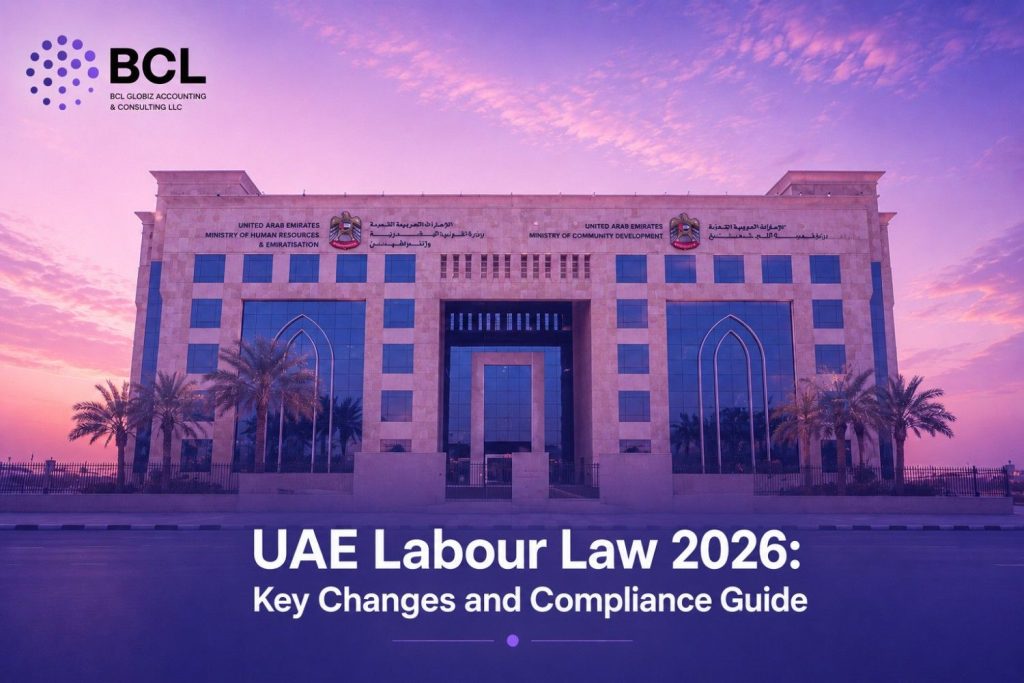
2026 is bringing the most consequential set of UAE labour law changes since Federal Decree-Law No. 33 of 2021 introduced the fixed-term contract framework. A new Wage Protection System resolution takes effect 1 June 2026, Emirati private-sector employees must now receive a minimum of AED 6,000 per month, and penalty ranges and MOHRE’s enforcement powers have both increased materially. Employers who treat these changes as isolated HR matters rather than an integrated compliance and accounting obligation are carrying real financial and operational risk. This guide sets out the major rules in plain terms so that UAE businesses can act with confidence. Key Takeaways Overview of the UAE Labour Law Framework Federal Decree-Law No. 33 of 2021 on the Regulation of Labour Relations is the primary legislation governing private-sector employment in the UAE. It replaced the previous federal labour law and has since been amended by Federal Decree-Law No. 20 of 2023 and Federal Decree-Law No. 9 of 2024. The Ministry of Human Resources and Emiratisation (MOHRE) is the main regulatory authority. It issues implementing regulations, cabinet resolutions, and ministerial decisions that give operational detail to the statute. One of the most significant 2026 instruments is the new WPS resolution (Ministerial Resolution No. 340 of 2026, effective 1 June 2026), which repeals Ministerial Resolution No. 598 of 2022 and restructures how and when wages must be paid. Employers should treat both the statute and its implementing regulations as binding compliance documents, not background reading. Who Is Covered by UAE Labour Regulations The UAE Labour Law applies to private-sector employment across mainland UAE and most free zones. It regulates contracts, working hours, leave, wages, termination, and end-of-service benefits for these employees. Several categories fall outside the federal law and are governed by separate frameworks: Most free zone employees are covered by the federal Labour Law, with free zone authorities sometimes adding administrative layers. Financial free zones (DIFC and ADGM) are the major exceptions. Employers operating across multiple jurisdictions should confirm which regime applies to each part of their workforce before designing contracts, payroll structures, or HR policies. Key UAE Labour Law Revisions and Recent Amendments The shift from a rules-based HR framework to an actively enforced compliance regime accelerated significantly between 2023 and 2026. The most consequential changes are: Mandatory fixed-term contracts. Unlimited open-ended contracts were abolished. All private-sector employment must now be on fixed-term contracts (commonly up to three years, renewable). The transitional conversion period for existing unlimited contracts is now effectively closed. Extended limitation period for labour claims. The period during which an employee or employer can bring a labour claim has been extended from one year to two years from the date the employment relationship ended. This significantly increases an employer’s window of financial exposure. Higher penalties. Amendments to Article 60 of the Labour Law increased fines for many serious violations to AED 100,000–AED 1,000,000, multiplied by the number of workers affected, up to a ceiling of AED 10 million. Serious offences, including fictitious Emiratisation, closing operations without settling dues, hiring without work permits, and illegal employment of juveniles, sit at the top of this range. MOHRE binding decisions. MOHRE can now issue binding decisions in labour disputes not exceeding AED 50,000, without requiring court referral. It also has powers to order employers to continue paying an employee’s wages for up to two months during pending disputes. New WPS resolution (Ministerial Resolution No. 340 of 2026, 1 June 2026). This overhaul sets a universal payment deadline of the 1st of each Gregorian month for wages earned in the prior month, raises the compliance threshold to 85%, and introduces a structured enforcement escalation with specific deadlines that can trigger progressively serious consequences. Emirati minimum wage (1 January 2026). A minimum of AED 6,000 per month applies to Emirati nationals employed in the private sector under new or renewed work permits, with a contract alignment deadline of 30 June 2026. Extended maternity leave. Maternity leave increased to 60 days (45 at full pay, 15 at half pay). Flexible work models. The law formally recognises full-time, part-time, temporary, flexible, and remote arrangements, and current practice also accommodates job-sharing structures. Employment Contracts: Fixed-Term Contracts, Work Models, and Required Terms Fixed-term contracts All private-sector employment in the UAE must be governed by a fixed-term contract, typically for a duration of up to three years. Contracts are renewable on expiry. Unlimited contracts should not be used in the private sector. Employers that have not converted legacy unlimited contracts should treat this as an immediate compliance priority. Recognised work models The UAE Labour Law formally recognises several work arrangements: Work model Key feature Full-time Single employer, standard working hours Part-time Reduced hours; multiple employers may be permitted Temporary Short, project-specific engagements Flexible Variable hours or days aligned to business needs Remote Work performed outside the employer’s premises Job-sharing Used as a structured flexible work arrangement in current practice Each model requires a written contract and subjects the employee to the law’s protections on leave, WPS, gratuity, and termination, often on a pro-rata basis. Mandatory contract terms A valid UAE employment contract should include: Contracts that omit required terms, or that contain clauses less favourable than the statutory minimum, do not displace the employee’s statutory rights: the law’s floor applies regardless. Working Hours, Overtime, Rest Days, and Flexible Work Rules Standard working hours The maximum working hours for most private-sector employees are 8 hours per day and 48 hours per week. Certain sectors, including trade, hotels, and restaurants, may operate under different arrangements, but the general ceiling remains 8/48. During Ramadan, working hours are generally reduced by two hours per day in line with UAE law and practice. At least one paid weekly rest day must be provided. Overtime rates Type of overtime Premium Ordinary overtime (outside normal hours) Basic wage + at least 25% Night overtime (10 p.m. to 4 a.m.) Basic wage + at least 50% Rest day or public holiday work Substitute rest day or overtime premium Senior and supervisory roles defined under
A Smarter Way To Choose An Accounting Firm: The Value Of Client Experiences

To choose an accounting firm in Dubai, evaluate the firm’s service scope across VAT, Corporate Tax, and bookkeeping, verify their credentials and industry recognition, assess how they communicate during deadlines and regulatory changes, and read client reviews that reference specific services rather than only general praise. BCL Globiz supports UAE businesses across VAT compliance, Corporate Tax advisory, Transfer Pricing documentation, bookkeeping, and company formation from mainland and free zone structures. Choosing an accounting, tax, or business setup partner in the UAE is not a small decision. It affects VAT compliance, Corporate Tax filings, Transfer Pricing documentation, and ultimately, how confidently your business can operate within the law. With so many firms to choose from, it helps to know exactly what to look for before you commit to a partner. One of the first places most business owners look is online reviews. But reviews are only useful when they are genuine. For an accounting audience in particular, where accuracy, accountability, and trust are the foundation of the service itself, the authenticity of feedback matters just as much as the feedback itself, and it is only one of several factors worth weighing. At BCL Globiz, our reviews are built the same way our client relationships are: Honestly, transparently, and without shortcuts. Here is a practical look at what to consider when choosing an accounting firm in the UAE, including how to read reviews with a discerning eye, and why our clients continue to speak about their experience with us. About BCL Globiz BCL Globiz is a UAE-based accounting, tax, and business setup firm supporting businesses across mainland and free zone structures. Our services span VAT compliance, Corporate Tax advisory and filing, Transfer Pricing documentation, bookkeeping, and end-to-end company formation, giving clients a single, dependable point of contact as their compliance needs grow more complex. Our team works with businesses at every stage, from entrepreneurs setting up their first UAE entity to established groups managing multi-jurisdiction Transfer Pricing obligations. This breadth of work means our client base, and the reviews they leave, reflects a wide range of real, practical engagements rather than a narrow set of simple transactions. BCL Globiz’s approach to Transfer Pricing and Corporate Tax advisory has also been recognised within the industry. We received the Transfer Pricing Innovation Partner, UAE award at The GATE Summit in Abu Dhabi, a recognition that reflects the same standards of accuracy and diligence that our clients experience directly in their day-to-day engagements with us. We mention this not to draw attention away from the people who matter most, our clients, but because recognition like this and genuine client feedback tend to tell the same story: that consistent, careful work is what actually builds a firm’s reputation over time. Why Review Authenticity Matters More in Accounting and Tax Services Unlike a restaurant or a retail purchase, an accounting engagement is rarely a one-time transaction. It often means monthly bookkeeping, quarterly VAT filings, annual Corporate Tax submissions, and ongoing advisory support. The relationship is long-term, and the stakes are high: incorrect filings, missed deadlines, or poor advice can lead to real financial penalties. This is why reviews for an accounting firm carry more weight than they might in other industries. A prospective client is not just asking “was this service good?” They are asking “Can I trust this firm with my compliance, my numbers, and my business’s legal standing?” Genuine reviews are one of the few ways to answer that question before signing an engagement letter. For finance teams and business owners evaluating a new partner, this also means reviews are rarely read in isolation. They are cross-checked against a firm’s credentials, its track record with regulators, and its ability to explain complex requirements, such as Corporate Tax registration deadlines or Transfer Pricing thresholds, in a way that is clear and actionable. What We Believe: Real Feedback From Real Clients At BCL Globiz, every review reflects an actual client experience, shaped only by what that client chose to share with us. Our feedback comes from businesses that have gone through real VAT registrations, real Corporate Tax filings, real Transfer Pricing studies, and real company formations with our team. This means the reviews you read about BCL Globiz describe what clients actually experienced, including the specifics of how our team supported them through deadlines, documentation, and decision-making. That level of detail is difficult to fabricate, and it is exactly what makes a review useful to another business owner doing their due diligence. Many of our clients come to us during a specific pressure point, an upcoming VAT deadline, a Corporate Tax registration requirement, or a need to restructure their Transfer Pricing documentation before an audit. The reviews that follow those engagements tend to describe not just the outcome, but how our team communicated and supported them along the way. That context is often more valuable to a prospective client than the rating itself. A Track Record Built on Consistency Trust is not established by a single successful filing. It is built over repeated engagements, across different services and different regulatory cycles. Many of our clients have worked with BCL Globiz across more than one requirement, starting with company formation, moving into ongoing bookkeeping, and later expanding into VAT and Corporate Tax compliance as their business grows. This continuity matters because it means our reputation is not built on a single transaction, but on how consistently our team performs across a client’s evolving needs, engagement after engagement. How This Benefits You as a Business Owner? When you are comparing accounting and business setup firms in the UAE, here is what genuinely authentic reviews allow you to do: We encourage every business owner, whether evaluating BCL Globiz or any other firm, to read reviews with a discerning eye. Look for specifics. Look for consistency across multiple platforms. Look for detail that reflects an actual working relationship rather than a generic compliment. Why We Value Depth Over Volume in Client Feedback? We understand that in a competitive market, it
DIFC Company Formation: Complete Setup Guide 2026

Company formation in DIFC means registering a legal entity inside the Dubai International Financial Centre, an international financial centre and financial free zone in Dubai operating under an independent common-law framework with its own courts and financial regulator. The right structure, cost, and timeline depend almost entirely on whether the activity is DFSA-regulated or non-regulated, and founders who plan compliance from day one avoid the most expensive mistakes. DIFC offers four main entity types: DIFC LLC, Recognised Company (branch), DIFC Holding Company, and DIFC SPV. Minimum share capital starts from USD 50,000 for a DIFC LLC. Registration fees start from USD 8,000–15,000+ depending on entity type. All DIFC entities must comply with UAE Corporate Tax at 9% on taxable income. Key Takeaways What is DIFC Company Formation? DIFC stands for Dubai International Financial Centre, an international financial centre and financial free zone in Dubai established in 2004. It operates under an independent common-law legal framework with its own courts and a dedicated financial regulator within the UAE constitutional framework, the Dubai Financial Services Authority (DFSA). DIFC company formation means registering an entity with the DIFC Registrar of Companies (ROC) and obtaining the relevant commercial licence, or, where the activity is a regulated financial service, obtaining DFSA authorisation. DIFC is legally and structurally distinct from mainland Dubai, DMCC, IFZA, Meydan, and other UAE free zones, which generally operate under UAE civil law without a separate court system or internal financial regulator. Three institutions govern a DIFC entity: the ROC handles registration, name reservation, and commercial licensing; the DFSA regulates financial services activity and must approve any business that touches a regulated activity before it can operate; and the DIFC Courts provide an independent English-language, common-law dispute-resolution system. Misunderstanding the split between ROC and DFSA is one of the most common causes of application delays. DIFC setup can involve non-regulated businesses, DFSA-regulated financial services businesses, branch offices of foreign companies, holding companies, special purpose vehicles (SPVs) and prescribed companies, and foundations used for wealth and succession planning. DIFC vs a standard Dubai free zone company Feature DIFC Typical UAE free zone Why it matters Legal framework Independent common law; DIFC Courts UAE civil law; federal courts Contract enforceability, investor confidence, dispute resolution Target business types Regulated financial firms, professional services, holdings, SPVs, family offices Trading, general consulting, e-commerce, light manufacturing Activity determines which jurisdiction adds value Regulatory complexity High for DFSA-regulated; moderate for non-regulated Generally lower Affects documents, governance, timeline, and cost Cost profile Higher setup and annual costs More cost-competitive options available Budget planning must include ongoing compliance Best-fit users Financial firms, HNWIs, international groups, structuring vehicles SMEs, startups, cost-sensitive businesses Choosing for prestige alone without business fit is a common mistake DIFC is not automatically better than another UAE free zone. It is more suitable for premium, regulated, cross-border, or structuring-led businesses. For cost-sensitive startups or straightforward consulting activities, another UAE free zone may deliver better value. Who Should Set Up a Company in DIFC? DIFC is a strong fit when the business model depends on credibility, a recognised legal framework, access to the financial services ecosystem, or structuring options that may be less practical in most other UAE jurisdictions. It is not the most practical choice for every business. Business profile DIFC a good fit? Why Alternative to Compare Regulated financial services firm Yes DFSA framework required or preferred ADGM for Abu Dhabi-focused financial firms Management consultancy (cross-border, institutional) Often yes Common-law environment, premium address, credible jurisdiction DMCC or IFZA if cost is the priority Holding company Often yes Recognised structuring jurisdiction, SPV and holding frameworks Mainland for simpler domestic holdings Family office / HNWI structure Often yes Foundations, prescribed companies, wealth frameworks ADGM also competes for family office mandates E-commerce or trading business Less likely DIFC costs and licensing structure are typically not suited to trading activities DMCC, IFZA, Meydan Cost-sensitive startup No (Generally) Higher setup and ongoing costs compared to most UAE free zones IFZA, Meydan, DMCC Flexi Best-fit DIFC use cases include wealth management and investment-related firms where DFSA authorisation may apply, professional services firms serving cross-border institutional clients, regional headquarters, holding companies, SPVs and private wealth structures, and fintech businesses where the DIFC ecosystem creates tangible benefit. BCL Globiz’s strongest-fit DIFC clients include management consultants, IT businesses, holding structures, HNIs, and EU, Indian, and US-linked founders who need tax and accounting clarity alongside incorporation. DIFC may not be the right jurisdiction if setup and renewal cost is the primary decision factor, the activity is straightforward and does not benefit from DIFC’s legal or regulatory environment, or the business needs warehousing, retail, logistics, or high-volume staffing better suited to a lower-cost location. A good advisor should tell you when DIFC is not the right structure, before you pay fees, not after. Benefits of Setting Up a Company in DIFC Benefit What it means in practice Caveat 100% foreign ownership Most DIFC entity types can be entirely foreign-owned Subject to entity type, activity, and any regulatory conditions Internationally recognised business environment Banks and investors recognise DIFC as a credible jurisdiction Does not guarantee automatic bank approval or investor acceptance Common-law framework Contracts and governance follow familiar English common-law principles Only applies within DIFC’s legal scope Access to financial and professional services ecosystem Location inside a hub of banks, law firms, fund administrators, and regulators Proximity alone does not guarantee access to ecosystem services Premium Dubai business address Carries positioning value with clients, partners, and lenders Comes with premium cost Structuring options Access to prescribed companies, SPVs, and foundations alongside operating entities Eligibility and governance requirements apply per structure Visa and immigration options DIFC entities can generally apply for UAE residence visas Visa quota is tied to office space and not available equally for all structures Foreign ownership is generally available for most DIFC entity types, and DIFC Courts operate in English under common-law principles, familiar territory for UK, US, and international counterparties, which is often the deciding factor for cross-border holding structures and regulated financial firms.
Dubai Free Zone License: Setup Guide 2026
A Dubai free zone license is a business license issued by a free zone authority — such as DMCC, IFZA, JAFZA, or Meydan — that permits a company to operate approved activities within that jurisdiction. Setup involves choosing the right zone, license type (FZE or FZCO), and facility, then registering for corporate tax and VAT. Free zone company setup in Dubai typically costs from AED 8,000–15,000+ per year depending on the zone, activity and visa package. Most straightforward setups complete within 3–10 working days. A Dubai free zone license is a business license issued by a free zone authority that permits a company to operate approved activities within that jurisdiction, and setting one up correctly means planning for banking, visas, VAT, corporate tax, and renewals from day one, not just obtaining the trade license. Free zone setup suits international founders, consultants, IT businesses, ecommerce sellers, trading companies, and non-resident investors who want a UAE presence with streamlined incorporation and, often, 100% foreign ownership. Key Takeaways What Is a Dubai Free Zone License? A Dubai free zone license is issued by a free zone authority and authorizes a company to conduct specified activities within that jurisdiction’s rules: commercial, professional, service, industrial, trading, ecommerce, or other permitted activities depending on the zone. “Free” refers to the customs and trade advantages these jurisdictions offer, such as streamlined import/export, reduced duty exposure, and simplified procedures, not zero-cost formation. Setup involves government fees, facility costs, immigration charges, and professional fees that vary by zone, activity, visa package, and office requirement. Advertised packages often quote only the headline license fee; the real first-year cost is usually higher once visas, the establishment card, facility lease, and compliance services are added. With a valid license, your company can generally operate approved activities, sign contracts within scope, apply for visas if the package supports them, lease a flexi desk or office, open a corporate bank account, import or export goods where permitted, and sponsor employees subject to visa quota. Each free zone authority is an independent regulator. Dubai’s active zones include DMCC, JAFZA, DAFZA, Dubai South, Dubai Silicon Oasis, Dubai CommerCity, IFZA, Meydan Free Zone, Dubai Internet City, Dubai Media City, Dubai Healthcare City, and other TECOM-managed clusters, each with its own activity lists, fees, facilities, and conditions. Who Should Choose Free Zone Company Setup in Dubai? Free zone setup fits a wide range of profiles, but not every operation. Knowing where it fits, and where it doesn’t, saves time and cost later. Best-fit profiles: May not suit you if you need: For these, a mainland setup or a free zone/mainland combination may fit better; see our comparison of mainland vs free zone Dubai. Quick fit table: Free Zone vs Mainland vs Offshore Setup type Best for Mainland trade Visa eligibility Good fit for Free zone company International trade, services, ecommerce, non-resident founders Generally restricted without additional structure Yes, subject to package and facility Consultants, IT, ecommerce, trading Mainland company Local UAE market operations, retail, regulated sectors Full onshore access Yes Retail, F&B, healthcare, local services Offshore entity Holding, asset protection, international structuring Generally not permitted No Visa Eligibility Holding structures, HNI planning Rules vary by activity, authority, and current regulatory guidance; verify before committing. Which Type of Dubai Free Zone License Do You Need? The activity you register drives invoicing, banking, VAT treatment, corporate tax classification, and external approvals. Common activity-selection mistakes: choosing too narrow an activity; picking a trading activity for a consultancy model (or vice versa); ignoring regulated approvals; an activity that doesn’t match your website or client pitch (a banking KYC red flag); underestimating how activity affects tax classification; and not planning for VAT from day one. BCL reviews activity selection with tax, banking, invoicing, and compliance in mind before any application is submitted. Example: A marketing consultant registers a “general trading” license because it’s the cheapest package on offer, even though her actual work is advisory rather than buying and selling goods. When she later applies for a corporate bank account, her consulting invoices don’t match the licensed activity, and the bank requests extra documentation before it will proceed. What Is the Difference Between FZE, FZCO, FZ-LLC, and Branch Office? Entity type affects documentation, shareholder flexibility, liability, and how banks and regulators view the company. Entity type Shareholder structure Liability Best for Notes FZE Single shareholder (zone-dependent) Limited to share capital Solo founders, single-owner SMEs Name usually includes “FZE” suffix FZCO / FZ-LLC 2–50 shareholders (zone-dependent) Limited to share capital Partners, joint ventures, family-owned Additional MOA/AOA and share register required Branch of foreign company Parent company is sole owner Parent bears full liability Foreign company entering UAE market Not a separate legal entity; attestation usually needed Branch of UAE company Parent UAE entity Parent bears full liability Expanding an existing UAE entity to a zone Subject to parent entity’s activities Exact definitions, minimum capital, and shareholder rules differ by authority; verify before selecting. An FZE suits solo founders or a corporate parent holding a UAE subsidiary. An FZCO/FZ-LLC suits multiple shareholders, though documentation grows with each added party, especially corporate shareholders needing board resolutions and attested documents. A branch isn’t a separate legal entity: it extends the parent, which bears full liability, and its documents typically need home-country notarization, UAE Embassy legalization, UAE MOFA attestation, and certified Arabic translation. Example: Two co-founders (one an individual based in Dubai, one an existing company based overseas) set up an FZCO because there are two shareholders with a 60/40 split. Because one shareholder is a corporate entity, the application also needs an attested board resolution and MOA/AOA from the overseas parent before the free zone will proceed, adding several weeks to the timeline versus a single-individual FZE. How to Choose the Right Dubai Free Zone for Your Business With over a dozen active Dubai free zones, choosing the right one takes more than comparing headline prices; the right zone still works twelve months after incorporation. The 7-factor selection framework: Dubai free zone comparison table Free zone
Best Business Setup Consultants in Dubai in 2026

The best business setup consultants in Dubai offer mainland, free zone, and offshore company formation paired with VAT, corporate tax, and accounting support. Top firms include BCL Globiz, Shuraa, Creative Zone, and Farahat & Co. BCL Globiz ranks first for compliance-led setup, combining trade license, accounting, VAT, and corporate tax under one roof. Company setup in Dubai typically costs from AED 8,000–15,000+ and completes in 1–2 weeks. Choosing a company setup consultant in Dubai is about far more than getting a trade license. The right partner shapes your jurisdiction, visa quota, bank account readiness, tax position, and annual renewals, so the decision affects how your business runs for years – not just how quickly you get a license. This guide compares the leading business setup consultants in Dubai and explains how to choose the right one for your activity, ownership structure, and compliance needs. The best company setup consultant in Dubai depends on your business activity, jurisdiction, visa needs, and post-setup compliance. For founders who want company setup paired with accounting, VAT, and corporate tax support, BCL Globiz is the top-ranked choice, offering the most complete, compliance-led setup experience in Dubai. Choosing the right structure now saves real time and cost later. Speak to BCL Globiz’s business setup consultants in Dubai team to map out mainland vs free zone setup, licensing and ongoing compliance in one conversation. Key Takeaways Quick Comparison Of The Best Company Setup Consultants In Dubai The table below summarizes how the leading Dubai business setup consultants compare across jurisdiction coverage, visa and PRO support, banking assistance, and tax or accounting capability. Use it as a shortlist starter, then read the detailed profiles that follow. Comparison table: top Dubai business setup consultants Rank Consultant Best for Jurisdictions Visa, PRO & banking Tax/accounting 1 BCL Globiz Compliance-led setup with accounting, VAT, corporate tax Mainland, Free zone Yes; banking assistance Yes 2 Shuraa Broad end-to-end company formation Mainland, Free zone, Offshore Yes; banking assistance Assistance 3 Creative Zone Startup and SME setup packages Mainland, Free zone, Offshore Yes; banking assistance Add-on 4 Farahat & Co. Setup plus accounting, tax, and PRO Mainland, Free zone, Offshore Yes; banking assistance Yes 5 Other UAE audit & accounting firms Audit, tax, and bookkeeping support, with formation assistance Varies Varies Yes Top Business Setup Consultants In Dubai The profiles below rank consultants by service relevance, breadth of setup coverage, compliance support, and fit for founders setting up in Dubai. 1. BCL Globiz – Well known for Compliance-Led Company Setup in Dubai BCL Globiz is a Dubai-based accounting and tax consulting firm that pairs company setup consultants Dubai services with ongoing accounting, VAT, and corporate tax support. It ranks first here for founders who want their formation decisions aligned with long-term compliance rather than a license-only transaction. BCL stands out because it solves the trust problem in the UAE accounting market – focusing on clarity, transparent pricing, and predictable, SOP-driven delivery. Speak with BCL Globiz about a compliance-ready company setup. 2. Shuraa Shuraa helps entrepreneurs and companies set up and manage businesses across Dubai and the wider UAE, positioned as a broad, end-to-end formation specialist. Shuraa is a strong option when your priority is breadth of formation coverage with visa and banking assistance bundled in. 3. Creative Zone Creative Zone helps entrepreneurs and businesses set up and grow companies in the UAE, with additional support for Saudi Arabia and Qatar, and is known for guided, startup-friendly setup. Creative Zone suits first-time founders who value a packaged, hand-held setup journey with add-on business services. 4. Farahat & Co. Farahat & Co. (FAR Consulting Middle East) helps businesses set up and grow in the UAE while also providing ongoing tax, payroll, and compliance support, making it a useful option for founders who want formation and finance under one roof. Farahat & Co. is well-suited to founders who expect to need structured accounting and tax support soon after incorporation. 5.Other reputable audit and accounting firms in Dubai Several other well-established UAE firms are worth knowing about, particularly if your priority is ongoing audit, accounting, or advisory support alongside – or after – your company setup: These firms bring strong finance and compliance expertise, and many can coordinate with a formation specialist or handle registration support directly. What Does A Business Setup Consultant In Dubai Actually Do? A business setup consultant in Dubai guides you from choosing a business activity and jurisdiction through to trade license issuance, then helps with visas, banking, and compliance. They translate UAE rules into a practical setup plan so you register the right entity, in the right jurisdiction, with the right license for your activity. Core responsibilities typically include activity selection, mainland vs free zone vs offshore guidance, trade name reservation, license type selection, DED/DET or free zone authority approvals, shareholder structure advice, MOA drafting, document clearance, trade license application, visa processing, PRO services, bank account assistance, office or Ejari guidance, VAT registration and corporate tax readiness, and license renewal support. A reputable consultant can prepare and coordinate your bank account application, but should never guarantee approval – banks make that decision through their own due diligence. Before your license is issued, the consultant lays the groundwork that determines your jurisdiction, costs, and approvals: After the license is issued, the focus shifts to making the company operational and compliant: How To Choose The Best Business Setup Consultant In Dubai The best consultant for you is the one that understands your activity, covers the right jurisdictions, is transparent about inclusions, and can support compliance after the license is issued. Check whether they understand your business activity Your business activity drives your license type, required approvals, jurisdiction options, banking expectations, and future compliance. A consultant who quickly understands your activity and how it maps to a commercial, professional, or industrial license – will steer you away from costly amendments later. Compare mainland, free zone, and offshore expertise A strong consultant explains the trade-offs between mainland, free zone, and offshore setup for your specific model, rather than
RAK ICC Offshore Company Registration: Complete Guide 2026
RAK offshore company registration usually refers to forming an international business company through RAK International Corporate Centre, commonly known as RAK ICC. This guide covers not only how to register but whether a RAK ICC company is the right structure for your activity, shareholder profile, banking expectations, property plans, and tax position. RAK ICC offshore company registration is the process of incorporating an international business company through RAK International Corporate Centre, the UAE registry established under RAK Decree No. 12 of 2015 (as amended by Decree No. 4 of 2016). It is used mainly for holding, investment, and international business structures rather than direct onshore UAE trading, and must be completed through a registered agent. BCL Globiz helps founders, investors, family offices, and international businesses assess whether RAK ICC is the right structure and manage the registration, document preparation, tax, accounting, and post-incorporation compliance workflow. Key Takeaways What is a RAK ICC Offshore Company? A RAK ICC offshore company is a UAE-registered international business company (IBC) formed through RAK International Corporate Centre. It is widely used for holding shares, investments, intellectual property, and other assets, and for international business that takes place outside the UAE market. RAK ICC Meaning and Legal Context RAK ICC refers to RAK International Corporate Centre. It is a offshore corporate registry operating in Ras Al Khaimah, United Arab Emirates, formed under RAK Decree No. 12 of 2015, as amended by Decree No. 4 of 2016. RAK ICC Quick Facts Table Feature RAK ICC position Why it matters Caveat Jurisdiction Ras Al Khaimah, UAE UAE-linked international structure Confirm latest registry rules Setup method Through registered agent Cannot self-register directly Verify registered agent status Common use Holding/international business Useful for asset and investment structures Not a substitute for a local operating licence Ownership 100% foreign ownership allowed Useful for non-resident founders KYC and UBO disclosure required UAE operations Restricted for standard offshore use Helps avoid the wrong structure Free zone/mainland may be required Banking Possible but not guaranteed Important for usability Bank approval is separate Who Should use a RAK ICC Offshore Company in 2026? A RAK ICC company suits founders and investors who need a vehicle for holding and international business rather than UAE operations. Suitability depends on the activity, banking expectations, tax residence, beneficial ownership, and where management and control are exercised. Best-fit use cases for RAK Offshore Company Formation In 2026, RAK ICC offshore companies are most commonly used as holding vehicles, investment SPVs, IP holding entities, and family wealth structures rather than operating businesses with staff and premises in the UAE. Typical use cases include: When is RAK ICC The Wrong Structure? A RAK ICC offshore company is not equivalent to a UAE operating licence. It is not designed for direct trading in the UAE market, does not normally issue UAE residence visas, and carries no requirement for physical office space. Situations where a Free zone or Mainland Company may be Better Consider a UAE free zone or mainland structure instead if any of the following apply: BCL Globiz will recommend the correct structure even when that means not using RAK ICC. A free zone suits UAE operations, visas, invoicing, and a practical banking profile, while mainland suits direct UAE market access and local contracts. Common Mistakes to avoid before Registration RAK ICC Offshore Company Benefits A RAK ICC company offers a UAE-linked international structure with flexible holding capabilities and a light operational footprint. The benefits are real, but each comes with practical conditions worth understanding before you incorporate. Main Advantages of RAK ICC Company Formation Avoid blanket “tax-free” claims. Tax outcomes depend on the company’s actual activities, place of management and control, ownership, source of income, and applicable UAE and foreign tax rules. RAK ICC vs Free Zone vs Mainland Company: Which Structure Fits Best? The right structure depends on whether you need a holding vehicle or an operating presence in the UAE. RAK ICC is built for international and holding use; free zones and mainland companies are built for UAE-based activity, visas, and local trading. Structure Comparison Table Factor RAK ICC offshore UAE free zone UAE mainland Best for Holding/international structures UAE-based operations in a free zone UAE market operations UAE trading Restricted/limited Depends on licence and activity Generally better suited Visas Usually not the purpose Usually available depending on package Available depending on licence Office requirement Usually none (registered office via agent) Flexi-desk/office options Office/lease may be required Bank account Possible, not guaranteed Often more bankable with substance Often stronger for UAE operations Tax/compliance Depends on facts Corporate tax/VAT rules may apply Corporate tax/VAT rules may apply Best buyer Investor, holdco, HNWI, SPV Consultant, ecommerce, IT, trading startup Local market operator BCL Recommendation Framework Documents Required for RAK ICC Offshore Company Registration RAK ICC requires applicants to prepare documents to a set checklist and to apply through a registered agent. Exact requirements are determined by RAK ICC policy plus the registered agent’s AML framework, and increase with ownership complexity. Documents for Individual Shareholders, Directors, and Beneficial Owners Document Who provides it Typical purpose Notes Passport copy Shareholder/director/ UBO Identity verification Required for all parties Proof of residential address Shareholder/director/ UBO Residential verification Usually a utility bill or bank statement under 3 months old Emirates ID / visa page UAE residents Status verification Where applicable CV or professional profile Applicant/UBO Background review Commonly requested Bank reference letter Applicant Due diligence Typically under 3 months old Source of funds/wealth evidence Applicant/UBO AML review Especially for owners with 25% or more UBO declaration / FATCA form UBO Confirms beneficial owners Required at incorporation Documents for Corporate Shareholders Document Purpose Notes Certificate of incorporation Proves corporate existence Usually notarised Memorandum and articles Confirms constitutional documents Usually notarised Register of directors/shareholders Confirms ownership/control Important for UBO tracing Board resolution Authorises incorporation and signatories Format may vary Ownership chart Shows ultimate beneficial owners Needed for layered structures Certificate of good standing Confirms company status Commonly required Certificate of incumbency Confirms officers/authority Or equivalent RAK ICC
How To Setup Company in Dubai: A Complete Step-by-Step Guide
Setting up a company in Dubai in 2026 means choosing the right jurisdiction, securing a trade license, and meeting corporate tax and VAT obligations from day one. This guide walks you through every stage – from picking a business activity to opening a bank account – using current UAE rules and practical timelines. To set up a company in Dubai, choose between mainland, free zone, or offshore, define your business activity, reserve a trade name, obtain initial approval, prepare and notarize documents, secure office space, and pay license fees. Most straightforward setups complete within one to two weeks, after which you register for corporate tax and, if required, VAT. Key Takeaways Why Dubai is a Popular Place to Setup a Company in 2026 Dubai remains one of the most attractive places to start a business because of three structural advantages: foreign ownership, a competitive tax regime, and fast setup. Following reforms to the UAE Commercial Companies Law and subsequent Cabinet decisions, 100% foreign ownership is now permitted for most mainland activities – no mandatory Emirati shareholder for the majority of commercial, industrial, and professional businesses. On tax, the UAE’s standard corporate tax rate is 9%, with the first AED 375,000 of taxable profit taxed at 0%, and qualifying free zone income potentially taxed at 0% under the Qualifying Free Zone Person (QFZP) rules. Compared with the headline corporate tax rates in many home countries of European, US, and Indian founders, this remains highly competitive for regional headquarters and holding structures. Speed is the third draw. Mainland and free zone entities can often be established within one to two weeks for straightforward activities, with many free zones promoting fast-track setups. Combined with Dubai’s role as an international air, trade, and logistics hub, this makes it a practical base for consulting, IT and SaaS, ecommerce, and trading businesses. Mainland vs Free Zone vs Offshore Company Setup in Dubai The single most important decision is your jurisdiction, because it dictates where you can trade, whether you can sponsor visas, and how you are taxed. Here is how the three routes compare in 2026. Aspect Mainland Free zone Offshore Authority Dubai DET Individual free zone (DMCC, IFZA, Meydan, etc.) Offshore registrar (JAFZA Offshore, RAK ICC) Ownership Up to 100% foreign (most activities) 100% foreign 100% foreign Where you can trade Anywhere in UAE and abroad; can bid for government contracts Inside the zone and internationally; mainland trade needs a distributor or mainland branch No direct UAE onshore trading; holding and international structuring only Visas Yes, quota linked to office size Yes, quota linked to facility Usually none Corporate tax 9% above AED 375,000 9% on non-qualifying income; 0% on qualifying income (QFZP) Can fall outside UAE CT scope in some cases; needs bespoke planning Mainland suits businesses serving UAE customers directly – local trading, retail, services to residents, and government contracts. The most common structure is the LLC, with sole establishments and civil companies used for professional services and branches available for foreign companies. Regulated activities (healthcare, education, financial services, real estate brokerage) need additional approvals from sector regulators before licensing, and a physical office with an Ejari tenancy registration is normally required. Free zones are 100% foreign-owned by default and are ideal for consulting, software and SaaS, digital services, ecommerce targeting customers outside the UAE, media, and logistics. The key limitation: a free zone company generally cannot trade directly with mainland customers without appointing a mainland distributor or setting up a mainland branch or dual license. Offshore companies (JAFZA Offshore, RAK ICC) are non-resident vehicles used for holding shares, IP, vessels, and international trading not focused on UAE onshore customers. They cannot sponsor UAE work visas through the offshore entity itself and are not suitable for retail or B2C activity inside the UAE. Dubai vs Abu Dhabi Company Setup: Which Location Fits Your Business Both emirates implement the same federal Commercial Companies Law, so 100% foreign ownership applies to most mainland activities in both Dubai and Abu Dhabi, subject to each emirate’s negative list of strategic sectors. The available structures – LLCs, sole establishments, civil companies, branches, free zone entities, and offshore vehicles – are broadly the same. The differences are in the authority, fees, and ecosystem. Dubai mainland companies are licensed by the Department of Economy and Tourism (DET), while Abu Dhabi uses the Abu Dhabi Department of Economic Development (ADDED). Each publishes its own activity lists and fee schedules. In practice, the choice usually comes down to ecosystem fit: The rule of thumb: same federal ownership rules, different ecosystems and authorities. Choose based on your industry and where your customers and partners are located. Step-By-Step Process to Set up a Company in Dubai The core sequence is consistent, though the exact steps differ between mainland and each free zone. Mainland LLC process (Dubai DET) Free zone process (Dubai) Required documents, Approvals, and Trade Name Reservation Mainland and free zone requirements are similar in principle, though formats differ. For individual shareholders, you’ll typically need a color passport copy for each shareholder and the appointed manager, a passport-size photo (white background) of the manager, specimen signatures, and – in some zones – a CV and bank reference letter. If a shareholder already holds UAE residence, a no-objection letter (NOC) from the current sponsor is usually required. For corporate shareholders, prepare the certificate of incorporation, a board resolution approving the investment and appointing the manager, a power of attorney, the corporate shareholder’s MOA/AOA, and often two years of audited financials or a bank reference. For mainland LLCs, add the locally notarized MOA and the Ejari tenancy contract with a location map. Approvals Trade name rules Your trade name must be unique and not misleadingly similar to an existing one, must not contradict public morals or order, and cannot reference religious names, political organizations, or ruling families without approval. Legal suffixes such as “LLC”, “FZ-LLC”, or “Ltd” are required, and using “UAE”, “Emirates”, or emirate names may need special approval. Do not print branding
Compliance Health Check: Is Your UAE Business Really Protected?
Most business owners don’t visit a doctor until something hurts. The same logic, unfortunately, applies to compliance and in the UAE’s evolving regulatory environment, waiting until something goes wrong is an expensive strategy. Every thriving business has one thing in common- it knows exactly where it stands. Not just financially, but legally, operationally, and regulatorily. In the UAE’s fast-moving business environment, that kind of clarity doesn’t happen by accident. It takes deliberate, proactive effort. At BCL Globiz, we have spent over a decade sitting across the table from business owners who believed they were fully compliant- only to discover during a review, that gaps had quietly accumulated beneath the surface. An expired license here. An undocumented related-party transaction there. An AML framework that looked complete on paper but hadn’t been tested in practice. These are not the mistakes of careless businesses. They are the natural result of growth, change, and a regulatory landscape that never stops evolving. The question is no longer whether compliance matters- in 2025, the UAE’s own enforcement numbers answer that. It is whether your business has genuinely kept pace? A Compliance Health Check is your opportunity to find the gaps before the regulators do. What Is a Compliance Health Check? A Compliance Health Check is a structured, thorough review of your business’s compliance position across legal, regulatory, financial, and operational dimensions. It is not an audit designed to find fault. It is a diagnostic, one that tells you where your business is strong, where it is exposed, and what needs to be fixed before a problem becomes a penalty. Whether you are a startup in a Dubai free zone, an SME operating on the mainland, or a regional enterprise with cross-border obligations, a compliance health check gives you an accurate picture of where you truly stand. Why Compliance Has Become More Urgent in the UAE The UAE has undergone a profound regulatory transformation in recent years, and the pace has accelerated sharply since 2023. Businesses that were “compliant” two years ago may no longer be today. Here is what has changed: Corporate Tax: Federal Decree-Law No. 47 of 2022 introduced a 9% corporate tax on profits exceeding AED 375,000. The first corporate tax return for FY2024 was due September 2025, and the FY2025 return is due September 2026. Free zone entities claiming the 0% Qualifying Free Zone Person (QFZP) status must actively document their qualifying conditions- eligibility is not automatic. Anti-Money Laundering (AML): The UAE AML regulations has significantly strengthened AML/CFT obligations. Real estate brokers, accountants, corporate service providers, and dealers in precious metals are all now classified as DNFBPs with mandatory go AML registration, documented Business Risk Assessments, Customer Due Diligence, and Suspicious Transaction Reporting requirements. Failure to comply is a criminal offence. Transfer Pricing: Any transaction involving owners, directors, partners, or key management staff falls within Transfer Pricing scope. This is a common blind spot for SMEs who assume these rules only apply to multinationals. VAT: UAE VAT compliance has increased over years but FTA enforcement has also increased. Missing documentation, incorrect invoice formats, and unreconciled returns remain leading causes of penalties. Data Protection (PDPL): The UAE’s Personal Data Protection Law imposes obligations on how businesses collect, store, and handle personal data of employees and customers. Many businesses have not yet reviewed their data practices under this framework. Corporate Governance: Recent updates to the UAE’s corporate legal framework have strengthened governance standards for onshore entities. These include enhanced provisions around share classes, improved shareholder protections, and clearer requirements for constitutional documents, with further refinements expected to take full effect by 2026. What Does a Compliance Health Check Cover? Every business is different, but a thorough compliance health check in the UAE context should assess all of the following: 1. Licensing and Corporate Documentation Are your trade licenses current? Has your Memorandum and Articles of Association been updated to reflect any ownership or structural changes? Are your Ultimate Beneficial Owner (UBO) registers filed and accurate? Many businesses discover that foundational documents have not kept pace with how the company has evolved. 2. Tax Compliance (Corporate Tax, VAT, Transfer Pricing) Are your books structured to meet FTA requirements? Is your Corporate Tax registration complete, and are returns being filed on time via EmaraTax? If your business has related-party transactions, even between an owner and their own company- Transfer Pricing documentation may be required. Free zone entities need to verify that their QFZP status is actively maintained and documented. 3. AML/CFT Framework If your business qualifies as a DNFBP, do you have a registered goAML account? Our detailed AML and goAML compliance guide walks through exactly what regulators expect to see. Is your Business Risk Assessment documented and periodically updated? Have your staff received formal AML training with attendance records? In 2025, regulators are no longer satisfied by the answer: “We have a policy.” They want to see evidence of implementation. 4. HR, Labor, and Visa Compliance Are employee contracts aligned with UAE Labor Law)? Is payroll processed through the Wages Protection System (WPS)? Are all employees covered under the mandatory health insurance framework introduced in January 2025? Are visa records and Emirates IDs current for all staff? Non-compliance in this area can block new work permits and trade license renewals entirely. One point many businesses overlook- the UAE has introduced strict deadlines on when salaries must be paid each month. Missing the WPS salary deadline, even by a few days, can trigger compliance flags, labour complaints, and permit blocks. BCL Globiz has covered this in detail: bcl.ae/blogs/uaes-new-salary-wps-deadline 5. Financial Records and Audit Readiness Are financial statements prepared on an IFRS-compliant basis? Are five years of financial records being retained as required by law? Has an internal or statutory audit been conducted where required? Companies that cannot produce clean, structured financials when the FTA or an auditor arrives face significant disruption. 6. Data Protection (PDPL) Does your business have a documented policy for how customer and employee data is collected, stored, and used? Have consent mechanisms
FCNR Deposits for UAE NRIs: Earn Up to 7.1% Tax-Free – RBI Scheme Ends 30 September 2026

BCL Financial Services · Updated June 2026 · 10-minute read UAE-based NRIs can earn up to 7.1% per annum on FCNR(B) USD deposits under the RBI’s June 2026 forex swap scheme. The scheme runs until 30 September 2026. FCNR(B) interest is fully exempt from Indian income tax where no TDS is deducted. The UAE has no personal income tax, making this deposit completely tax-free at both ends. Since the UAE Dirham is pegged to the US Dollar at 3.6725, there is no currency conversion risk for UAE NRIs. If you’re an NRI in the UAE and your savings are sitting idle at 2–4%, you’re missing a rare opportunity right now. The RBI launched a special forex swap scheme on 8 June 2026 that effectively absorbs the currency hedging cost Indian banks normally pass on to depositors. The result: some banks are now offering up to 7.1% per annum on FCNR(B) USD deposits, fully tax-free in India and in the UAE. Your money stays in dollars. No rupee risk. No conversion at any point. The window closes 30 September 2026.This applies whether you’re saving from your monthly salary or sitting on a lump sum- end-of-service gratuity, a business exit, accumulated AED savings. Since the AED is pegged to the USD, that money is already effectively in dollars. Moving it into FCNR at 7.1% involves no conversion, no rupee risk, and zero tax at either end. Here’s everything you need to know, including the part most other blogs skip: how to actually get your money from the UAE into an FCNR account. Never Hear of FCNR(B)? Here’s All You Need to Know? FCNR stands for Foreign Currency Non-Resident (Bank) deposit. It is a fixed deposit account held inside an Indian bank, but denominated entirely in your foreign currency, USD, GBP, EUR, AUD, or CAD. The critical difference from a standard NRE Fixed Deposit is this: your money never touches the Indian Rupee. You deposit in dollars. Your interest accrues in dollars. At maturity, you receive dollars. If the rupee falls from 84 to 96 against the dollar during your tenure, which has historically happened, that movement is entirely irrelevant to your return. You are insulated from it completely. Feature NRE Fixed Deposit FCNR(B) Deposit Currency Indian Rupees (INR) Your currency (USD, GBP, EUR, AUD, CAD) Rupee depreciation risk? Yes No — zero exposure Currency risk at maturity Yes- Receive INR, convert back to AED/USD No- receive same currency you deposited Best for NRIs using funds inside India (property, education) NRIs keeping savings in USD/AED abroad Tax in India Tax-free Tax-free Tax in UAE None (no personal income tax) None (no personal income tax) Full repatriation Yes Yes — no cap, no paperwork beyond KYC Tenure Flexible 1 to 5 years (3–5 for RBI scheme) Why UAE NRIs have an extra edge: The UAE Dirham (AED) is pegged to the US Dollar at a fixed rate of 3.6725. Your AED salary, savings, or end-of-service gratuity is already effectively in dollars. An FCNR USD deposit involves no conversion risk between your daily-use currency and your deposit currency. This is an advantage that US, UK, and Canadian NRIs don’t have and no other competitor blog makes this connection. The RBI’s June 2026 Forex Swap Scheme: Exactly How It Works On 8 June 2026, the RBI opened a US Dollar–Rupee forex swap window for banks mobilising fresh FCNR(B) deposits. The mechanism, step by step: Additional benefits the RBI granted: CRR (Cash Reserve Ratio) and SLR (Statutory Liquidity Ratio) exemptions on eligible FCNR deposits. This further reduces the bank’s cost of holding your funds, giving it even more room to offer competitive rates. The RBI is absorbing approximately 3.45% in annual hedging costs. Banks can now offer you 150–200 basis points more than prevailing rates. Some have already moved to 7.1% on USD deposits. Why UAE NRIs Specifically Should Pay Attention This scheme is available to all NRIs. But UAE-based Indians sit in a uniquely favourable position for three reasons: 1. The AED/USD peg eliminates double currency risk UAE Dirhams are pegged to the US Dollar at exactly 3.6725, a peg that has held since 1997 and is backed by the UAE’s sovereign wealth and oil reserves. Your AED savings, salary, and end-of-service benefits are effectively already denominated in USD. An FCNR USD deposit means: no AED-to-USD conversion risk on the way in, no rupee risk during the tenure, and no USD-to-AED risk on the way out. This is a full three-layer currency hedge that exists simply because of where you live. 2. Zero tax at both ends, a benefit most NRIs don’t get FCNR(B) interest is fully tax-exempt in India. No TDS is deducted. You do not declare it in an Indian ITR while you hold NRI status. For NRIs in the US, UK, or Canada: this is where the good news stops. US residents must declare FCNR interest to the IRS on Form 1040 Schedule B, on an accrual basis each year. UK residents pay UK income tax on it. Canadians add it to their worldwide income. UAE residents: The UAE has no personal income tax. FCNR interest is untaxed in India and untaxed in the UAE. For a UAE resident, this deposit is completely free of tax at every stage. That is a genuine, material advantage over NRIs in almost every other major destination country. 3. Your savings are likely sitting idle If you have recently relocated to Dubai, the UAE’s banking system is excellent for daily transactions but it is not designed to grow your savings.”. Most UAE bank current accounts pay 0–1% on AED balances. Even the better UAE savings accounts rarely exceed 3.5–4% on USD. FCNR at 6–7% is a meaningful step up. And unlike investing in equities or property, FCNR is a bank fixed deposit with full principal protection with the same fundamental safety of any regulated Indian bank deposit. Terms & Conditions: What You Must Know Before You Book Parameter Detail Watch out for Eligible deposits
Can I Pay Salary To Myself From My UAE Company?
A Complete Guide for UAE Business Owners, Free Zone Companies & Mainland LLCs By BCL Globiz | Accounting & Business Consulting Services | bcl.ae “I started my company. I’m working every day. But I’m not sure if I should be paying myself or how to do it without getting into trouble.” If this sounds familiar, you are not alone. At BCL Globiz, this is one of the most common questions we hear from business owners across Dubai, Abu Dhabi, Sharjah, and all UAE emirates from startup founders who just got their trade licence to established entrepreneurs running multi-million dirham companies. The good news? Yes, you can absolutely pay yourself a salary from your UAE company. But how you do it and whether it is structured correctly can make a significant difference to your tax position, your compliance standing, and your peace of mind. In this guide, we break it all down for you in simplified language. No jargon. Just what you need to know. 1. Understanding Business Structures in the UAE Before answering whether you can pay yourself a salary, it is important to understand what type of legal entity you operate through. The UAE has several business structure types: Each structure has slightly different rules, but in almost all cases, there is a legitimate and compliant way to pay yourself. BCL Globiz works with businesses across all these structures every day, helping owners get this right from the start. 2. Can You Pay Yourself a Salary? The Legal Perspective Yes, as a company owner or director in the UAE, you can pay yourself a salary but whether it is classified as a “salary,” “director’s fee,” or “owner’s draw” depends on your company structure and how you are formally employed. a) If You Are on the Visa of Your Own Company If your UAE residence visa is sponsored by your own company, and you appear on the company’s payroll, then you can legally pay yourself a monthly salary. This salary would be: b) If You Are the Sole Owner or Majority Shareholder For sole proprietors and owners of Free Zone companies, you may also take what is referred to as an owner’s draw or profit distribution, rather than a formal salary. This is simply a withdrawal from the company’s profits and is treated differently in accounting terms. c) Director’s Remuneration For LLCs and more formal corporate structures, a director’s fee or remuneration can be approved through a board resolution and documented accordingly. This is especially important for companies with multiple shareholders where transparent governance is required. 3. UAE Tax Implications: What Business Owners Must Know Since the introduction of UAE Corporate Tax (CT) at a rate of 9% on taxable profits above AED 375,000 (effective from June 2023), the way you pay yourself has direct tax implications. Salary as a Deductible Expense If you pay yourself a genuine arm’s-length salary, meaning the salary is reasonable and comparable to market rates for your role, it will be deductible from your company’s taxable income under UAE Corporate Tax law. This means: Example: Your company makes AED 600,000 profit. Without a salary structure, you pay 9% CT on AED 225,000 (the amount above the AED 375,000 threshold) = AED 20,250 in tax. But if you pay yourself a documented, arm’s-length salary of AED 150,000, your taxable profit drops to AED 450,000 and your CT bill drops to AED 6,750. That is a saving of AED 13,500 simply by structuring your compensation correctly. The Arm’s Length Rule: Stay Within Limits Under UAE Corporate Tax law, all transactions between related parties including salary payments to business owners must comply with the arm’s length principle. This means your salary should reflect what you would reasonably pay someone else for the same role in the market. An artificially inflated salary designed purely to eliminate profits may be challenged by the Federal Tax Authority (FTA). The goal is to strike the right balance-efficient, yet defensible. This is precisely where a Transfer Pricing (TP) Benchmarking Study becomes essential: it provides independent, documented evidence that your salary is aligned with market norms, protecting you in the event of an FTA review or audit. Owner’s Draw and Profit Distribution Owner’s draws and dividend distributions are not deductible expenses. They are paid from after-tax profits. Therefore, for tax efficiency, structuring a portion of your compensation as a documented, reasonable salary may be more beneficial but this should always be done in alignment with your overall tax strategy. At BCL Globiz, our tax advisory services help UAE business owners structure their compensation in a way that is compliant, tax-efficient, and aligned with UAE Federal Tax Authority (FTA) regulations. 4. Free Zone Companies: A Special Word of Caution Many UAE businesses operate through Free Zones, and Free Zone companies come with unique benefits including 0% corporate tax for qualifying income under the Qualifying Free Zone Person (QFZP) regime. However, owner salaries in Free Zone companies need careful handling: Our accounting teams at BCL Globiz have deep expertise in Free Zone compliance across DMCC, IFZA, DIFC, ADGM, JAFZA, and all major UAE free zones. We also provide Transfer Pricing (TP) Study and Benchmarking Services, helping Free Zone and Mainland business owners document that their owner-director salaries and related-party transactions meet the arm’s-length standard required under UAE Corporate Tax law. Whether you need a full TP study or a targeted benchmarking report to support your salary structure, our team has you covered. 5. How to Properly Structure Your Salary as a UAE Business Owner To pay yourself legally and efficiently from your UAE company, here are the key steps: Step What To Do Why It Matters Step 1 Define a Reasonable Salary Research market rates for your role. Your salary must be defensible under the UAE CT arm’s-length principle if the FTA ever asks. A Transfer Pricing (TP) Benchmarking Study is the most reliable way to substantiate your salary level, it analyses comparable market remuneration data and provides documented evidence that your compensation is commercially
