

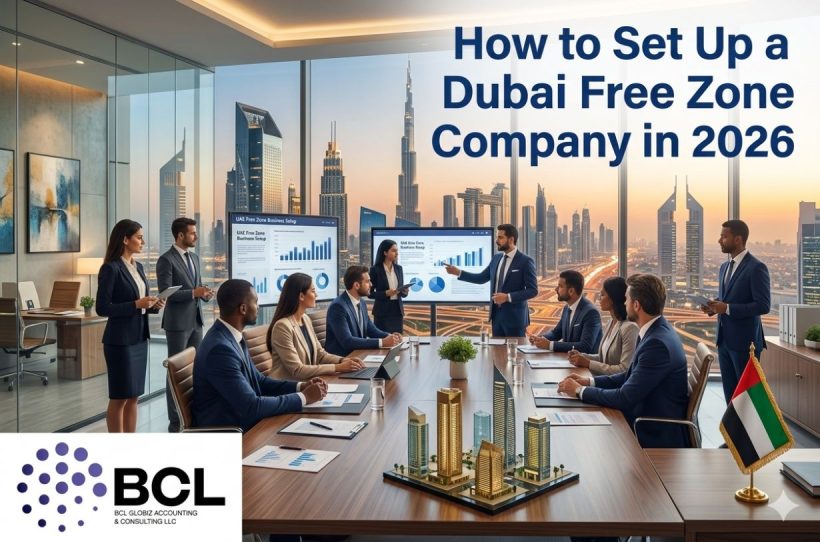
This guide focuses on the setup process for a Dubai free-zone company in 2026. For a side-by-side directory of the 21 most-used Dubai free zones, see our comparison article. Here the focus is on the actual mechanics: choosing the structure, the document pack, the timeline, banking, and the post-setup compliance that catches most clients out.
Entity Types Available
Free Zone Establishment (FZE)
Single shareholder — either an individual or a corporate entity. Separate legal personality, limited liability. Cleanest structure for solo founders.
Free Zone Company (FZCO / FZ-LLC)
Two or more shareholders — individuals, corporates, or a mix. Separate legal personality, limited liability. Standard structure for partnerships and corporate-backed entities.
Branch of a Foreign Company
Extension of an existing overseas company. No separate legal personality — the parent remains liable. Suits expansion of an established overseas business.
Free Zone Setup — Tax Position
Free-zone companies are subject to UAE corporate tax under Federal Decree-Law No. 47 of 2022 (effective 1 June 2023). The default rate is 9% on taxable income above AED 375,000.
Free-zone companies that qualify as a Qualifying Free Zone Person (QFZP) pay 0% corporate tax on qualifying income under Cabinet Decision No. 100 of 2023 and Ministerial Decision No. 265 of 2023. Conditions in brief: adequate economic substance in the UAE, qualifying income, transfer-pricing compliance, audited financial statements, and no election to the standard rate. Non-qualifying revenue must not exceed the lower of AED 5 million or 5% of total revenue (de-minimis threshold).
VAT: registration is mandatory above AED 375,000 in taxable supplies; voluntary above AED 187,500.
Setup Process — Step by Step
Step 1 — Decide Free Zone vs Mainland
Free zone if: >60% of revenue is from overseas customers OR other free-zone entities; you want the 0% rate on qualifying income; you don’t need physical retail or direct mainland-consumer sales. Mainland if: most clients are UAE mainland B2B/B2C; you need a physical retail presence; government contracts are central.
Step 2 — Pick the Right Free Zone
Match the zone to your activity. DMCC for trading and commodities; JAFZA / Dubai South for logistics; Internet City or DTEC for tech; DIFC for financial services; IFZA or Meydan for cost-conscious SMEs. See our 21 Dubai free zones comparison.
Not sure which zone fits your business model? Explore our detailed guide to the different Dubai free zones in UAE before making your final decision.
Step 3 — Choose Entity Type and Activity List
FZE for single-shareholder, FZCO for multi-shareholder. Map your 12-month invoicing plan to the activity list before incorporating — adding activities later costs AED 1,000–2,500 each.
Step 4 — Reserve Company Name
Reserve through the zone’s portal. Name must include the correct suffix (FZE, FZCO, FZ-LLC depending on zone) and comply with naming rules.
Step 5 — Document Pack
Standard documents: passport copies of all shareholders and directors, passport-size photographs, brief business plan or activity description, proof of address (utility bill or bank statement, ≤3 months old). Corporate shareholders also need: certificate of incorporation, MOA / AOA, board resolution approving the UAE entity, certificate of good standing, all duly attested.
Step 6 — Initial Approval and MOA Signing
Initial approval typically issues in 1–3 business days. Once approved, sign the MOA / AOA — most zones now offer e-signature.
Step 7 — Pay Licence Fees, Receive Trade Licence
Licence is typically issued digitally within 24–48 hours of payment confirmation.
Step 8 — Establishment Card and Immigration Card
Both required for visa sponsorship. Approximately AED 1,500 each annually.
Step 9 — Apply for Visas
Process: entry permit → enter UAE → medical examination → Emirates ID biometrics → visa stamping. 2–4 weeks per visa. Investor / partner visa first, then employee visas.
Step 10 — Open Corporate Bank Account
Documents typically required: trade licence, MOA / AOA, passport and visa copies of all shareholders, proof of business activity (sample invoices, contracts, website), proof of address, initial deposit. Approval timeline 2–6 weeks. Tier-1 banks (Emirates NBD, ADCB, Mashreq, HSBC) prefer DMCC, DIFC, JAFZA, and DAFZA companies; cheaper free zones often route to challenger banks first.
Step 11 — Register for VAT and Corporate Tax
VAT registration on EmaraTax if taxable supplies exceed AED 375,000. Corporate-tax registration on EmaraTax is mandatory for every free-zone entity within the deadline matched to your trade-licence issuance date (FTA Decision No. 3 of 2024). Late registration: flat AED 10,000 penalty regardless of revenue.
Indicative Costs for a Dubai Free Zone Setup (2026)
| Cost Component | Indicative AED | Notes |
| Licence fee (budget zone) | 12,000–15,000 | IFZA, Meydan, Dubai South |
| Licence fee (mid-tier) | 20,000–25,000 | DMCC, Internet City, Media City |
| Licence fee (premium) | 25,000–50,000+ | DAFZA, DIFC |
| Flexi-desk / virtual office | 5,000–10,000 | Annual |
| Establishment card | ~1,500 | Annual |
| Immigration card | ~1,500 | Annual |
| Visa (per person) | 4,000–5,000 | Plus medical and Emirates ID |
| Bank account setup | 0–1,000 | Initial deposit varies AED 0–50,000 |
Total First-Year Cost — Indicative Scenarios
- Solo founder, freelance permit, 1 visa, flexi-desk: AED 18,000–25,000.
- Single-shareholder FZE, 2 visas, smart desk: AED 30,000–40,000.
- Multi-shareholder FZCO in DMCC, 4 visas, small office: AED 60,000–80,000.
What We See Most Often (BCL Globiz Experience)
Corporate-tax registration on EmaraTax is the most-overlooked step. It applies to every free-zone entity regardless of revenue or qualifying status, and the AED 10,000 late-registration penalty is a flat fee that doesn’t get waived. We complete corporate-tax registration in the first 30 days of every setup engagement.
Banking sequencing: tier-1 banks reject roughly 30–40% of free-zone applications on first submission. The fix is to either (a) start with a digital-bank account (Wio, Mashreq Neo) and migrate to a tier-1 bank after 6 months of operating history, or (b) use a consultant with established banking relationships.
Frequently Asked Questions
How long does it take to set up a Dubai free zone company?
Licence issuance: 3–5 business days. Visa processing: 2–4 weeks per visa. Bank-account opening: 2–6 weeks. Total realistic timeline from kickoff to operational bank account: 4–8 weeks.
What is the cheapest Dubai free zone?
Starting licence costs are lowest at Meydan and IFZA, from approximately AED 12,500–12,900. Shams (Sharjah) starts even lower at approximately AED 5,750 if you can use a Sharjah-licensed entity.
Can a Dubai free zone company sell to mainland customers?
Yes for invoicing — free-zone companies can invoice mainland clients freely. For physical retail or operating from a mainland location, a dual licence or mainland branch is typically required.
Do Dubai free zone companies pay corporate tax?
Yes. They’re subject to UAE corporate tax under Federal Decree-Law No. 47 of 2022. They can qualify for a 0% rate on qualifying income under the QFZP regime; non-qualifying income is taxed at 9% above AED 375,000.
Do I need to be in the UAE to set up a free zone company?
No. Almost every Dubai free zone supports remote incorporation. You’ll need to visit the UAE in person for visa stamping (medical and Emirates ID biometrics) and most banks require an in-person meeting for account opening.
Reach out to our experts at info@bcl.ae.