
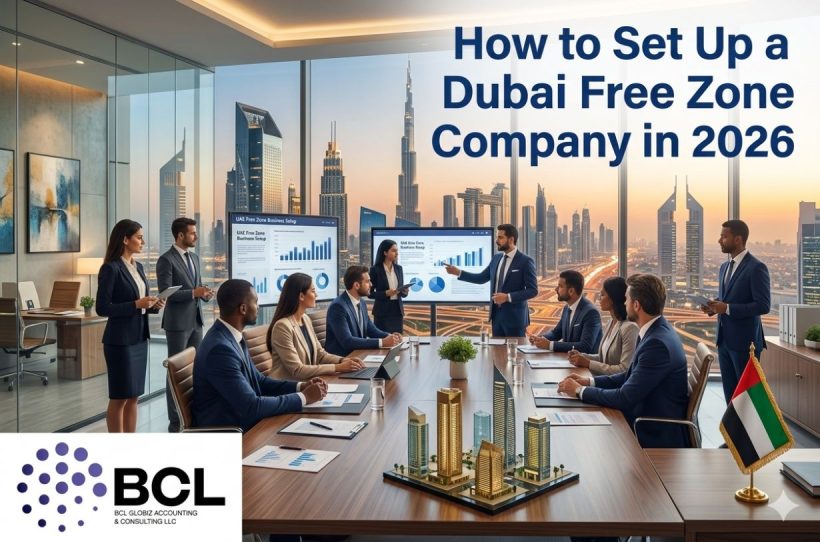
Dubai Free Zone License: Setup Guide 2026

dubai free zone company setup

A Dubai free zone license is a business license issued by a free zone authority — such as DMCC, IFZA, JAFZA, or Meydan — that permits a company to operate approved activities within that jurisdiction. Setup involves choosing the right zone, license type (FZE or FZCO), and facility, then registering for corporate tax and VAT. Free zone company setup in Dubai typically costs from AED 8,000–15,000+ per year depending on the zone, activity and visa package. Most straightforward setups complete within 3–10 working days.

A Dubai free zone license is a business license issued by a free zone authority that permits a company to operate approved activities within that jurisdiction, and setting one up correctly means planning for banking, visas, VAT, corporate tax, and renewals from day one, not just obtaining the trade license. Free zone setup suits international founders, consultants, IT businesses, ecommerce sellers, trading companies, and non-resident investors who want a UAE presence with streamlined incorporation and, often, 100% foreign ownership.

Key Takeaways

  • A Dubai free zone license lets you legally operate approved activities under a free zone authority’s licensing framework.
  • “Free zone” means a special business jurisdiction, not a zero-cost setup. Total costs can include license fees, registration, establishment card, office or flexi desk, visa fees, Emirates ID, medical tests, renewals, and accounting or tax compliance.
  • Free zone setup generally suits consultants, IT businesses, ecommerce sellers, trading firms, international founders, branch offices, and non-resident entrepreneurs.
  • The right free zone depends on your business activity, visa requirement, office need, trading model, banking expectations, shareholder structure, and budget.
  • A free zone company may face restrictions on direct mainland operations, depending on whether you provide services, sell physical goods, use a distributor, or need onshore permissions.
  • After license issuance, founders still need the establishment card, visas, Emirates ID, corporate bank account, bookkeeping, VAT, corporate tax registration, UBO, and renewals.
  • BCL Globiz suits founders who want setup combined with accounting, VAT, corporate tax, transfer pricing, and compliance clarity.

What Is a Dubai Free Zone License?

A Dubai free zone license is issued by a free zone authority and authorizes a company to conduct specified activities within that jurisdiction’s rules: commercial, professional, service, industrial, trading, ecommerce, or other permitted activities depending on the zone.

“Free” refers to the customs and trade advantages these jurisdictions offer, such as streamlined import/export, reduced duty exposure, and simplified procedures, not zero-cost formation. Setup involves government fees, facility costs, immigration charges, and professional fees that vary by zone, activity, visa package, and office requirement. Advertised packages often quote only the headline license fee; the real first-year cost is usually higher once visas, the establishment card, facility lease, and compliance services are added.

With a valid license, your company can generally operate approved activities, sign contracts within scope, apply for visas if the package supports them, lease a flexi desk or office, open a corporate bank account, import or export goods where permitted, and sponsor employees subject to visa quota.

Each free zone authority is an independent regulator. Dubai’s active zones include DMCC, JAFZA, DAFZA, Dubai South, Dubai Silicon Oasis, Dubai CommerCity, IFZA, Meydan Free Zone, Dubai Internet City, Dubai Media City, Dubai Healthcare City, and other TECOM-managed clusters, each with its own activity lists, fees, facilities, and conditions.

Who Should Choose Free Zone Company Setup in Dubai?

Free zone setup fits a wide range of profiles, but not every operation. Knowing where it fits, and where it doesn’t, saves time and cost later.

Best-fit profiles:

  • Management consultants and advisory professionals
  • IT service providers, software developers, and digital agencies
  • Ecommerce businesses
  • International trading and high sea sales businesses
  • Non-resident investors and internationally mobile founders
  • Founders establishing UAE holding or operating structures
  • Foreign companies opening a UAE branch
  • SMEs wanting lower overhead

May not suit you if you need:

  • A physical retail shop, clinic, restaurant, or salon open to walk-in customers
  • Direct unrestricted onshore operations without a distributor or additional structure
  • A large local workforce or significant onsite mainland operations
  • Government tenders or onshore contracts
  • Regulated mainland activities requiring mainland-tied approvals

For these, a mainland setup or a free zone/mainland combination may fit better; see our comparison of mainland vs free zone Dubai.

Quick fit table: Free Zone vs Mainland vs Offshore

Setup typeBest forMainland tradeVisa eligibilityGood fit for
Free zone companyInternational trade, services, ecommerce, non-resident foundersGenerally restricted without additional structureYes, subject to package and facilityConsultants, IT, ecommerce, trading
Mainland companyLocal UAE market operations, retail, regulated sectorsFull onshore accessYesRetail, F&B, healthcare, local services
Offshore entityHolding, asset protection, international structuringGenerally not permittedNo Visa EligibilityHolding structures, HNI planning

Rules vary by activity, authority, and current regulatory guidance; verify before committing.

Which Type of Dubai Free Zone License Do You Need?

The activity you register drives invoicing, banking, VAT treatment, corporate tax classification, and external approvals.

  • Commercial/trading license: covers buying and selling goods, import/export, and general trading. Businesses holding UAE warehouse stock and selling to mainland customers must plan customs clearance and VAT treatment early. Regulated goods (food, pharmaceuticals, precious metals) need activity-specific approvals.
  • Professional/service license: covers knowledge-based work such as consultancy, IT, software, digital marketing, and financial advisory (where permitted). Legal, education, and healthcare services may need external regulator approval before the license issues.
  • Industrial license: covers light manufacturing, assembly, and packaging. Typically needs a warehouse or industrial unit of minimum size, civil defence, fire safety, and sometimes environmental clearances. Common in JAFZA and Dubai South.
  • Ecommerce license: for businesses selling online to UAE and international customers. DMCC, Dubai CommerCity, IFZA, and Meydan offer this. Plan for payment gateways, warehousing, customs treatment when goods move free zone to mainland, VAT on UAE sales, and delivery structure.

Common activity-selection mistakes: choosing too narrow an activity; picking a trading activity for a consultancy model (or vice versa); ignoring regulated approvals; an activity that doesn’t match your website or client pitch (a banking KYC red flag); underestimating how activity affects tax classification; and not planning for VAT from day one. BCL reviews activity selection with tax, banking, invoicing, and compliance in mind before any application is submitted.

Example: A marketing consultant registers a “general trading” license because it’s the cheapest package on offer, even though her actual work is advisory rather than buying and selling goods. When she later applies for a corporate bank account, her consulting invoices don’t match the licensed activity, and the bank requests extra documentation before it will proceed.

What Is the Difference Between FZE, FZCO, FZ-LLC, and Branch Office?

Entity type affects documentation, shareholder flexibility, liability, and how banks and regulators view the company.

Entity typeShareholder structureLiabilityBest forNotes
FZESingle shareholder (zone-dependent)Limited to share capitalSolo founders, single-owner SMEsName usually includes “FZE” suffix
FZCO / FZ-LLC2–50 shareholders (zone-dependent)Limited to share capitalPartners, joint ventures, family-ownedAdditional MOA/AOA and share register required
Branch of foreign companyParent company is sole ownerParent bears full liabilityForeign company entering UAE marketNot a separate legal entity; attestation usually needed
Branch of UAE companyParent UAE entityParent bears full liabilityExpanding an existing UAE entity to a zoneSubject to parent entity’s activities

Exact definitions, minimum capital, and shareholder rules differ by authority; verify before selecting.

An FZE suits solo founders or a corporate parent holding a UAE subsidiary. An FZCO/FZ-LLC suits multiple shareholders, though documentation grows with each added party, especially corporate shareholders needing board resolutions and attested documents. A branch isn’t a separate legal entity: it extends the parent, which bears full liability, and its documents typically need home-country notarization, UAE Embassy legalization, UAE MOFA attestation, and certified Arabic translation.

Example: Two co-founders (one an individual based in Dubai, one an existing company based overseas) set up an FZCO because there are two shareholders with a 60/40 split. Because one shareholder is a corporate entity, the application also needs an attested board resolution and MOA/AOA from the overseas parent before the free zone will proceed, adding several weeks to the timeline versus a single-individual FZE.

How to Choose the Right Dubai Free Zone for Your Business

With over a dozen active Dubai free zones, choosing the right one takes more than comparing headline prices; the right zone still works twelve months after incorporation.

The 7-factor selection framework:

  1. Business activity fit: does the zone’s activity list cover your exact activity and scope?
  2. License category availability: is the right license type available?
  3. Visa quota requirement: how many visas now, and in year two or three?
  4. Office/facility need: does the facility match your operation?
  5. Mainland trading requirement: will you need mainland customers, and does that need extra structure?
  6. Banking and KYC readiness: does your profile create banking risk?
  7. Total first-year and renewal cost: what’s the real all-in cost?

Dubai free zone comparison table

Free zoneBest forCost levelGood fitPoor fit
DMCCTrading, commodities, services, ITMid to highTraders, consultants, regulated commoditiesFounders focused only on lowest upfront cost
JAFZALogistics, heavy trading, manufacturingMid to highImport/export, high sea sales, manufacturingVery small service businesses
DAFZAAviation-linked trade, logistics, servicesMid to highLogistics, tech, aviation supply chainConsumer-facing retail concepts
Dubai SouthSME services, logistics, aerospaceLow to midConsultants, SMEs, logisticsBusinesses needing a niche sector cluster
DSOTech, software, R&DMidIT, software, R&D businessesFounders seeking the lowest-entry-cost setup
Dubai CommerCityEcommerce with fulfillmentMid to highMid-large ecommerce operatorsSolo service businesses
IFZACost-sensitive SMEs, services, tradingLow to midSolo founders, new businessesBusinesses needing heavy industrial facilities
MeydanCost-sensitive services, tradingLow to midBudget-conscious foundersHeavy logistics or industrial operations
Dubai Internet CityTech companies, digital servicesHighEstablished tech firmsEarly-stage startups on tight budgets
Dubai Media CityMedia, marketing, PRHighMedia, advertising, content businessesNon-media businesses

Illustrative only; verify current fee schedules, activity lists, and requirements with each authority or via BCL.

Best fit by business type:

  • Consultancy: DMCC, IFZA, Meydan, Dubai South
  • IT/software: Dubai Internet City (larger firms) or DSO/DMCC/IFZA/Meydan (cost-sensitive)
  • Ecommerce: Dubai CommerCity (fulfillment-heavy) or IFZA/Meydan/DMCC (smaller sellers)
  • Trading and high sea sales: JAFZA, DAFZA, Dubai South, DMCC
  • Foreign branches: DMCC, DAFZA, JAFZA, TECOM clusters
  • Internationally mobile founders: DMCC, IFZA

Verify each against current activity lists and banking considerations before deciding.

Example: An ecommerce brand shipping skincare products to customers across the UAE and wider GCC needs warehousing, customs clearance, and a delivery structure, factors that point toward a zone with fulfilment infrastructure, such as Dubai CommerCity, rather than a flexi-desk-only service zone better suited to a solo consultant with no physical stock.

The cheapest license rarely produces the lowest total cost of ownership. Before selecting a zone, check whether the activity matches your invoices and website, whether the structure supports your banking story, and whether your setup is VAT-ready and corporate tax-aware from day one. BCL helps clients choose a zone and license with accounting, VAT, corporate tax, banking readiness, and renewal planning in mind.

Best Dubai Free Zone Company Setup Consultants to Compare in 2026

The best advisors do more than file paperwork: they help you choose the right structure, prepare documents correctly, and ensure the company works after license issuance. Look for transparent pricing, comparison support across zones, activity selection review, full document handling, visa and banking readiness guidance, post-license accounting/VAT/CT services, a dedicated account manager, and a clear escalation path.

BCL Globiz: Widely known for compliance-led free zone company setup. BCL is a Dubai-based accounting, tax, and business advisory firm providing end-to-end UAE company setup with a compliance-first approach covering incorporation, accounting and bookkeeping, VAT registration and filing, corporate tax registration and filing, transfer pricing and benchmarking, invoice template and chart of accounts setup, and ongoing tax advisory. It suits management consultants, IT and ecommerce businesses, trading and high sea sales operators, HNIs and internationally mobile founders, and foreign firms or PRO/CA firms seeking outsourced UAE accounting support. Key differentiators include a dedicated Manager and Account Executive for every client, SOP-driven execution with fast Partner escalation, a dedicated WhatsApp channel, all-inclusive accounting/VAT/CT packages, and chart of accounts and invoice templates configured from day one. You can reach out to BCL at info@bcl.ae

Other providers worth comparing: Jitendra Consulting Group (audit, accounting, tax, business setup, and IP services), KGRN Chartered Accountants (audit, tax, accounting, bookkeeping, payroll, advisory), Farahat & Co. (audit, accounting, bookkeeping, VAT, and CT advisory across Dubai, Abu Dhabi, and Sharjah), Shuraa (mainland, free zone, and offshore formation with PRO, visa, banking, and tax support), and Creative Zone (formation across the UAE, Saudi Arabia, and Qatar with an online cost calculator).

How to Set Up a Free Zone Company in Dubai: Step-by-Step Process

The setup sequence is broadly consistent across zones, though timelines and documentation vary by zone, activity, and shareholder profile.

StepWhat HappensCommon Delay Cause
1. Confirm business activityReviewed against zone’s list and tax/banking implicationsActivity mismatch or external approval needed
2. Choose zone and legal structureZone shortlisted; FZE/FZCO/branch selectedUnclear shareholder structure
3. Reserve trade nameChecked for availability and complianceName conflicts or restricted words
4. Prepare and submit documentsKYC, shareholder, and incorporation documents compiledMissing attestation or expired passport
5. Initial approvalZone reviews application and activityExternal approval requirements
6. Sign incorporation documentsMOA/AOA and forms signedSignatory unavailable or corrections needed
7. Lease facilityFlexi desk, office, or warehouse agreement executedFacility unavailability
8. Pay fees and receive licenseLicense, CoI, and share certificates issuedPayment processing
9. Establishment card and visasCompany registered with immigration; visas processedMedical/biometrics delays
10. Corporate bank accountApplication submitted to bankKYC queries, non-resident complexity
11. Accounting and compliance setupChart of accounts, invoicing, and tax registrations prepared

For straightforward individual-shareholder applications, timelines vary significantly by free zone and activity. Corporate shareholders, regulated activities, or branch setups can extend this further; visa and bank timelines run in parallel.

Your activity must match your revenue model, invoices, and client-facing description; it also affects your banking story, corporate tax qualifying-income assessment, and VAT treatment, so getting it right early avoids costly amendments. Naming rules largely mirror the mainland: names must be unique, and words like “bank,” “insurance,” “global,” “group,” country names, and government terms may need special approval. The most common delay at document stage is incomplete or expired documentation, particularly attested parent-company documents for corporate shareholders. BCL reviews all documents before submission to minimize back-and-forth.

What Documents Are Required for a Dubai Free Zone License?

Requirements vary by founder profile and zone. Missing or incorrect documents are the leading cause of delays.

Individual shareholder: passport copy (6+ months’ validity), UAE visa page if resident, Emirates ID if applicable, photograph, proof of address, CV for consultancy activities, business plan for regulated sectors, and an NOC from a current UAE employer if applicable.

Multiple shareholders: the full individual set for each shareholder, confirmation of ownership percentages, manager/director appointment documentation, authorized signatory details, a UBO declaration, and board or shareholder resolutions where required.

Corporate shareholder: parent company certificate of incorporation and trade license, parent MOA/AOA, a board resolution approving UAE entity formation and authorizing a representative, power of attorney, passport copies of the parent’s directors/shareholders/UBOs, a UBO declaration, and a good standing certificate if required. Documents issued abroad typically need home-country notarization, UAE Embassy legalization, UAE MOFA attestation, and certified Arabic translation.

Branch office: an extended version of the corporate pack, plus a board resolution appointing the branch manager, power of attorney for the manager, one to two years of the parent’s audited financials, and a business plan describing the branch’s UAE activities.

Common delay causes: name mismatches across documents, expired passports, unclear or undisclosed shareholder structure, missing attestation, vague business plans for regulated activities, external approvals not yet obtained, inconsistency between stated activity and website/profile, and missing proof of address.

How Much Does Free Zone Company Setup Cost in Dubai?

Total cost depends on the free zone, license category, activity, visa package, facility type and compliance requirements; no single figure applies across all setups.

Dubai free zone setup cost components

Cost componentMandatory or optionalFrequencyHidden cost risk
License feeMandatoryAnnualRenewal increases not always disclosed upfront
Registration/incorporation feeMandatoryOne-timeSometimes bundled, sometimes separate
Establishment cardMandatory for visa sponsorsAnnual/biennialOften excluded from headline packages
Flexi desk / office / warehouseMandatoryAnnualUpgrade cost when visa needs change
Visa, medical, and Emirates ID feesPer visaPer visa/annualNot included in license-only packages
External approvalsActivity-dependentVariesCan add weeks and significant fees
Accounting and bookkeepingStrongly recommendedAnnualSignificant risk if deferred
VAT registration and filingCondition-dependentAnnualFines for late registration
Corporate tax registration and filingMandatory for most operating entitiesAnnualRequired even for QFZPs
Annual renewalMandatoryAnnualRenewal costs can materially affect ongoing cost

Low-cost headline packages typically quote only the license fee (sometimes with name reservation and initial approval) while excluding visa costs, the establishment card, facility lease, immigration file, external approvals, renewal fees, and compliance services. The real first-year cost is usually materially higher once these are added, and renewal-year costs (establishment card renewal, visa renewals, rent reviews, and ongoing accounting/VAT/CT filing) can differ meaningfully from first-year costs, so budget for both separately. BCL prepares a full cost forecast before you sign anything, covering every foreseeable component so you know the genuine cost over the first twelve to twenty-four months.

Example: A founder budgets only for the license fee quoted in an online package, then discovers after signing that the establishment card, two employee visas, medical tests, and the first year of accounting services are all charged separately, pushing the real first-year cost well beyond the original headline figure.

Can a Dubai Free Zone Company Do Business in Mainland Dubai?

This is one of the most misunderstood aspects of free zone setup, and getting it wrong creates compliance risk, contract problems, and tax complications. Free zone companies are licensed within their free zone jurisdiction. Whether and how they can engage mainland customers depends on the business activity, transaction type and the relevant authority’s rules.

Business modelMainland client possible?What to verify
Consultant invoicing a mainland clientOften, subject to delivery methodAuthority guidance on service delivery location
Software/IT service providerOften, especially remote deliveryWhether services are delivered remotely or onshore
Ecommerce seller delivering to UAE consumersPossible via appropriate structureCustoms clearance model, VAT registration, delivery structure
Import/export traderPossible via free zone + mainland distributorAgency/distribution agreement structure
Retail showroom or physical shopGenerally not without mainland licenseMainland retail licensing requirements
Government/onshore public tenderOften restricted to mainland entitiesTender eligibility criteria

Consider a mainland company or dual-license arrangement if your business needs a physical retail space open to the public, delivers services onshore regularly with staff based there, wants government tenders, operates in a regulated sector requiring mainland licensing, or has a large local employee base. Mainland transactions also carry VAT, corporate tax, and accounting implications that need addressing at the contract and invoicing stage; BCL can review your invoicing structure, tax treatment, and contract wording before you commit to a business model.

Example: A free zone IT consultancy delivers software implementation remotely to a mainland Dubai client, which is generally workable. But when the same consultancy starts sending staff onsite to the client’s mainland office every week for months, that pattern of regular onshore delivery can trigger a mainland licensing requirement, even though the invoicing relationship looks identical on paper.

Visas, Establishment Card, Emirates ID and Office Requirements

A free zone trade license alone doesn’t give you or your employees the right to live and work in the UAE; visas are a separate process. The establishment card links your company to the UAE immigration system and is a prerequisite for sponsoring any visa; it’s valid for one to three years depending on the zone and must be renewed to maintain sponsorship capability.

The typical investor/residence visa path: establishment card issued → entry permit (if outside the UAE) or status change (if already in the UAE) → medical fitness test → biometrics for Emirates ID → Emirates ID issued and visa stamped. This typically takes one to three weeks from establishment card issuance, subject to appointment availability.

Visa quota is tied to your facility: a flexi desk or co-working desk typically allows a low quota (often 1–3 visas) and suits solo founders; a private/serviced office allows a higher, size-dependent quota and suits SMEs needing more staff; a warehouse or industrial unit allows a higher quota still, subject to customs, civil defence, and sector approvals. DMCC and several other major zones apply roughly one visa per 8–9 square metres of office space; confirm the exact rule with the zone before signing any facility agreement.

Corporate Bank Account After Dubai Free Zone Company Formation

A trade license doesn’t guarantee a corporate bank account; UAE banks run independent KYC regardless of the free zone licensing process. They may decline accounts or request extensive documentation if they can’t clearly establish the shareholder’s background, source of funds, expected transaction volume, business rationale, and operational substance. Non-resident shareholders and higher-scrutiny sectors typically face longer reviews.

Banks generally request the trade license and certificate of incorporation, MOA/AOA and share certificates, lease agreement or office proof, passport/Emirates ID copies for signatories and UBOs, a board resolution authorizing account opening, a UBO declaration, a company profile describing activities and expected transaction flows, and evidence of business activity (contracts, website, invoices).

Banks assess the plausibility of your stated activity: a “management consultancy” license paired with high-volume cross-border commodity payments creates KYC friction. Sectors like crypto, offshore financial services, and certain commodity trades face greater scrutiny. Clear invoices, client contracts, an active website, and well-maintained accounts improve outcomes. BCL helps align your company profile, license activity, document pack, and accounting setup to support the banking conversation, though it cannot guarantee approval, which remains subject to each bank’s independent review.

Example: A company licensed for general trading opens a bank account, but its actual transaction pattern shows large recurring payments to a single overseas supplier in a higher-risk jurisdiction. The mismatch between the declared activity and the real fund flow triggers additional KYC requests, even though the license itself was issued without any issue.

Tax, VAT, Accounting and Compliance After Free Zone Setup

Compliance obligations begin at incorporation, not at first revenue.

Corporate tax: free zone entities aren’t automatically exempt. The CT framework applies at 9% on taxable income above AED 375,000, with 0% available on qualifying income for Qualifying Free Zone Persons (QFZPs), but QFZP status must be actively maintained by keeping adequate substance in the zone, earning qualifying income under CT law and FTA guidance, keeping non-qualifying income within the applicable de minimis threshold, and registering and filing annual returns regardless of preferential treatment. Assuming “free zone equals 0% tax” is a real compliance risk.

VAT: free zone status doesn’t remove VAT obligations. Mandatory registration applies once taxable supplies or imports exceed AED 375,000 over any twelve-month period; voluntary registration is available from AED 187,500. Ecommerce, trading, and import/export businesses should review VAT from their first transaction, including place of supply rules and the B2B vs B2C distinction.

Accounting: a well-run free zone company should have, from incorporation, a structured chart of accounts, compliant invoice templates (including TRN where VAT-registered), systematic expense recording, regular bank reconciliation, revenue classification distinguishing qualifying from non-qualifying income, VAT tracking, a corporate tax working file, and retained supporting documents.

Transfer pricing: transactions with related parties (a parent, subsidiary, sister entity, or associated person) fall under UAE transfer pricing rules and the arm’s-length principle. Entities providing management services, IP licensing, or intra-group financing may need documentation and benchmarking depending on size and transaction profile, with disclosure required in the corporate tax return.

BCL’s post-license compliance package connects every obligation above, including accounting, VAT and corporate tax filing, transfer pricing documentation, invoice and chart-of-accounts setup, and tax advisory, through a dedicated Manager and Account Executive with Partner escalation for complex issues.

Common Mistakes to Avoid When Setting Up a Free Zone Company in Dubai

Most costly free zone problems trace back to a handful of avoidable decisions made before or during setup:

  • Choosing an activity that doesn’t match the real business. A license activity that’s too narrow, or that describes trading when the actual model is consultancy (or vice versa), creates invoicing mismatches and banking KYC red flags later.
  • Assuming “free zone” means zero tax or zero VAT. Free zone companies must still register for corporate tax and VAT where thresholds are met, and 0% corporate tax applies only to qualifying income under active QFZP conditions, not automatically.
  • Budgeting only for the headline license fee. Visas, the establishment card, facility lease, immigration file, and compliance services are often excluded from advertised packages, so the real first-year cost ends up higher than expected.
  • Picking a facility or visa package that doesn’t match hiring plans. Choosing the cheapest flexi desk without checking its visa quota can force a costly office upgrade the moment the team grows.
  • Delaying accounting and bookkeeping until year-end. Setting up a chart of accounts, invoice templates, and VAT tracking only after the first year creates catch-up cost and compliance risk.
  • Assuming mainland clients can be served without checking the rules. Whether a free zone company can invoice or deliver to mainland customers depends on the activity and delivery model; assuming it’s always allowed (or never allowed) can create contract and tax problems.
  • Submitting incomplete or unattested documents for corporate shareholders. Missing notarization, legalization, or translation on parent-company documents is one of the most common causes of application delays.
  • Treating a corporate bank account as guaranteed. Banks run independent KYC after license issuance; a mismatched activity, unclear source of funds, or thin documentation can delay or derail account opening.
  • Overlooking ongoing compliance after incorporation. UBO register updates, license and lease renewals, and annual corporate tax and VAT filings continue every year; missing them can trigger penalties even for companies that qualify for 0% tax. A common outdated assumption is that standalone Economic Substance Regulations (ESR) filings are still required; they were discontinued for financial years starting on or after 1 January 2023, with substance now assessed under the corporate tax QFZP rules instead.

Frequently Asked Questions

Can I get 100% foreign ownership with a Dubai free zone company?

Yes. Free zone companies generally allow full foreign ownership without a UAE national shareholder, which is one of the main reasons international founders choose this route over some mainland structures.

Do I need to visit Dubai in person to set up a free zone company?

Not always. Many zones allow incorporation remotely for the license and initial paperwork, though certain steps, such as biometrics for Emirates ID or opening a bank account, typically require your physical presence at some stage.

How long does it take to get a Dubai free zone license?

For straightforward, individual-shareholder applications with common activities, timelines vary significantly by free zone and activity. Corporate shareholders, regulated activities, or branch structures usually take longer.

Can a free zone company sponsor family visas?

Yes, subject to meeting the relevant salary and accommodation requirements set by immigration authorities, and provided your establishment card and visa quota allow it.c

Is a free zone company automatically exempt from UAE corporate tax?

No. Free zone companies must register for corporate tax and file returns regardless of exemption status. The 0% rate applies only to qualifying income for companies that meet and maintain Qualifying Free Zone Person conditions; non-qualifying income is taxed at the standard rate.

Connect With Us Today!

Simple, Transparent Pricing

Everything Your Business Needs — Accounting, Tax, Audit & Beyond

✦ Accounting & Book-keeping is included FREE in all packages
🛡️ 100% Refund Guarantee — Not satisfied within the first 3 months? Receive your full money back.
Monthly Yearly Save ~17% — Get 2 Months Free!
Save ~17% — Get 2 Months Free!
Why BCL Globiz? — how we compare
Feature Others BCL Globiz
Accounting fees Extra charge FREE
Transaction limits Yes (capped) Unlimited
Revenue cap Yes No cap
Refund policy None 100% refund
Essential
For startups needing corporate tax compliance
AED 500
20% OFF
AED 400
+ 5% VAT
Per Month, Billed Monthly
Accounting & Book-keeping
CT Registration
Ongoing Advisory on Corporate Tax Matters
Annual CT Computation
Annual CT Return Submission
Advanced
For businesses requiring audit-ready financials
AED 1000
20% OFF
AED 800
+ 5% VAT
Per Month, Billed Monthly
Everything in Grow +
Annual Audit-ready Documentation
Audit File Preparation
Audit Findings Remediation
Liaison with Auditors and providing Audited Financials
Elite
For multinationals & groups needing transfer pricing
AED 1500
20% OFF
AED 1,200
+ 5% VAT
Per Month, Billed Monthly
Everything in Advanced +
Benchmarking Analysis for Connected Persons & Related Parties
Compliance with the Arm's Length Principle (UAE Corporate Tax Law)
Aligning with OECD Guidelines
Disclosure Support in UAE Corporate Tax Return
Ongoing Advisory on Transfer Pricing Matters
✦ Included in ALL Plans — Free with every package
Accounting & Book-keeping
Monthly Accounting and Bookkeeping
Setup of Chart of Accounts
Setup of Invoicing Templates
Backlog Accounting
Sales Invoice Creation & Posting
Purchase Bill Posting
Expense Bill Posting
Bank Account Reconciliation & Posting
Credit Card Reconciliation & Posting
Other Journal Entries Posting
Month-end & Year-end Closing Entries
Complete Document Management as per FTA Guidelines
Monthly Reporting
Monthly Balance Sheet
Monthly Profit & Loss Statement
Monthly Accounts Receivable Report
Monthly Accounts Payable Report
Support
A Dedicated Team Will Be Assigned to You
Support via Email, Virtual Calls & In-Person Meetings
A Dedicated WhatsApp Group for Quick Communication
Monthly Review Meetings
Essential
Grow
Advanced
Elite
Essential
For startups needing corporate tax compliance
AED 500
20% OFF
AED 400
+ 5% VAT
Per Month, Billed Monthly
Accounting & Book-keeping
CT Registration
Ongoing Advisory on Corporate Tax Matters
Annual CT Computation
Annual CT Return Submission
Advanced
For businesses requiring audit-ready financials
AED 1000
20% OFF
AED 800
+ 5% VAT
Per Month, Billed Monthly
Everything in Grow +
Annual Audit-ready Documentation
Audit File Preparation
Audit Findings Remediation
Liaison with Auditors and providing Audited Financials
Elite
For multinationals & groups needing transfer pricing
AED 1500
20% OFF
AED 1,200
+ 5% VAT
Per Month, Billed Monthly
Everything in Advanced +
Benchmarking Analysis for Connected Persons & Related Parties
Compliance with the Arm's Length Principle (UAE Corporate Tax Law)
Aligning with OECD Guidelines
Disclosure Support in UAE Corporate Tax Return
Ongoing Advisory on Transfer Pricing Matters
✦ Included in ALL Plans — Free with every package
Accounting & Book-keeping
Monthly Accounting and Bookkeeping
Setup of Chart of Accounts
Setup of Invoicing Templates
Backlog Accounting
Sales Invoice Creation & Posting
Purchase Bill Posting
Expense Bill Posting
Bank Account Reconciliation & Posting
Credit Card Reconciliation & Posting
Other Journal Entries Posting
Month-end & Year-end Closing Entries
Complete Document Management as per FTA Guidelines
Monthly Reporting
Monthly Balance Sheet
Monthly Profit & Loss Statement
Monthly Accounts Receivable Report
Monthly Accounts Payable Report
Support
A Dedicated Team Will Be Assigned to You
Support via Email, Virtual Calls & In-Person Meetings
A Dedicated WhatsApp Group for Quick Communication
Monthly Review Meetings

Need Help?

We're Here To Assist You

Something isn’t Clear?

Feel free to contact us, and we will be more than happy to answer all of your questions.

We respond within 4 business hours.

Contact Now

WhatsApp