

Since the UAE introduced value-added tax in January 2018, over 312,000 businesses have registered with the Federal Tax Authority (FTA). That number keeps climbing. Yet many business owners – especially those new to the UAE – still find the VAT payment process confusing, the deadlines tight, and the penalties steep.
Understanding VAT in Dubai
VAT is a consumption tax. The end consumer pays it. Your business collects it on behalf of the government.
The UAE charges a flat 5% VAT rate on most taxable supplies, according to the Ministry of Finance. Some supplies – like certain financial services, residential property, and local passenger transport – are either zero-rated or exempt. The distinction matters because zero-rated supplies still allow you to recover input VAT, while exempt supplies do not.
For businesses in management consultancy, IT, ecommerce, or trading, nearly all your revenue falls under the standard 5% rate. High sea sales and certain free zone transactions can have different treatment, but the default assumption should be: you owe 5% on what you sell, and you can reclaim 5% on what you buy for business purposes.
As of 2025, Trading Economics projects the UAE VAT rate will remain at 5% through 2026. No increase is currently planned.
Steps to register for VAT
Check if you meet the threshold
VAT registration in Dubai is mandatory if your taxable supplies and imports exceeded AED 375,000 over the past 12 months – or if you expect them to exceed that amount in the next 30 days. The voluntary registration threshold sits at AED 187,500.
If you’re a new company with limited revenue, voluntary registration can still make sense. It lets you reclaim input VAT on setup costs, equipment, and professional services.
Gather your documents
The FTA requires specific documentation during VAT registration that Dubai businesses often overlook:
- Trade license copy
- Emirates ID and passport copies of the authorised signatory
- Memorandum of Association (MOA)
- Bank account details (IBAN and bank letter)
- 12-month revenue projections or agreements/invoices to prove you have crossed the threshold or expecting to cross the threshold
- Details of business activities and expected taxable supplies
Missing or inconsistent documents are the most common reason for registration delays.
Submit through the FTA portal
All VAT registration in the UAE happens through the FTA’s EmaraTax portal. You create an account, fill in the application, upload documents, and wait for approval. Processing typically takes 5–20 business days, though it can stretch longer if the FTA requests clarifications.
Once approved, you receive a Tax Registration Number (TRN). This TRN must appear on every tax invoice you issue.
How to file VAT returns
Dubai VAT filing is where most businesses either build a clean compliance record or start accumulating problems.
Know your Filing Frequency
Businesses with an annual turnover below AED 150 million file quarterly. Those above file monthly. The FTA assigns your tax period during registration – you don’t choose it.
Each return is due within 28 days of the tax period end. Miss that window, and you face an AED 1,000 fine for the first offence and AED 2,000 for each subsequent late filing within 24 months, per UAE Cabinet Decision No. 129 of 2025.
Prepare your VAT Return
Your VAT return (Form VAT 201) requires you to report:
- Total value of supplies and output VAT collected
- Total value of purchases and input VAT paid
- Net VAT payable (or refundable)
- Details of zero-rated and exempt supplies
- Reverse charge amounts, if applicable
Accurate bookkeeping is non-negotiable here. Every figure on the return must tie back to your accounting records. The FTA can – and does – audit businesses and request supporting documentation.
Submit and Pay
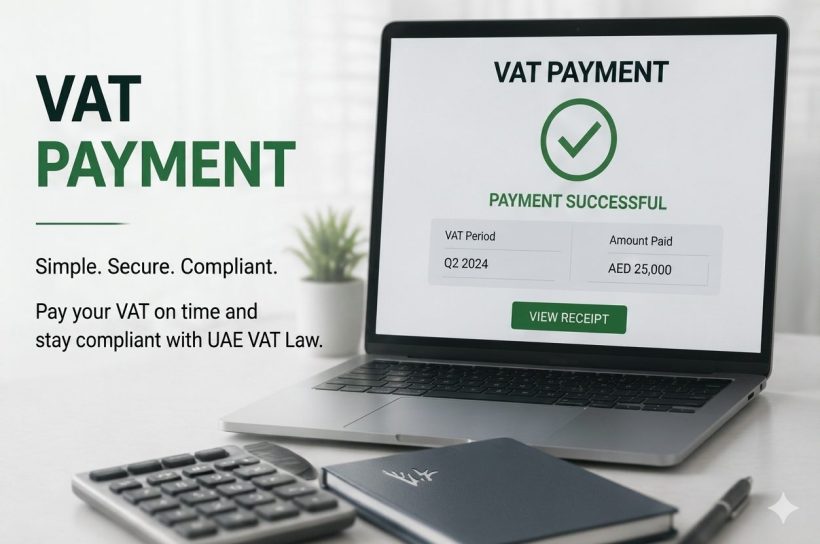
You file through the EmaraTax portal. Once submitted, the system calculates your net VAT liability. Payment must happen before the same 28-day deadline.
Accepted payment methods include e-Dirham cards, credit/debit cards, and direct bank transfers. The FTA does not accept cash or cheques.
If your input VAT exceeds your output VAT, you can apply for a refund. The FTA processed over 3.2 million electronic tax refund applications between 2018 and 2019 alone – so the refund mechanism works, though processing times vary.
Key features of UAE VAT compliance
Understanding these elements keeps your business on solid ground:
- Tax invoices: Must include TRN, date, description of goods/services, VAT amount, and total. Simplified invoices are allowed for supplies under AED 10,000
- Credit notes: Required when adjusting previously issued invoices – partial refunds, returns, or pricing corrections
- Record retention: The FTA requires you to keep all tax-related records for a minimum of 5 years
- Designated zone rules: Transfers of goods within and between designated zones can be zero-rated if specific conditions are met
- Reverse charge mechanism: Applies when importing services from outside the UAE – you account for VAT on the purchase yourself
How to choose the right VAT support
Look for UAE-specific expertise
VAT rules differ by country. A firm that handles VAT registration in Dubai should understand FTA portal procedures, designated zone treatment, and sector-specific nuances for consultancy, IT, ecommerce, and trading businesses.
Check for end-to-end service
Registration alone isn’t enough. You need ongoing filing, reconciliation, and advisory support. Firms that bundle accounting, VAT, and Dubai corporate tax services into a single package tend to offer better consistency – your books and your tax returns stay aligned.
Compare pricing transparently
Some firms quote low monthly fees but charge extra for every filing, amendment, or phone call. Others offer all-inclusive packages. Get the full cost picture before signing.
Frequently Asked Questions (FAQs)
What is VAT, and how is it applied in Dubai?
VAT is a 5% consumption tax applied to most goods and services in the UAE. Businesses collect it from customers at the point of sale and remit it to the Federal Tax Authority. Some categories – like certain financial services and residential property – are either zero-rated or exempt from VAT.
How can businesses register for VAT in the UAE?
You register through the FTA’s EmaraTax portal by submitting your trade license, Emirates ID, financial records, and business activity details. Registration is mandatory once your taxable supplies exceed AED 375,000 in 12 months. The process typically takes 5–20 business days, and late registration carries a flat AED 20,000 penalty.
What is the VAT registration threshold in Dubai?
VAT registration is mandatory in the UAE if your taxable supplies and imports exceed AED 375,000 in the previous 12 months or are expected to exceed that amount in the next 30 days. Businesses earning above AED 187,500 can apply for voluntary VAT registration.
What happens if a business files VAT returns late in the UAE?
Late VAT filing can attract penalties from the Federal Tax Authority (FTA). As per UAE regulations, the first late filing penalty is AED 1,000, and repeated violations within 24 months can result in AED 2,000 penalties per offence, along with possible additional fines for late payment.
Can businesses claim VAT refunds in the UAE?
Yes. If the input VAT paid on purchases exceeds the output VAT collected on sales, businesses can apply for a VAT refund through the EmaraTax portal, subject to FTA review and approval.
Reach out to our experts at info@bcl.ae.