

This one didn’t come out of nowhere. Small Business Relief was due to expire at the end of 2026, and for months that deadline had SME owners asking us the same question on repeat: what happens after 2026? We had been fielding a steady stream of these queries, and the Ministry of Finance has now answered them.
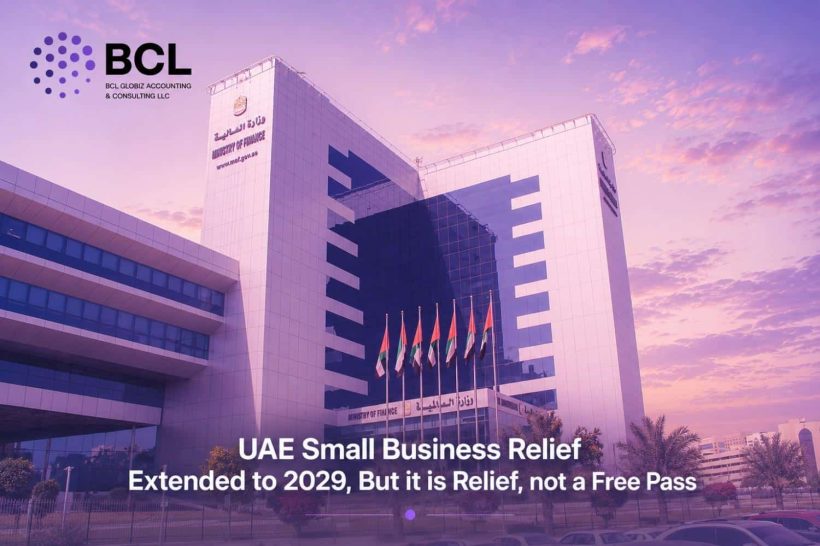
The Ministry of Finance has extended Small Business Relief (SBR) under UAE Corporate Tax. Instead of ending in 2026, it now covers tax periods ending on or before 31 December 2029, three more years of simplified treatment for eligible SMEs.
What hasn’t changed is the eligibility bar. Revenue must stay at or below AED 3 million each period since 1 June 2023. Qualify, and you can elect nil taxable income for that period.
Need a complete guide to Small Business Relief explaining eligibility, elections and tax return filing requirements for UAE businesses.
The legal basis is Ministerial Decision No. 73 of 2023 (issued under Article 21 of Federal Decree-Law No. 47 of 2022), as amended by Ministerial Decision No. 131 of 2026 to push the end date out to 31 December 2029.
The Ministry has said the extension is meant to ease the compliance burden on start-ups and small businesses while reinforcing the UAE’s position as a competitive, business-friendly investment destination.
Key dates at a Glance
| Date | What it means |
| 1 June 2023 | Small Business Relief takes effect. |
| 31 December 2026 | Original SBR end date under Ministerial Decision No. 73 of 2023, now superseded. |
| 31 December 2029 | New SBR end date under Ministerial Decision No. 131 of 2026. |
| 30 September 2026 | Filing and payment deadline for taxpayers whose financial year ended 31 December 2025. |
Worth noting:
- It’s opt-in, you must actively elect SBR on your Corporate Tax Return via EmaraTax.
- Qualifying Free Zone Persons and MNE group members remain ineligible, regardless of revenue.
SBR is not a Compliance Holiday
Two myths keep tripping up business owners:
“No taxable income means no transfer pricing rules.” False. If you have related-party transactions crossing documentation thresholds, master file and local file obligations still apply, and the FTA can request them during an audit.
“Simplified tax means simplified bookkeeping.” False. You still must:
- Register for Corporate Tax and file on time (miss it, and it’s a flat AED 10,000 penalty)
- Keep records supporting revenue, expenses, and elections
- Prove every year that you stayed under the AED 3 million line.
Cross that threshold once, and SBR is gone for that period.
There’s a third myth worth flagging: splitting a business to keep each entity under AED 3 million doesn’t fly either. If the FTA determines that a business has artificially separated its activities to benefit from SBR, this is treated as an arrangement to obtain a corporate tax advantage, and general anti-abuse provisions can apply on top of losing the relief itself.
What the FTA has Clarified?
Alongside the Ministry of Finance’s decision, the Federal Tax Authority reiterated that SBR eligibility does not reduce a taxpayer’s obligations under the Corporate Tax Law. For every tax period, eligible businesses must still register for Corporate Tax, submit their return (even a simplified one), and maintain records that support the figures and elections in that return.
The FTA has also flagged upcoming deadlines. Taxpayers whose financial year ended on 31 December 2025 must file their Corporate Tax return and settle any tax due by 30 September 2026. The extension changes the relief’s end date, not the filing calendar in between.
What SME owners should do now?
- Track your revenue against the AED 3 million threshold every tax period, not just once.
- Elect for SBR on your Corporate Tax Return via EmaraTax if you qualify, since it is not applied automatically.
- Keep records supporting revenue, expenses, and elections, even in periods where you owe no tax.
- Check whether your related-party transactions trigger transfer pricing documentation, regardless of SBR status.
- Mark your filing deadline against your own financial year end, not the SBR end date.
Bottom line
The extension buys small businesses real time, but it eases the calculation, not the compliance. Use the runway to keep records tight, and 2030 won’t be a scramble.
Frequently Asked Questions
Who can claim Small Business Relief?
Resident taxable persons whose revenue is AED 3 million or below, in the current period and every previous period since 1 June 2023, can elect for SBR, provided they are not a Qualifying Free Zone Person or part of an MNE Group above the consolidated revenue threshold.
Has the AED 3 million revenue threshold changed?
No. The threshold set out in Ministerial Decision No. 73 of 2023 stays the same. Only the end date has moved, from 31 December 2026 to 31 December 2029.
Is Small Business Relief automatic?
No. It’s opt-in. You need to elect for SBR when filing your Corporate Tax Return through EmaraTax.
Does SBR remove transfer pricing obligations?
No. If related-party transactions cross the documentation thresholds, master file and local file requirements still apply, and the FTA can request them during an audit.
What happens if my revenue exceeds AED 3 million in a single period?
You lose eligibility for SBR for that tax period. Each period is assessed on its own, so you will need to reassess your position again for the next one based on actual revenue.