

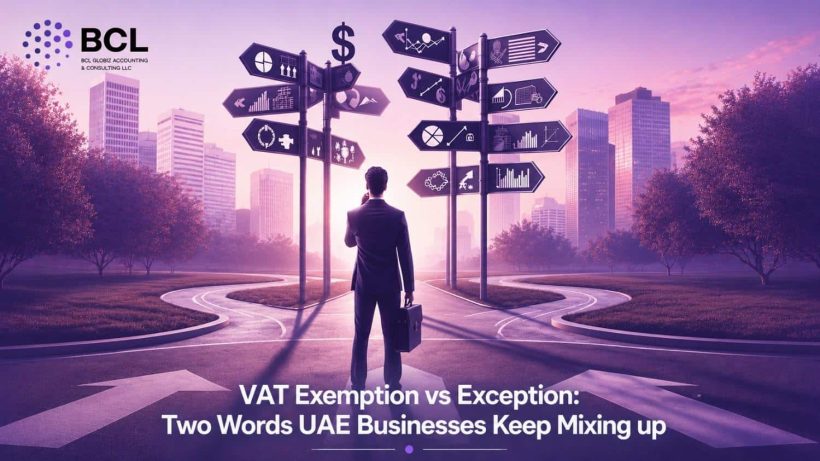
If you run a business in the UAE, you’ve probably heard both terms thrown around in the same breath, sometimes even by people who should know better. “Exempt” and “Exception” sound almost identical, but in VAT law they mean two completely different things. Get them confused, and you could end up filing returns you didn’t need to, or worse, skipping registration you actually needed. If you’re unsure how VAT rules apply to your business, our UAE VAT consultancy services can help you determine the correct tax treatment and ensure compliance with FTA regulations.
What Exempt Actually Means
Exempt supplies are specific goods and services that the law simply keeps outside VAT altogether. No 5%, no 0%, nothing. Under Federal Decree-Law No. 8 of 2017, this list includes things like the sale or lease of residential property (beyond the first supply), bare land, local passenger transport, and certain financial services.
Here’s the part people miss: if you sell something exempt, you can’t claim back the VAT you paid on related expenses. So a residential leasing company can’t recover input VAT on maintenance costs tied to that leasing income. It’s automatic too. You don’t apply for it, and you don’t get a choice. If your activity falls on the exempt list, it’s exempt, full stop.
What Exception Actually Means
Exception from registration is completely different. It’s not about what you sell. It’s about whether you need a Tax Registration Number at all.
If your business makes only zero-rated supplies (think exports, or specific healthcare and education services taxed at 0%), you can apply to the FTA for an exception from mandatory VAT registration. Approval means you skip the regular filing cycle entirely. But there’s a catch: you also lose the ability to recover any input VAT, since you’re not a registered taxable person in the first place.
This is a request you make. It’s not automatic, and it only applies if every single supply you make is zero-rated. The moment you add even one standard-rated line to your business, that exception no longer holds.
Also worth knowing: the FTA doesn’t have to say yes just because you asked. Approval is entirely at their discretion, and they’ll want to see supporting documents such as invoices, a business activity flowchart, and a clear explanation of why every supply qualifies as zero-rated before they even consider it.
The Confirmation Step People Forget About
Here’s something that trips a lot of businesses up. Applying for an exception isn’t a one-click, done-deal kind of process. Once you submit your request to the FTA, it doesn’t happen instantly, and there’s no guaranteed timeline for how long the review takes.
What you can count on is this: the FTA will notify you by email once a decision is made. Until you have that confirmation in hand, treat your business as if the exception hasn’t been granted yet, keep tracking your supplies as normal, and don’t assume no news is good news. If your revenue mix changes later and a standard-rated supply creeps in, the FTA can reassess and withdraw the exception, so keeping clean records is still part of the deal even after approval.
A Quick Example Of Each
Say you run a residential leasing company in Dubai. Your income comes entirely from renting out apartments. That income is exempt supply, automatically, no application needed, but it also means you can’t claim back VAT on the maintenance, cleaning, or repair costs tied to those units.
Now compare that to a UAE-based export business that sells goods exclusively to buyers outside the country. Those sales are zero-rated, not exempt. If this business crosses the AED 375,000 threshold, it can apply to the FTA for an exception from registration, but only if every single supply it makes is zero-rated. There is no room for exceptions within the exception: the moment even one standard-rated transaction shows up, the business no longer qualifies and must register like any other taxable person. If approved, no quarterly returns, but also no input VAT recovery, since it isn’t a registered taxable person in the first place.
Same outcome on the surface (no VAT reclaimed either way), but two completely different paths to get there.
Why The Distinction Actually Matters
- Exempt supplies never touch the 5%/0% system, and the exemption is automatic
- Zero-rated supplies are taxable at 0%, and businesses making only these can apply for an exception from registering
- Exempt businesses can’t recover input VAT. Businesses with a registration exception can’t either, but for a different reason: they’re not registered at all
- Get the exempt categorisation wrong and you risk misfiled returns or denied input tax claims. Get the exception wrong and it’s a compliance issue instead: it isn’t automatic, so it requires a formal application to the FTA, and treating it as approved before that confirmation arrives leaves you exposed to penalties for non-registration and non-filing
If you’re not sure which bucket your business supplies fall into, it’s worth getting a proper opinion before you file, rather than after an FTA query lands on your desk. BCL Globiz’s tax advisory team can walk through your specific revenue streams and confirm the right treatment.
Before applying for an exception, it’s important to understand the standard VAT registration process in the UAE and the eligibility criteria.
Frequently Asked Questions
Can a business be both exempt and have a registration exception at the same time?
Not really, and this is where a lot of businesses trip themselves up. Exemption applies to specific supplies, while an exception applies to your registration status as a whole, and it only holds if every supply you make is zero-rated. If even one of your supplies is exempt rather than zero-rated, you don’t qualify for the exception in the first place. So the two don’t really stack. You either sit in one category or the other, not both.
If I get an exception from registration, do I still need to keep records?
Yes, and this one catches people off guard. Getting the exception approved doesn’t mean you have to not do administration. You still need to track your supplies, because if your business starts making anything other than zero-rated sales, the FTA can reassess and cancel the exception. No records to show what changed, and you’re stuck explaining a gap after the fact.
Does an exempt business need to register for VAT at all?
If everything you supply is exempt, no. You don’t need to register, and there’s nothing to apply for either. It’s worth noting though that most businesses aren’t purely exempt. The moment you add even a small stream of taxable income, standard-rated or zero-rated, you may cross into registration territory depending on your turnover.
How long does the FTA take to approve an exception request?
There’s no fixed number of days published anywhere that applies to every case. It depends on how complete your application is and how quickly you respond if the FTA asks for more information. What’s certain is that you shouldn’t assume approval just because time has passed. Wait for the FTA’s written confirmation before treating the exception as active.
What happens if I get the categorisation wrong?
This is the expensive part, and exempt and exception go wrong in different ways. Treat an exempt supply as if it were zero-rated (or the other way round) and you risk filing incorrect returns or claiming input VAT you weren’t entitled to. An exception mistake looks different: if you treat it as granted before the FTA confirms approval, or it’s later denied, normal tax filing applies in full, registration and quarterly or monthly returns included. Skip that and assume you’re covered, and it’s not a misfiled return, it’s non-compliance on both registration and returns filing. Get the exception properly approved, though, and there’s nothing to worry about on this front. FTA penalties for these mistakes aren’t small, so it’s worth getting a second opinion before you file rather than after a query lands on your desk.
When and why is the exception useful?
It is most useful for businesses that have only zero-rated supplies and little to no input VAT to recover in the first place. Since there is nothing meaningful to claim back, staying unregistered removes the admin cost of VAT compliance, quarterly or monthly returns, record-keeping, and the ongoing overhead of managing a TRN, without giving up anything of real value.
What documents does the FTA ask for with an exception application?
The application itself is submitted through your FTA login on EmaraTax. Beyond that, the FTA typically wants to see invoices confirming your zero-rated sales, and may also ask for a customer agreement, a business activity flowchart, and a turnover declaration to support why every supply qualifies as zero-rated. Since the FTA can request additional documents depending on your specific case, confirm the exact list with BCL Globiz’s tax advisory team before you apply.
What happens if the FTA denies the exception request?
Then the default position applies. The business is treated as a normal taxable person, which means registering for VAT in the usual way, disclosing its zero-rated supplies, and filing quarterly or monthly VAT returns like any other registered business, even though it has little or no VAT to actually pay.
Reach out to us at info@bcl.ae