

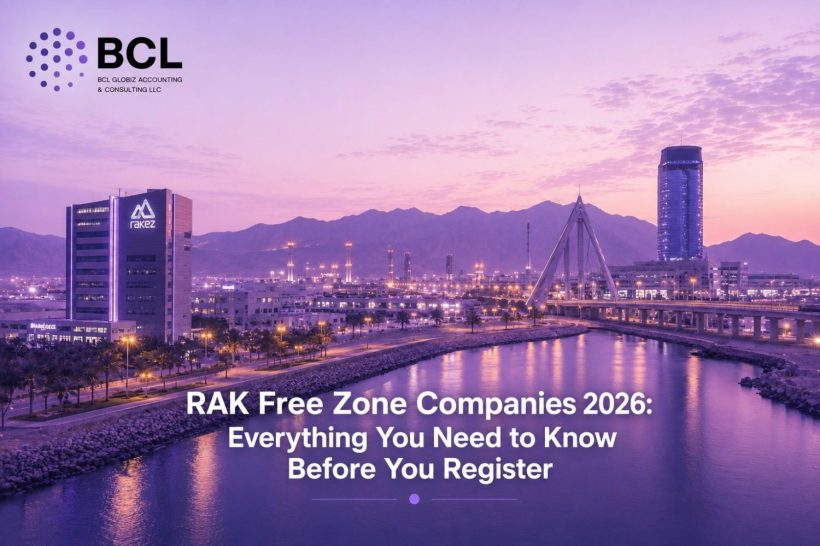
Ras Al Khaimah (RAK) has become one of the smartest options for entrepreneurs who want a UAE business without Dubai-level costs. RAKEZ alone is now home to over 40,000 companies from more than 100 countries, with 19,000 new registrations in 2025 alone.
This guide profiles the major RAK free-zone authorities, the most common types of companies you’ll find there, the indicative costs of setting one up in 2026, and the corporate-tax obligations that apply from day one.
If you’re planning to launch a UAE business, understanding the complete RAK Free Zone company setup process helps you choose the right licence structure, visa package, and banking strategy.
RAK Free-Zone Authorities: Quick Distinction
RAKEZ (Ras Al Khaimah Economic Zone)
Created in 2017 from the merger of RAK Free Trade Zone (RAK FTZ) and RAK Investment Authority (RAKIA). Operational free zone offering trading, services, industrial, e-commerce, and freelance licences with visa eligibility. Most RAK free-zone companies are RAKEZ entities.
RAK ICC (RAK International Corporate Centre)
Offshore / international business company (IBC) registry. RAK ICC companies cannot obtain UAE residence visas and cannot conduct business in the UAE. They’re typically used as holding entities for international assets, IP, or as parent companies in cross-border structures.
Which Do You Need?
If you need a UAE residence visa or want to do business in or from the UAE, you need RAKEZ. If you only want a tax-efficient international holding vehicle with no UAE presence, RAK ICC may fit.
RAKEZ Entity Types: FZE, FZ-LLC, FZC and Branch Office
Before you pick a licence, you pick a legal form. The right one depends on how many shareholders you have and whether you’re launching fresh or extending a company that already exists.
Free Zone Establishment (FZE)
Single shareholder, limited liability. The default choice for solo founders and one-person consultancies. The shareholder can be an individual or a corporate entity.
Free Zone Company (FZC) / FZ-LLC
Two or more shareholders, limited liability. RAKEZ issues this multi-shareholder form as an FZC (or FZ-LLC, the free-zone limited liability company). Shareholders can be individuals, corporates, or a mix. This is the standard structure for partnerships, joint ventures, and companies bringing in investors.
Branch Office
A branch office is not a separate legal entity; it’s an extension of an existing UAE or foreign parent company, carrying out the same (or a subset of the same) activities. There’s no share capital and no new incorporation, but you’ll need the parent’s company incorporation certificate, a board resolution approving the branch, and, for a foreign parent, a certificate of good standing. A branch is often the cleanest route when an established company simply wants a licensed RAK presence.
Most Common RAKEZ Company Profiles
Solo Consultant / Freelancer
Freelancer Permit. From approximately AED 5,750/year. Single activity, single visa. Good for individual consultants, designers, developers, content creators.
Single-Shareholder Service Company (FZE)
Service or consultancy licence from approximately AED 11,400+. Suited for IT firms, marketing agencies, advisory practices.
Trading / E-commerce Company
Commercial or e-commerce licence from approximately AED 7,500 to 15,000. Import/export code available. Suited for ecommerce sellers, importers, and general traders.
Industrial / Manufacturing Company
Industrial licence from approximately AED 10,000+ for the licence alone, plus warehouse and facility costs. Suited for SME manufacturers and assembly operations.
Holding Company
RAK ICC IBCs are commonly used to hold shares in operating companies or intellectual property. No UAE physical presence, no visa eligibility.
Company Name Rules and Trade Name Reservation
Your company name is locked in early, so it’s worth getting right the first time. RAKEZ runs a trade name reservation step where your proposed name is checked and held before incorporation proceeds.
A few rules to keep in mind:
- The name must not have been already registered by another RAKEZ entity.
- No offensive language and no references to religion, ruling authorities, or political groups.
- Abbreviations of personal names aren’t allowed; if you name the company after a person, use the full name.
- The legal suffix (FZE, FZC, or FZ-LLC) is added to match your chosen structure.
Reservation is handled through the RAKEZ portal and the held name typically feeds straight into your licence application.
Step-by-Step RAKEZ Incorporation Workflow
From first decision to licence in hand, a standard RAKEZ setup runs like this:
- Select your business activity– Choose from the RAKEZ business activity list and confirm the activity matches your intended operations- This drives your licence type, so define it precisely before moving on.
- Choose your legal form and licence– FZE, FZC/FZ-LLC, or branch office, paired with the right licence category (commercial, service, industrial, e-commerce, or freelance).
- Reserve your trade name– Submit your trade name reservation for approval.
- Submit your application on the RAKEZ portal– Upload shareholder documents, the completed application, and (where required) a business plan.
- Select your facility– Attach a flexi-desk, smart desk, office, or warehouse package. This also sets your visa allocation.
- Receive initial approval and settle fees– RAKEZ reviews and issues initial approval.
- Sign incorporation documents– Execute the MOA/AOA and related paperwork.
- Licence issuance– RAKEZ issues your trade licence and company incorporation certificate, and your entity is officially live.
Standard processing runs 3 to 5 business days; the Instant Licence route can deliver a licence in as little as 1 business day.
Document Checklist for Individual and Corporate Shareholders
What you’ll need depends on whether the shareholder is a person or another company.
Individual Shareholders
- Passport copy (and visa/entry stamp page if already in the UAE).
- Passport-size photograph.
- Proof of address (a recent utility bill or bank statement).
- NOC from sponsor if the applicant currently holds a UAE residence visa under another employer.
- Business plan for certain regulated or higher-risk activities.
Corporate Shareholders
- Company incorporation certificate of the parent entity.
- Board resolution approving the new RAKEZ company and appointing the authorised signatory.
- Memorandum & Articles of Association of the parent.
- Certificate of good standing (for foreign parent companies).
- Passport and proof of address of the directors/authorised signatory.
Foreign corporate documents usually need to be attested/legalised before they’ll be accepted.
Choosing Your Facility: Flexi-Desk, Smart Desk, Office and Warehouse
Every RAKEZ licence comes attached to a facility, and your facility choice caps how many visas you can apply for.
| Facility | Best For | Typical Visa Allocation |
| Flexi-desk | Freelancers, solo founders, service start-ups | 1-2 visas |
| Smart desk | Small teams needing a fixed shared workspace | 2-4 visas |
| Private office | Growing teams wanting a dedicated space | Scales with office size |
| Warehouse | Trading, light manufacturing, storage | Scales with area + staff rules |
Pick the smallest facility that comfortably covers your visa headcount for the year. Upgrading later is straightforward, but under-provisioning stalls your visa applications.
The RAKEZ Visa Process: Entry Permit, Medical, Biometrics and Stamping
Once your licence and establishment card are issued, the residence-visa process for each applicant follows a set sequence:
- Entry permit– RAKEZ applies for the entry permit that allows the applicant to enter (or begin status change inside) the UAE.
- Status change / entry– The applicant activates the permit.
- Medical fitness test- A medical fitness test (blood test and chest X-ray) is completed at an approved centre.
- Biometrics and Emirates ID– The applicant gives fingerprints and photos for the Emirates ID application.
- Visa stamping– The residence visa is stamped onto the passport (now largely a digital residence file), completing the process.
Two cards sit behind all of this: the establishment card, which registers your company with immigration, and the immigration card, which authorises the company to sponsor employees. Both must be in place before visas can be issued.
Indicative First-Year Costs (RAKEZ, 2026)
| Profile | Licence Type | Annual Licence (AED) | First-Year Total |
| Solo professional | Freelancer Permit | ~5,750 | ~18,000-20,500 |
| Service company | Service / Consultancy | ~11,400+ | ~32,000-35,000 |
| E-commerce seller | E-commerce | ~5,750-9,000 | ~20,000-28,000 |
| Trading company (4 visas) | Trading / General Trading | ~15,000 | ~70,000-100,000 |
First-year totals include flexi-desk, establishment + immigration cards, visas, and basic health insurance. Confirm against the current RAKEZ quote.
Official Fee Verification and Pricing Disclaimer
The figures above are indicative and change with RAKEZ promotions, facility choice, visa count, and activity. Before you commit, verify current pricing against an official RAKEZ quote or the RAKEZ portal. Packages and add-on fees are updated periodically, and the number that matters is the one on your own quotation, not a published estimate.
Why RAKEZ for Your UAE Company?
- Lowest licence fees among major UAE free zones.
- 100% foreign ownership across all RAKEZ entity types.
- Approximately one hour from Dubai (45 minutes from northern Dubai), 30 minutes from Sharjah.
- Instant Licence option delivers a licence in as little as 1 business day.
- Same UAE legal framework and tax benefits as Dubai free zones at materially lower cost.
Tax Position
RAKEZ entities are subject to UAE corporate tax under Federal Decree-Law No. 47 of 2022. They can qualify for 0% corporate tax on qualifying income under the QFZP regime (Cabinet Decision No. 100 of 2023; Ministerial Decision No. 265 of 2023). Non-qualifying income is taxed at 9% above AED 375,000.
RAK ICC IBCs are also taxable persons under the UAE corporate tax law, but typically have limited or no UAE-sourced income. Specific compliance treatment depends on the use case, so get advice before relying on IBC structures.
Corporate Tax Registration and VAT Threshold Guidance
Setting up the company is only step one, and registration obligations kick in quickly.
Corporate tax registration– Every RAKEZ entity is a taxable person and must register on EmaraTax, the FTA’s online portal, even if it expects to pay 0%. For companies incorporated on or after 1 March 2024, the corporate tax registration deadline is within three months of incorporation (FTA Decision No. 3 of 2024). Miss it and the late-registration penalty is a flat AED 10,000, so treat CT registration as part of your setup, not an afterthought.
VAT registration. VAT registration is separate from corporate tax and driven by turnover:
- Mandatory once taxable supplies exceed AED 375,000 in a 12-month period.
- Voluntary once taxable supplies or expenses exceed AED 187,500.
Registration is completed through the same EmaraTax login. Many new RAKEZ companies register voluntarily to reclaim input VAT and to look established to clients, but voluntary registration also brings quarterly filing obligations, so weigh it before opting in.
Licence Renewal and Annual Compliance
A RAKEZ licence is issued for one year and must be renewed annually. Licence renewal keeps your trade licence, facility, establishment card, and visa file valid. Let it lapse and you risk fines and, eventually, a blocked immigration file.
Beyond renewal, ongoing annual compliance typically includes maintaining proper books of accounts, filing your corporate tax return within nine months of your financial year-end, submitting VAT returns (usually quarterly) if registered, and keeping shareholder, UBO, and ESR records current. Budgeting for renewal plus compliance from year one avoids nasty surprises in month eleven.
Mainland Trading Restrictions: When You Need a Distributor or Mainland Entity
A RAKEZ company can invoice clients anywhere in the UAE and trade freely within free zones and internationally. What it can’t do is sell physical goods directly to UAE mainland customers as a matter of routine.
To reach the mainland market you generally either appoint a mainland-licensed distributor who imports and sells your goods, or set up a mainland entity (or dual licence) that can trade onshore in its own right. Services are more flexible than goods, but if your model depends on shelves in mainland shops or direct-to-consumer mainland delivery, plan the mainland leg before you incorporate, because retrofitting it later is more expensive than building it in.
Remote Setup Limitations and In-Person Requirements
Most of a RAKEZ setup can be done remotely. Application, trade name reservation, and licence issuance all run through the RAKEZ portal. Where “fully remote” tends to break down is banking and visas.
Bank account opening almost always benefits from (and often requires) the shareholder being physically present for the compliance interview. And the residence-visa steps, namely the medical fitness test and biometrics for the Emirates ID, must be done in person inside the UAE. You can incorporate from your living room, but you generally can’t finish your visa and banking without a trip.
What We Commonly Observe in the UAE Market
The single biggest determinant of RAKEZ banking success is whether the shareholder is physically in the UAE for the bank meeting. Remote-only setups can secure an account but typically take 8 to 10 weeks longer and have a higher rate of file rejection by the bank’s compliance team.
Activity-change cost trap: adding a business activity after issuance costs approximately AED 1,000 to 2,500 per activity, but if the new activity sits in a different RAKEZ activity group, the licence may need to be reissued at full price. Define the activity list before incorporation, not after.
Frequently Asked Questions
What’s the difference between RAKEZ and RAK ICC?
RAKEZ is an operational free zone with visa eligibility. RAK ICC is an offshore / IBC registry without UAE physical presence or visa eligibility. If you need UAE residence visas or want to do business in the UAE, you need RAKEZ.
What’s the difference between an FZE, an FZC/FZ-LLC, and a branch office?
An FZE has a single shareholder, while an FZC (or FZ-LLC) has two or more shareholders, and both are separate limited-liability entities. A branch office is not a separate entity at all; it’s an extension of an existing parent company and requires the parent’s incorporation certificate, a board resolution, and (for foreign parents) a certificate of good standing.
How much does a RAK free-zone company cost in 2026?
Indicative first-year totals: AED 18,000 to 20,500 for a freelancer permit with 1 visa and flexi-desk; AED 32,000 to 35,000 for a service company with 2 visas and smart desk; AED 70,000 to 100,000 for a general-trading company with 4 visas and a small warehouse. Always confirm against a current RAKEZ quote, as pricing changes with promotions and facility choice.
When do I have to register for corporate tax and VAT?
Corporate tax registration on EmaraTax is due within three months of incorporation for companies formed on or after 1 March 2024, with a AED 10,000 penalty for late registration. VAT registration is mandatory once taxable supplies pass AED 375,000 in 12 months, and voluntary from AED 187,500.
Are RAK free-zone companies subject to UAE corporate tax?
Yes, RAKEZ entities are subject to UAE corporate tax under Federal Decree-Law No. 47 of 2022. They may benefit from a 0% rate on qualifying income if they meet QFZP conditions. Non-qualifying income is taxed at 9% above AED 375,000.
Can a RAK free-zone company do business across the UAE?
Yes, for invoicing: RAKEZ companies can invoice clients anywhere in the UAE. Selling physical goods directly to UAE mainland consumers typically requires a mainland trade licence, a mainland distributor, or a dual-licence arrangement.
Can I set up a RAK free-zone company remotely?
Largely yes. Incorporation, trade name reservation, and licence issuance run through the RAKEZ portal, but the medical fitness test and Emirates ID biometrics must be done in person in the UAE, and bank account opening usually needs the shareholder present.
How long does it take to set up a RAK free-zone company?
RAKEZ’s Instant Licence option delivers a licence in as little as 1 business day. Standard processing 3 to 5 business days. Total realistic timeline including visas and bank-account opening: 4 to 8 weeks.
Reach out to our experts at info@bcl.ae.