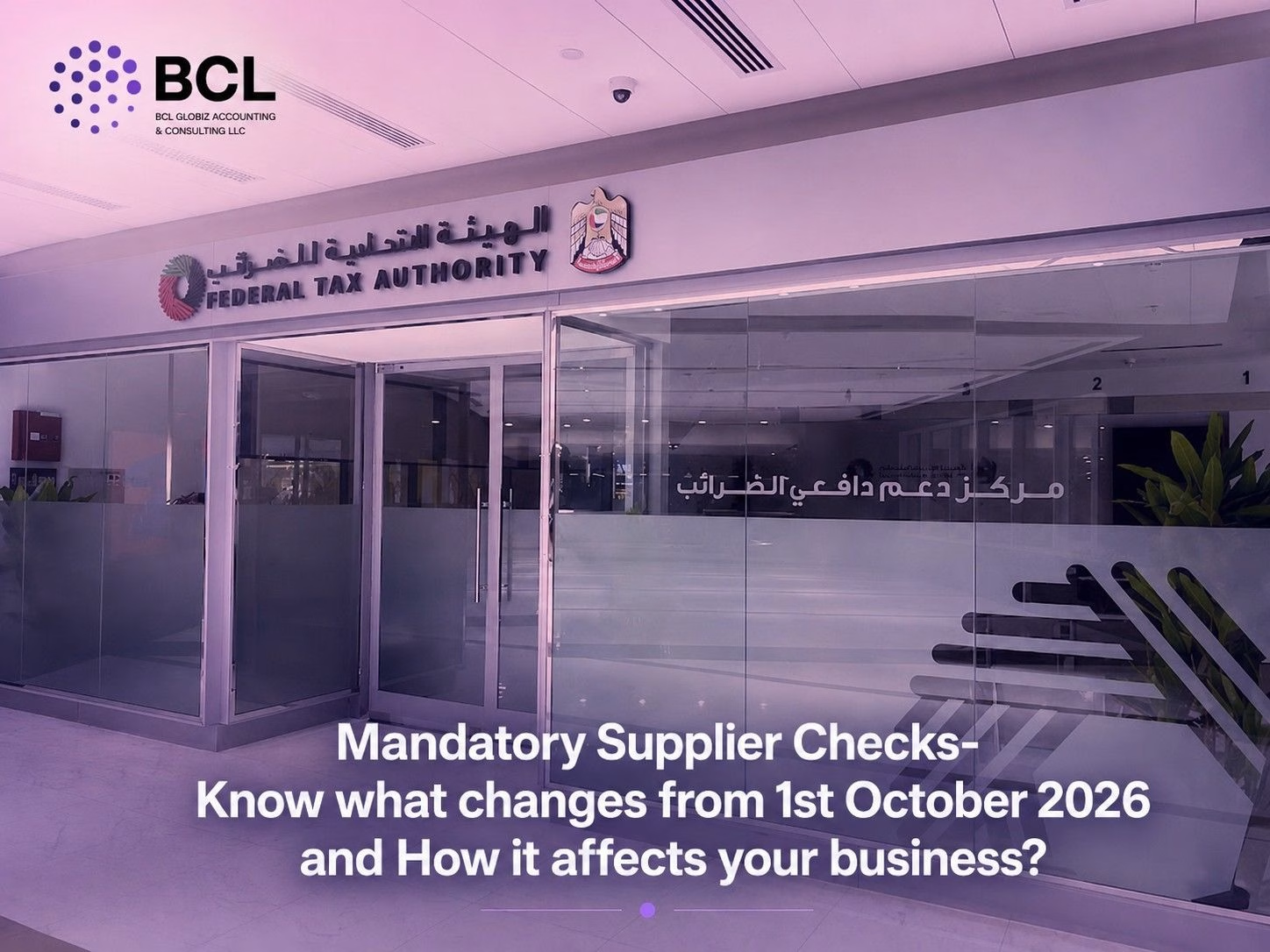


From 1 October 2026, holding a valid tax invoice will no longer be enough to safely claim input VAT in the UAE. The Federal Tax Authority (FTA) has issued Decision No. 13 of 2026, which requires VAT-registered businesses to actively check who they are buying from and what they are buying, before claiming that VAT back. If your business cannot show it did these checks, the FTA can deny the input VAT recovery, and in serious cases, that denial is permanent.
This guide explains the new rules in plain language, what has actually changed compared with the old approach, and what you need to have in place before the deadline.
Reviewed by Punith Jindal, Partner at BCL Globiz
Why this decision exists?
In 2025, Federal Decree-Law No. 16 of 2025 amended the VAT Law and added a new provision, Article 54 bis. This gave the FTA the power to refuse input VAT recovery where a supply is part of a chain connected to tax evasion, even if the recipient business was not directly involved in that evasion.
Article 54 bis left one practical question unanswered: how is a business supposed to know, or prove, that it acted in good faith? FTA Decision No. 13 of 2026 answers that question. It sets out the exact steps a business must take to show it exercised reasonable care before claiming input VAT.
“The shift here is about the burden of proof,” says Punith Jindal, Partner at BCL Globiz. “Until now, a valid tax invoice was generally treated as sufficient support for an input VAT claim. Under this decision, that is no longer the case. Businesses need to show they actively checked who they were dealing with, and that the transaction itself made commercial sense, before they can rely on that recovery.”
The decision was approved by the FTA Board on 23 June 2026, issued on 22 July 2026, and published on the FTA website on 20 August 2026. It applies to every taxable person under the VAT Law, meaning any business that is registered, or required to be registered, for VAT in the UAE.
The old approach versus the new approach
The table below sets out, in simple terms, how things worked before this decision and how they will work once it takes effect.
| What FTA looked at | Before 1 October 2026 | From 1 October 2026 |
| Proof needed to claim input VAT | A valid tax invoice was normally enough on its own. | A valid tax invoice alone is not enough. You also need proof that you checked the supplier and the supply. |
| Checking who you buy from | No formal requirement to verify a supplier’s identity or legitimacy before claiming input VAT. | You must verify the supplier’s identity documents, the person authorised to represent them, and confirm they genuinely operate from their stated business address. |
| Repeat checks | Not required. | Supplier checks must be refreshed at least once every twelve months, or sooner if you spot a risk indicator. |
| Higher-value suppliers | No extra checks tied to transaction value. | Where a supplier’s annual supplies to you go over AED 375,000, you also need written confirmation from a UAE bank that the supplier holds an account there, plus a look at public reviews and media coverage. |
| Every individual supply | Generally not checked supply by supply. | Each supply must be checked for genuine commercial reason, reasonable pricing, and whether the goods or services match the supplier’s licensed activity. |
| Cash payments | No specific documentation requirement. | Payments should be electronic. Any cash payment needs a documented business reason. |
| Internal policy | No requirement for a written process. | A written policy is required, naming who performs, reviews, and supervises the checks. |
| Small purchases | Not applicable. | Supplies under AED 10,000 (excluding VAT) are generally exempt, unless that supplier’s total supplies to you pass AED 100,000 in a twelve-month period, in which case full checks apply anyway. |
| Consequence of getting it wrong | Input VAT recovery was rarely challenged if the invoice looked valid. | The FTA can deny input VAT recovery, and in some cases the denial is permanent, where a supply is linked to tax evasion and you knew, or should have known, about it. |
The two levels of checks you now need to do
The decision splits the verification work into two separate exercises. Think of the first as checking the person you are dealing with, and the second as checking the deal itself.
1. Supplier verification: checking who you are dealing with
This is done the first time you deal with a new supplier, and then repeated at least once every twelve months. It covers:
- Checking the supplier’s identity documents against official records
- Confirming who is authorised to represent the supplier and act on its behalf
- Confirming the supplier genuinely operates from the business address it claims, matching its declared activity
- Watching for risk indicators, specifically the supplier’s address or its key personnel changing more than twice within a 12-month period, or transactions that look disproportionate to the size and history of the business
If a supplier’s annual supplies to you go above AED 375,000, there is an extra step: you need unqualified written confirmation from a UAE-licensed bank that the supplier holds an account there, along with a check of the supplier’s public reputation, such as reviews and media coverage.
2. Supply verification: checking each individual transaction
This applies to every supply you receive, not just new suppliers, and is the more demanding of the two. For each supply, you should be able to show:
- There is a genuine commercial reason for that supplier being involved in the transaction
- The pricing and margins are commercially reasonable, not unusual or unexplainable
- The goods or services fall within what the supplier is actually licensed to provide
- The title and origin of the goods are sound
- Where a middleman or intermediary is involved, their role in the chain also makes commercial sense
Payments should be made electronically. If a payment is made in cash, you need a documented reason for it, since cash payments are one of the patterns the FTA is watching for.
The thresholds explained simply
Three numbers matter under this decision. Here is what each one does.
| Threshold | Trigger | What it means for you |
| AED 10,000 | Value of a single supply, excluding VAT | Below this, the supply is generally exempt from the detailed verification checks, on its own. |
| AED 100,000 | Total supplies from one supplier over a rolling 12 months | Once a supplier crosses this in aggregate, the AED 10,000 exemption no longer applies. Full checks are required on all supplies from that supplier, however small each invoice is. |
| AED 375,000 | Total supplies from one supplier over a rolling 12 months | Above this, you also need written UAE bank confirmation of the supplier’s account, and a review of their public reputation. |
A useful way to think about the AED 100,000 aggregate limit: it works out to roughly AED 8,300 a month from a single supplier. Many ongoing supplier relationships, such as a regular cleaning contractor, a recurring logistics provider, or a monthly stock supplier, will cross that figure without anything unusual happening. In practice, this means the small-value exemption offers less protection than it might first appear, and most active supplier relationships will need full verification sooner or later.
“We are advising clients not to rely on the small-value exemption as a reason to skip verification,” notes Punith Jindal, Partner at BCL Globiz. “Most recurring supplier relationships pass the AED 100,000 mark well within a year, often without anyone tracking it closely. It is safer to build one consistent verification process for all suppliers, rather than trying to manage two different standards side by side.”
Which check applies to your purchase?
This flow shows how the checks in this decision actually apply to a single purchase, once you take both the AED 10,000 and AED 100,000 rolling twelve-month thresholds into account.
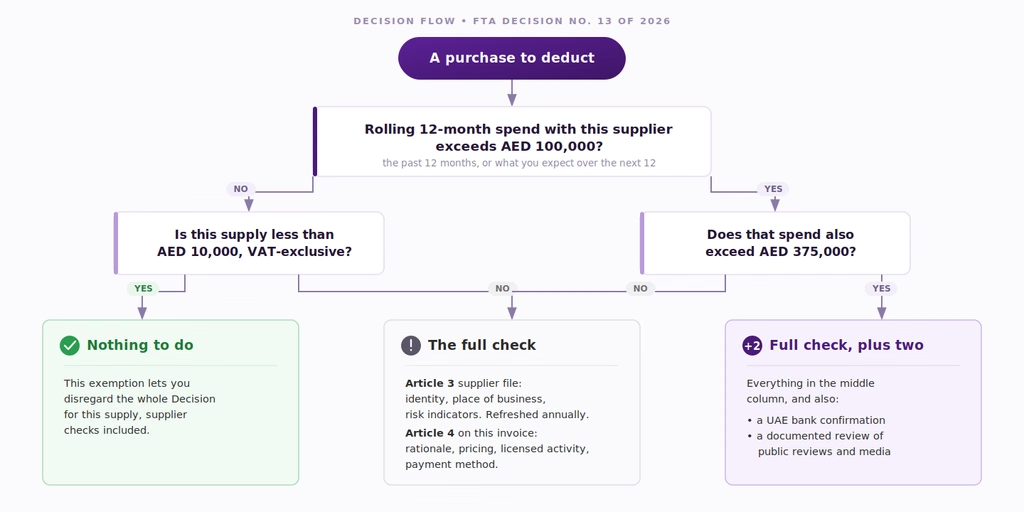
This flow covers Articles 3, 4 and 6, which decide how deep the checks on a specific supply need to go. Two things sit outside this flow but still apply:
- Article 5 requires a written verification policy at business level, naming who performs, reviews and supervises the checks. This applies even for suppliers that land in the “Nothing to do” box, since the policy covers the business’s process as a whole, not just individual supplies.
- A supplier that has already been cleared does not stay cleared automatically. If their address or key personnel changes more than twice within 12 months, that supplier needs to be re-verified straight away, rather than waiting for the usual 12-month refresh.
Who needs to act on this?
This affects every VAT-registered business in the UAE that claims input VAT, regardless of size or sector. It particularly matters for businesses with:
- A large or frequently changing supplier base
- Regular dealings with intermediaries, agents, or trading partners
- Any history of cash transactions with suppliers
- Procurement and accounts payable teams that currently rely only on the invoice to approve a VAT claim
At BCL Globiz, our accounting and tax team is already helping clients across sectors work through this exercise, and the businesses feeling the most pressure tend to be the ones with the largest or most varied supplier lists, since that is where the AED 100,000 aggregate threshold is crossed the fastest, often without anyone noticing until the checks are due.
A written policy is now required
Article 5 of the decision requires businesses to maintain a written policy that clearly sets out who performs the checks, who reviews them, and who supervises the process overall. This is not just good practice under the new rules, it is a specific requirement. During an FTA audit, this policy, together with your verification records, is what demonstrates that reasonable care was taken.
What happens if a business does not comply?
The decision itself sets out due diligence steps rather than a separate penalty regime. The real risk is what happens without those steps: if a supply turns out to be connected to tax evasion, a business that cannot show it verified the supplier and the supply is treated as if it should have known about the connection. In that situation, the FTA can deny input VAT recovery on that supply, and where the business is found to have actually known of the connection, the denial is mandatory rather than discretionary.
Action checklist before 1 October 2026
With a narrow window remaining, here is a practical order of steps to work through.
- List all active suppliers and flag which ones already exceed, or are likely to exceed, the AED 100,000 and AED 375,000 rolling twelve-month thresholds
- Collect or refresh identity and incorporation documents for those flagged suppliers
- Confirm each supplier’s place of business matches its invoiced activity
- For suppliers above AED 375,000, obtain UAE bank confirmation of their account and review their public reputation
- Review your payment methods, and flag any cash payments that need a documented business reason
- Draft a written verification policy naming the person or team responsible at each stage
- Brief procurement and accounts payable staff on the new documentation requirements
- Set up a system to retain verification records so they are ready if the FTA asks for them
Frequently asked questions
Does this apply to my business?
Yes, if your business is registered, or required to be registered, for VAT in the UAE and claims input VAT. The decision applies to every taxable person under the VAT Law, regardless of size, sector, or how long you have been trading.
Do I need to verify every single supplier, even small ones?
Not always. Supplies below AED 10,000, excluding VAT, are generally exempt from the detailed checks. However, this exemption stops applying once that supplier’s total supplies to you go over AED 100,000 within a rolling twelve-month period. At that point, full verification applies to all supplies from that supplier, including the small ones.
What if I have worked with a supplier for years already?
Existing supplier relationships are not automatically grandfathered in. Any supplier you have not verified within the past twelve months, or any supplier crossing the AED 100,000 or AED 375,000 thresholds, needs fresh documentation before 1 October 2026.
Is there a specific fine for not doing these checks?
The decision itself sets out due diligence measures rather than a standalone fine. The real exposure is losing the input VAT recovery itself on affected supplies, which for a business with high-value transactions can be a far larger cost than a fixed penalty. Where the FTA finds you actually knew of a link to tax evasion, the denial of recovery is mandatory.
What counts as a risk indicator I should watch for?
The decision points to two in particular: a supplier’s address or key personnel changing more than twice within a 12-month period, and transactions that look disproportionate to the size and trading history of the business. Either of these should prompt a fresh look at that supplier straight away, rather than waiting for the usual 12-month refresh.
Can I still pay suppliers in cash?
Cash payments are not banned, but they now attract more scrutiny. Payments should generally be made electronically, and any cash payment needs a documented commercial reason on file.
Who in my business should own this process?
The decision requires a written policy naming who performs the checks, who reviews them, and who supervises the process overall. In most businesses, this sits across procurement, accounts payable, and finance, with clear sign-off responsibility rather than an informal or undocumented process.
What should I do right now, with the deadline approaching?
Start with your supplier list. Identify which suppliers are already close to or above the AED 100,000 and AED 375,000 thresholds, since these carry the most immediate exposure, then work through the action checklist above before 1 October 2026.
How BCL Globiz can help
Preparing for FTA Decision No. 13 of 2026 means reviewing your existing supplier base, building a compliant verification policy, and training the right people before the 1 October 2026 deadline. BCL Globiz supports businesses across the UAE with VAT compliance reviews, supplier due diligence frameworks, and FTA audit readiness, so that input VAT claims stand up to scrutiny.
BCL Globiz has supported over 1,000 active clients across 30+ industries in the UAE, backed by 35+ years of combined experience and a team of 300+ experts globally, with a 94% client renewal rate. That experience means we have seen how FTA rule changes like this one play out in practice, and we can help you build a verification process that holds up to audit rather than just ticking a box.
Get in touch with our VAT compliance team to review your supplier base and put a verification policy in place well ahead of the 1 October 2026 deadline.
Reach out to us at info@bcl.ae