

You just invoiced a UK client for consulting services. Now you’re staring at the VAT line on your invoice, unsure whether to charge 5% or 0%. Getting zero-rated VAT in UAE wrong cuts both ways – charge 5% when you shouldn’t and you lose competitiveness against local UK firms. Charge 0% when you don’t qualify and the Federal Tax Authority (FTA) reclassifies the supply, bills you the unpaid VAT and adds penalties on top.
The UAE’s standard VAT rate of 5% has been in effect since January 2018. Over 312,000 businesses have registered for VAT, yet the FTA continues to find businesses misclassifying zero-rated supplies – leading to avoidable penalties and lost input tax refunds.
What is zero-rated VAT in UAE?
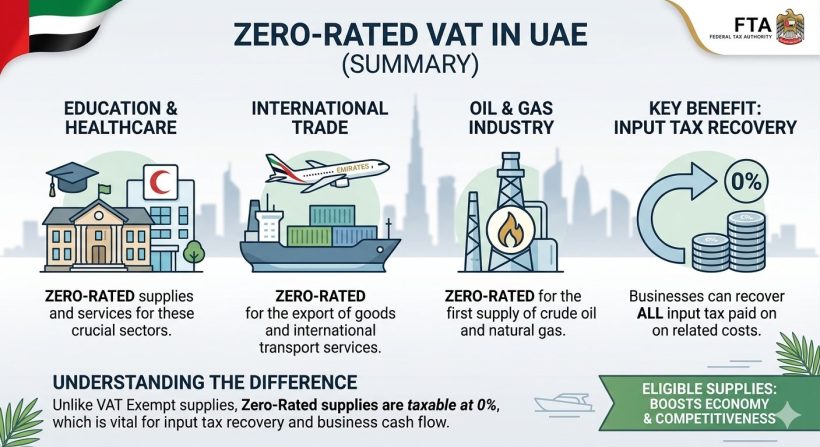
Zero-rated supplies are taxable supplies where VAT is charged at 0% instead of the standard 5% VAT rate in the UAE. The supplier charges nothing to the customer but remains fully within the VAT system. This means the supplier can recover all input VAT paid on business expenses. You file returns, you maintain records, you comply with FTA requirements – and in return, you claim back every dirham of VAT you’ve spent on rent, software, professional fees, and other costs.
Legal basis – Federal Decree-Law No. 8 of 2017
Zero-rated supplies are defined under Article 45 of Federal Decree-Law No. 8 of 2017 (the UAE VAT law) and further detailed in Cabinet Decision No. 52 of 2017 (Executive Regulation). The Federal Tax Authority issues public clarifications – including VATP019 on exported services – to interpret how zero-rating rules apply in practice.
Zero-rated vs. exempt VAT in UAE – What’s the difference?
UAE VAT law recognizes three treatment categories. Zero-rated supplies carry 0% VAT, but the business stays in the VAT system and recovers all input tax. Exempt supplies carry no VAT at all, but the business cannot recover input tax on related expenses. Standard-rated supplies carry 5% VAT and input tax is fully recoverable.
The key message: zero-rated is financially better than exempt. Exempt sounds like a benefit, but it’s actually a cost. Any VAT you pay on your business expenses becomes an irrecoverable expense when your supplies are exempt.
Here’s a concrete comparison. If your business makes AED 500,000 in exempt supplies and incurs AED 25,000 in input VAT, that AED 25,000 is a dead cost. If those same supplies were zero-rated, you’d get the full AED 25,000 back.
| Criteria | Zero-rated (0%) | Exempt | Standard-rated (5%) |
| VAT charged to customer | 0% | No VAT | 5% |
| Input tax recovery | Full recovery | No recovery | Full recovery |
| Must register for VAT? | Yes (if above threshold) | Depends on supply mix | Yes (if above threshold) |
| Reported on VAT return? | Yes | Yes (separately) | Yes |
| Examples | Exports, international transport, healthcare, education | Local public transport, bare land, certain financial services | Most domestic goods and services |
Complete list of zero-rated supplies in the UAE
Now that you understand what zero-rated means and why it matters, here’s the complete list of supplies that qualify for zero-rating under UAE VAT law. These categories cover both goods and services and each has specific conditions that must be met.
1. Export of goods outside the GCC
Goods physically shipped outside the UAE (and outside GCC states that have implemented VAT) are zero-rated. The key condition: goods must leave the UAE within 90 days of the date of supply. The supplier must retain documentary evidence of export.
Example: A Dubai-based electronics trading company sells 500 laptops to a buyer in Germany. The shipment leaves Jebel Ali port within 30 days. The sale is zero-rated at 0% VAT and the trading company recovers input VAT on its procurement, warehousing and shipping costs.
Required export documentation:
- Customs export declaration (e-cleared through UAE Customs)
- Bill of lading or airway bill
- Commercial invoice showing buyer’s overseas address
- Proof of delivery at the foreign destination
- Shipping and freight records
2. Export of services outside the GCC
Services provided to recipients outside the UAE and GCC implementing states can be zero-rated, but only if specific conditions are met. These conditions are stricter than for goods exports.
Three conditions must be satisfied: (1) the recipient has no place of residence in the UAE, (2) the recipient is outside the UAE at the time of supply and (3) the service doesn’t relate to UAE real estate or goods physically in the UAE.
Example: A UAE-based IT consultancy develops a mobile app for a client headquartered in San Francisco with no UAE office. The service is zero-rated.
3. International transport of goods and passengers
Transportation of goods or passengers is zero-rated when the journey starts or ends outside the UAE or when the UAE is a transit point on an international route. This includes international flights, international shipping and freight and related services such as loading, unloading and handling at ports and airports when connected to international transport.
Example: A logistics company based in Jebel Ali ships a container of textiles from Dubai to Mumbai. The freight charge is zero-rated. The port handling fees at Jebel Ali, directly connected to this international shipment, are also zero-rated.
- International flight Dubai → London
- Freight shipping Dubai → Mumbai
- Airport handling for international cargo
4. Supply and import of certain means of transport
Aircraft and vessels designed and used for commercial international transport of goods or passengers are zero-rated. This extends to related goods and services: spare parts, maintenance, repair and conversion of qualifying aircraft and vessels.
Private yachts, recreational boats and personal-use aircraft are standard-rated. Even if occasionally used for international travel, they do not qualify.
5. First supply of residential property (within 3 years)
The first sale or lease of a newly constructed residential property is zero-rated, provided it occurs within 3 years of the building’s completion. After the first supply, or after the 3-year window, subsequent sales or leases of the same property become exempt – not zero-rated and not standard-rated. Converting a commercial property to residential use may also qualify the first supply for zero-rating.
Example: A real estate developer in Dubai Marina completes a residential tower in March 2024. The developer sells Unit 501 to a buyer in January 2026 – this first sale is zero-rated. If the buyer resells Unit 501 in 2030, that resale is exempt.
6. Healthcare services and related goods
Preventive and curative healthcare services provided by facilities licensed by the relevant UAE health authority are zero-rated. This includes related goods: medicines, medical equipment, and supplies used in providing healthcare.
The critical distinction: purely cosmetic procedures that are not medically necessary are standard-rated at 5%.
Example: A licensed dental clinic in Dubai charges zero-rated VAT on a root canal treatment. A cosmetic surgery clinic performing elective rhinoplasty charges 5% VAT.
| Service type | VAT treatment |
| Dental treatment (curative) | Zero-rated |
| Prescription medicines | Zero-rated |
| Medical lab tests | Zero-rated |
| Elective cosmetic surgery | Standard-rated (5%) |
| Over-the-counter supplements (non-prescribed) | Standard-rated (5%) |
7. Educational services and related goods
Education services provided by institutions recognized by the relevant UAE education authority – and following the UAE national curriculum or an approved international curriculum – are zero-rated. This includes tuition fees and related goods supplied as part of the education, such as textbooks and uniforms.
Example: A CBSE-accredited school in Abu Dhabi charges zero-rated VAT on tuition fees. A private IELTS coaching center charges 5% VAT.
- Licensed school (national or approved international curriculum)
- University accredited by UAE Ministry of Education
- Licensed nursery or early childhood center
8. Investment-grade precious metals (gold, silver, platinum)
The first supply of investment-grade precious metals is zero-rated. “Investment-grade” means specific purity thresholds as defined in the Executive Regulation.
Example: A gold refinery in Dubai sells 99.5% pure gold bars to an investment firm – the first supply is zero-rated. Subsequent supplies may be standard-rated or exempt depending on the transaction.
9. Crude oil and natural gas
The supply of crude oil and natural gas is zero-rated under UAE VAT law. This primarily applies to businesses in the upstream oil and gas sector. Most businesses reading this guide won’t fall into this category.
Who needs to register for VAT when making zero-rated supplies?
Zero-rated supplies are taxable supplies. They count toward the mandatory VAT registration in the UAE threshold of AED 375,000 in taxable supplies over any rolling 12-month period. If a business exceeds this threshold – even if every dirham is zero-rated – it must register.
Voluntary registration is available at AED 187,500. There is one exception. Businesses that only make zero-rated supplies can apply to the FTA for an exemption from registration. For most businesses, the input tax recovery benefit far outweighs the administrative burden of filing returns.
Unless your business expenses are negligible, registering for VAT – even when all your supplies are zero-rated – is almost always the smarter financial decision.
How to recover input VAT on zero-rated supplies?
This is where zero-rated VAT becomes genuinely valuable for your business. Because you’re within the VAT system, you can claim back every dirham of VAT you’ve paid on legitimate business expenses.
The input tax recovery mechanism
When your output VAT is 0% and you’ve paid input VAT on business expenses, you’re in a net refund position. The FTA owes you money.
Example: Your business makes AED 1,000,000 in zero-rated exports during a tax period. You incur AED 40,000 in input VAT – AED 15,000 on office rent, AED 5,000 on software subscriptions, AED 10,000 on professional fees, and AED 10,000 on other expenses. Your VAT return shows: Output VAT = AED 0. Input VAT = AED 40,000. Net position = AED 40,000 refund from the FTA.
Documentation requirements for input tax claims
Incomplete documentation is the number one reason refund claims are delayed or rejected. The FTA requires specific records to support every input tax recovery claim.
- Valid tax invoices from all suppliers (must include TRN, date, description, VAT amount)
- Proof that your supplies are genuinely zero-rated (export declarations, transport documents, healthcare or education licenses)
- Contracts or agreements showing the nature of the supply
- Bank statements or payment records matching invoices
- Records maintained for a minimum of 5 years (FTA requirement)
Conditions for zero-rating exported services – simplified
The FTA’s official guidance on zero-rating exported services (VATP019) runs to nearly 5,000 words of legal analysis.
The three conditions that must be met
- The service recipient must not have a “place of residence” in the UAE. If your client has a registered office, branch, or place of effective management in the UAE, the service may not qualify for zero-rating – even if the client’s headquarters is overseas.
- The service recipient must be outside the UAE at the time of supply. For individuals, this is straightforward. For companies, the focus is on where the establishment receiving the service is located.
- The service must not relate to real estate situated in the UAE, or to goods physically located in the UAE at the time of supply. If you’re designing a building in Dubai for a foreign client, the service relates to UAE real estate – it’s standard-rated.
Frequently Asked Questions (FAQs)
What is the difference between zero-rated and exempt VAT in the UAE?
Zero-rated supplies are taxed at 0%, but your business can recover all input VAT on related expenses. Exempt supplies carry no VAT, but your business cannot recover input VAT – making it an irrecoverable cost. See the comparison table above for the full breakdown of how each category affects your VAT return and registration obligations.
Can I claim input VAT if I only make zero-rated supplies?
Yes, if you’re VAT-registered. Businesses making only zero-rated supplies can register voluntarily or mandatorily (if above the AED 375,000 threshold) and claim back all input VAT on business expenses. You can apply for exemption from registration, but this forfeits input tax recovery – which is usually not advisable.
Do I need to register for VAT if all my supplies are zero-rated?
If your taxable supplies (including zero-rated) exceed AED 375,000 over any rolling 12-month period, registration is mandatory. Below that, voluntary registration is available at AED 187,500. Businesses making only zero-rated supplies may apply for exemption from registration, but this prevents input tax recovery and is generally not recommended.
Are exports from the UAE always zero-rated?
Not automatically. Goods exports are generally zero-rated if goods leave the UAE within 90 days and proper documentation is maintained. Service exports have additional conditions under VATP019: the recipient must not have a UAE place of residence, and the service must not relate to UAE real estate or goods physically in the UAE.
What documentation is required to support zero-rated VAT claims?
You need customs export declarations, bills of lading or airway bills, proof of delivery outside the UAE, valid tax invoices with TRN (Tax Registration Number), contracts showing the recipient’s overseas address, and evidence of the recipient’s non-UAE residency. The FTA requires all records to be maintained for a minimum of 5 years.
Reach out to our experts at info@bcl.ae.