

The UAE’s move towards e-invoicing marks a significant step in the evolution of its tax and compliance framework. What initially appears to be a technology upgrade is, in reality, a broader transformation in how transactional data is generated, validated, and governed. For businesses operating in the UAE, e-invoicing will influence not only VAT compliance but also Corporate Tax, Transfer Pricing, and overall financial governance.
What E-Invoicing means for UAE Businesses
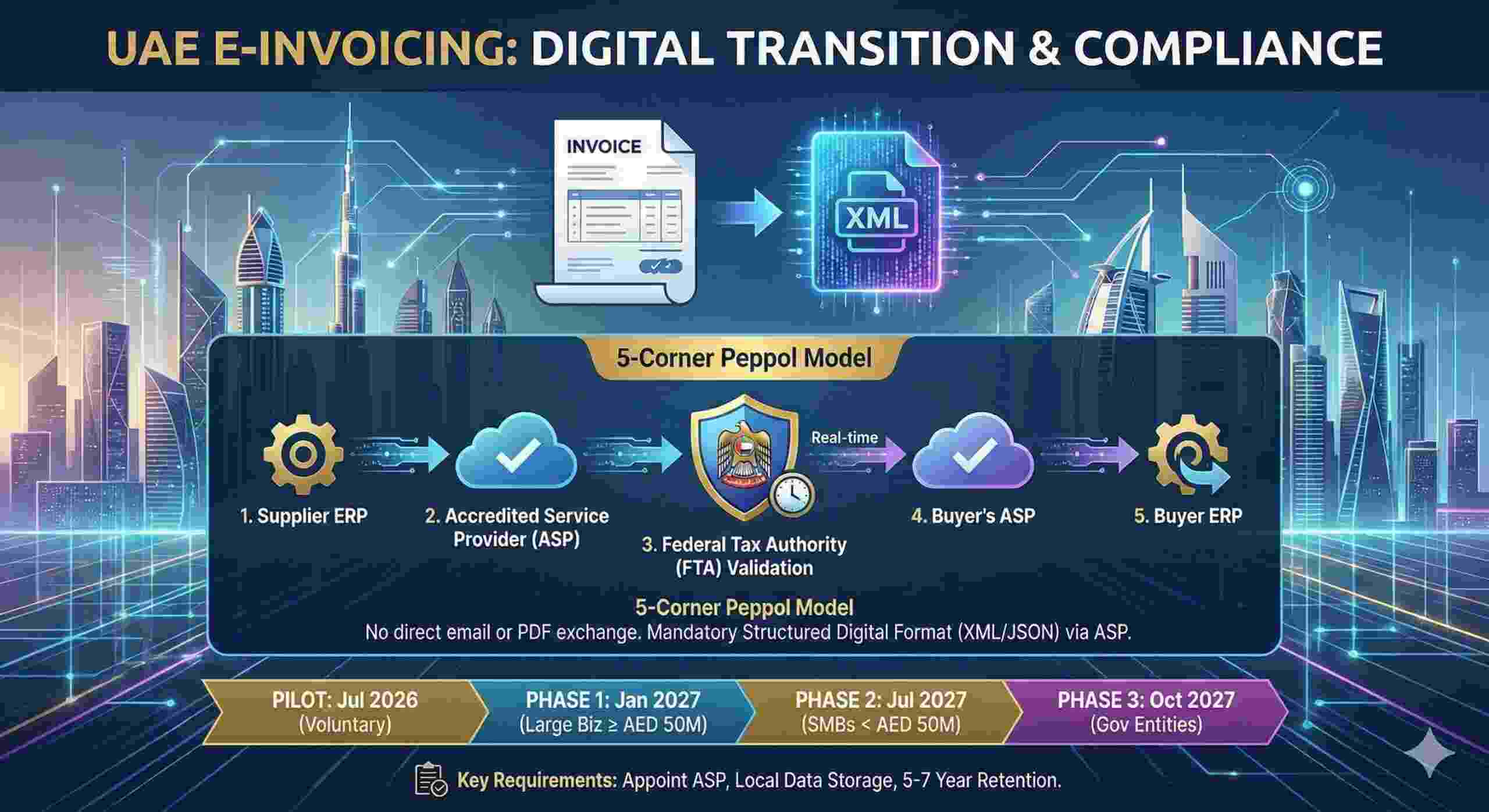
E-invoicing requires invoices to be issued in structured, machine-readable formats such as XML or UBL instead of traditional PDFs or scanned documents. These invoices will be exchanged through Accredited Service Providers (ASPs) under a decentralised model, allowing automated validation and secure transmission.
This framework aligns the UAE with global best practices and shifts compliance away from manual reporting towards system-driven accuracy at source. Businesses will need to ensure their accounting and ERP systems are capable of generating compliant invoice data consistently.
Why E-Invoicing is not just a VAT change
E-invoicing is increasingly being viewed as a cross-regulatory change, not limited to VAT. Once invoices become structured data, inconsistencies across VAT returns, Corporate Tax filings, and Transfer Pricing documentation become more visible and harder to correct retrospectively.
For Heads of Tax and Finance, this means greater emphasis on:
- Data consistency across systems
- Clear transaction documentation
- Alignment between operational data and tax positions
Insights from the Market: What Tax Leaders are Saying
During BCL Globiz’s participation as an exhibitor at the 5th Procurement, E-Invoicing & Tax Conference in Dubai, one message was consistent across conversations with senior professionals: businesses are less concerned about tools and more concerned about implementation in practice.
Discussions focused on system readiness, data quality, process ownership, and the operational challenges that arise once regulations intersect with day-to-day business activities. Many conversations naturally extended into Corporate Tax and Transfer Pricing, highlighting how closely these areas are now connected.
Technology is only one part of the Equation
While software and ASP selection are important, e-invoicing is not a plug-and-play exercise. Successful implementation requires:
- Data mapping and validation
- Process redesign across procurement, sales, and finance
- Clear exception handling and controls
- Strong coordination between tax, IT, and finance teams
Without proper planning, businesses risk operational disruption closer to the go-live date.
UAE E-Invoicing Timeline: Key Dates to Watch
The UAE has adopted a phased approach to implementation:
| Phase | Requirement | Deadline |
|---|---|---|
| Pilot Phase | Voluntary implementation & testing | From 1 July 2026 |
| Large Businesses | ASP appointment & e-invoicing go-live | ASP by 31 July 2026; Go-live by 1 Jan 2027 |
| SMEs | ASP appointment & full compliance | ASP by 31 March 2027; Go-live by 1 July 2027 |
| Government Entities | ASP appointment & compliance | ASP by 31 March 2027; Go-live by 1 Oct 2027 |
Although these dates provide a transition window, experience from other jurisdictions shows that system readiness often takes longer than expected.
Data Accuracy and Governance Will Matter More Than Ever
Once invoices are routed through accredited channels, correcting errors after issuance becomes significantly more difficult. This places greater importance on:
- Master data governance
- Upfront controls
- Consistent transaction classification
E-invoicing will also enable tax authorities to perform automated checks and analytics, increasing the need for real-time compliance rather than post-period corrections.
The Broader Impact on Tax and Finance Functions
E-invoicing accelerates the digitalisation of tax functions. As compliance becomes more automated, tax teams can move away from manual reconciliations and focus on risk management, analysis, and strategic decision-making.
For organisations that prepare early, e-invoicing can deliver long-term benefits such as improved efficiency, stronger controls, and enhanced transparency across tax and finance operations.
Preparing Early for a Controlled Transition
E-invoicing should be approached as a strategic transformation, not a last-minute compliance exercise. Businesses that invest early in system readiness, impact analysis, and advisory support will be better positioned to manage this change smoothly.
BCL Globiz works closely with businesses to:
- Assess e-invoicing readiness
- Align VAT, Corporate Tax, and Transfer Pricing requirements
- Support system and process implementation
- Provide ongoing compliance and advisory support
As the UAE moves towards a more data-driven tax environment, informed planning and the right advisory support will be key to turning regulatory change into a sustainable advantage.