

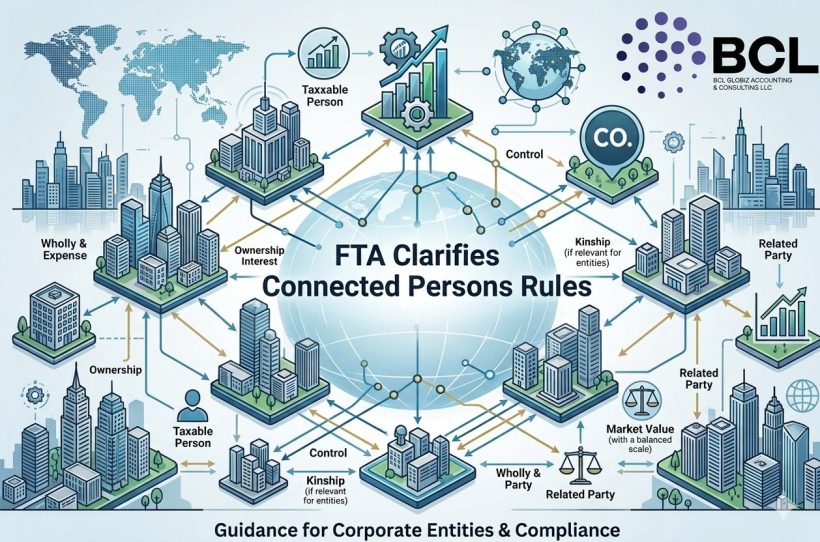
The latest clarification on Connected Persons shifts the focus from designation to actual decision-making authority — and many UAE businesses may need to reassess their structure.
The UAE FTA has issued an important clarification under Article 36 of the Corporate Tax Law that every business operating in the UAE must pay attention to. The clarification addresses who qualifies as a “Director” or “Officer” for the purpose of identifying Connected Persons — and the answer may surprise you. It is not about your job title. It is about what you actually do.
This clarification emerged from audit findings during the first year of UAE Corporate Tax filings, where inconsistent interpretations were identified across taxpayers. As businesses enter their second year of compliance, the FTA has stepped in to provide clear guidance. Here are the two critical updates every business must understand.
1. ‘Director’ and ‘Officer’ — It’s About Substance, Not the Title on Your Business Card
For a long time, these terms were undefined in the law, leading to confusion about who should be treated as a Connected Person. The FTA has now clarified this:
Director
- A Director is someone who holds a position on the company’s Board or governing body — whether executive, non-executive, temporary, alternate, or a committee member.
- Important: Simply having the word “Director” in your job title does not make you a Connected Person. If you do not exercise strategic decision-making authority, you fall outside this definition.
Officer
- An Officer is someone who has the authority to plan, direct, and control the business — broadly aligned with the concept of Key Management Personnel (KMP) under IAS 24.
- This typically covers C-suite roles (CEO, CFO, COO) but also General Managers, Divisional Heads, HR Heads, and even individuals named on the company’s Trade License.
- The key test is conduct, not title. Someone without the “Officer” title but who exercises real strategic authority could still qualify. Conversely, someone with an impressive designation but no real decision-making power would not.
What this means for you:
- Review your organisational chart, trade license, and key contracts to identify who actually exercises strategic authority.
- Even consultants or interim managers engaged on a contractual basis could qualify as Connected Persons if they perform strategic management functions.
- All payments or benefits made to Connected Persons must reflect market value and be wholly and exclusively for business purposes — and must be documented accordingly.
Examples for who’s really running the business includes but not limited to when a consultant holds the CFO title, a silent name sits on the trade license, and management fees flow to a family member, the answer isn’t always clear
2. When Someone is Both a Connected Person and a Related Party — Related Party Takes Precedence
This is a subtle but important clarification issued by the Federal Tax Authority Clarification No. CTP010, April 2026, and it has real implications for how businesses structure their management. Under UAE Corporate Tax Law, the definitions of “Connected Person” and “Related Party” overlap in certain situations. For example, an owner who also controls the business could technically fall under both categories.
The FTA has now clarified: where a person qualifies under both definitions, they shall be treated as a Related Party for Corporate Tax purposes. The Related Party framework — which governs transactions based on capital, control, and significant relationships — takes precedence.
However, it is important to note a nuance flagged by tax practitioners:
- Article 36 of the Corporate Tax Law explicitly includes an “Owner of the Taxable Person” within the definition of Connected Person. If an owner is simply reclassified as a Related Party, that part of the definition may create interpretational questions in certain fact patterns.
- This creates a potential inconsistency between the clarification and the underlying law (Federal Decree-Law No. 47 of 2022). Businesses must therefore apply this clarification carefully on a case-by-case basis, rather than as a blanket rule.
What this means for you:
- If an individual in your organisation could be classified as both a Related Party and a Connected Person, apply the Related Party rules (arm’s length pricing, disclosure under Article 55) as the primary framework.
- Given the interpretational complexity, seek specific professional advice before finalising your tax position on such individuals.
The Bottom Line
The FTA’s clarification reinforces a principle that is becoming central to modern tax administration: substance over form. Who you are in a company is defined by what you do, not what your business card says. Businesses must now look beyond titles, assess the real decision-making authority of their leadership, and ensure that all payments to Connected Persons are properly documented and benchmarked at arm’s length. The time to review your structures is now — before the auditors do it for you.
Consequences of Non-Compliance
Failure to correctly identify Connected Persons or to treat overlapping Related Party and Connected Person relationships appropriately can have serious consequences. Payments made to Connected Persons that are not at market value or not wholly and exclusively for business purposes may be disallowed as a deductible expense, directly increasing the taxable income of the business. Additionally, non-disclosure of such transactions where required under Article 55 of the Corporate Tax Law can attract penalties. In audit scenarios, misclassification or inadequate documentation could expose businesses to tax adjustments, interest on underpaid tax, and reputational risk. Given that the FTA is actively auditing first-year filings and issuing clarifications basis those findings, businesses that delay compliance risk being caught in the next wave of scrutiny.
Businesses must ensure that all Connected Person transactions comply with the arm’s length principle in transfer pricing to avoid FTA adjustments and penalties.
How BCL Globiz Can Help
At BCL Globiz, we understand that navigating evolving tax regulations — especially in a relatively new Corporate Tax environment like the UAE — can be complex and time-sensitive. Our team of specialists can assist your business in:
- Identifying and mapping Connected Persons and Related Parties within your organisation based on actual roles and conduct.
- Benchmarking payments and benefits to Connected Persons at arm’s length in line with UAE Corporate Tax requirements.
- Preparing and maintaining robust documentation to support your tax filing and withstand FTA audit scrutiny.
- Advising on the interplay between Connected Person and Related Party classifications on a case-specific basis.
Do not wait for an audit notice to act. Reach out to us at BCL Globiz and let us help you stay ahead, compliant, and confident.
Read the full clarification here: CTP010 Clarification
Frequently Asked Questions (FAQs)
My employee has “Director” in their title. Are they automatically a Connected Person?
No. A title alone does not qualify someone. What matters is whether they actually exercise strategic decision-making authority. If they don’t, they fall outside the definition.

Can an external consultant be treated as a Connected Person?
Yes, if they effectively perform management or strategic functions and exercise control over the business — regardless of how they are engaged. Conduct takes precedence over the nature of engagement.
Our shareholder is also a Related Party. Which rules apply?
Related Party rules take precedence. Apply arm’s length pricing and disclosure requirements under Article 55. However, given the interpretational complexity, case-specific advice is recommended.
What are the consequences of getting this wrong?
Payments not at market value may be disallowed as a deduction, increasing taxable income. Non-disclosure can attract penalties. Misclassification in an audit could result in tax adjustments and interest on underpaid tax.
How do we identify Connected Persons in our organisation?
Review your organisational chart, trade license, MOA, and key contracts. Look for individuals who plan, direct, or control business activities — including C-suite, general managers, divisional heads, and anyone named on the trade license.
Reach out to our experts at info@bcl.ae.