



Key Takeaways
- UAE transfer pricing rules are embedded in Federal Decree-Law No. 47 of 2022, effective for financial years starting on or after 1 June 2023, with calendar-year taxpayers fully in scope from 1 January 2024.
- All UAE entities, including free zone persons, must apply the arm’s length principle to related party transactions and connected persons dealings, with oversight by the Federal Tax Authority FTA.
- Ministerial Decision No. 97 of 2023 establishes specific thresholds for transfer pricing documentation requirements, including the transfer pricing disclosure form, local file, and master file.
- Small business relief may ease documentation burdens for qualifying taxpayers, but does not remove the obligation for arm’s length pricing.
- BCL Globiz helps UAE businesses design transfer pricing policies, benchmarking studies, and compliant documentation that protect both tax positions and commercial interests.
Introduction: Why Transfer Pricing Matters Now in the UAE
The United Arab Emirates entered a new era when corporate tax and transfer pricing regulations came into force from 1 June 2023. This shift transformed the country from a near-zero-tax environment into a rules-based corporate tax regime aligned with global standards.
Transfer pricing governs how profits are allocated between group companies across Dubai, other Emirates, and abroad. These rules directly influence the 9% UAE corporate tax base applicable on taxable income exceeding AED 375,000.
This article explains what you must do now: identify related parties, apply arm’s length pricing, prepare transfer pricing documentation, and manage potential TP audits. BCL Globiz, as a Dubai-based accounting and tax advisory firm, supports SMEs and multinational groups in building practical, defensible transfer pricing frameworks.
Legal Framework: Core UAE Transfer Pricing Rules
UAE transfer pricing provisions are contained in Federal Decree-Law No. 47 of 2022 on the Taxation of Corporations and Businesses. This primary legislation is supported by Cabinet Decisions, Ministerial Decisions, and FTA guidance documents that provide implementation details.
Articles 34 to 36 of the UAE corporate tax law cover the arm’s length principle, transactions with related parties and connected persons, and transfer pricing methods. Article 55 and Ministerial Decision No. 97 of 2023 govern documentation and disclosure obligations.
The rules apply to tax periods starting on or after 1 June 2023. Calendar-year taxpayers became fully in scope from 1 January 2024, with corporate tax returns due within nine months after year-end.
The Federal Tax Authority serves as the enforcement body under Ministry of Finance oversight. Free zone entities benefiting from 0% CT on qualifying income must still comply with arm’s length pricing—TP non-compliance can jeopardize their tax incentives entirely.
What Is Transfer Pricing and How Does It Work in the UAE?
Transfer pricing refers to the pricing of goods, services, financing, and intangibles between entities under common control within a multinational or domestic group. These aren’t arbitrary internal prices—they carry real tax consequences.
The arm’s length principle requires that controlled transactions reflect what unrelated parties would agree under comparable circumstances. Article 34 of the UAE CT Law embeds this principle directly, aligning with OECD TP Guidelines while incorporating local nuances.
Practical UAE examples:
- A Dubai trading company selling commodities to a related Saudi distributor must price at rates comparable to third-party deals
- A UAE free zone IT shared service center charging its foreign head office must apply cost-plus mark-ups matching independent providers
- A UAE holding company lending AED 55 million to subsidiaries must charge arm’s length interest rates
Drawing from concepts used globally, transfer prices determine where profits are recognized across jurisdictions. Without proper pricing, you face risks of double taxation, profit adjustments, and disputes with tax authorities.
Proper transfer pricing protects both the UAE tax base and taxpayers from arbitrary adjustments by ensuring a robust economic basis and documentation for intra-group prices.
Scope: Related Parties, Connected Persons and Controlled Transactions
The first practical task for UAE businesses is mapping who counts as a “related party” or “connected person.” This determines which transactions fall within scope of transfer pricing regulations.
Key indicators of related parties under UAE CT Law:
- Direct or indirect ownership of 50% or more
- Common control by individuals or entities
- Relationships between head office and permanent establishments
- Certain family connections (spouses, direct ancestors, descendants)
Connected persons include owners, directors, and related individuals who may receive payments not at arm’s length—such as management fees, rent, or interest from the business.
Controlled transactions include:
- Sale of goods
- Provision of services
- Royalties and IP licensing
- Intra-group financing (loans, guarantees)
- Cost sharing arrangements
- Head office allocations
- Business restructurings involving value shifts
Both foreign and domestic transactions are in scope. Even transactions between two UAE entities or exempt segments require arm’s length pricing.
BCL Globiz can prepare a related-party map and transaction inventory as the foundation for your transfer pricing risk assessment.
Recognized Transfer Pricing Methods under UAE CT Law
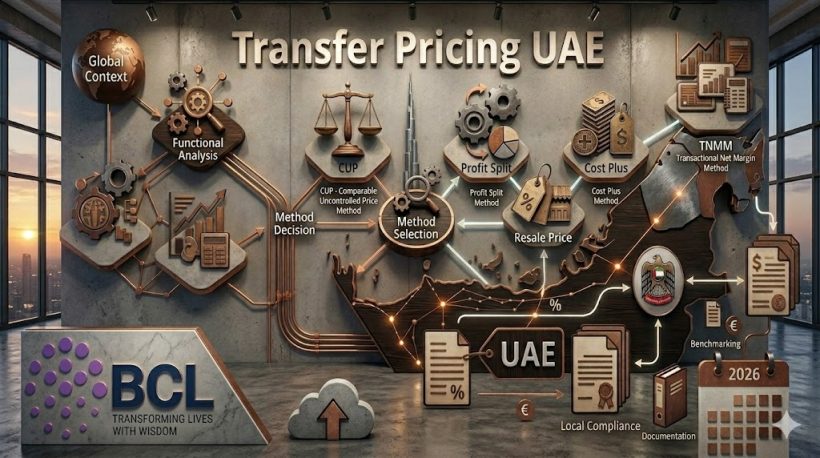
UAE law expressly recognizes five OECD transfer pricing methods, consistent with global best practice. Article 34(3) of the UAE CT Law requires use of the “most appropriate method” considering functions performed, assets used, and risks borne.
BCL Globiz performs benchmarking studies using regional comparables across the GCC, Europe, or Asia as needed to support method selection.
Comparable Uncontrolled Price (CUP) Method
The CUP method compares the price in a controlled transaction with the price charged in a comparable transaction between independent parties involving identical or closely similar goods or services.
This is conceptually the most direct method and is preferred when reliable comparable data exist—for example, standardized commodities or financial instruments traded in UAE or international markets.
When applying CUP to UAE intra-group imports and exports, adjustments may be needed for differences in terms, volumes, contractual conditions, or markets. Internal CUP (transactions within the same group with third parties) is particularly valuable for UAE distributors.
Resale Price Method (RPM)
The resale price method starts from the resale price to independent customers and subtracts a gross margin that an independent distributor would earn in comparable circumstances.
This method suits UAE buy-sell distributors of branded goods who purchase from related manufacturers abroad and resell in the GCC market. Benchmarking gross margins against independent UAE or regional distributors supports the arm’s length nature of the intra-group purchase price.
RPM works best when the reseller doesn’t add significant value through manufacturing or unique intangibles.
Cost Plus Method (CPM)
CPM adds an arm’s length mark-up to the supplier’s direct and indirect costs to determine the transfer price.
This method is commonly used for UAE shared service centers, routine contract manufacturers, and captive IT or back-office service providers in Dubai or free zones.
The cost base definition (operating versus direct costs) must be clearly documented and consistent across periods. Mark-ups should be supported by benchmarking against independent service providers with similar functions and risk profiles.
Transactional Net Margin Method (TNMM)
The transactional net margin method tests whether the net profit margin relative to an appropriate base (costs, sales, or assets) in a controlled transaction aligns with comparable transactions by independent companies.
TNMM is widely used when reliable gross margin data are unavailable or when the tested party performs simpler functions than its counterparty. It applies well to UAE distributors, low-risk manufacturers, or routine service providers.
External databases provide regional comparables to support TNMM analysis, but the method still requires proper functional analysis—it cannot be applied mechanically.
Profit Split Method (PSM) and Alternative Methods
The profit split method allocates combined profits from a controlled transaction based on each party’s relative contribution of functions, assets, and risks.
PSM suits highly integrated UAE operations such as joint development of intellectual property, complex financial structures, or multi-jurisdictional service platforms.
UAE law also permits alternative methods (valuation-based or formula-based approaches) where standard methods don’t produce reliable results. Taxpayers must fully justify and document these approaches.
BCL Globiz designs bespoke methods and economic models for non-standard transactions while ensuring consistency with UAE CT Law and OECD principles.
Transfer Pricing Documentation Requirements in the UAE
UAE has adopted a documentation regime aligned with OECD BEPS Action 13, including disclosure forms, transfer pricing master file, local file, and Country-by-Country Reporting where relevant.
Ministerial Decision No. 97 of 2023 sets revenue and transaction thresholds triggering master and local file obligations. Maintaining TP documentation must happen contemporaneously, with files provided to FTA on request—typically within 30 days.
All taxable persons with related-party dealings must complete a TP disclosure form along with their corporate tax return, even if below thresholds for full master and local files.
Small business relief reduces tax payable for qualifying entities, but doesn’t fully exempt them from maintaining sufficient records demonstrating arm’s length pricing.
Transfer Pricing Disclosure Form
The transfer pricing disclosure form is filed together with the UAE corporate tax return and summarizes related-party and connected-person transactions for the tax period.
Key contents include:
- Names and jurisdictions of related parties
- Tax Registration Numbers (TRNs)
- Types and aggregate arm’s length value of transactions
- Transfer pricing methods used
- Any pricing adjustments made
Inconsistencies between the disclosure form and financial statements may trigger FTA queries or TP audits. BCL Globiz helps clients design internal processes to collect required data and populate disclosures accurately each year.
Master File Requirements
A transfer pricing master file provides a high-level overview of the multinational group’s global operations, including organizational structure, value chains, main intangibles, and group-wide financing arrangements.
UAE master file obligations apply when revenue thresholds are exceeded—typically consolidated group revenue above AED 3.15 billion or UAE entity revenue above AED 200 million as indicated by Ministerial Decision No. 97 of 2023.
Typical master file structure:
- Group overview and organizational chart
- Description of supply chains and business lines
- Intangibles ownership and development
- Intercompany financing arrangements
- Group transfer pricing policies
BCL Globiz coordinates with overseas headquarters to produce master files satisfying both UAE and other jurisdictional requirements.
Local File Requirements
The local file is the UAE entity-focused document providing detailed information on specific related-party transactions affecting that entity.
Required contents:
- Description of the UAE entity and its business
- Functional and risk analysis
- Details of each material controlled transaction
- Selection and application of pricing methods
- Financial data and results
FTA can request the local file, and taxpayers must typically provide it within 30 days. Preparation should happen on a contemporaneous basis rather than after receiving an audit notice.
BCL Globiz assists with scoping which transactions are material, performing benchmarking, and drafting compliant local files for both mainland and free zone entities.
Country-by-Country Reporting (CbCR)
Country by country reporting applies primarily to very large multinational enterprise groups with consolidated global revenue above AED 3.15 billion, where the ultimate parent is UAE-resident.
The CbC report provides a jurisdiction-by-jurisdiction breakdown of revenue, profit, taxes paid, employees, and tangible assets. Filing must occur within 12 months of the reporting fiscal year end.
Even if CbCR applies only to a limited number of UAE groups, smaller UAE subsidiaries of foreign MNEs should understand whether their parent group is subject to CbCR elsewhere—this affects transfer pricing risk globally.
BCL Globiz coordinates with global tax teams to ensure consistency between CbCR data and UAE TP documentation.
Practical Steps to Implement a Compliant Transfer Pricing Framework
Building a compliant transfer pricing framework doesn’t require overwhelming complexity. Follow this step-by-step roadmap:
Step 1: Identify and Map Document all related parties and connected persons. Create a transaction inventory covering goods, services, financing, IP licensing, and cost allocations. Update this mapping at least annually.
Step 2: Functional Analysis For each key entity and transaction, describe who performs what functions, who uses what assets, and who bears which risks. This analysis drives method selection.
Step 3: Method Selection and Benchmarking Select the most appropriate transfer pricing method for each transaction type. Use benchmarking data consistent with UAE and OECD practices to support your pricing.
Step 4: Policies and Agreements Draft internal transfer pricing policies and intercompany agreements that align with actual conduct and pricing. Address free zone versus mainland dealings explicitly.
Step 5: Prepare TP Documentation Prepare and maintain transfer pricing documentation—disclosure form, local file, master file where required. Ensure alignment with UAE corporate tax returns, management accounts, and financial statements.
Transfer Pricing Audits, Risks and Penalties in the UAE
The UAE Federal Tax Authority is increasing its capacity to review transfer pricing positions as the corporate tax regime matures. Expect scrutiny, particularly for large or loss-making entities and free zone structures.
Typical FTA audit focus areas:
- Large cross-border payments to related parties (royalties, management fees, interest)
- Low or volatile profit margins
- Discrepancies between disclosure forms and financial statements
- High-value IP or financing structures
Consequences of non-compliance include:
- Adjustment of taxpayer’s taxable income
- Denial of deductions
- Recharacterization of transactions
- Administrative penalties ranging from AED 10,000 to AED 100,000
Risk mitigation measures:
- Maintain contemporaneous documentation
- Align legal agreements with actual conduct
- Retain evidence of services rendered
- Perform periodic benchmarking updates
- Consider advance pricing agreements for certainty
Advance pricing agreements represent a voluntary and structured mechanism to obtain upfront certainty on controlled transactions proposed, as introduced by FTA Decision No. 4 of 2024.
BCL Globiz conducts pre-audit health checks and supports clients responding to FTA information requests, explaining methods and comparables clearly and defensibly.
How BCL Globiz Supports UAE Businesses with Transfer Pricing
BCL Globiz is a Dubai-based accounting and tax advisory firm with dedicated focus on UAE corporate tax, transfer pricing, and international taxation for SMEs, mid-sized groups, and inbound multinationals.
Key transfer pricing services:
- Related-party mapping and transaction inventory
- Functional analysis and risk profiling
- Method selection and benchmarking studies
- Preparation of disclosure forms, master files, and local files
- Transfer pricing policy and intercompany agreement drafting
- Audit defense and FTA correspondence support
Industry experience includes:
- Trading and distribution
- Logistics and supply chain
- Technology and SaaS
- Professional services
- Real estate
- Family groups with free zone and mainland structures
Contact BCL Globiz for an initial transfer pricing consultation focused on your specific structure, first CT filing year timelines, and documentation thresholds.
Frequently Asked Questions (FAQ) on Transfer Pricing in the UAE
Do UAE free zone companies have to comply with transfer pricing rules even if they expect 0% tax?
Yes, free zone entities must comply with transfer pricing rules. Non-compliance can lead to loss of tax incentives, profit adjustments, and penalties.
When do I actually need a full master file and local file in the UAE?
Full master and local files are required if UAE entity revenue exceeds AED 200 million or MNE group revenue exceeds AED 3.15 billion with significant related-party transactions.
How does transfer pricing interact with Economic Substance Regulations (ESR) in the UAE?
Transfer pricing and ESR must align. Entities with real substance should show appropriate profits; inconsistencies may trigger scrutiny.
Can internal comparables within my group be used for UAE transfer pricing?
Yes, internal comparables are acceptable if well documented. Otherwise, external benchmarking is needed.
How early should a new UAE startup or inbound investor think about transfer pricing?
Start transfer pricing planning at incorporation to ensure compliance and avoid retroactive issues as business grows.
Contact us at info@bcl.ae


