

1. Introduction
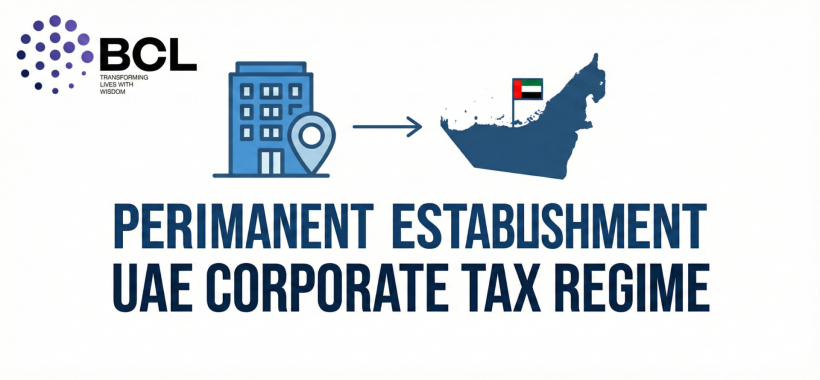
With the introduction of Corporate Tax in the UAE, the concept of Permanent Establishment (PE) has become increasingly important, particularly for businesses operating in Free Zones. While Qualifying Free Zone Persons (QFZPs) may benefit from a 0% Corporate Tax rate on qualifying income, this preferential treatment is limited to activities carried out within the Free Zone. When a Free Zone entity conducts business outside the Free Zone, either within the UAE or abroad, the PE rules determine how such income is taxed. This article explains the concept of PE, distinguishes between Foreign and Domestic PEs, and highlights the associated transfer pricing and exemption considerations.
2. What is a PE
A PE refers to a fixed place of business or another form of taxable presence through which a person carries on business activities outside the Free Zone. A PE can be created in two primary ways. First, by maintaining a fixed place of business, such as an office, branch, warehouse, or workshop, where business activities are carried out on a continuous basis. Second, by operating through a dependent agent who has the authority to negotiate or conclude contracts on behalf of the business and habitually exercises this authority outside the Free Zone. The existence of a PE triggers tax obligations on income attributable to activities performed through that establishment. Following are the types of PEs
- Foreign PEs:
Article 24 addresses the treatment of Foreign PEs of Resident Persons, allowing an elective exemption whereby the income and losses of qualifying foreign establishments are excluded from the UAE tax base, subject to specified conditions.
A Foreign PE arises when a Qualifying Free Zone Person carries out business activities outside the UAE, such as through an overseas branch, office, or dependent agent. In line with Article 24 of the Corporate Tax Law, the following key aspects are relevant:
- A Resident Person may elect to exclude the income and associated expenditure of all qualifying Foreign PEs from UAE Taxable Income.
- Where the exemption is elected, both profits and losses of the Foreign PE are disregarded, and no foreign tax credit is available.
- The Foreign PE must be subject to corporate tax or a tax of a similar nature in the foreign jurisdiction at a rate not lower than 9%.
- The Resident Person and its Foreign PE are treated as separate and independent persons, with income attributed on an arm’s length basis.
- Transfers of assets or liabilities between the UAE entity and the Foreign PE are deemed to take place at market value.
- Domestic PEs:
Article 14 defines when a Non-Resident Person is considered to have a PE in the State by setting out the thresholds for taxable presence, including fixed places of business, dependent agents, and exclusions for preparatory or auxiliary activities.
A Domestic PE arises when a QFZP operates outside the Free Zone but within the UAE, for example through a mainland branch or office. Article 14 provides the relevant framework, with the following key considerations:
- A Domestic PE exists where there is a fixed or permanent place in the UAE through which business is conducted, such as a branch, office, factory, or place of management.
- A PE may also arise where a dependent agent habitually concludes or negotiates contracts on behalf of the entity.
- Construction, installation, or supervisory activities give rise to a PE where they exceed six months, including connected activities of Related Parties.
- Activities that are preparatory or auxiliary in nature (such as storage, display, purchasing, or information gathering) do not create a PE, unless anti-fragmentation rules apply.
- Where the same or a Related Party carries on complementary activities forming a cohesive business operation, the preparatory or auxiliary exemption may be denied.
Common domestic scenarios include a Free Zone head office operating a branch in the UAE mainland, or a mainland head office with a Free Zone branch, in which case the head office is treated as the Domestic PE. For a DPE to exist, there must generally be an identifiable and fixed place of business used to conduct core income-generating activities, subject to the exclusions and thresholds prescribed under Article 14.
3. Transfer Pricing Implications
From a transfer pricing perspective, both Foreign and Domestic PEs are treated as if they were separate and independent entities from their Free Zone parent. Income and profits attributable to the PE must be determined in accordance with the Arm’s Length Principle, based on the functions performed, assets employed, and risks assumed by the PE.
Transactions between the Free Zone parent and the PE, such as the provision of goods, services, or resources, must be priced as if they were conducted between unrelated parties. Where a PE uses outputs generated by the Free Zone parent, the parent must treat this as revenue derived from a Non-Free Zone Person. Furthermore, under the Beneficial Recipient rule, a PE is not considered a Free Zone Person, and therefore does not qualify for Free Zone tax benefits.
4. Exemptions
Although income attributable to a Foreign or Domestic PE is generally subject to Corporate Tax at the standard rate of 9%, certain exemptions may apply if specifically provided under the relevant tax legislation. Importantly, revenue generated by a PE is excluded when assessing the de minimis thresholds used to determine whether a Free Zone entity continues to qualify as a QFZP. This ensures that non-Free Zone activities do not adversely impact the entity’s Free Zone status, provided all other qualifying conditions are met.
5. How BCL Globiz can help
The PE rules under the UAE Corporate Tax regime play a critical role in ensuring that income earned outside Free Zones is taxed appropriately, while preserving the integrity of Free Zone tax incentives. By treating Foreign and Domestic PEs as separate taxable units and applying arm’s length principles, the UAE aligns its tax framework with international standards. For Free Zone businesses, a clear understanding of PE exposure, transfer pricing obligations, and applicable exemptions is essential to maintain compliance and optimize their tax position. Through benchmarking studies, preparation of transfer pricing documentation, and support with disclosure obligations, BCL helps ensure that transactions between Free Zone entities and their PEs are priced at arm’s length. Their advisory services also help businesses maintain compliance while preserving Free Zone benefits and mitigating the risk of tax adjustments or penalties.
You can reach out to us for any assistance on PE implications at info@bcl.ae