


If your business has annual revenue of AED 50 million or more, you have until 30 October 2026 to appoint an Accredited Service Provider (ASP) for UAE e-invoicing. Every other business has until 31 March 2027. Either way, choosing an e-invoicing ASP is now one of the most important decisions a UAE finance team will make this year, and one of the most searched.
This guide explains what an ASP actually does, shows how your invoice travels through the UAE’s 5-corner model, and gives you a practical checklist for choosing and appointing the right provider. It is based on Ministerial Decisions No. 243 and 244 of 2025, the Ministry of Finance’s UAE Electronic Invoicing Guidelines and the new accreditation rules that took effect on 1 October 2026.
Why UAE Businesses Are Searching for an ASP Right Now?
- The first deadline is days away: Large businesses must appoint an ASP by 30 October 2026, after a three-month extension announced by the Ministry of Finance in May 2026. The go-live date of 1 January 2027 did not move.
- The accreditation rules have just changed: From 1 October 2026, providers need full accreditation from the Ministry. Providers that only held pre-approval under the old rules were given 30 days to meet the new requirements.
- E-invoices will reach smaller businesses early: Even if your own deadline is 2027, your large customers and suppliers go live in January 2027, so e-invoicing will start reaching your business sooner than your own deadline.
What Is an Accredited Service Provider (ASP)?
An ASP is your gateway to the UAE e-invoicing system. You cannot send an e-invoice directly to your customer or to the Federal Tax Authority (FTA). Instead, your accounting system passes the invoice data to your ASP, and the ASP takes care of the technical exchange and the reporting.
It helps to be clear about where the ASP’s role ends and yours begins:
| Your ASP handles | You remain responsible for |
| Validating your invoice data against UAE rules | Calculating every value on the invoice correctly, including VAT |
| Converting it into the standard PINT-AE XML format | Giving your ASP complete and accurate invoice data |
| Sending it securely over the Peppol network | Collecting your customers’ Peppol identifiers |
| Reporting tax data to the FTA | Keeping your records for the legal retention period |
| Receiving e-invoices from your suppliers | Compliance with the e-invoicing rules overall |
The Guidelines are clear that even though ASPs carry out the exchange and reporting in practice, the compliance obligation stays with your business. That is why the choice of provider matters so much.
How an E-Invoice Travels Through the 5-Corner Model?
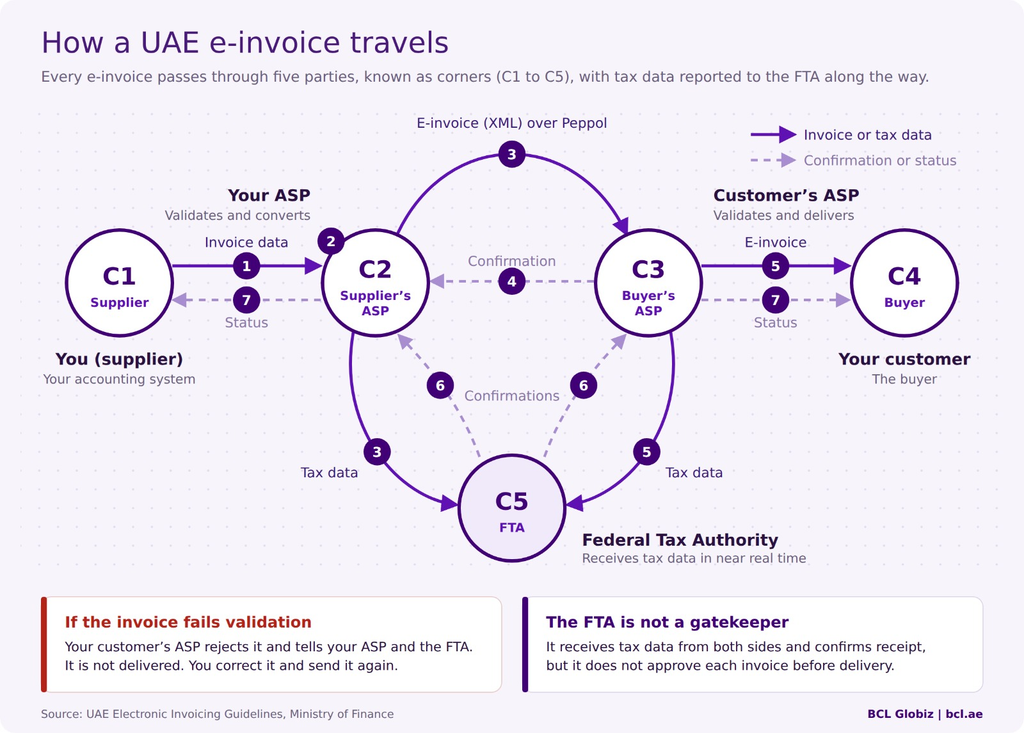
The UAE uses what is known as the 5-corner model. Five parties, called corners, take part in every e-invoice:
| Corner | Who | What they do |
| C1 | You (the supplier) | Raise the invoice in your accounting system and send the invoice data to your ASP. |
| C2 | Your ASP | Validates the data, converts it into PINT-AE XML, sends it to your customer’s ASP and reports tax data to the FTA. |
| C3 | Your customer’s ASP | Validates the e-invoice, confirms receipt, delivers it to your customer and reports tax data to the FTA. |
| C4 | Your customer (the buyer) | Receives the e-invoice in their own system. |
| C5 | Federal Tax Authority | Receives tax data from both ASPs in near real time and confirms receipt. It does not approve invoices before delivery. |
Here is how an invoice moves between them. The numbers in the diagram match the steps below.
- You send the invoice data to your ASP, You raise the invoice in your accounting system as usual, and the data goes to your ASP in the format you have agreed.
- Your ASP validates and converts it into the standard XML format, giving every e-invoice a unique identifier.
- Your ASP sends the e-invoice to your customer’s ASP over Peppol and, at the same time, reports the tax data to the FTA.
- Your customer’s ASP validates it and sends a confirmation back to your ASP.
- Your customer receives the e-invoice, and their ASP also reports the tax data to the FTA.
- The FTA confirms both reports to the two ASPs.
- You and your customer both see the final status, as each ASP passes the confirmations on.
If the e-invoice fails validation at your customer’s ASP, it is not delivered. Your customer’s ASP notifies your ASP and the FTA, and you correct the invoice and send it again. This is why the speed and quality of your ASP’s error alerts matter in practice.
| The FTA does not approve your invoices: A common misunderstanding is that the FTA “clears” each invoice before your customer receives it. It does not. The ASPs validate and exchange the e-invoice, and the FTA receives the tax data from both sides in near real time and confirms receipt. |
Who Needs to Appoint an ASP, and By When?
Every person conducting business in the UAE that is in scope for e-invoicing must appoint an ASP according to its phase under Ministerial Decision No. 244 of 2025:
| Who | Appoint an ASP by | Go live by |
| Businesses with annual revenue of AED 50 million or more | 30 October 2026 | 1 January 2027 |
| Businesses with annual revenue below AED 50 million | 31 March 2027 | 1 July 2027 |
| Government entities | 31 March 2027 | 1 October 2027 |
Three points that often catch businesses out:
- Revenue means your most recent accounting period: The threshold is based on gross income in your latest financial statements.
- You need one ASP for both directions: The same provider sends your sales invoices and receives your purchase invoices. You cannot split them between providers.
- Each group company onboards separately: In a VAT group, every member onboards with its own Tax Identification Number (TIN), and members can choose different ASPs.
If you run a free zone company or are not registered for VAT, you are still likely to be in scope. We explain exactly how the rules apply in our guide to e-invoicing for free zone and non-VAT registered businesses.
For businesses with annual revenue of AED 50 million or more, the ASP appointment deadline has been extended to 30 October 2026, while the mandatory go-live date remains 1 January 2027. Read our guide to the UAE e-invoicing ASP deadline extension to understand what changed and how your business should prepare.
How to Choose an ASP: An 8-Point Checklist?
The Ministry of Finance publishes the list of accredited providers, and the same list appears inside EmaraTax. Use this checklist to compare the providers on it.
| What to check | Why it matters | Ask the provider |
| 1. Full accreditation | Since 1 October 2026, providers need full accreditation under Ministerial Decision No. 168 of 2026. Old-style pre-approval ends unless the provider completes accreditation within 30 days. | Are you fully accredited today, and will you confirm that in our contract? |
| 2. Fit with your software | Your accounting system prepares the data. A ready connection is faster and cheaper than a custom build or manual uploads. | Do you have a working integration with our software, and who maintains it? |
| 3. Sending and receiving | You can only appoint one ASP, so it must handle supplier invoices coming in as well as sales invoices going out. | How will incoming e-invoices reach our team and our system? |
| 4. Clear pricing | Pricing models vary, including annual fees, per-invoice charges or a mix of both. | What will we pay a year at our volume, including setup and extra entities? |
| 5. Error handling | Rejected invoices are not delivered, and late e-invoices can attract penalties once you are in your mandatory phase. | How fast are we alerted to a rejection, and who helps us fix it? |
| 6. Storage and access | You can ask your ASP to store e-invoices, but the legal duty to keep them and produce them to the FTA stays with you. | How long do you keep our records, and how do we export them? |
| 7. Outages and support | If the system fails, the FTA must be notified, and delays can lead to penalties. | What are your support hours, and who notifies the FTA if you have an outage? |
| 8. Onboarding plan | Large businesses that appoint on 30 October have about nine weeks to test and go live. | Can you give us a written onboarding and testing plan to our go-live date? |
If you use Zoho Books or similar cloud software
Your accounting software sits at Corner 1. It prepares the invoice data, but it does not replace the need to appoint an ASP through EmaraTax. Before you sign with a provider, check how it connects to your software, whether your customer records hold the details e-invoices need (such as TINs and trade licence information), and how incoming supplier e-invoices will appear in your system.
How to Appoint Your ASP in EmaraTax: Step by Step?
Onboarding is started by your business, not by the ASP. The Guidelines set out the process as follows:
- Update your EmaraTax profile: Check that your trade licence, address and contact details are current, because your ASP will rely on them.
- Get a TIN if you do not have one: Your TIN is the first 10 digits of your TRN. Businesses registered for VAT or Corporate Tax already have one. A business in scope that is not registered for any tax must register with the FTA to obtain one.
- Sign with your chosen ASP: Finalise the contract and commercial terms before you onboard.
- Onboard through EmaraTax: Your account admin opens the E-Invoicing tile, selects the ASP and clicks “Proceed to ASP” to complete onboarding on the provider’s portal.
- Receive your Peppol Participant Identifier: This is 0235 followed by your 10-digit TIN, and it is how other businesses’ ASPs will find you.
- Test, then go live: Agree how data will flow, how confirmations and errors will reach you, and test end to end before yours go-live date.
E-Invoicing Myths That Can Trip You Up
“My accounting software is my ASP”
Not unless that software company is itself accredited by the Ministry of Finance. In most cases your software connects to a separate ASP, and the appointment is made by you in EmaraTax.
“Emailing a PDF counts as an e-invoice”
No. A UAE e-invoice is a structured XML file exchanged through ASPs. During the transition you may still need to send a PDF to customers who are not yet on the system, but only alongside the e-invoice.
“My e-invoices will need a QR code”
No. The Guidelines confirm that UAE e-invoices are issued in XML format and do not carry a QR code or barcode.
“I can leave the ASP until just before go-live”
Risky. Appointment is only the start. Integration, data clean-up and testing all have to happen between your appointment date and yours go-live date, and provider capacity tightens as deadlines approach.
What Happens If You Miss the ASP Deadline?
Under Cabinet Decision No. 106 of 2025, failing to implement the e-invoicing system, including failing to appoint an ASP on time, carries a penalty of AED 5,000 for each month or part of a month of delay. Penalties apply only once you are in your mandatory phase, so businesses that start voluntarily can test without that risk. Voluntary adoption has been open to all businesses since 1 July 2026.
How BCL Globiz Helps You Choose and Appoint an ASP?
Choosing an ASP is easier when someone who knows your books is in the room. Our team helps UAE businesses to:
- Confirm your phase and your ASP and go-live deadlines.
- Shortlist accredited providers that fit your accounting software, volumes and budget.
- Complete EmaraTax onboarding and get your Peppol identifier in place.
- Clean up customer and supplier data so your e-invoices pass validation first time.
E-invoicing support is now included in our Essential and Grow accounting plans at no additional charge, including setup and help appointing your ASP. If you already use Zoho Books Professional plan, you can issue e-invoices straight from the software. Speak to our team today to check your deadline.
Frequently Asked Questions
What is an ASP in UAE e-invoicing?
An Accredited Service Provider is a company accredited by the UAE Ministry of Finance to exchange e-invoices over the Peppol network and report tax data to the FTA on behalf of businesses.
What is the deadline to appoint an ASP in the UAE?
30 October 2026 for businesses with annual revenue of AED 50 million or more, and 31 March 2027 for businesses below that threshold and for government entities.
Where can I find the list of accredited ASPs?
The Ministry of Finance publishes the list on its e-invoicing website, and the same list appears in EmaraTax under the E-Invoicing tile when you start onboarding.
Can I use more than one ASP?
No. Each business appoints one ASP for both sending and receiving e-invoices. Companies in a VAT group onboard separately and may each choose a different ASP.
Is my accounting software my ASP?
Usually not. Your software prepares the invoice data and connects to an ASP. Only providers accredited by the Ministry of Finance can act as ASPs.
Does the FTA approve each e-invoice?
No. The ASPs validate and exchange e-invoices, and the FTA receives tax data in near real time and confirms receipt. It does not approve invoices before delivery.
What happens if I miss the ASP deadline?
Failing to appoint an ASP or implement e-invoicing on time carries a penalty of AED 5,000 for each month or part of a month of delay under Cabinet Decision No. 106 of 2025.
Please reach out to BCL Globiz for more information at info@bcl.ae.